
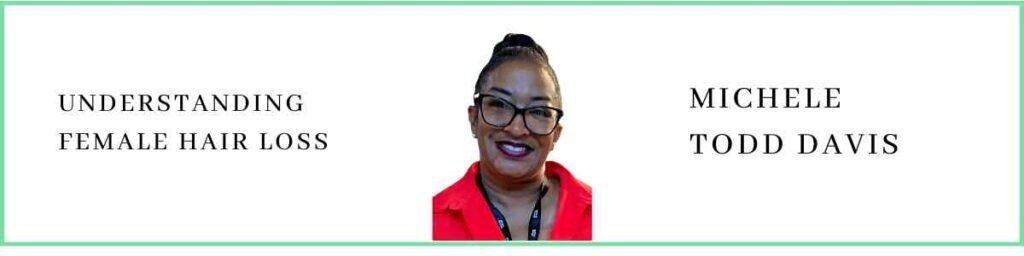
Michele Todd Davis, a licensed trichologist, entrepreneur, and owner of Sketches Beauty Studio, discusses a crucial yet often overlooked topic: female hair loss. Michele, who began her journey into trichology due to her own experiences with hair loss, shares her extensive knowledge on understanding the types and causes of hair loss, its emotional impact, and effective strategies for treatment. They dive into the importance of pH balance, the effects of stress and hormones on hair health, and the often-toxic nature of common hair care products. Michele also provides insights into the duality of topical and internal treatments.
3 Key Takeaways
The Hidden Triggers:
During our conversation, Michele highlighted how unrealized stressors – both good and bad – could affect our body, particularly the adrenal glands, influencing hair health. She emphasized the importance of viewing stress holistically, recognizing its impact on both our internal hormonal balance and external appearance.
The Role of Traction Alopecia:
Michele addressed a common yet often overlooked issue: traction alopecia. Frequently experienced due to a cultural legacy of tightly styled hair, this condition results from prolonged tension on the hair follicles. Michele underscored the importance of understanding the balance and pH needed for healthy scalp and hair to prevent such issues.
From Stress to Nutrition- A Whole Approach:
The discussion transitioned to broader aspects like hormonal changes seen in menopause and pregnancy, emphasizing their profound impact on hair health. Michele shared insights on how nutrition plays a crucial role in maintaining hair health, highlighting the repercussions of consuming foods from stressed and processed sources. She advised on the importance of maintaining a balanced diet while being aware of hidden factors such as hormonal additives in foods.
ShowNotes
Click on the timestamps to go directly to that point in the episode
[02:43] Michele’s Journey into Trichology
[04:56] The Impact of Stress on Hair Health
[07:44] Exploring Traction Alopecia
[13:30] The Role of pH Balance in Hair Care
[22:34] Hormonal Changes and Hair Loss
Get In Touch:
If you’re interested in connecting with Michele Todd Davis, you can reach her via her email, via phone on (704) 965-1038, via LinkedIn, or on Facebook.
For those interested in sharing their own stories on “Chatting with the Experts,” reach out to Paula Okonneh through her website or connect via LinkedIn.
Paula: [00:00:00] Welcome to another episode of Chatting with the Experts where I speak with phenomenal women from Africa, from the Caribbean, and in the diaspora. These women are successful professionals and entrepreneurs, and they share my mission, which is to educate, empower, and inspire women globally. We sometimes have a few men join us, but 99% of the time it’s women. Today we are gonna be talking about a topic that I think is really, really necessary and it’s Understanding Female Hair Loss. My guest who will be joining me in a few minutes says that hair loss, especially in women, is a major concern in today’s society. She says it is often misunderstood or dismissed as a cosmetic issue.
In this session we’ll explore the types of hair [00:01:00] loss we’ll explore also uncover underlying causes, we’ll address emotional impact and highlight ways that women can reclaim confidence and embrace support systems. My guest is a licensed trichologist, entrepreneur, and a proud Winston-Salem State University, that is WSSU alumni. And she has a powerful legacy of service, leadership and community impact. She is a proud owner of Sketches Beauty Studio, which was recognized in 2004 by Hollywood Hair Magazine as one of North Carolina’s top three salons, and she’s earned national acclaim as a celebrity stylist and beauty educator. [00:02:00] Please welcome the phenomenal Michele Todd Davis.
Michele: How are you, Ms. Paula, my sister, and thank you. Thank you so much for having me today.
Paula: Absolutely. I wanna thank you for saying yes to being a guest on my show. And you know, I also wanna thank you for doing such phenomenal work, such great work with female hair loss. I remember when you started talking about it in, probably it was 2006 or around that time. And yeah, you’ve come a long way since then, but, you know, let’s talk about this. How did you get into this in the first place? Do you have a story?
Michele: Actually, I do. As you know, we moved from Charlotte in 2006 out to California and prior to moving, we would take [00:03:00] vacations in different states and I would study and look at other salons to see what people were doing across, you know, across the coast.
Paula: Mm-hmm.
Michele: Well, when I got out there to California, I noticed that there was a lack in the places that I had visited. And so after the move, I went to work for Yamaguchi. I won’t go into that whole story how we got there. However I noticed that there were women coming into the resort from Canada, from, you know, in and out of the country, basically.
Paula: Mm-hmm.
Michele: And there were needs that weren’t being met. Pretty much people were resorting to hair weaves, braids, what we consider protective style or protective styling today. And, I started, I actually started the [00:04:00] search. I’ll tell you a little story about myself, personal story. We were living out there in California and doing a lot of running with my daughter who was in the cello running track, playing different sports. And somebody caught a picture of me because I’m accustomed to being on the side of the camera where I’m taking pictures of others. But I noticed in the picture. One whole side of my head looked shallow, but I never noticed it because every day I would shampoo my hair, brush it back into a ponytail, and because it was wavy, it just, you know, it was just what it was.
I’d pull it in a ponytail. Never noticed a thing until I saw this picture. Then I started doing research on hair loss and tricology because I personally was experiencing it and wasn’t aware that I was having the experience. So the stressors, it was multiple stressors because I [00:05:00] think sometimes we think stress has to be a bad thing. You can have stressors in your life that are actually positive things going on, but causing stressors internally that you don’t even notice, right?
Paula: Mm-hmm.
Michele: And so as women, I think sometimes we need to look at the broader picture of what that means, because unrealized stressors can affect what’s one of the hormones, our adrenal glands, and we’ll talk about that a little later. But those are things that sometimes we actually overlook.
Paula: Mm-hmm.
Michele: So long story short. Well, fast forward, I found a trichologist in California and started doing my study back in 2006. And over time I realized the need with hair loss is not just something we do topically, but internally in terms of [00:06:00] diet, exercises, minimizing circulation, certain modalities that we have to add in order to increase growth. So once I started learning these things and finding proper nutritionals to add to my meals. We started having some progress and the rest was history. It was one of those things that, it’s not a one size fits all, but we have to find what works for us.
And today I’d like for us to discuss that duality as we converse today. So that was my start leading into trichology hair loss and and so forth.
Paula: Wow. Well, there’s nothing, you know, better than hearing someone’s story and how they got into sometimes the things that they later on become passionate about. ’cause I know you’re very, very passionate about [00:07:00] not just well, I shouldn’t say just. Only about the physical things that can contribute to hair loss, but also as you mentioned, like nutrition, you know, stress. You said there’s good stress. Is there good stress? Because you said not all stress is bad, but stress-related thinning and you know, as you mentioned, even medical conditions.
So, many times we women, as we said, because of societal expectations of what we call, what we understand is beauty. You know, we have a lot of what we call in our community protective hairstyle. And I heard offline, I mean, when you and I were talking, we talked about traction alopecia. What is that? Because, oh yeah, what is that?
Michele: So traction alopecia. You know how, when and let’s go back to childhood. Mm-hmm. You remember there was a time where we would pull our kids hair [00:08:00] real tight ’cause we want ’em to have this smooth, straight.
Paula: Yeah.
Michele: Braid. Nobody wants any crinkly hair, but that’s our natural hair, right?
Paula: Mm-hmm.
Michele: Well, we’re pulling against a follicle in that root. That’s unnatural to the hair. I’ll give you. Let me back up a second. This is how funny God is, so this is how He worked. To us, hair is terribly important, right?
Paula: Mm-hmm.
Michele: The vanity of a thing, to our bodies, hair is not important. So when we think about the systems in our body, hair is the least important to the body, but the most important to us physically. I always say God created the hair to be our x-ray. And so when we see something happening, we know something internally might be happening.
Paula: Mm-hmm.
Michele: And I’m jumping and, but this is gonna be related to the [00:09:00] traction alopecia as well. When our bodies are lacking in anything, minerals, nutrition, it pulls from the hair because it’s the least needed. Then you notice your nails start breaking, or you might notice something going on with your skin because we can’t see our organs inside. So when these things are occurring, it’s time for us to go and do something else, but I’m gonna come back now to traction alopecia. When we are pulling and tugging and trying to find styles that we call protective without adding something to bring the pH down in your skin on your scalp, protective styles may not be as protective as we think. Which can cause traction, which is a pulling and a tugging at the hair follicle. So then you start seeing [00:10:00] edges missing.
Paula: Yes.
Michele: Or when people are using clip-ins, you start noticing little spots that look like areata alopecia.
Paula: Hmm.
Michele: And one thing that we like to do, what we found to be a good mode of protection for the hair is bringing down the balance of the hair as well as the scalp. Well, the scalp as well as the hair. ’cause people focus on hair, but we never focus on our scalp.
Paula: Sure.
Michele: Correct. And that’s where the traction comes from. It’s a scalp issue. So we have a therapy that we use and it’s actually called scalp therapy. So, and doing scrubs and exfoliating, but what it’s also doing is opening up the mouth of that follicle so hair can push through. You and I were talking about, female pattern baldness, male pattern ball. Well, we’ll stick with the female [00:11:00] pattern baldness.
Paula: Yeah. Yeah.
Michele: Because we know as we age as women, our estrogen is reduced.
Paula: Mm-hmm.
Michele: But our testosterone is increased. And I know the term, people probably have heard the term DHT, which is the hydro testosterone and everybody’s producing it. And we’re finding people younger and younger. It’s being produced in their bodies. But years, probably, gosh, I couldn’t tell you dates, but years ago we heard of Nioxin and Minoxidil and steroids to be applied to the hair.
Paula: Mm-hmm.
Michele: They were designed to open up that follicle so hair could come through.
Paula: Mm-hmm.
Michele: The problem is when you stop taking it, it minimizes and it and then there, it’s almost like a cement on the scalp, but DHT is clogging that [00:12:00] pore.
Paula: Mm-hmm.
Michele: That follicle. So hair can’t be produced. That’s where, I don’t know if I should pull this down because you probably cannot see it on the screen, but I will put that in the screen.
Paula: Okay.
Michele: Deca scalp, can you see that?
Paula: Yes, I can. I can. Yes. Satin scalp therapy.
Michele: Deca plus scalp therapy. This is gold in a jar. This is Bitcoin. This is probably one of the most well-kept secrets. I’m saying well-kept secrets because the company doesn’t really advertise. We teach other stylists how to give clients what they need within. So it’s one of those things that you won’t see advertised across the [00:13:00] television waves. So it keeps it very reasonable. Product line is very, very reasonable. But when I say this product has done exactly what it says it’s going to do, it does exactly what it says it’s gonna do if you do what you’re supposed to do in terms of using it.
And I don’t want to divvy off into that, but it’s essential oils and the pH of it is at a 4.5. So with, Hey. Okay, let’s go back a minute. With our bodies and our bloodstreams, we talk about pH a lot. You hear pH, this pH that and products being pH-balanced. But do they tell you the number of the pH? We’ve learned in trichology that there are neutralizers and normalizers for hair. You remember when relaxers were very popular?
Paula: Yes.
Michele: And people were saying over time, oh, it’s breaking my hair and it’s taking my hair [00:14:00] out. Or it’s, you know, all the things. Well, really relaxers weren’t bad thing. The bad thing was, is we didn’t understand how to truly and properly bring down the pH. ’cause most companies didn’t understand that then. So if you have a relaxer that is at a pH of a 14, that’s the highest it can go because it’s designed to open up, do its job to rearrange bonds, straighten the hair back out. And then you need to come in and close it with your neutralizer. But a neutralizer, a neutral pH is a seven.
Paula: Mm-hmm.
Michele: The proper pH for hair is below a six and a five. So between a four and a six is a proper range for hair.
Paula: Mm-hmm.
Michele: But if you’ve gotta neutralizer or normalizer that’s a seven. You are not even bringing it down to where the hair needs it to be. [00:15:00]
Paula: That’s why the hair breaks?
Michele: That’s why the hair breaks. And so we learned that over time. But that wasn’t because I’ve been in this industry 40 years. We didn’t know that back then. Oh, right. We coat hair with conditioners. People go home and say, oh, I got this because it’s softening the hair. It’s coating your hair doesn’t mean it’s penetrating into the hair. ’cause most molecules are too large. But because of advertising and it sounds good. We go with what the bottle says without having full understanding.
Paula: So, you know, you touched on something, which is, these days we have so much more knowledge about a lot of things, hair including because we, for many years, you know, especially our type of hair, we just wanted our hair to look good without thinking about anything. You know, how is it really affecting our hair? How it’s affecting us too, [00:16:00] you know? And so now, I mean, you’re such a good teacher, you are explaining how these things work and giving us even a better understanding of when we go to the store, even when we would have styled it, when we understand the, you know, what’s actually happening with our hair, then we make better choices.
Michele: Absolutely.
Paula: So I have a question. So does that also… explain why hair loss in women can be different from hair loss in men because men don’t do half the things that we women do with our hair.
Michele: Absolutely. Well, partly because still you gotta think internally with DHT, if you are not going in because you can’t change that. That’s the internal part.
Paula: Mm-hmm.
Michele: Now, once the hair comes above the epidermis, then once it’s out where we can handle it, what we do [00:17:00] is the cause. What women do, ’cause you know, we’ll go buy anything if it looks good, you know how we do.
Paula: Mm-hmm. Yeah.
Michele: It’s got to be fancy. It’s got to be bright lights and shining, and then we’re going forward. But some of the chemicals that and I’m learning. I’m constantly learning daily.
Paula: Mm-hmm.
Michele: Some of these products that we have been using, if we go in and read ingredients. Some of these things are cancer-causing issues, right?
Paula: Mm-hmm.
Michele: Some of these things we can have reactions to because it’s foreign to our bodies, and so if we have hair breakage or hair loss, we could be having reactions.
Paula: Mm-hmm.
Michele: That’s one reason why I keep it very simple in terms of what I decide to do, because people will call me and tell me, oh, I heard about this. Did you hear about this? Can we try this? Well, send me some ingredients first. I mean, if we can try it, it doesn’t mean it’s not gonna produce nice [00:18:00] results momentarily, but long term, what are we gonna have happen?
Paula: Important, important to know.
Michele: Just think about, there was a product line that was out there, was very popular and hair, everybody’s hair looked beautiful upon the initial usage of it.
Paula: Mm-hmm.
Michele: But over time. Because a very important component was missing.
Paula: Mm-hmm.
Michele: People started having breakage. People started having issues, and all of a sudden it disappeared. So it was a quick end. Now that product wasn’t necessarily bad.
Paula: Mm.
Michele: But over time, anything in over… I’m not gonna say improperly used because how it was designed to be used was fine, but there was a piece in between that needed to happen for it to work effectively long term. And so that’s the thing that we don’t realize the [00:19:00] in-between pieces, because now we have, what is it? Instagram. I think it’s Instagram, you know? People are coming on with these…
Paula: TikTok?
Michele: Quick, instant looks, and…
Paula: Yes.
Michele: We think we can do them at home. And then I’m getting calls because, oh, I need you to fix my actual hair.
Paula: Mm-hmm.
Michele: Behind the glues, the sprays. It’s a big thing. But again, God is interesting because he knew we would be so vain that this is one way he could get our attention.
Paula: Mm-hmm.
Michele: What’s through our hair and a lot of the things that people are doing doesn’t have to be bad. The protective styles, the braids, the weaves. My suggestion is to make sure you understand pH balance of your skin and your scalp.
Paula: How do we get to understand that Michele? PH balance.
Michele: Well, by these kind of [00:20:00] conversations.
Paula: Alright.
Michele: Because it’s not a common thing, because it’s not the pretty, the lights, you know, it’s not the
Paula: mm-hmm.
Michele: The bright stuff.
Paula: Mm-hmm.
Michele: It’s the nest, the foundation.
Paula: Mm-hmm.
Michele: Getting back to foundational things is where I think we miss the boat in a lot of circumstances.
Paula: Mm-hmm.
Michele: And Mr. Mason, you know, you asked the question, men don’t have the same thing as women because they don’t. You’d be surprised. Men have a whole… I’ve seen a guy literally do this technique where he sprays adhesive on scalp and shaves hair weave onto, and it’s so natural you would never know. But there again, there’s adhesive clogging, so you’re gonna have to keep doing that because guess what? Somebody’s not going in and protecting the scalp in-between. So that’s where trichology, that’s where the [00:21:00] education piece comes in, because you can do these things, but let’s protect in between. You can put a bandaid on something, but don’t you need to put alcohol on it first to get the bacteria out and then cover. We wanna just put a bandaid on it. We don’t wanna clean up the surface. Yes. So that’s where our conversations are needed.
Paula: Okay. Whoa, this is eyeopening. You know, because many times, okay, let’s call spade a spade. Women are into looking good for the most part. We like to look good and so there are lifestyle factors that come into play. You know, the chemical treatment, you talked about that. There’s some products out there that are not necessarily bad. Well, some of them you said you really do need to look at the ingredients because some of them can cause cancer. I know that this is where you probably want to name them, probably offline. We could talk about that, but not online.
But we don’t [00:22:00] know, you know, hairstyles, we go and do the, you know, that’s, I guess where it comes into, you know, the loss of the hairline, et cetera. You talked just now about adhesives and as you said, they’re covering the follicles, you know, and if you don’t remove it, then how does the hair breathe or how does the hair grow through? You know, there’s so many, many, many conditions and so many things now that you’re making me even think about and, you know, educating us. And that’s what this program is all about. So I’m gonna digress a bit from just the looking good to talking about like, as women we have hormonal shifts, we got menopause. For those who are older, the younger women, pregnancy and birth control, how does that come into play? Is that something you can talk about? How it affects us?
Michele: Well, it. So when we [00:23:00] talk about hormonal changes, you know, there’s a gland, a hormonal gland, the adrenal gland that
Paula: mm-hmm.
Michele: You don’t hear a whole lot about, we don’t do a lot of discussing, but the adrenal gland, if when we’re triggered by stress, we think about stress.
Paula: Mm-hmm.
Michele: We just think we’re stressed and we think about heart conditions. We just think the word, but the adrenal gland is one of those hormonal glands constricting, it releases and it sits over our kidneys. So, you know, we’ve got umpteen issues, kidney, liver disease, and we don’t. We’re not fully aware of the stress, stress causing the adrenal gland to constrict. It’s similar to the hair follicle. When you have a constricting blood flow, it minimizes blood flow, so we don’t get blood flow to the heart. We are not getting [00:24:00] blood flow to the hair bulb. See, there’s things we just can’t see.
Paula: Mm-hmm.
Michele: That’s why I say they’re good stress. There’s bad stress, but when the adrenal gland is affected, that’s where, and I hate to say the term, you know, when they always say stress can cause death.
Paula: Yes.
Michele: That’s because we’re affecting that particular gland. And it’s really a part of our endocrine system. And I’m trying not to go too far into it, but those are reasonings where death and some of these major issues occur with us with heart disease, liver disease, and kidney disease. So from the beginning, let me go back a minute. ’cause you asked the question, stress causing hair loss.
Paula: Mm-hmm.
Michele: That’s one of the reasons why the constriction of blood. Well, the constriction of the adrenal gland.
Paula: Mm-hmm.
Michele: Which caused constrictions to the [00:25:00] blood vessels. So if we don’t get circulation, and part of what we talked about with the therapy, that’s one of those modalities that can cause circulation. But at the same time, then it goes to how do we do some exercises and some things to keep our functions going. That’s where the exercise piece comes in. There’s a tool and I didn’t wanna talk about that just yet. But there’s a tool that we use. We do electrotherapy treatments, and it’s a radiation that you can do on the scalp. You can actually do it on the face to get blood flow circulating from an inner cellular layer. Now we can do massage, but that’s more of a surface level, but to go intercellular electrotherapies are very important parts of those treatments. And that’s a part of the trichology, you know, that’s the trichology [00:26:00] piece. But as far as menopause, pregnancy stress, all of those trigger go back to a adrenal glands.
Paula: Mm-hmm.
Michele: So how do we manage menopause? How do we manage pregnancy?
Paula: Yeah, probably let’s talk more about menopause now, because the people, the women who are really on this my show for the most listeners, lemme see. My target audience are women 40 and above. So they will come into more of the… for the most part, the menopause, you know?
Michele: So is that a question? Or are we sharing some things that people,
Paula: I’m asking that basically like we talked about hormones and hormonal shifts and how that affects our hair loss, and I’m saying if we have to address hair loss, let’s talk about menopausal women [00:27:00] as opposed to childbearing women, because the target audience are mainly menopausal. That’s what I’m saying.
Michele: Exactly. Uhhuh. Okay. Well with menopause and strategies, I touched on it a little bit already because these dualities have to be combined with multiple things, but I will say there is a product and I was trying to not go into product so much, but in terms of product usage.
There’s a, I don’t know if you’ve heard of Lolavie. I used it back in the salon years ago when I was in Charlotte. I don’t know if you remember, and I’ll make sure to have a link that you can go on to take a look maybe. But sometimes with the foods that we eat, even if we are vegetarian or, well, I won’t even say vegetarian, but [00:28:00] doing vegetables, eating our chicken, our fish, you know, the things that we consider the proper diet, have to remember in society how… we got to a place where farmers began milking cows more for weight than for nutrition. So what would happen is, instead of milking and getting the weight where it was, they would milk until the cow ulcerated because they were selling for weight, right? You remember years ago when we were young, people didn’t have what is it called where people have allergies to milk.
What was it? What’s the term? Maybe lactose intolerance. Lactose intolerance. Lactose intolerance is just simply a form of getting milk that has probably been ulcerated. [00:29:00] Milking and now all of a sudden society can’t drink milk or needs something added to in order to digest because our systems, it’s foreign into our systems, right?
Paula: Mm-hmm.
Michele: Chicken, they cage the chicken. You know, you notice cage-free eggs are a popular thing, but they’re way more expensive, and I would advise purchasing those because the ones that get to roam free don’t have the same cortisol stressors because chickens, if you are caged, you are now stressed.
Paula: Yeah.
Michele: So if we’re eating a chicken or an egg from a caged bird. The cortisol effects are now, now we are taking that in.
Paula: Yes. Yes.
Michele: And we don’t think about those parts of it, but that’s something that’s very real. And we’re not talking about that part, because that’s the part we can’t see.
Paula: Yes.
Michele: And so what we find is, [00:30:00] I wanna say probably after the eighties you notice you had more lactose intolerance, overweight kids. ’cause we had a period where children were obese people were doing more fast foods. We were doing things that are causing detriment to our own bodies. So by the time we get into the menopause stage, as my mom, she could take garlic. She didn’t have the same issues that occur with us now, praise God. I had a long menopause situation, you know, pre perimenopause, but it wasn’t as bad as some people have because I thought about the things my mom did, which is the garlics. I did my leves. So I had added nutritionals. I understood about how food works and keeping my pH, my blood alkalized because, so here’s another funny story. [00:31:00] Hair, we need to be more on the acidic, below a neutral state. Bloodstream, we need to be more alkalized.
Paula: Wow.
Michele: So that’s, it’s healthier. Alkalinity is healthier in the bloodstream, but for the hair, alkalinity can be dangerous. And cause
Paula: That’s Right.
Michele: Breakage because it’s opening things. Right?
Paula: Wow. Wow. Michele.
Michele: So those are something, ma’am?
Paula: No, go ahead. I’m sitting here bowled over by all what you are sharing. I’m thinking we gotta do a part two, a part three of this, because there’s so many things that we would need to still touch, touch on, you know, like, you know, understanding the nutritional deficiencies you just talked about, you know, like lactose intolerance coming from milking cows because of the weight and then if you have been ingesting that as a young person and then now you’re menopausal age, how that too, in terms of could have helped or not helped, but contributed to your hair [00:32:00] loss and how hair loss now is different than it probably was, or probably is more pronounced now. It’s more common, I think off camera. You’ve mentioned that it used to be like 3 million women experiencing hair loss and in the eighties,
Michele: 30 million.
Paula: Yeah. And now is 30 million, you know?
Michele: No, just in 2008, like back in 2006, 2008.
Paula: Mm-hmm.
Michele: I wanna say the numbers were maybe 3 million American women.
Paula: Mm-hmm.
Michele: To date, it’s over 30 million.
Paula: My God.
Michele: That’s just American women. Yeah. That are experiencing hair loss.
Paula: Mm-hmm.
Michele: So it’s steadily increasing, but now, you guess who we see with hair loss children, you notice how many children that are walking around in hair weaves and artificial, and then you gotta think about the hair.
Paula: It’s so much to talk about, but so much to talk about because of time. We are gonna have to put this on [00:33:00] pause for now because we have people in the audience who wanna ask you questions, et cetera. I know we’re gonna have to continue this conversation. Again, we probably have to do a series on this ’cause this is so enlightening and at the same time scary. But someone who’s listening to this who hasn’t had the opportunity to be in the audience today, how can they get in touch with you? Michele, are you on Facebook, LinkedIn, phone number?
Michele: I am. So do you want me to just share it?
Paula: You can just mention it.
Michele: And so my Facebook page…
Paula: Mm-hmm.
Michele: Is Michele Todd Davis and that’s Michele with one L. M-I-C-H-E-L-E. Do I put it in the chat? Will it be?
Paula: I’ll put it in the chat. I’ll put it in the chat. Okay. Facebook?
Michele: Facebook and my email address would be sketchessalon.@hotmail.com.
Paula: Okay.
Michele: [00:34:00] And my LinkedIn profile, I want to say is Michele Davis.
Paula: Don’t worry. We’ll put it in the chat. Don’t worry about that. And we’ll put it in the show notes. Don’t worry about that. Yeah.
Michele: Sounds beautiful.
Paula: So people listening. You can get in touch with her. ’cause as you can see, Michele is very knowledgeable about hair loss. I mean, because this is a woman’s show, we are talking more about female hair loss. But hair loss is not gender based. Men also experience this. So I wanna thank you, Michele, and also for coming on the show. But I also wanna say to those listening in and those in the audience that if you’d like to be a guest on this show, please reach out to me on chattingwiththeexperts.com. That’s my website. I’m on LinkedIn as Paula Okonneh. My Instagram handle is at chat_experts_podcast. [00:35:00] I’m also on Facebook as Paula Okonneh. I have a business page there too. And we have a YouTube channel. Please subscribe to my YouTube channel, which is Chatting with the Experts where you can hear from phenomenal women and a few men, all about the many issues that are affecting all of us. And because the whole premise of this show is to educate and empower and inspire women globally.
There’s so many entrepreneurs. There’s professional women and a few men who will be sharing things that can empower you, can inspire you, and can educate you. Thank you so much, Michele, for being such an informative guest, and now we’ll open up the floor to the audience so those who’ve joined us so that they can ask you questions that we didn’t have time to address today. Thank you again.