
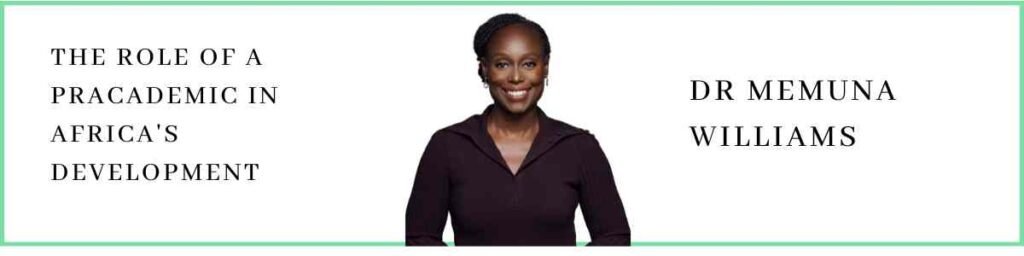
Dr. Memuna Williams is a distinguished pracademic who merges practice and academia to empower small and medium-sized enterprises (SMEs) and their communities. Dr. Williams discusses her unique career path, including her work in social responsibility, entrepreneurship, and leadership, and highlights innovative projects she’s spearheaded across Africa. From mentoring underserved youth to co-authoring a book, Dr. Williams shares insights into her mission of fostering economic development and personal growth. The conversation delves into the entrepreneurial ecosystem, the challenges and innovations within SMEs, and the importance of community service. Dr. Williams also offers a glimpse into her advisory work and the impact of her initiative, Champs for Change, aimed at nurturing sports and related careers among African youth.
3 Key Takeaways
Empowering Communities Through Practice:
Dr. Williams’ journey has been marked by a commitment to community service, deeply influenced by her upbringing. From a trained linguist to an advocate for small and medium-sized enterprises (SMEs), she has always been driven by a desire to give back. Her work spans across several African countries, including South Africa, Uganda, Côte d’Ivoire, Burkina Faso, Togo, and Tanzania, focusing on youth entrepreneurial leadership training and social responsibility.
In these communities, Dr. Williams has played a pivotal role in inspiring innovation through entrepreneurship programs. With hands-on training in business and the use of the business model canvas, she empowers young people to devise creative solutions, even in the face of resource constraints. Her efforts have resulted in thousands of innovative ideas, many of which have evolved into sustainable businesses supporting jobs and livelihoods.
Addressing Limited Resources as Catalysts:
A key takeaway from Dr. Williams’ research is the idea that limited resources, typically seen as a hindrance, can actually drive innovation. Her findings suggest that resource constraints force SMEs to think outside the box and come up with novel solutions. This perspective challenges the common narrative, highlighting how necessity can indeed be the mother of invention, especially in underrepresented regions of Africa.
Champs for Change: A New Venture:
Dr. Williams’ passion for youth mentorship culminated in her involvement with the Champs for Change initiative. This project aims to connect African youth with opportunities in the sports ecosystem, not only as athletes but also in fields like sports medicine, events, marketing, and media. By showcasing the wide array of careers associated with sports, Champs for Change encourages young people to explore diverse avenues of success.
ShowNotes
Click on the timestamps to go directly to that point in the episode
[02:38] Defining a Pracademic
[04:27] Journey to Becoming a Pracademic
[07:20] Community Service and Entrepreneurship
[08:08] Empowering Youth Through Innovation
[19:57] Challenges and Innovations in SMEs
[23:26] Advisory Work and Champs for Change
Get In Touch:
If you’re interested in learning more, Dr. Williams invites you to connect with her on LinkedIn and Instagram.
You can also explore the publication, “Purpose, Perseverance, Passion”, for yourself. Both the Kindle and hardcover editions are available, offering readers both immediate access and a tangible piece of storytelling to cherish.
For those interested in sharing their own stories on “Chatting with the Experts,” reach out to Paula Okonneh through her website or connect via LinkedIn.
Paula: [00:00:00] Well, hello everyone, and welcome to this week’s episode of Chatting with the Experts with me, Paula Okonneh, the host, where I speak with dynamic women from Africa, from the Caribbean, and in the diaspora. These women are professionals and successful entrepreneurs, and they share the mission with me, which is to educate, empower, and inspire women globally. Today, it’s very interesting. We are gonna be talking about being a Pracademic. And what we’ll do is, or what I’ll do is speak to my guest about her entrepreneurial work, which is at the intersection of practice and academia. Well, we would need to do that, would be Dr. Memuna Williams. Let me tell you a little bit about her.
She is a [00:01:00] doctoral practitioner who bridges academia and practice to strengthen people, to strengthen small and medium sized entrepreneurs, also known as SMEs and their communities in order to foster personal growth and economic development. She completed a doctoral thesis titled Forms of Corporate Social Responsibilities, also known as CSR in Small and Medium Enterprises while practicing in youth entrepreneurial leadership training and having lived in nine countries, she is a subject matter expert in social responsibility, SMEs, nonprofits, entrepreneurship and strategy, leadership, [00:02:00] cultural competency, and qualitative research. Oh my word. Isn’t that impressive? And so that I welcome Dr Memuna Williams to the show.
Memuna: Hi, Paula. It’s great to be with you. Thanks for having me.
Paula: Absolutely. Every week I have amazing women, dynamic women. Women that inspire, inspire me and others, and you are no exception. Your bio is phenomenal. Woo!
Memuna: Thank you very much. Thank you very much. Yeah.
Paula: So tell us about being a Pracademic. What does that mean? I mean, I saw it, you mentioned it, and I’m like, okay, we need to find out more about this. Tell us how you got to that description of yourself.
Memuna: Yeah. So, when you were reading my biography just now, I think you used the term, doctoral practitioner.
Paula: Mm-hmm.
Memuna: And recently I [00:03:00] had the opportunity to give a keynote speech for women in leadership promo for a course at WITS university which here in South Africa is famous for being the university where Nelson Mandela went to law school. And the administrator, when she was introducing me, she said that you, Dr. Williams is a pracademic. So I think that’s what you are referring to. And I thought, wow, I’d like that better than doctoral practitioner. I’m gonna start using that as a way to describe myself.
Paula: Absolutely love it. So we have to give credit to her.
Memuna: Absolutely. Yeah. So, yeah. Yeah, she’s a fantastic person and she exemplifies, you know, that support that women give each other that I learned in Charlotte where you and I first met. You know, where there was an amazing community of [00:04:00] women business owners at NAWBO that showed me how they can support me and who taught me to support women business owners. So fast forward so many years, it’s really nice to see that still happening in different contexts and, you know, that support being given. I couldn’t be happier to be her colleague at the moment.
Paula: Oh yes, absolutely. Absolutely. So, tell us about your journey. How did you become the pracademic? I don’t want it to say doctoral academic, but, we are not using that word anymore. We use the new word pracademic.
Memuna: So, pr academic so usually when people do a doctorate, it’s a PhD. And my doctorate is a DBA, a Doctor of Business Administration. And partly what that means is that it encourages you the DBA to remain more practice leaning [00:05:00] than academic leaning. But at the doctoral level, there’s also an expectation that you would do something in academics, whether it’s teaching or continuing to do research or things along those lines. And so kind of getting more closely connected to places like WITS. And other business schools here in South Africa, that allows me to live into that personality of doctoral practitioner meaning that I stay more in practice than in academia.
Paula: Absolutely love that because, you know, academia is great and sometimes you have to now take it and apply it and be with the people. And I can see in talking with you earlier on off camera, that you have a heart for the people. You know, we have wanted to give back or even in addition to giving back to strengthen and build people [00:06:00] up.
Memuna: Mm-hmm. Yeah. Yeah. No, absolutely. And as you know, from having known me for so many years, I started out my career as a linguist. I’m a trained French-English translator and worked many years in that profession. But when I searched my heart you know, I realized that, you know, the example that my parents had given me of community service, like always almost adopting children. There were always many children in our home, always paying school fees for cousins and other people around us, and all of those kinds of things, both my mom and my dad. I realized that I wanted, you know, to be in that space more. And, having done my MBA already, I decided okay, like let me use my business knowledge to do that work and to support people\ as they want to [00:07:00] grow through specific subjects that I love as a manager. So leadership and strategy and entrepreneurship and also, you know, just support them in a different way than my parents had, but still do that community service as well.
Paula: Yeah. Yes. I love the part about community service and, you know, helping cousins and relative, because, you know our culture is one of, I say extended family. Nuclear family, great but then you realize that every nuclear family comes from a family that was a nuclear family prior to that, you know, or
Memuna: mm-hmm.
Paula: And so, you know, it’s just that we just, it’s exponential. And so you many times you realize that we got here because somebody else was there to support us or support our parents or support our grandparents. And I tell that to my children all the time that we didn’t get here by just being here. [00:08:00] Others carried us.
Memuna: Yeah. Yeah. Absolutely. And, you know, that’s kind of what I tried to carry for today. I think some of the best examples of how I’ve been able to do that in practice recently is through the work that I was doing at an NGO that focuses on entrepreneurship and financial literacy and workplace readiness training and having the opportunity to work with young people in different communities across different countries in Africa seven up to the time that I was leaving and even into nine, which was like our total field that we were going to be working on. Just seeing everybody working together, the community centers who brought together the young people that we worked with and the young people. You know, my particular focus was on underserved young people [00:09:00] who maybe had dropped out of high school or didn’t quite know what to do when they finished with college and bringing them these hands-on training in business using the business model canvas.
But, and just seeing, you know, what comes up for them, you know, because of their particular experiences in South Africa, when I was doing this program, we had what they called load shedding, which was. You know, rolling blackouts. Mm-hmm. And so you sort saw a lot of amazing ideas coming out coming from the young people around how you can do things differently. A young person in Soweto came up with kinectically charged cell phone. You know, like you it, yeah, it charges as you are moving you know, to be, you know, if you don’t have electricity at home, you can do it that way. And just so many amazing ideas. I think as of last year, [00:10:00] the end of the second year of the program. We counted about 4,000 new ideas that people had come up with, the young people had come up with across the seven countries that we had been in up to that point. And so there’s no shortage of need, of you know, support that can be given. And that can then in turn, really make a difference in the communities because now. Some of these ideas are turned into actual businesses and like they’re supporting people with jobs, supporting households better and things like that. So it was really, really gratifying and I’m happy to be able to do that.
Paula: Hmm. Oh my gosh. It blesses me beyond measure just to hear about that, you know, the innovation, especially among the youth, you know, many times people forget that the youth are the future. They are our future. They are the tomorrows. [00:11:00]
Memuna: Mm-hmm.
Paula: In that position, you know, and as I mentioned earlier, many a times we get to where we are today or because of, you know, someone seeing something in us or our parents or our grandparents, or however we may go. So, you know, your passion for youth, especially on underserved areas is really heartwarming.
Memuna: Mm-hmm. Yeah. Absolutely. And I think, what I see part of what I do now in across the work that we’ve been talking about is mentor people, both when I’m at home in the US and when I am here. And I think that a trend that I see is a bit of a lack of confidence. You know, I don’t have the education, I don’t have this, that, or the other, or what it might be. And I think that when I, you know, the examples that I just gave about the particular program, often what you see is people have a lot of what they need in order to be able [00:12:00] to address a circumstance to be able to do that next thing that they think that they don’t need. They just need a little bit of support.
They just need it to be teased out for somebody to hold up a mirror to them and say, can you see that you actually have this, this is what I see when I see you. And that little bit of encouragement can make all of the difference of changing trepidation to excitement and to maybe even a little bit of a memory around, this is what this person said to me that gave me that sentiment. And whenever I go back to that place, I might just remind myself of that so that I can keep on going.
Paula: Yes. So you mentioned that you’ve done this in like seven, not like, but in seven countries in Africa. Would you mind mentioning which countries those are?
Memuna: Yeah, no, absolutely. Yeah, the program was in South Africa where I live.
Paula: Mm-hmm.
Memuna: [00:13:00] Uganda, Cote d’Ivoire There’s always one that escapes me now, but I’ll keep going. Burkina Faso, Togo, Tanzania, I think that’s six. And there was one more. You know, if I look in my records I’ll be able to find it, but we were also gonna be going to Sierra Leone and Liberia and those were the eighth and ninth countries. And I went there and laid the groundwork for the program as well. But it was nice. It would cover a lot of the Sub-Sahara in East Africa and West Africa, and then also here in South Africa.
Paula: Wow. I know this Sub-Sahara Africa ’cause we tend to get on overlooked.
Memuna: Yes. And that’s actually one of the things that I liked about that program was that it was very intentional about going to underserved places. So you didn’t hear me say Ghana or Nigeria or Kenya. You heard me say a few different places [00:14:00] in East Africa and West Africa, including some French speaking countries you know, Togo, Burkina Faso. Often these programs don’t go to these places. So that was one way in which underserved populations were served on this program but also within the country, making sure that you went beyond the capital.
So, you know, yes, we went to Wagadugu but we also went to a place called Koudougou which is a few hours drive outside of the capital city. So I also was on a journey of discovery in many of these countries. In Tanzania, actually, our main place where we did the program was in Arusha and not in Dar es Salaam, and so it was a very interesting program from that standpoint as well. And we really were able to reach quite a few people who otherwise in regular programs like this, wouldn’t have had the opportunity to have this kind of training. [00:15:00]
Paula: Absolutely. So, because I know that you’re subject expert on, social responsibility, SME and nonprofits are included in that amongst many others, entrepreneurship and strategy.
Memuna: Mm-hmm.
Paula: How do you get funding for this? Is that something you can talk about?
Memuna: Debt funded for the work that I do. Yes. Yeah. So like what I’ve been describing is salaried work. So that’s probably my third vertical where when I go deep. So you and I have talked recently about work that I’ve been doing with Champs for Change.
Paula: Mm-hmm.
Memuna: And that’s advisory. It’s become an entrepreneurial venture that I’m deeply involved with, but in that vertical, so my other verticals are the academics and then like kind of information sharing. That’s new for me. And we’ll see how that gets [00:16:00] funded. But on this third vertical over here, it’s often salaried work or paid consulting or stuff along those lines.
Paula: So it’s new and exciting. I can see that in your facial expression. New, yeah.
Memuna: Exciting. Yeah. Absolutely. Yeah, no, I mean, it’s what I want to be doing. As we’ve talked about a little bit already supporting people towards doing the best that they can do so that they can improve their communities and have better lives. It’s my thought that when people do better than all of the other things that we worry about today, planet is a big thing that we worry about. If you have people who have concern for the planet, then the planet will do better. And so can we focus on the things that we need to do to support people so that everything else can then be taken care [00:17:00] of?
Paula: So I know that I think you’re the executive director of Empowering Sustainable Change. Yeah.
Memuna: Mm-hmm.
Paula: Let’s talk a bit about that. I mean, is that thing, the work you’ve talked about so far, does it come under that vertical or is this something.
Memuna: Yeah. So the three verticals that I just described are the three verticals that fall under empowering sustainable change. And yeah, on the information side there, what I like to focus on is attributes and behaviors and characteristics of you know, that help people to do better in their lives, you know, what does the characteristic of perseverance mean, for example? That’s one. And then on a more academic side, related to my research on social responsibility, what does it look like to, [00:18:00] for small businesses to develop social responsibility programs from end to end, from a small business perspective and not from a corporate perspective? So I spend a lot of time thinking about that and talking about that as part of my information sharing. And I think that’s important because I think that having small businesses that are strong in many areas, including areas that governments or large businesses that they supply to demand just helps strengthen them further in other ways. Like people talk about a lot of different things, strategy, leadership, all of these other management subjects, and I talk about some of those things as well. But the social responsibility, I think, is perhaps not spoken about as much. And so that’s an area where I want them to get additional support.
So that’s some of the information sharing that I do. And I might also do [00:19:00] writing. You’ve seen perhaps some of the work that I do at Lionesses of Africa. So I do some contributions in that way. And then my work gets shared in that way as well. And the academics supporting students graduate student supervision as young people are getting their education, that allows me to reach young people in an academic way. You know, doing executive education specifically for women or just in a general executive education course, that’s part of the work as well. And then the deep advisory. Increasingly external, but internal as well as I just described at length.
Paula: Oh wow. Lionesses of Africa. That’s a publication that you contribute to.
Memuna: Yes.
Paula: Say more about that, but maybe for another time.
Memuna: Okay.
Paula: So I had on a guest recently [00:20:00] and we were talking about resources and one of the things I know that you are involved with is SMEs small and medium sized enterprises. How have you found that limited resources have been, you know, like a catalyst for them in some ways.
Memuna: Yeah, that’s a really good question. In my research one of my findings was, so when you look at the existing literature, often what you find is this idea that small and medium sized businesses are resource constrained, and often this is seen as a weakness of small and medium businesses. But when I looked at how do small and medium businesses develop social responsibility programs for beginning to end, what I found about this [00:21:00] idea of resource constraint was that it’s actually something that forces them to think differently, to be creative, and to come up with novel ways of doing things. That kind of set aside this idea that resource constraint for a small business is necessarily a bad thing and that it can actually help them and kind of push them forward and allow them to think differently and do good things you know, as a positive, as opposed to the negative that it’s always portrayed as.
Paula: Absolutely love that, especially within the African countries, especially those that, as you say, are less represented because I know, I mean, we all know them. Necessity is the mother of invention. And the times when you’re pushed to the wall, I mean, or you know, as you say, we have limited access to resources. That’s when you can look within yourself or look within the [00:22:00] community and see that what we do have actually, you know, innovate with that.
Memuna: Yeah, absolutely. That’s definitely what the research said. And then you know, partly, you know, what I’ve learned as well from talking to business owners is that the business itself serves a different purpose in this Sub-Sahara depending on where you are. Of course, in a country like South Africa where I sit, that has a little bit more wealth and a little bit more systems in place. You know, you have government programs and those provide support to people. But in a place like I’m from in Sierra Leone that has weaknesses across those areas, it’s really the business or the place of work that kind of substitutes for a lot of the things that people need. And so, you know, your healthcare, you are looking to your employer you know, and the employer, you know, might have their own different ideas [00:23:00] about where they come in a person’s life that’s working for them. But eventually they come to realize that they’re playing an important social role in this person’s life. And that’s also a part of that innovation that we’ve just been talking about.
Paula: Wow. I could talk forever with you .
Memuna: As we say here in Johannesburg.
Paula: Oh, well, before we wrap up, I wanna, ask you a bit about your advisory work. I know you talk so much about the, not talk so much in the sense that too much, but you know, you have mentioned the three verticals, but I know you have some ongoing cycle of teaching and learning within in depth advisory work.
Memuna: Hmm.
Paula: See your face is lighted up. It’s lighting up.
Memuna: Yeah. Yeah. I do have a particularly interesting [00:24:00] project right now the Champs for Change project has just taken on a life of its own. And so that’s been a lot of fun. You know, I never know where these asks are gonna take me. And they’ve been happening, from, you know, 12, 13 years ago since I moved into this line of work where somebody will just approach me and say, me, you look like somebody who could help me with this. And I think that one of my like this term that people use nowadays, superpowers is kind of being able to, and maybe that’s why I did the kind of research that I did, like interviews. You end up with a lot of information and then you have to whittle it down to a little is not being afraid of looking at the pictures and looking at the unknowns and figuring it out. And I’m able to do that for myself and I’m able to do that for people. And that’s how I came to be involved with [00:25:00] Champs for Change because my business partner one of my business partners, Clarisse Machanguana, she and I met you know, in doing social work, community service, and she said, Memuna, can you help me with this? We’ve seen this problem of, you know, young people wanting more mentorship, can we develop something together? And two years later, we’ve just launched a book together and gone into business together, which was completely unexpected, but it’s been a lot of fun.
Paula: I’m talking about the book. I happen to have it right here.
Memuna: Yay.
Paula: I got it today and I’m going to be reading it.
Memuna: That’s fantastic.
Paula: It’s thrilling to me to hear that, you know, Champs for Change is something that, you know, is really going to bring about the change because people [00:26:00] within the… I know it’s geared towards encouraging African kids and kids of African descent to go into sports, but at the same time, knowing that there’s so many other opportunities that are linked to sports, did I summarize it, right?
Memuna: Exactly right. Yes. So it’s not just being an athlete and caring about athletes. Those are important. They’re core to sports, but the whole ecosystem surrounding sports, sports medicine wellness events, entertainment around sports and all these marketing media. Those are all important careers that support the sports ecosystem. Sports is growing in Africa. The sports business is growing in Africa. We have a lot of young people. We have a lot of young people with different interests from, you know, the previous generation. And so this is just an interesting time for the idea of Champs for Change to have [00:27:00] come around. And we couldn’t be more pleased with how it’s starting out.
Paula: And it’s much needed because, you know, you of African heritage being of Nigerian, I know that my parents’ generation did not encourage any of the children or any young person to go into sports. So seeing it from that angle, people like you and Clarisse and Randy, I know who else are called or etched in the book, you know, many times we can’t be what we can’t see. When we see someone or someone else who are enabling us to see beyond the limitations and see the opportunities that are there.
Memuna: Yeah.
Paula: That make the difference, and we need those voices. So I wanna thank you. Wanna thank Clarisse who I haven’t met, Randy, who I also haven’t met for championing that [00:28:00] change.
Memuna: Absolutely. It’s our pleasure. And it’s part of the larger work you know, that we’ve been talking about today the larger practice, the larger academics. Yeah. So thank you very much for bringing that out.
Paula: Hmm. Yes, absolutely. So as I mentioned a few minutes ago, Memuna and I can talk for hours, but we have limited time. So for those of you who are viewing this or who are in the audience, and would like to continue the conversation. Memuna, how can you be found online or offline?
Memuna: Yeah, absolutely. Online, I’m at LinkedIn also on Facebook and Instagram and Threads. So I can be found there. And my website is sustainable-change.org is where I can be found.
Paula: Awesome. And just as Dr. Memuna Williams has been a guest on my show, I’d love to encourage [00:29:00] other women, women from Africa, the Caribbean, and in the diaspora to reach out to me on my website. If you’d like to be a guest, my website is chattingwiththeexperts.com. I’m also on LinkedIn as Paula Okonneh. I’m on Instagram at… my handle is at chat_experts_podcast. I’m on Facebook. I have a business page there, but do more interaction on my personal page, which is Paula Okonneh. And I have a YouTube channel Chatting with the Experts that you can also reach out to me on. Drop us a comment, drop comments, and like, and subscribe to our YouTube channel. Woo. I can’t believe how fast time has gone, but there’s an old saying that says time flies when you’re having fun.
Memuna: Mm-hmm.
Paula: I’ve really enjoyed talking with [00:30:00] you. So what we are gonna do now is open up the floor to those who have joined us, so that any questions that I might have left out, they’ll have an opportunity to talk with you or ask you or comment on what they heard. So thank you again, Dr. Memuna Williams for being a guest. Such an awesome guest on Chatting with the Experts.
Memuna: Okay. Thank you so much, Paula.