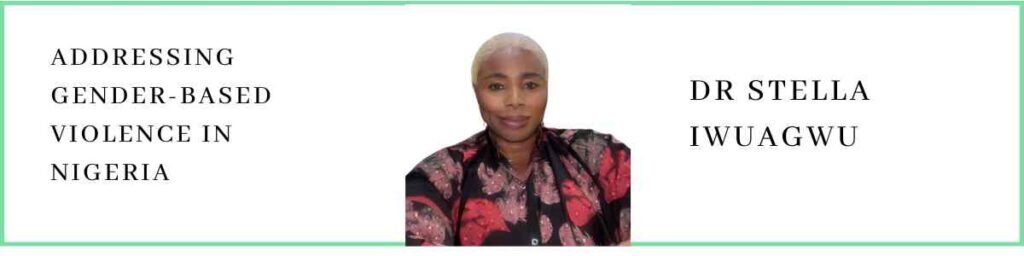
Dr. Stella Iwuagwu, a public health professional and executive director of the Centre for the Right to Health, explores the critical issue of gender-based violence against women and girls in Nigeria, with a focus on those with disabilities. She discusses the widespread physical, sexual, and emotional violence these women face. The episode highlights the heightened vulnerability of disabled women, explaining how societal prejudices and a lack of infrastructure exacerbate their plight. Dr. Stella also speaks on the efforts of her organization to advocate for victims, create awareness, and engage various community sectors, including religious and cultural leaders, to drive change. Dr. Stella shares insights from her documentary ‘Breaking the Silence’ and calls for collective actions to raise awareness and drive change.
3 Key Takeaways
The Particular Plight of Women with Disabilities:
Dr. Stella’s personal connection to the issue, being a woman with a disability herself, fuels her passion for addressing these injustices. Women with disabilities are often devalued, seen as burdens or even blamed for their circumstances. The lack of societal value for these women leads to inadequate protection and support. The discussion delves into the intersectional factors like cultural biases and lack of accessibility to education and healthcare, further isolating them from the protections and opportunities available to others.
Efforts and Advocacy by the Centre for the Right to Health:
Dr. Stella elaborates on the efforts of her organization, the Centre for the Right to Health, which seeks to address these challenges from multiple dimensions. The organization champions healthcare access and justice for the most vulnerable, emphasizing gender-based violence as a critical public health issue. They conduct advocacy, organize education and awareness programs, and highlight the plight of women with disabilities through documentaries like “Breaking the Silence.” The documentary is a pivotal tool used to engage religious and cultural leaders, aiming to foster community-level dialogues and strategies for addressing gender-based violence.
Engaging Communities and Religious Institutions:
Highlighting the essential role of religious and cultural institutions, Dr. Stella discusses efforts to mobilize these groups to drive change. By premiering documentaries and facilitating discussions, the Centre for the Right to Health makes leaders aware of the hidden issues within their communities. They challenge existing cultural norms and push for stronger, more effective actions against gender-based violence, emphasizing the urgent need for both men and women to support change actively.
ShowNotes
Click on the timestamps to go directly to that point in the episode
[02:29] The Epidemic of Gender-Based Violence
[06:11] Vulnerability of Women with Disabilities
[11:18] Challenges in Education and Employment
[14:57] Centre for the Right to Health Initiatives
[18:39] Engaging Religious and Cultural Leaders
[28:03] Documentary: Breaking the Silence
Get In Touch:
If you’re interested in connecting with Dr Stella, you can reach her via email, on Facebook, or on LinkedIn.
You can also watch the documentary, Breaking the Silence, here.
For those interested in sharing their own stories on “Chatting with the Experts,” reach out to Paula Okonneh through her website or connect via LinkedIn.
Paula: [00:00:00] Hello everyone. I’m Paula Okonneh, podcaster coach and TV show host of Chatting with the Experts. This show amplifies the voices of African women, Caribbean women, and diaspora women who will share in their knowledge and expertise to inspire, to educate and empower women globally. What I do wanna say is that everyone’s voice matters. Your voice matters. And so I’m here to celebrate that. So let’s dive right into today’s episode of Chatting with the Experts. Our title today is Exploring Gender-Based Violence against women and girls in Nigeria, and we are gonna highlight the heightened vulnerability of women and girls with [00:01:00] disabilities.
So I’ll tell you a little bit about the guest who will be joining me in a few minutes. Her name is Dr. Stella Iwuagwu and she’s a public health professional. I’m also the founder and executive director of Center for the Right to Health, a Nigerian based nonprofit organization. Center for the Right to Health advocates for quality healthcare, especially for the most vulnerable. And so that’s what we are gonna be talking about today. So with that, I wanna welcome Dr Stella to Chatting with the Experts.
Dr Stella: Hello.
Paula: Hello, Dr Stella. It’s always a pleasure to have you here and I read a snippet of your bio because there’s so much more I could talk [00:02:00] about where you are concerned. But today is a little different. We are not talking about your business, your farm business, which is, you know, so, so amazing. But we are gonna be touching on a topic that is in some ways heartbreaking, but we need to address it. So we today, as we said, the title is Exploring Gender-Based Violence Against Women and Girls in Nigeria. Tell me more about that, please.
Dr Stella: Well, gender-based violence against women and girls in Nigeria has reached epidemic proportion. It’s happening at home, in school, at work, in public places, and as a matter of fact, Nigerian women are in danger species, and it starts right from birth. At birth, there is a selection, a preference for male child, almost across culture. In terms of it, access to [00:03:00] education, the girls are probably often sent to her or care for someone or sent off to us households in one form or the other. And, so a lot of preference is given to the education of the male child. And a lot of girls that are hawking or selling or that are used as house girls also experience a lot of both physical and sexual violence.
Paula: Mm-hmm.
Dr Stella: So there’s physical violence that’s going on. There is also physical violence is so rampant right now. As a matter of fact, women as and girls are so endangered that we are having serious cases of using girls body parts for rituals?
Paula: Oh, no.
Dr Stella: You’ll be dating someone. You think you have a boyfriend or you’re going to go visit your boyfriend and before you know it, there are many, so many cases where men have been caught with body parts of women for rituals, no only with money rituals. [00:04:00] There are also a lot of cases where girls, women are kidnapped and their organs are stolen, trafficked in the organ trade. A lot of women and girls are trafficked for sex works across border and even within the country, so that’s the challenge. Then even in our homes, women are not safe. A lot of women experience physical violence. It does not matter the culture. It’s across culture. It’s across socioeconomic classes, across level of education.
But then of course, those with lesser education and lesser economic and inability experience more violence. So there’s the physical violence, the sexual violence. There’s also emotional violence, you know? A lot of female genital mutilation, early marriage, you know, not being able to access care, antenatal care, maternity care, or even [00:05:00] beating while trying to give birth is also a form of violence that happened within our health system in the workplace. A lot of women are working full-time job and they also expected to sexually satisfy their bosses or experience a lot of sexual harassment, that abuse in the workplace. You enter the market to go and shop for something and men are dragging you here and pulling you here. You do not have respect for your bodily autonomy and you don’t have a say.
And if anything happen, you are blamed about how you are dressed or is it a crime to be a woman in Nigeria? Well, while we’re talking about all of that, there is a group of women that I want to particularly address. I was going through a section on that was talking about women in general. When we discuss gender-based violence, sometimes we break it. Even women with HIV go through the stigma and experience more violence because they often the ones that are blamed for bringing infection, even when [00:06:00] that is not the fact. But there’s a group that are often, that are more at risk of gender-based violence, but the studies don’t even mention them. That is women with disability.
Paula: Yes.
Dr Stella: Maybe I took interest because I myself am a woman with disability.
Paula: Mm.
Dr Stella: Women are more at risk of gender-based violence than men. That’s a fact. But women with disability are three times more at risk of gender-based violence than other women. Yet none of the studies mentioned them. Nobody’s really looking seriously at their vulnerability. Why are women with disability more vulnerable, three times more vulnerable than other women? That brings us to the intersectoral factors, the intersectional factors that increase their vulnerability. [00:07:00] So visualize this, a woman who cannot see, cannot see her assailant coming. The woman who cannot hear, cannot hear her assailant coming. A woman who cannot speak may not even be able to protest and not wanting advances. ’cause a lot of women with disability experience, sexual violence, physical violence, even sometimes by their care providers. A woman who cannot speak, may not even be able to report and tell the story of what happened to her.
We have that even among kids in schools for girls and people with disability who have cases there. Now, a woman who cannot physically run on a wheelchair, on a crutches, how far can you run when your assailant is coming to you so you can’t even protect yourself? You are like a [00:08:00] sitting duck with practically for your assailant.
They said abusers abuse mainly because of power, right? So if a man is feeling a sense of power, can you not imagine the level of powerlessness between a man and a woman on a wheelchair or a woman with disability who is even less powerful? In our society, women are less valued than men. The women with disability are even more… more what? How do I put it? They’re even less valued than other women that don’t have disability.
Paula: And that’s sad.
Dr Stella: So society protects what they value. To what extent are women with disabilities valued? We have many cases of, so we look at the cultural lens. So when we’re looking at those intersectionalities, let’s look at the [00:09:00] cultural factors that increases the vulnerability of women to gender-based violence and even the increased higher vulnerability of women with disability to gender-based violence.
Paula: So let’s talk about that.
Dr Stella: And women are less valued than men. And then as a woman with disability, you are either seen as a burden or maybe you brought it upon yourself, or you are a cause. So in this perspective, you find out that you are less protected. You as a woman with disability, you are more at risk. Then sometimes for ritual purposes, maybe you are an albino, they will tell you, oh, go and sleep with an albino. Then you are gonna go for a ritual. We did a documentary recently that was funded by the Ford Foundation that explored gender-based violence experienced by women living with disability. It’s on YouTube. Hopefully, some of you would’ve watched it or [00:10:00] would get to watch it either before or after this program. In that story, we have one of the girls with disability. She’s like a little person, but she went to play a role in a movie and where she went to look for work. She was sexually abused and after the incident, the man used white handkerchief to wipe her down.
So that has some element of rituals in it. We have cases where women that are blind, they are not seen as good enough to marry. The men will sneak in at night or in unusual places and sleep with them, and then these women are because they have little or no education. Employment is also a challenge, so they are often financially dependent. They’re destitute sometimes and financially dependent on others, either their carer or the man in their life. [00:11:00] And this increases their vulnerability also. They can’t walk away from bad… not only are they more at risk at gender-based violence, they’re often not able to walk away or report it.
Paula: Lemme ask you a question.
Dr Stella: Some of these challenges.
Paula: Let me ask a question. So what are some of the biggest obstacles that, when it comes to education that some of that girls, let’s start with girls, because girls grow up into women. What are some of the biggest obstacles that they, that our girls, I have to say, face when trying to access education? Are there schools?
Dr Stella: Yeah. Well, for most people, both girls and boys get access to education. But for girls with disability, that structure is often not there.
Paula: That’s what I’m asking.
Dr Stella: Whether you are blind.
Paula: Yes.
Dr Stella: How do you transport yourself to school? If you can’t see, who will interpret for you? If you can’t hear, who will… So do [00:12:00] services they have, like in Western cultures here, we don’t have back home. Where we have is either poorly funded and very limited accessibility. Look at the transport system.
Paula: Mm-hmm.
Dr Stella: So of course. So that limitation, I remember I did my fourth year in nursing at the Obafemi Awolowo University.
Paula: And nursing you said?
Dr Stella: Unconscious because I had an accident. It was so difficult. There’s barely any bus that would transport you. So you need to see me trying to cross through and there’s barely any space for wheelchairs. Stairs everywhere. I remember in those days we used to see some people, few blind students who’ve had cases, case on wheelchair. How do you navigate that? It’s absolutely difficult. It’s very limiting, and [00:13:00] yet we have a few persons with disability that broke the barrier and went through it. So they have to work three or four times harder than other people to get the education.
How do we provide a levelled playing ground for them? So it’s discriminatory. So that now limits even the ability to get opportunities for work. With limited qualification, you also have limited employment. Even the ones that are fully qualified to get a job becomes also a challenge. Workplaces are not accessible, you know? So those are some of the challenges. Remember the last time I went to Nigeria, somebody had to carry me on their back to climb a three story building.
Paula: Because there was no elevator.
Dr Stella: Imagine a person that is a person with disability that is pregnant. How do you deal with transportation to get to the hospital? When you get to the hospital, are there ramps to take you there? [00:14:00] When you finally get to the clinic or to the labour room, how high is the bed or the couch? Can you be able to get onto it? I remember one time I got there and the nurse just said, oh, get on the couch. Get on the couch. The couch is that high. I’m still on a wheelchair. How is spinal cord injury? They didn’t even ask what I can be able to do or not be able to do. So little understanding and adaptation. Lot of people have not actually… the eyes that people with disability are almost in invisible, so we don’t focus on their circumstances when we do at all, is from pity, or handouts, not as full fledged human beings, citizens with basic rights and accommodation that ought to be provided for them to have a fulfilled life.
Paula: So, Dr. Stella, I I wanna ask you, [00:15:00] so as the executive director actually of Center of Right to Health, what exactly does the Center of Right do and how can we help?
Dr Stella: When we look at health, we look at Health 360 from multiple dimension.
Paula: Mm-hmm.
Dr Stella: And, we focus more on the most vulnerable. How do we actualize their health? Health is not only what happens in the hospital.
Paula: Mm-hmm.
Dr Stella: Health is also your ability to access services, your ability to access food, your ability to live, equality, life and gender-based violence has been declared a public health crisis. Because you have emotional challenges. The domestic gender-based violence that people experience with at home and outside can lead to changes in their DNA, predisposes them to mental health challenge, physical challenges, illnesses. They have a lot of pregnant women that are beaten even in their pregnancy, and sometimes there’s no recourse.
Paula: Mm-hmm.
Dr Stella: There are very few safe houses. [00:16:00] Access to justice is very limited. So what we do, so we identify persons with disability, particularly women with disability, as one of the vulnerable population that we are focusing on highlighting their cases. While there’s a lot of conversation around gender-based violence, there’s not much happening highlighting the plight of persons with disability. Being a person with disability myself, I felt like since there’s a gap, this is something we can take up. How do we ensure that they have access to healthcare? When they experience sexual violence, how do we ensure that there is consequences for the perpetrators?
How do we ensure that their basic needs are met? Look at what are those? Do they need help for education? Do they need help for basic health services? Do they need to start a little business so they can be economically independent? We do advocacy to bring their circumstances to the fall so that the duty bearers will [00:17:00] begin to highlight. The other day I went to a place, most of the places in Nigeria are not accessible. So how can they excel and have a quality life when they can’t even access public spaces? So these are some of the things we look at. How do we ensure to mobilizing the multi sector?
Right now we’re talking with priests in this project. We’re talking with religious leaders.
Paula: Mm-hmm.
Dr Stella: Because they have captive audience in most churches are not even accessible. And where they are… where are your congregation in the community where you operate. They say a society is known by how they treat their most vulnerable, and persons with disability are the most vulnerable in our society. How we reaching out when we do reach out is mainly from a charity perspective. You might be giving her bread, yet she’s dying emotionally.
Paula: Mm-hmm.
Dr Stella: They’re often isolated. They may not even come to the place of [00:18:00] worship. So can we find a way to connect her with worship centers? Can we reach out and ask, are you okay? If the person comes to the health center, can you ask, are you safe? Give her an opportunity to share with you her challenge, empathy. Have a conversation. What can you give, what support?
Paula: So what I’m hearing is from you
Dr Stella: shelter, we don’t have any shelter. And then how do you help someone that is in a domestic violence situation and they can’t leave? There are many ways people can help. We’re also engaging with the traditional institution, traditional gatekeepers.
Paula: I wanted to ask you that too.
Dr Stella: But even when laws are passed at national level or state level, it takes a while to trickle to community level. So we are mobilizing an army of compassion to begin to look at this, to start community dialogue and community conversation. How do we begin to change the norms that are driving some of these patriachical tendencies [00:19:00] that drive the epidemic of gender-based violence. How do we work with men? How do we have a few men of goodwill that will speak up on behalf of women?
Paula: So, Dr Stella, quick question. So these are questions that you’re asking. How do we get men involved in this? Are you seeing any positive directions? Is this something that your center is addressing? Is this something that, you know, like you made a very valid point about religious, institutions, the church, you know, where as you said, you have a captive audience, the congregants.
Dr Stella: Mm-hmm.
Paula: Is this something that the Center of Right to Health is able to reach out to?
Dr Stella: Yeah. It is something we’re already doing.
Paula: You’re already doing.
Dr Stella: We did that documentary Breaking the Silence. It’s on YouTube.
Paula: Yes.
Dr Stella: We put it out there.
Paula: Yes.
Dr Stella: So we’re showing it to churches, to religious leaders. So we had a session where we premiered the [00:20:00] documentary. We had almost 80 – 100 religious and cultural leaders in the room, and they watched the girls share their experiences.
Paula: Mm-hmm.
Dr Stella: So stories are powerful and the stories told touched their hearts, brought awareness to them about what they do not even realize is happening in their community. And there’s a resolve to do something about it. And we followed up with community engagement. We went with their, we went to their community. We paid advocacy visit to all their communities, and they’re able to call their cabinets and village heads so we can have a conversation and let them begin to increase awareness and come up with their own unique community approach to addressing these challenges.
At least start with knowing the persons with disability in your community who are the most vulnerable. Sometimes they’ll share palliative, everybody will share, forget those that need the palliative the most. You know, we’re talking about health [00:21:00] insurance. How do sometimes the opportunity to register them for free health insurance, but if they don’t know where they are, how can that service get to the person that need it the most?
So it’s creating this awareness to identify the most vulnerable and explore their challenges and find ways to protect them. But as we’re talking about persons with disability, we’re also talking about other women who may not have a disability, who are also experiencing gender-based violence.
Paula: Yes.
Dr Stella: So it’s a difficult conversation, but we are starting from the most vulnerable. It’s easier for them to assist to understand how, if this is happening to women with disability that are most vulnerable. So you can imagine what is happening to other women.
Paula: Mm-hmm.
Dr Stella: Women with disability are not spared. If we cannot spare them the pain, if we can’t protect them, who then are we protecting? So we bring it to their attention and they run with it. We’re doing that. We’re also talking with the media. We’re talking with the media. So this is a tool. Take it, listen to it. What are you [00:22:00] doing in the media to bring attention? So we do media, radio programs and what I’m doing now to highlight, to bring it to attention.
You know, ask question. You know, another reason why we are focusing on religious leaders is this, many women stay in abusive relationship because of religious percepts. Oh, divorce is crazy. Or you can’t leave. You must have done something wrong. You have to be a virtuous woman and people are dying. One of the cases that opened up the craziness, what is happening in the religious community is the death of Osinachi Nwachukwu, the singer, the gospel singer.
Paula: Yes. Yes.
Dr Stella: That was, you know, like
Paula: four years ago.
Dr Stella: So it’s brought to their attention. What message are we passing in our religious institution? Are we really speaking to the men? Because oftentimes they tell you, pray, pray, pray. Sometimes you got to leave to live.
Paula: Alexa, say that again. You’ve got to, you gotta leave to leave to live.
Dr Stella: You got L-E-A-V-E to live. [00:23:00]
Paula: L-I-V-E.
Dr Stella: Yeah. Then I say, oh, you can, you’re bringing shame to the family. So that’s another cultural thing. So there’s a religious shame. It’s also the cultural shame that keep women in place. Stay for your children. We need to understand that children themself are traumatized.
Paula: Yes.
Dr Stella: They die a little each day as they experience violence.
Paula: Yes.
Dr Stella: So you need to leave for your children’s sake.
Paula: Yes.
Dr Stella: So children are not the reason to stay. They’re the reason to leave.
Paula: Yes.
Dr Stella: If you love your children, don’t let them see you battered. Take a stance.
Paula: Yes.
Dr Stella: And we need to also talk to families, and families exist within communities, and this is where the Christian mothers have their norms. Sometimes Christian mothers, particularly in the Catholic church, you might be as communicated because your daughter left a violent marriage.
Paula: Mm-hmm.
Dr Stella: What are we saying?
Paula: [00:24:00] Yes.
Dr Stella: That you should die in the marriage because you want to please God? What kind of God is that? This is where we are focusing on our religious institutions and our cultural institutions, and many of those are led by men. And then we also have cultural gatekeepers that also women, particularly in an Igbo land and all the powers and widowhood practices and all of the things that happen in that space. Sometimes because a woman is married in a community, you lose your dignity in the midst of your other women. You know? So there’s a lot that is happening that we need to culturally explore. Inheritance, property inheritance, particularly in Igbo land, women do not inherit as wives nor as daughters.
Paula: It goes to the men.
Dr Stella: You’ll walk and build with your husband. [00:25:00] Buy land, acquire land, acquire property. At the end of the day, they tell you the thing goes to the sons. You have no authority. If your father dies intestate, all the resources goes to the male. Women are not, they say, oh, you will inherit in your husband’s house, but when you go to your husband’s house, you don’t inherit. It is the son that inherits. So what happens to the woman has a girl child or the woman protected. There’s a lot to unpack. Even though the Supreme Court has passed a law that says women should be allowed to inherit from their father’s property. They’ll tell you when they finish at the Supreme Court, come and enforce it in the village.
But if we start engaging with men to say, protect your daughters, value your daughters. Don’t let them be harm. As a program, we have called Sisters Keepers, that we are targeting the men, the brothers, the uncles, the fathers. How do we protect our sisters if we let the family marrying her know that it is zero sum. We don’t tolerate [00:26:00] violence. Don’t hurt our children. And girl, you know, if you abuse, there is home. But the tendency is, oh, you better behave. There’s no home for you to come back to. You’re not allowed to come back here. So whatever she sees, and then we deal with all this bride price and stuff that, that make it seem like a shuttle, like something that is sold.
There’s a lot to unpack and we need to look at the multi-sector. You know, like in some of the cases that we are dealing with, these kids, they know who got them pregnant. A lot of them are underaged. What is the security services doing about it? What are the social welfare departments doing about it? A lot of the time these women don’t have the capacity to do the leg work to access justice and in Nigeria, justice costs money. It requires resources. A lot of which we don’t have.
Paula: Wait, lemme stop you there. A lot of which, lemme stop you right there. You said it requires resources and money [00:27:00] and a lot of which we don’t have. I beg to differ. We probably have it but it’s in the wrong hands. We have it and a lot of people are not even aware of what their rights are in the first place. So even though the resources can be there, you have to have people aware who can actually…
Dr Stella: access the resources.
Paula: Yes.
Dr Stella: Yeah, so we’re putting out information, but there are times when people need to be physically removed from where they are.
Paula: I agree.
Dr Stella: There are times when you have to physically go to the location and make a inquiry. Sometimes we see a lot flying on the social media. We have cases of women beating, and so we’ll track and track and track, and then until we find a location. We have to send someone there to rescue, to inquire, you know, all these are programmatic logistics. Have logistics implication, have, you know, funding implication.
Paula: I love that. That’s what Center for the Right to Health are doing.
Dr Stella: Yes.
Paula: This is really good. [00:28:00] I know. Not to cut you short, I’m just looking at time. I know that you did, you mentioned a documentary you did called Breaking the Silence. Let’s talk a little bit about that. I’m gonna put it in the chat. Of course.
Dr Stella: Yeah. The documentary is called Breaking the Silence. It’s really a documentary we did where women with disability in Imo State.
Paula: Imo State.
Dr Stella: To share their experiences. Yes, we focused on Imo State because a lot of work has been done in other areas and in Igbo culture it’s even more pervasive. So they shared their experiences who had a case of a little person that was sexually abused, had a child who have another case of a blind woman that was also sexually abused. And the sad thing about this, as all the children in that family, I think they have like a hereditary thing. I think is a pigmentosa. So again, in most of this situation, nobody is taking responsibility, you know? So you have a woman with [00:29:00] disability that can barely feed herself and is now stuck with a child that they cannot take care of. We have cases of balance at workplace, denial of work opportunity. We’ll have cases where some of these women will get married or somebody showed interest and then they are not worthy of being married. The other family, the man’s family will reject them, castigate them, you know,
Paula: Even if the man is interested .
Dr Stella: If the man is interested, the family of the man might not want it because sometimes women with disability are seen as bad women. They are seen as unworthy and sometimes like, oh, you haven’t seen all the… they deserve love and affection. Okay, good. [00:30:00] So that’s part of the things that are shared in the documentary, and we are just using it as a story to enable people understand some of the perspective of…
Paula: yes.
Dr Stella: Gender-based violence, that women with disability experience. They also shared some of the challenges they have with transportation. Some of the challenges at workplaces, you know, accessing opportunities. While the person with disability that plays tennis, she is like an Olympic media mid medalist. But if you see where she lives, the squalor.
Paula: Oh no.
Dr Stella: And you know, so if they were able-bodied, I think they will be better appreciated than that.
Paula: Absolutely.
Dr Stella: So those are some of the cases that were highlighted in the documentary and it’s just a tool to create awareness and, raise some sensitivity. So that people can begin to find a space to address it. Like we said, now that you have heard, what are you going to do about it?
Paula: Yes.
Dr Stella: Now that you’ve heard their story, what are you [00:31:00] going to do about it?
Paula: Absolutely.
Dr Stella: And we are here to further the conversation in people are acting just sphere of influence. So if it’s have persons with disability around you, knowing that they’re vulnerable, ask about their safety. Are you safe? Create a trusted environment for them to be able to share their circumstances with you. Lead, understand the resources that are valuable and direct them to some of those resources. And sometimes support organizations providing support for those persons. Because right now, Nigeria is a very rough place. Some of them, even hunger is a major challenge. As a matter of fact, hunger is being weaponized in Nigeria right now. People are hungry.
Paula: Yes.
Dr Stella: We have a saying that the hungry man is an angry man, but the hungry man is too weak to fight.
Paula: Mm-hmm.
Dr Stella: So it’s really difficult to pursue right when you are hungry. You know, part of the cases that we have also, you know, sometimes when there’s a situation where a person has experienced violence and this [00:32:00] is often either the woman or there’s a child involved and the case is taken to the police. Then you will see cultural pressure from either the family or the cultural institutions will push it. Oh, withdraw. It is a family thing. No, no. It’s a crime.
Paula: It’s a crime.
Dr Stella: It’s not just a crime against the human being that you’ve molested. It’s a crime against the State. It’s sometimes we have to put the people in hiding so they cannot be reached and pressured because if there are no consequences, impunity will continue to reign.
Paula: Absolutely.
Dr Stella: But we need to highlight these cases, and that’s one we also trained the media about. Let’s not just sensationalize it and forget about it. Let’s follow it to its conclusion. Let’s encourage them until justice is served.
Paula: And that’s one reason that I invited you today to spread more light, to spread more awareness of these things that are [00:33:00] happening, continue to happen and may continue to happen if we are not aware of it, if we are not shedding light on it. And if we are not committed to change because nothing happens except someone takes the first step. So in continuance with this, we are gonna open up the floor to audience members so they can ask you further questions so we can find out how else we can help you. But for those looking online, how can they get in touch with you, Dr. Stella?
Dr Stella: I can be reached on siwuagwu@gmail.com
Paula: Okay.
Dr Stella: siwuagwu@gmail.com I’m also available on WhatsApp.
Paula: Okay.
Dr Stella: Can reach me on WhatsApp, either on my Nigerian WhatsApp, which is +234 809 300 6708 or my US number, which is +1 [00:34:00] 216 904 4260. And, can also be reached through our Facebook and Instagram, CRH Nigeria. So, that’s really the best way to reach me. We can put it in the…
Paula: in the chat.
Dr Stella: In the chat. And our website is, http://crhnigeria.org/. So you, in the website and Facebook, you see a lot of our work that we do. We have mobile health services because sometimes people don’t have access to healthcare. We take healthcare to where it is most needed, and we continue to be a voice for those that do not have the voice to be able to advocate for themselves. And then we build capacity because nobody can advocate even while sometimes some people can advocate better for you. But when you train people and give them the knowledge and skills for their own advocacy, it increases the number of voices they’re speaking [00:35:00] up for justice. Change is possible.
Paula: Thank you, thank you, thank you. Awareness definitely changes things. And so for those of you who have listened in or who are in the audience and who would like to help, Dr Stella is available for you after this livestream to have a conversation with her. And to the general public, if you’d like to be a guest on the show, just like Dr Stella has been, you can reach out to me on my website, which is chattingwiththeexperts.com. I can also be reached on LinkedIn as Paula Okonneh. I have a YouTube channel, which is Chatting with the Experts. We ask that you reach out to us, then subscribe, leave your comments. I’m on Facebook and I am on Instagram. My handle on Instagram is at [00:36:00] chat_experts_podcast. I wanna thank you for listening to Chatting with the Experts today, and if this episode stretched your thinking, made you think about all of what Dr. Stella has outlined here. We ask that you pass on this message. Don’t keep it to yourself. You can do that by dropping a note, a comment on YouTube or dropping a note for me on LinkedIn or on my side Chatting with the Experts. Thank you so much, Dr Stella, for bringing awareness to this or to what’s happening to our fellow women in Nigeria, especially women with disabilities. And let’s now open up the floor to questions from everyone who joined us.
Thank you.
Dr Stella: Thank you for the opportunity.