
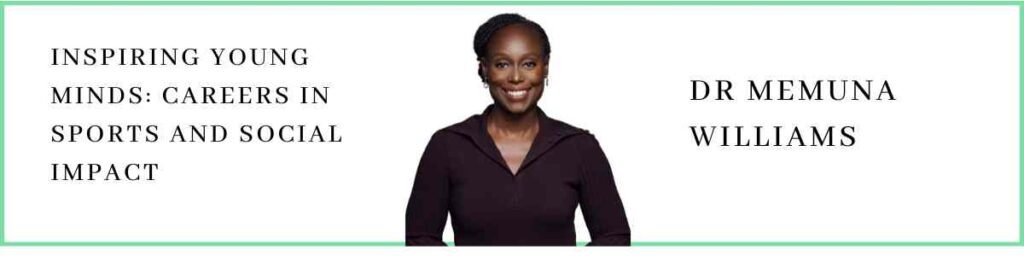
Dr. Memuna Williams talks about the newly released book ‘Purpose Perseverance Passion- Preparing Youth for Careers in Sports,’ which she co-edited. She discusses the book’s intent to provide a resource for young people interested in sports careers, featuring 40 unique stories from professionals across Africa and the diaspora. Highlighting contributions from various individuals, including former athletes and executives, the episode emphasizes the impact of storytelling on inspiring the next generation. Dr. Williams also outlines her involvement in social enterprises and education, aiming to drive sustainable change through leadership and entrepreneurship.
3 Key Takeaways
The Role of Storytelling:
Dr. Williams discussed the significance of storytelling, especially in a professional context. According to Dr. Williams, storytelling adds life and relatability to the narrative, making lessons more accessible and impactful. She urged the need for diverse narratives, especially from communities often overlooked in mainstream discourse. This mission resonates deeply with the book’s partners, We Will Lead Africa, whose goal is to enable people to own and share their unique stories.
Unique Stories for a Diverse Audience:
Highlighting the book’s diversity, Dr. Williams expressed pride in the wide-ranging experiences featured. Noteworthy contributors include former professional athletes and executives such as Claire Akamanzi and Christopher Williams. The array of voices aims to ensure every reader finds a story they can relate to, catalyzing their journey into the sports industry.
Inspiring Change Across Communities:
An inspiring highlight from the episode was the work of Dr. Williams’ co-editor, Clarisse Machanguana. Clarisse’s impact goes beyond her basketball legacy; her social enterprise in Mozambique exemplifies the profound community impact achievable through sports. These stories serve as encouragement for young people, demonstrating pathways to effect community change and personal success.
ShowNotes
Click on the timestamps to go directly to that point in the episode
[02:14] Discussing the Book: Purpose Perseverance Passion
[03:45] Stories of Inspiration and Impact
[12:26] The Importance of Storytelling
[17:35] Community Impact and Giving Back
[25:51] Where to Find More Information
Get In Touch:
If you’re interested in learning more, Dr. Williams invites you to connect with her on LinkedIn and Instagram.
You can also explore the publication, “Purpose, Perseverance, Passion”, for yourself. Both the Kindle and hardcover editions are available, offering readers both immediate access and a tangible piece of storytelling to cherish.
For those interested in sharing their own stories on “Chatting with the Experts,” reach out to Paula Okonneh through her website or connect via LinkedIn.
Paula: [00:00:00] Well, hello and welcome to another episode of Chatting with the Experts, the TV show in which I, Paula Okonneh, the host speak with women from Africa, from the Caribbean, and in the diaspora. These women are professionals and successful entrepreneurs, and they share my mission, which is to educate, to inspire and empower women globally. On a few episodes we’ve had men, but most of the time I’m speaking with women. So, today’s episode is called Purpose Perseverance Passion- Preparing Youth for Careers in Sports. And Purpose Perseverance Passion is a subtitle of a newly released book by Champs for Change. In collaboration with We Will Lead Africa.[00:01:00]
So in today’s episode, we will use this release as a starting point to discuss pathways to experiences in careers and careers in sports. So with me to do that will be Dr. Memuna Williams, who is an award-winning executive and thought leader dedicated to driving sustainable change through education, leadership, and entrepreneurship. She’s had over 30 years of global experience spanning nonprofits and social ventures, and she’s led impactful teams and projects across Africa, North America, and beyond. I. I’m always so impressed with my guest bio, but I can never say enough about them. So with that, why don’t I welcome Memuna to Chatting with the Experts where she can expand more on anything I may have left out [00:02:00] in her bio. So welcome to the show, Memuna.
Memuna: Thank you for having me, Paula. It’s really nice to be here.
Paula: It’s such a pleasure to have you here. Wow. Wow. Wow. So first and foremost, I wanna congratulate you on co-authoring, or is it co-editing the book Purpose Per, no, I can’t speak today. Purpose Perseverance Passion- Preparing Youth for Careers in Sports.
Memuna: Yeah, absolutely. Yeah. So I’m the lead editor.
Paula: Okay.
Memuna: And, my co-editors are Clarisse Machanguana and Randy Soumahoro. And, we’re really thankful to the team at We Will Lead Africa who have dedicated five volumes before this collaboration. With us on a sports volume to telling leadership stories about people in Africa and in the African [00:03:00] diaspora. They’ve had focuses purely on leadership, focuses on women, focuses on community, and so we’re really privileged to have been able to leverage their platform and their voice to bring out this volume of stories as well.
Paula: But one thing that I love doing is collecting the books of my guests. Any book that my guests have authored, I try and get a copy of it. So wonderful. Trust me, I’m gonna get the copy of this to have…
Memuna: Great!
Paula: To add to my collection.
Memuna: Yeah. Well, thank you. And it’ll be money well spent because I found that I’ve enjoyed reading all of the stories in it. We ended up collecting 40 stories from people who adults in Africa, professionals in Africa who are currently in careers and sports entrepreneurs, very senior [00:04:00] executives, former athletes, and the sentiment I had as the stories were coming in and then as I was reading the manuscript afterwards, was that each story was so unique and such a delight to read. And then the first external validation that I had was when we sent the book, the manuscript for final professional proofreading. And the proofreader final note was this was a fun read and congratulations with your project. So I think that you and others will definitely enjoy it.
Paula: Well, I’m celebrating you for your contribution to that. Even though I haven’t read it by the time, yeah, probably next meet I would’ve read it and I would congratulate you even more.’ I mean I’m always so thrilled when I get to meet authors, authors, you know, who have written books for whatever purpose, but knowing that it’s gonna impact [00:05:00] certain segments of people are sometimes gonna impact the world, and so…
Memuna: Mm-hmm.
Paula: That’s why we are here. And oh my gosh, I’m so excited about it.
Memuna: Yeah. No, no, absolutely. And it was written with a specific impact, intent in mind. So I said that it’s about professionals who are currently in careers and sports. And so what we intend is for this book to be a resource for young people who are interested in careers and sports so that they can see themselves in the stories and kind of see what it took for people to get into those careers today. And maybe find a faster way forward into getting into their own careers in sports, which seemed to be starting to be a little bit more accepted today as, you know, a place to go for a career. For a lot of the people in, this book and a lot of them tell the stories, they grew [00:06:00] up at a time when parents frowned on young people going into careers in sports. And now we are starting to see families, parents being more accepting of those careers but also careers in adjacent areas such as the arts and other creative endeavors and stuff like that.
So, we really hope that young people will take this up and read the stories. Again, they’re really enjoyable read. We’ve got people like Clare Akamanzi, who is the current CEO of NBA Africa, who contributed a story. My husband, who’s actually the former CEO of NBA Africa also contributed a story. We’ve got a number of former athletes who have played professionally in the NBA, but we also got stories about how a Polo League started in South Africa and the Pickleball League started in Cape Town and, you know, a social [00:07:00] enterprise in Mozambique. So it’s quite a variety of stories, people in the media, some amazing media personalities from the diaspora working in, you know, the Olympics channel, so Benny Bonsu. So just yeah, are some amazing people who I think young people can look up to and hopefully will also enjoy their stories.
Paula: Exciting. Notice how I’m leaning forward. I’m leaning, it’s almost like, can you tell me more? Oh my God.
Memuna: Right? Yeah, yeah, sure. So I think one of the things that I would love to share is about my co-editor, Clarisse Machanguana, who maybe those who follow basketball closely would recognize. But the thing I love about Clarisse is that she’s at one at and the same time, very humble, but also very sure of herself. So, she’s almost humbled to the point of being [00:08:00] self-effacing, but you also see her describe herself as the most successful Mozambican basketball player. And I think that that’s not hyperbole. Even though she’s a woman, you know, she played, I believe it was 34 years in professional leagues. Around the world, including 22 years in the WNBA. And she played in major markets like New York and Los Angeles, and actually Charlotte, where you and I first met many, many years ago.
So yeah she’s a phenomenal person. You know, yeah. I started to get to know her when my husband was at NBA Africa, and I would be fortunate to be seated with her at dinner, and she would tell me about how she wakes up at four o’clock in the morning every day in retirement now. And like goes for long walks, you know, to maintain her [00:09:00] physical fitness. And so it’s just been a joy to get to know her. And I was just lucky to have co mentored during a program that NBA Africa has called BAL for her. Where on the sidelines of the BAL tournament and NBA Africa there’s a full day mentoring workshops that are done where young women who are interested in careers in sports come to be mentored in different verticals.
And Clarissa and I ended up twice in a social entrepreneur’s vertical. Because when she retired from basketball, she started a very, very successful social enterprise where she focuses on health, education and sports for young people. And we came away from those co-mentoring sessions, feeling like young people, the young women there seemed to want more. We could have talked to them beyond the day that we had with them, and it might not [00:10:00] have been enough. And so that’s how we came around to starting to think about doing an initiative that would deliver. More sustainable interventions for all young people interested in sports, and the book is intended as our first permanent resource into the hands of those young people.
Paula: Absolutely love it.
Memuna: Mm-hmm.
Paula: We absolutely love it for what both of you are doing in collaboration with so many because, you know, we can’t be what we can’t see or what we don’t see. It’s important for young people to see themselves in whatever, you know, it’s sphere of life that they are aspiring to be in, you know?
Memuna: Mm-hmm.
Paula: When we have examples that are tangible, we hear about them. Some of us can even feel them or have been around there. It’s like, so if they can do it, so can I.
Memuna: Yeah. Yeah. And that’s [00:11:00] definitely the story that our third editor, Randy says he’s quite a bit younger than Clarisse and I, and he happens also to be a young man and he’s one of the contributors. And he tells the story about how he came to be inspired to want to be in a sports career, but also in a marketing career especially by another of the contributors, Christopher Williams, who’s an executive that has worked at Nike and Adidas and some of these major brands. And also was an executive at in residence at African Leadership University for a time, which is where he and Randy met, and Randy describes, you know, being inspired by him. So I just imagine that meeting on campus between Randy and Christopher you know, that’s a special in-person experience, but I think that through these stories as well.
One of the things that we’re proud of is the diversity we have you know, African-American males, [00:12:00] African males African women maybe only African-American women not represented, but I’m technically African American as I’m also an American citizen. And you know, we have Caucasian women, we have everybody across the spectrum represented in the book. So hopefully everybody will find somebody that they can see themselves in these stories.
Paula: Yes. So, you know, you mentioned a lot about storytelling and that, you know, that’s almost like the foundation of this book and in the business world, we hear a lot about storytelling. But tell me why storytelling matters in particular with this book.
Memuna: Yeah, no, absolutely. That’s such a good question. And we actually just officially launched this book last week Thursday at an event. You know, where we brought together speakers and one of our panels was on the importance of storytelling. [00:13:00] And one of our panelists made the point that, you know, you can have like bullet points or make the point, you know, in a succinct way. But that almost doesn’t land as much as when you elaborate through the story. And it can be, you know, prose or it can be poetry, but when you bring in, you know, when you color in those lines with a story, it brings it to life and makes it more accessible and makes it more lasting.
And that’s why one of the reasons that it’s important. And of course as, you know, people of color we’re talking to people in the diaspora, people in Africa our stories are not often told, you know, there’s not a lot of ownership around what stories are told when it comes to people like us. So, that’s the reason for being, for example, for our partners at We Will Lead [00:14:00] Africa. They want us to own our stories and tell our stories. You know, just own that and put that out into the world so that can be used.
Paula: Yeah. Absolutely. So really and truly in some ways it’s a first. Is it? Well, let me not assume ’cause I was about to say it’s a first of a kind dialogue that is showcasing sports professionals as well as who are also positioning themselves as social innovators and leaders is, am I assuming correctly or am I actually speaking a fact?
Memuna: Yeah, no, I think that there’s something to that. I mean, one would have to go out and look and make sure that there isn’t anything else, but I think it’s fairly unique in that way. And you really see this thread through the stories of especially the former athletes. They’ve been fortunate in many cases to [00:15:00] have sports be something that catalyzes them into a different kind of life. They feel lucky, they feel responsible, and they almost all invariably seem to want to come back and give back to the communities that they’re from. And so, Clarissa’s story, which is one of the stories that is captured here, is a quintessential story just like that. And that is, you know, I know her story very well now, and I can tell it without rereading the story. But it’s fundamentally about feeling so lucky that she got to do the things that she got to do through basketball. The part of the reason that she does the foundation now is that it’s her way of giving back and their stories from all across the continent like that in the book, you know, from Benin to Dakar, to you know, to Mozambique and beyond.
Paula: I’m not speechless, I’m just musing what you have said. [00:16:00] But maybe I’m speechless because it thrills me to see that, you know, we are now in positions where we can, you know, haven’t gone through or haven’t had experiences that we can now be comfortable enough in whichever way, whether emotionally happy, whether financially and many times it’s financially, where we can now go back to our roots and say, Hey, been there, done this. Here’s how I can help you do the same thing. And even elevate that, you know, make better. Yeah. Yeah,
Memuna: Yeah. Absolutely. And like everybody’s doing it a little bit differently, right. Clarissa and I are some level of social enterprise. That’s how we met. But there are several stories. And here I mentioned Benin. We have a story from Ian Manhimi who used to play in the NBA and he’s giving back through entrepreneurship. I think he lists at least three entrepreneurial ventures that he has through which he’s creating [00:17:00] employment, demonstrating, you know, how these things can be done. I think he’s a franchise owner of something according to the story that he shared. So lots of different examples of how it can be done and how one can give back to the community and how one can model you know, that are captured through these particular stories. But I think more importantly, are happening in a range of different ways in Africa today.
Paula: Yeah. Yeah. Mm-hmm. So, still hammering on the paths of stories. Yeah. Can you gimme an example of like a community?
Memuna: Mm-hmm.
Paula: That is going through these pathways and experiences of all the individuals or some of the individuals that you’ve outlined?
Memuna: Yeah. Yeah, I mean, I think I’m hesitating a little bit because I’ve talked so much about about Clarisse. But maybe I’ll talk about Benny. So [00:18:00] she’s in the diaspora and before she joined the Olympic Channel doing Olympic news she was an educator. And if you Google her and look at what she’s been doing in the communities that she came from in the UK. She is beloved by her former students and they look up to her you know, they want to emulate her. And I think that even though I might not fully know Benny’s stories, whenever I see snippets of that either that she shows on her social media or that I pick up somewhere along the way, I think that those people who are being inspired by her, it’s making a huge difference in their communities and in their lives.
Yeah, so that’s just one story. And of course, Clarisse’s. She tells the story of kind of starting the Clarisse Machanguana Foundation at a time when HIV AIDS was really [00:19:00] out of control in Mozambique and the campaign that they did to bring awareness to HIV AIDS and to take away the stigma from people who had it and just how successful that campaign was and how much of a difference it made in the lives of young people in Mozambique to the point where she was named a 13th point of light for the Commonwealth. So continuing to black brag on Clarisse, but that’s like a huge community impact. Tens of thousands of young people impacted and potentially life saved. So, yeah, so there’s like stories about individuals. What they were able to do, how they were able to get themselves outta communities. My heritage is Sierra Leonian. So many of the stories I have some, a few other Sierra Leonians in the book have the privilege of having been able [00:20:00] to go beyond their circumstances through sports and through these stories. So yes, there’s no shortage of of good news stories in the book.
Paula: I’m definitely getting the book. I mean, it’s, yeah. Yes, yes. I love to hear such things. I mean, as I say, it’s not just for my generation. It’s not even for my generation. I mean, the whole purpose is for the upcoming generation and, you know, just knowing how impactful that would be, that is. That…
Memuna: Yeah.
Paula: Used to be. Gives me nothing but joy.
Memuna: Yeah.
Paula: Absolute joy.
Memuna: Yeah. Yeah. I think, I mean, it has the potential Paula to be a gift that keeps on giving. We’ll have another conversation about me as a doctoral practitioner. But one of the things that I am able to have the patience to do is to [00:21:00] analyze the stories and see what the thread is across you know, the stories. And so, kind of what I see is, you know, almost like, here’s how it used to be with you know, parents not wanting kids to play sports ’cause they thought that it interfered with their schooling and their academics. And today it’s about actually sports can inspire and if you do both your sports and your academics and you do them well that can actually catapult you you know, further than if you were just doing one or the other. Because it gives you this strength of attributes, you know, you know, people don’t always like this word anymore, but resilience, ability to do teamwork you know, all of these kinds of things which then sets you up well for either your first part of your career or your early education. You know, because you have that grit to keep on [00:22:00] going back.
You know, and then you are able to get a fairly good job, you know, leveraging your education and what you learned through sports. And because you have a specialty skill, whether it’s finance or something else, then. And if you might be a sports fan and or somehow you are curious about, you know, an opportunity that comes on in sports, well then the people who are hiring in those sports jobs, they want you. Because they know that you know what it takes because you’ve not only been there as an athlete somewhere along your path, but you’ve also done well and you’ve shown that you can you know, do work in another career.
So that’s something else that I’m doing and looking at thinking about how can we potentially use some of these stories as, you know, case studies as we go forward with the work of kind of supporting young people [00:23:00] who want to go into careers in sports. Because it’s not just about the book, it’s about the start of an initiative to support young people who want to go into careers in sports. And this really gives us a starting idea of how to go about this beyond, you know, whatever else people are doing out there, and ideas that we might have about how we might wanna go about it.
Paula: Yes. Because these stories are not just powerful, but they’re relatable. And they’re uplifting and you know…
Memuna: Absolutely.
Paula: Yeah. Ooh, this book, so Purpose Perseverance Passion.
Memuna: Yes. So yeah, this is what it looks like.
Paula: Yes. I’m just about to say what does it look like? There we go.
Memuna: Yeah. And it’s available today on Kindle. This is a hardcover even if I say so myself. It’s a very pretty book. It’s, you know, printed in color on the inside. So it’s, you know, something that’s nice to have and [00:24:00] feel and touch. But if you somehow just wanted to access it quickly you could also access it on Kindle. So it’s available currently in two two types of formats.
Paula: That’s the Kindle and hard copy?
Memuna: That’s correct, yeah.
Paula: Okay. Okay. I’ll be getting the hard copy.
Memuna: Lovely book. You know, when you have a hardcover book or a book, you know, you can keep on going back and paging through it and stuff like that. So, you know, I would definitely recommend it. And it, you know, it’s got the pictures of the authors.
Paula: Yes.
Memuna: You know, consistent with how We will Lead Africa has done its books historically. We maintain their format and so you can actually see who the people are and get to know them. There’s a woman who I didn’t know very well Maureen Ojung and when I finished reading her story, and this is when, you know, before we finalized the manuscript. It was [00:25:00] a full picture of her from a distance and you couldn’t really see her face.
Paula: Mm-hmm.
Memuna: And I said if I want to see her face as the editor when I finish reading her story, because now I’ve gotten to know her and I think that she’s so phenomenal. I want everybody to be able to see her face. So I chased her for a closer up picture and I love the picture that’s ended up in the book of her.
Paula: Oh, I won’t put you on the spot because I was gonna say, can you show us a picture in the book, Maureen?
Memuna: I’ll flip through and see if I can find it. But I like the picture.
Paula: Wow. Thank God for technology that enables us to get things at our fingertips almost immediately.
Memuna: Yeah.
Paula: Yeah, I’ll be ordering this. So why you look for it. Don’t worry about that. Why we look for it.
Memuna: Yeah.
Paula: I would love you to tell people where they can find you online. Oh, you found the picture?
Memuna: Oh yeah.
Paula: Can you see that? [00:26:00] Yeah. And she’s so pretty.
Memuna: Isn’t she?
Paula: Yeah. I love what she’s wearing too.
Memuna: Yeah.
Paula: Yeah.
Memuna: So, yeah. So yeah, I can be found. So Chance of Change has its own website, so that’s the first place that we can be found so that you can see what’s going on with that project. And for my own work I have a website called sustainable-change.org. I’m on LinkedIn. I’m on Instagram. Those are my kind of public facing personas so people can find me in all of those places.
Paula: Are you on Facebook? And the only reason I say that, ’cause I’m still getting more acquainted with Facebook.
Memuna: Yeah, I am. I’m on Facebook. I’m on Threads. Yeah, so Threads is also public facing, so I should have said that. Yeah. I’m maybe a little bit old fashioned with social media, so I tend to have Facebook as a personal place for my family and friends, but I am on Facebook if people wanted to look for me there as well.
Paula: Okay. Okay. [00:27:00] Wow. Thank you so much, Muna. And for those of you who are watching this after it’s been recorded, I want to say that Memuna and other remarkable inspiring women become guests on my shows by reaching out to me. So if you’d like to be a a guest on Chatting with the Experts, please reach out to me on my website, which is called chattingwiththeexperts.com. I’m also on LinkedIn as Paula Okonneh. I have a business page there now . I’m on Instagram. And my handle there is at chat_experts_podcast. I’m on Facebook getting there and I also have a YouTube channel. So they have so many different ways of reaching me, if you’d like to be a guest on Chatting with the Experts. And wow, Memuna. This is just, I mean, I’m still leaning forward because it’s been [00:28:00] such an interesting conversation about the change that is coming about through all these phenomenal people who are wonderful. Giving back. Giving back. So for those of you who are in the audience, I’d like you to stay back and have a one-on-one question and answer time with Memuna because I can’t ask every question. There’s so many other questions that you know you may have that I haven’t asked. So this is an opportunity to do just that. So thank you again, Memuna, for saying yes to being Chatting with the Experts, and I am going to order this book today.
Memuna: Wonderful. Wonderful.