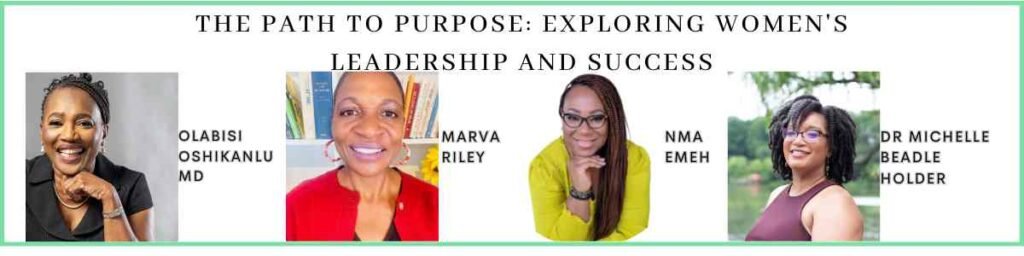
Dr. Olabisi Oshikanlu, Dr. Michelle Beadle Holder, Marva Riley, and Nma Emeh discuss how women can achieve success without sacrificing wellbeing, embracing authentic confidence, and leading purposefully in personal and professional spaces. Each guest shares their journey, overcoming limiting beliefs, finding one’s purpose, and leading uniquely. They also discuss the societal and generational roles imposed on women and how to unlearn these to lead more effectively.
Some Takeaways
Embracing Leadership, Overcoming Limiting Beliefs:
A major theme discussed was overcoming limiting beliefs that restrict personal and professional growth. Dr. Olabisi opened up about her shift from identifying solely as a physician to realizing her broader purpose in empowering others. Her story exemplifies the clarity that comes with embracing one’s true purpose.
Marva Riley resonated with this narrative, expressing her initial doubts about writing a book on her holistic healing journey. It was through the encouragement of her partner she was able to share her story and impact others positively—transcending her initial self-doubt.
The conversation also tackled the importance of speaking up. Nma Emeh advocated for confidence as a key to breaking silence and seizing opportunities. Reflecting on her experiences in corporate environments, she emphasized the significance of vocalizing desires to facilitate personal and professional advancement.
Redefining Roles and Finding Purpose:
Dr. Michelle Beadle Holder highlighted how traditional roles often confine women, and how redefining these roles can open doors to discovering one’s purpose. By viewing the kitchen as a laboratory for leadership and cultural expression, she illustrates the empowerment found in performing everyday tasks with intention and confidence.
In a profound exchange, the panelists explored how deep reflection can help identify one’s life purpose. Nma Emeh shared how Psalm 1[39:13]-14 became her guiding principle, steering her towards becoming a body confidence coach. Each of the panelists’ journeys emphasized that discernment of one’s calling often involves introspection into the constant themes that thread through their lives.
ShowNotes
Click on the timestamps to go directly to that point in the episode
[01:26] Dr. Olabisi Oshikanlu: Unlocking Potential
[02:49] Dr. Michelle Beadle Holder: Food at the Center
[04:12] Marva Riley: Holistic Health Advocate
[06:34] Nma Emeh: Body Image Confidence Coach
[07:55] Interactive Discussion and Audience Engagement
[09:06] Overcoming Limiting Beliefs in Leadership
[20:39] Finding and Living Your Purpose
Get In Touch:
For those who want to contact any of the guests:
– Dr. Olabisi Oshikanlu: Full Hands Ventures and LinkedIn
– Marva Riley: LinkedIn and books available on Amazon
– Nma Emeh: LinkedIn and website
– Dr. Michelle Beadle Holder: Food at the Center and LinkedIn
For those interested in sharing their own stories on “Chatting with the Experts,” reach out to Paula Okonneh through her website or connect via LinkedIn.
Paula: [00:00:00] Well, hello, hello, everyone, and welcome to another episode of Chatting with the Experts TV show, where I, the host, Paula Okonneh, speak with women from Africa, from the Caribbean, and in the diaspora. These women are professionals, and they are successful entrepreneurs, and our mission is to inspire, is to motivate and empower women globally. Sometimes we have a few men, but for the most part, it’s always women. Today, our topic is Elevated and Empowered, a new vision for success, wellbeing, and leadership. And this panel of dynamic women, these four dynamic women, will be exploring how women can achieve success without sacrificing well being while embracing their authentic confidence and leading with purpose in [00:01:00] personal and professional spaces.
These women are so inspiring, not just to me, but I know to so many who are joining today. So what I’ll do is I’ll let them introduce themselves before we jump in to the discussion. And so with that, I’m going to look at my screen. I would ask Dr. Olabisi Oshikanlu to introduce herself and then we go to the next person.
Dr Olabisi: Hello there Paula. Good afternoon from Atlanta, Georgia and good afternoon to the listening audience wherever you’re joining from. It’s a great pleasure to be here. My name is Dr. Olabisi Oshikanlu. I’m a physician. First, I’ll actually like to say I’m a mom, and then I’m a physician. I work with women and I help them and emerging leaders to unlock their potential to transform their futures. I help women, especially in healthcare reconnect with their passions and create [00:02:00] lives where success aligns with the deepest values and together with me, can help them to tackle challenges like work life imbalance, imposter syndrome, and other things that pressure them to have it all together. And I do this through my business called Full Hands Ventures. We offer workshops, coachings individually and in group seminars and podcasts like this or TV shows like this where we just inspire, encourage and empower and elevate women. Thank you.
Paula: Thank you. Dr. Dr. O, as we fondly call you and next going from my screen, I’m going to ask Dr. Michelle Beadle Holder to introduce herself.
Dr Michelle: Hello, everyone. Thank you for being here and thank you to Paula for convening this group of women as we talk about leadership [00:03:00] and well being. I’m Dr. Michelle Biedl Holder. I founded Food at the Center. I believe that everything important in life has food at the center of it all, and sometimes we work and forget to nourish ourselves. And that’s what I did for many years, and I want there to be a place where we see the kitchen as a form of leadership lab, where we come together, as family members, whether you’re at work or in your community, and bring connection, promote our health and well being, and celebrate our culture, the best parts of our culture.
And some of what we do is to help you transition from relying on takeout to cooking more at home. Not to say that you always not have takeout, but to make the best decisions that are good for you and your family. And so I’m really [00:04:00] looking forward to having the conversation with the group today.
Paula: Thank you so much, Dr. Michelle. And you know, we are thrilled to have you here. And next we have Marva Riley. She’s an RN, she’s an author, and she’s a holistic health advocate. Over to you, Marva.
Marva: Thank you so much. Thank you, Paula, for having me. I’m so happy to be with these amazing trailblazing women on the panel. And thank you to our audience for joining us today. My name is Marva Riley. I too, like Dr. O, live in Georgia. It’s a little bit outside of the Augusta area. Loving it. It’s a beautiful day today. Sunny and 76 degrees. I have all my windows open. I’m a [00:05:00] holistic health advocate. And I have been a registered nurse for 30 years. I thought about it, I said, it’s 2025. And I became a nurse in 1995. So that makes it 30 years of nursing. I spent most of my nursing practice in critical care. And then I became the patient. And since then, since I reclaimed my health using a holistic approach, I endeavor on a mission to inspire, encourage, and help motivate all people to become and remain the healthiest, happiest version of themselves. I have authored three books myself and a fourth book is a collaborative work with, I think 11 other women and one man. So, and my books are on Amazon for sale as well. So I’m excited to be here today. I [00:06:00] know that you’re going to hear a lot being shared today. And I hope that you will be able to take at least one nugget that will help you to succeed in taking the best care of yourself so that you can be the best leader that you can be
Paula: Awesome. Thank you so much, Marva. And next we’re gonna last but not least. We’re going to ask Nma Emeh to tell us all about herself.
Nma: Thank you, Miss Paula, and for having me and welcome everybody. Thank you for taking the time to join us for this discussion. My name is Nma Emeh and I am a body image confidence coach, passionate about empowering women and young girls. to break the generational cycle of hating their bodies. Why do I do this? Because statistics show that 9 out of 10 women are dissatisfied with their [00:07:00] body. And that number is just as bad as we go down the line for teenagers between 13 and 17. That number is about 78%. And then for girls within the age of Seven to 10, it’s about 54%. So it’s sort of a problem and I’m just here to help and I look forward to the discussion. Thank you.
Paula: Thank you so much, Nma. It’s a pleasure to have you here. And you know, as I said at the beginning, these four dynamic women have a lot to bring to the table. And I know that you, our audience will learn from them as I have been learning from them off camera for the past. Oh, year or so, because I’ve known most of them. In fact, every one of them has been a guest on Chatting with the Experts at some time or the other. Well, to the audience that joined us. I do want you to know that we are going to have this discussion for [00:08:00] 30 minutes. It’s going to be interactive in the sense that you can ask any questions at this for the first 30 minutes, just put it in the chat.
And once 30 to 35 minutes is over. We are going to open, I’m gonna stop recording so it becomes a safe space, and we’re gonna open up the floor to you all to ask questions, one-on-one to these women. And you also have an opportunity to switch on your cameras if you are comfortable doing that, or keep it switched off and ask questions by either unmuting your mic or putting your question in the chat, but I do want to show you that it’s going to be a safe space after 30 minutes. We are not recording in other words, so that just be between those of you there who have joined us and those of us here.
So, wow. As I mentioned, these women are all leaders in different spaces. And today, that’s one of the things [00:09:00] that we are going to be discussing among ourselves. And of course, you guys will be able to ask questions. And one of the questions that was brought up to me was, what is one limiting belief that you have had to overcome in your leadership journey, and how did you break through it? Because we are all from different fields, it will, you know, our answers may differ, but it’s all directed towards the leadership. Who would like to take that?
Dr Olabisi: Hi. Hi everyone. Thank you for asking that question, Paula. I think I can speak to that. And yesterday we met to just kinda like prep for this. And as I mentioned to you, when I began to think of the panel that we have, this wonderful lady, we’re going to talk about food and things like that, I began to see leadership as vision and as a recipe, just kind of like you’re preparing food. But when we think about limiting beliefs, for me, it’s been just having clarity being [00:10:00] able to say what’s my purpose. For years, I thought my purpose was just being a physician. I grew up, my father died very early on in my life. And so I grew up thinking, my whole purpose in life was to be a physician. But over the past 24 months, I’ve been able to pivot, to follow, I’ve gotten clarity. So I can see clearly, there’s a song, I can see clearly now.
So now I can see clearly, I had cataract surgery, so I can see clearly. And so now I know what my purpose is. My purpose is to empower emerging leaders. My purpose is to empower women in my field. My purpose is to encourage them and to help them get a sense of purpose. So before I just thought I just embodied being a physician, but now it’s like, I know that this is what I’m created for and I’m doing it with passion. That’s why I’m on this podcast. That’s why I have workshops for women. That’s why I have seminars for women. [00:11:00] That’s why I coach people with regards to who they are and helping them to overcome this filling of I can’t do it all. I’m a fraud that what we call imposter syndrome, or I shouldn’t be in the room. And I’ll stop this so that the other speakers can chime in.
Paula: Yes. So feeding into that. I’m sorry, Marva, you wanted to say something. Yes, go ahead.
Marva: I wanted to say something. Actually that limiting belief what comes to me is before I wrote my first book and my book is all about how I was able to overcome life threatening health issues, drug free using a holistic approach. And I used to have journaling as part of my healing tools. It’s one of my healing tools. And I used to always journal and write things in my journal. And he said to me, You should, you should write all these things you’re experiencing in a book [00:12:00] because you can help others by sharing your story and I said to him, Oh, even if I write a book, I’m not expecting anybody to read it, but at least if my children read it, then all my grandchildren, then I would be okay. And he said, No, you write your book like you’re writing in that black book. He said to me, put it in a book and publish it so other people can read it and benefit from it.
And I never thought that anybody would have bought my book, let alone learn from it, let alone express that what I wrote was able to help them transform their lives. So that was a limiting belief that I had to overcome with the help of my partner. Okay, so I think many of us as women grow up, believe in that, that person or that person can do it because I read books. But I never thought that since if this person or that person could write a book and people actually read it, I [00:13:00] bought and read these books, that someone would read the material that I published. And when I sold my first hundred books, I couldn’t believe it. And then people would reach out to me and say, for example, you know, when I read your book, your testimonial about healing from a life threatening heart disease called cardiomyopathy. Dr. O would know what I’m talking about. I had people reach out to me on YouTube, for example, and say, when I read your book and I realized that you were able to do it, I realized that there’s hope for me. So that’s a limiting belief that I had to overcome.
Paula: And as women, many times, we struggle with that. You know, big time not seeing the leadership within ourselves that’s already there until probably someone else has to, you know, help us, encourage us to look within ourselves and see that. And so that leads me to, Nma, I know that [00:14:00] you are, and you always have to correct me on this, you are body, image, complete the sentence.
Nma: Confidence speaker and coach.
Paula: And I know you speak a lot to women and young girls, because you want them to see within themselves that there is leadership.
Nma: Absolutely. And, a little bit about me, my background was in, I worked in finance and operations for Fortune 500 companies and sat on a couple of leadership teams and some of the limiting beliefs I had at the time was that I needed to be silent. And that’s something that resonates. Well, most women feel, especially the higher you go, especially if you’re a woman of color. You feel the need to be silent in rooms where you need to speak up. And for a long time, I was silent in rooms where I needed to speak up and it didn’t serve me well in that I sat out of roles that I knew I was well [00:15:00] qualified for, but because I didn’t elevate or amplify my voice, I missed out on those opportunities. And so that’s something that we continue to see with women. But in working with them now, hindsight is always 20, 20. What I do is building that confidence because what I’ve learned over the years is that confidence is not born in silence. You have to speak up and voice what you want, otherwise no one is going to know how they can help you.
And, a number of people on the panel, my fellows, speakers on the panel will know that one book I’m reading right now is The Aladin factor, which some of you may know about, and the main purpose, or thing that he’s saying in that book is to speak, to ask, to ask for what you want. And unfortunately, a lot of women, we don’t, we’ve been conditioned to be silent, to take a back seat, and then growing up in a minority family [00:16:00] or being black were even silenced even more. So one thing that I help people overcome is teaching them how to speak up and as they do that builds their confidence so they can go for the opportunities and experiences that they desire.
Paula: I absolutely love that. Now, Michelle, I know you have a unique take on leadership, leading with food, leading from the kitchen. Let’s talk more about that.
Dr Michelle: Thank you. I would say it started with me, my limiting belief. I’m trained as a medical sociologist. I have an anthropology background, and so I look at like the social determinants of health. That’s how I was trained to look at things. And I was a health science professor, I left academia to follow food. And my comfort zone when it comes to food is to be in the garden, not so much in the kitchen. [00:17:00] And so when I got the call, this inner calling to follow food, and within me it was saying, you should cook. I was like, oh no, that’s not for me. I’m gonna call my mom. Mommy knows how to cook. Mommy, can you come teach this class for me? And she did. You know, my mom. Is I always say she represents the health conscious leader in the family, but I also was under valuing my own contribution to the family and to the larger collective. So what some would say simple as home cooking was something that I didn’t have as much confidence in, even though I did it and I’m pretty good at it, people tell me.
So you get all these degrees and you’re, you know, doing your thing in your career, but what happens when you’re at home? How do you take care of yourself? And if we all have to eat every day, that’s an [00:18:00] essential part of self care, not only for yourself, but for the people that you love. And if you’re not eating well, you can’t lead as well because If you’re always grabbing the most convenient food that’s available to you, then it can increase anxiety and stress or feelings of anxiety and stress. But if you’re eating whole foods, foods prepared at home, then you get to take control because a leader has a vision, leader has a vision of what where she or he wants to go, and how to get there. And if you’re not nourishing yourself, you know, you may have brain fog. If you’re a leader, you’re all constantly making decisions, energy level, all of those things.
I think eventually when I started to cook, it started really small. It was all about getting a routine, practicing, practicing, gaining my confidence in the kitchen. So that’s [00:19:00] one of the things that I work to help people with, is to redevelop those skills, find out what they love, find your passion in the kitchen, explore, try new ingredients. And that sense of openness can contribute to other areas of your life in terms of your career and how you want to elevate yourself and your community. So, yeah, it’s the little things, I think, like cooking. That gave me more confidence and I can say, I can teach you, I can learn anything I can, and I can show you how to do it. And I want you to know how to do it. I don’t want to feed you. I want you to feed yourself.
Paula: Absolutely love that. Feed yourself. ‘Cause when you feed yourself, as you said, clears all brain fog and you can lead and lead others with that. So, you know, most of us here are [00:20:00] from many different cultures. And we, you know, I remember talking off camera with you, Michelle, and we talked about how, you know, there were certain roles that we felt put on us. And so I wondered, how can we, as women, unlearn certain societal and generational beliefs that kind of limit our confidence and even our self worth? How can we bring that into our leadership today and seeing ourselves different from how society? Looks at us. Does any one of you want to take that?
Dr Olabisi: I can speak to that. I love the fact that you’ve convened this panel because we’ve talked about health, we’ve talked about food, we’ve talked about body image. And one word we’ve banted around in the past couple of minutes has been vision. And I love acronyms. Everybody I know knows that I love acronyms. And so overnight, as I [00:21:00] thought about this, and I’m still answering your question, I thought about the word vision. So it starts, first of all, so V in the vision will be viewing your destination clearly. As I mentioned earlier, I had cataract surgery. I know when you have a cataract, you can’t really see. But once the cataracts were removed, everything, my whole world changed. So beginning to see ourselves as who am I? Seeing that I have a purpose that I have… asking myself, what is my goal and what impact do I want to have in the world?
And I think that that helps you to shift where you’re coming from. And it helps you to kind of break those generational things like, oh, this is this is a woman’s role, or a woman is supposed to be in the kitchen that we’ve talked about so just having that viewpoint and then imagining the possibilities, just like when you want to cook food, you think about what you want to cook in your mind. So imagining [00:22:00] yourself where you want to be. Yes, I’m a physician, but I see myself now more as someone who’s inspiring people, who’s helping people to unlock their potential. And that was always in me, people have always come to me for advice. But being able to ship that narrative from this is what my family expects of me, or this is what society expects from me.
I mentioned in the boardroom. I used to always think I had to have my hair permed, nothing wrong with that. But now I braid my hair, being able to break free out of that box that people have put you in. And, but that comes from you knowing, okay, what’s my purpose, what are my goals and stating them clearly. We know about SMART goals and then, saying to yourself, what’s the impact? Working with the end in mind. And I’ll stop there for now, but I’ll talk about the other parts of vision as we go along.
Paula: I love that. Working with the end in mind. I thought Marva, you wanted to say something.
Marva: I kind of wanted to piggyback on what [00:23:00] Dr. O said. I think once you find your purpose in life, and sometimes you would kind of know what your purpose is at a young age, but you don’t live in it until later on. For example, I always knew from I was a little girl. I think I mentioned it in our first interview, Paula, from I was a little girl, I wanted to be a nurse. When I was a little girl growing up in a little village in Jamaica, I admired the nurses because they were always caring for the neighbors and the village and stuff like that. So I always wanted to be a nurse, but I never had the opportunity to go to nursing school when I was in Jamaica, even as a young adult, I came to the States, I worked a full time job and I had two little children and a husband and I went to nursing school.
So that was my passion. Now, my passion, my nursing passion, has evolved over the [00:24:00] years from being a bedside nurse, to being now, a staunch advocate of holistic living. Now because I’m living in my purpose, I’m kind of tunnel vision. I know what it is I’m trying to do. I know what I’m trying to do. I know my goal is to encourage and inspire you to become your healthiest version. So when I see someone, that’s my focus. I’ll talk to you about that when I’m in front of the camera, that’s what I’m speaking to. When I’m working out, I’m speaking to others. If I go to the gym, that’s what I’m talking about. That’s my purpose.
And so I don’t have any more hesitance. I don’t have any more shyness. This is me. And I’ve developed my style over the years, which I tweaked, but this is my style. Take it or leave it. That’s just me at this point. I [00:25:00] have matured and I’m living in my purpose. So I think the most important thing is finding what your purpose is. What is it you love to do? I think one of the ladies said, I know Dr. Michelle said, she was in education and she eventually discovered her purpose in the quote unquote kitchen. I think Nma had a different profession. And has transitioned to body image. So once you live in your purpose, you’re going to lead in your purpose.
Paula: I couldn’t agree more. Once you discover your purpose, you lead in that purpose because that’s been me too. But this is not about me today. This is about you four dynamic women speaking to the world, to all who have joined us. Believe it or not, it’s almost 1:30pm.
Nma: I just have a quick p. m., something to say. [00:26:00] And Marva, you explained it so well and Dr. O as well. But I know that one question that I often get asked by clients is, how do I find my purpose? How do I discover my purpose? And so I’m going to peel it back a little bit., For me, I truly believe when you’re searching for your purpose, I’m a woman of faith. When you’re searching for your purpose, you have to go back to the one who created you because only he knows where your purpose lies. And so I encourage you to seek God. That’s step number one. But what I’ve also found out is that our purpose usually has something to do with what has been a constant theme throughout your life.
So you’re going to have to do some deep reflection. What has been a constant theme, a topic of discussion? What have people continue to say about you? What have you continued to think about all through the different stages of your life from birth through where you are today? So for me, for instance, [00:27:00] my body has been a constant topic of discussion. From the moment I was born, I was born way over 10 pounds. And so the doctor told my mom, this one would have killed you. So this is it. I’m the youngest of seven. And then growing up, I look quite different from my siblings who were tall, motherless, and more voluptuous, and so that became a topic of discussion as I moved into puberty. And then I get into my teens, and I get into my 20s, 30s, the same topic of discussion in the workplace. There were questions about how I got promoted, maybe it was because of my physical appearance.
And so during the pandemic, that was when I took a step back and I was like, Lord, I don’t want to do finance and operations anymore, but I don’t know what you’re calling me to. And then that’s when it hit me. What has been a constant topic of your discussion? And the Lord literally led me to Psalm 139 [00:28:00] verse 13 and 14. We are beautifully and wonderfully made; marvelous are your works and that my soul knows very well. And that has been the passage that I lead with, that I’m beautiful and wonderfully made. My name Nma, in Ibo, literally means beauty, but for a long time, I didn’t feel that way. But it’s not by chance that my parents named me, I don’t consider myself the most beautiful person and of all the names that they chose, that was the name I was given. So that’s how I know that I’m living in my purpose where I’m trying to help other women and young girls find the beauty that God has created in them from the inside out. I hope that helps you find your purpose.
Paula: Isn’t that beautiful? Absolutely beautiful. And yes, I hope whoever listens to this after we put it [00:29:00] out on the podcast and on the TV show and YouTube listen to this and know that they’re wonderfully and marvelously made and can find their purpose. That’s really very touching Nma, as well as everything else that Dr. O and Marva has said, before we open up the floor I do want to know if Dr. Michelle has any one thing to say, I mean in relation to that, about finding her purpose because you, I mean your story is really very unique. I love it. I’ve been part of the cooking class, it has changed my life in the sense I’m eating healthier. After joining your class, so please go ahead.
Dr Michelle: You talk about rules, and I think in many cultures, there are certain roles that are given to men and women. They start really early in life. And the kitchen has often [00:30:00] been regulated to the role of women and girls. And, I grew up being told that you should learn how to cook so that you can feed your family and your husband. And I grew up in a time where women were changing what was given to them. Like you had a choice, an option to not do it. We have takeout more now so than ever. And, I rebelled. I rejected it. I didn’t want to cook and I did everything to sabotage every meal my dad taught me to prepare. But it had to become something that I reclaim as my own, something that… you talk about leading, as leading yourself first. And so the role of cooking became something more expansive, not just a duty to family or to other, but something that I could give to [00:31:00] myself and that, could help nurture me in many ways, holistically, like Marva said, holistically, but I rejected it.
I didn’t want to do it. I saw it as less than. I had internalized many of the ideas about what being in the kitchen was, and I devalued it. And it’s only when I started to look at how much joy it brought me to smell the ingredients that I had, to grow. I grow food, to be able to grow something, watch something grow from seed to preparing it to nourish myself and the people that I love that I began to really value food. If we don’t have it, we will recognize that we don’t have it. So thinking about roles, it’s for everybody to do. If [00:32:00] you eat, you should be able to prepare at least one meal for yourself. And to do it with intention and confidence. And so, yeah, the simple thing as an everyday meal really, really brought me back to myself.
And I’m still teaching. I’m not in academia anymore. But I was actually, was it yesterday? or the day before? I was teaching a group of professors, their deans, how to cook a traditional Jamaican meal. And it was in someone’s kitchen. So I’m living in my purpose because I’m still teaching. And what I’m teaching is something that people can implement in their day to day life for the betterment of themselves and their family.
Paula: Not a great take on taking back your power, understanding your role and your purpose and doing it in the field in which you were [00:33:00] called, not necessarily the one that you thought or internalize that you needed to be in, but the one that you’re actually called to be in and doing it with such. I can see, I mean, the job every time you talk about what you do your face lights up. Finding your purpose and leadership obviously go together. All right, so we’re about to open up the floor, but I want all of you four or four of you dynamic women to just tell people where they can find you online just in case people have to drop off before we open up the floor to everyone. And I’m going to start again from looking at my screen. The first person who is to the right of me. Yeah, the right of me is Dr. O. Can you tell people if they are, if they would like to get in touch with you, where can they find you online?
Dr Olabisi: I’m just typing it in the chat right now. fullhandsventures.com. I just put it in the chat. [00:34:00] That’s my website. I’m also on LinkedIn. I’m on other social media handles, but I’m also on LinkedIn where I’m very active as Olabisi Oshikanlu MD. So just put Olabisi Oshikanlu MD, but you can go to my website. We have a lot of resources. And you can read more about me and what I do. Thank you.
Paula: Thank you, Dr. O. And to the right of you is Marva.
Marva: Okay. Thank you so much. So my name is Marva Riley, R I L E Y. I am on YouTube, Instagram, and Facebook. And you can also purchase a copy of my books. On amazontarget.com and walmart.com and any online bookstore. Just look up Marva Riley and be sure to subscribe to my YouTube channel. I’m always [00:35:00] posting great tips every single day to help you to become and remain the healthiest, happiest version of yourself.
Paula: Thank you, Marva. And maybe you can drop that in the chat as well. Next would be Nma Emeh, do you mind telling people how they can get in touch with you?
Nma: Yes, thank you. I am on all the social, well, majority of them. , LinkedIn, Facebook, Instagram, but I will also just post my, oops. I thought I did post my link tree, so ways to connect with me online and all my links are there. Thank you.
Paula: Absolutely.
Nma: Oh, and I have a free gift on the link tree so you can, it’s a free download if you’re one of those people who overthink, you know, I have a resource for you there.
Paula: Thank you so much. And [00:36:00] last but not least, Dr. Michelle.
Dr Michelle: You can find me, my website is foodatthecenter.com. I’m on Instagram, and there’s a link tree. I should have grabbed that. The link tree is on Instagram, Michelle Beadle Holder on Instagram, I’m on LinkedIn. I’m more active now. So, Michelle Beetle Holder, PhD, on LinkedIn. So, those are three places that you would normally find me. And I also have a cooking classes coming up in March. We’re going to be making curry chicken, Jamaican curry chicken, planting hash on the following week and also a jerk salmon. I also sell spices and I have a digital cookbook as well on my website. So if you go to the shop section, you’ll find it there.
Nma: I want to know when you’re making the oxtail.
Dr Michelle: Oh, all right. [00:37:00] Yes. And you can also, if you want to have something more private, more catered to you, then just reach out. And I can do something special for you.
Paula: Oh boy, now she’s made it even more special. Oh boy. So, to all who joined us, my name is Paula Okonneh. I am the host of this, TV show called Chatting with the Experts with Paula Okune. Oh, it’s so obvious. And what I do, I speak with women primarily. And these women are from Africa, the Caribbean, and in the diaspora, and what I encourage these women to do is to empower, educate, and inspire women globally through their own professional skills and services that they can showcase to the world. I’ve been a podcast host for about 12 or 13 years and my story is a different one. I got into this because [00:38:00] primarily I was so scared of public speaking. And so what I do in addition to the show is I teach men and women how to overcome public speaking through having a podcast. I teach them the way to do that.
And, that’s me in a nutshell. So I’m going to open up the floor to the audience, I’m going to stop recording. As I promised, and, everyone who has joined, feel free to ask any questions or questions that you might’ve thought of that you didn’t have a chance to ask, or I didn’t have a chance to ask these fantastic women. And, we’ll be doing that in a safe space.