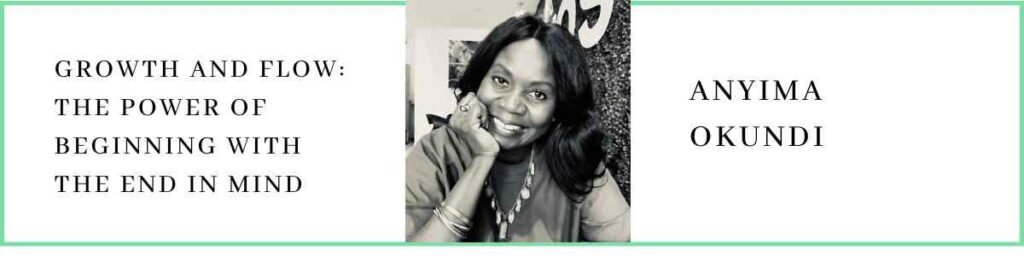
Anyima Okundi, a seasoned entrepreneur and executive coach, discusses the importance of envisioning the end goal to better navigate life’s transitions and challenges. Anyima shares her personal experiences, including her global upbringing and professional journey, which have shaped her understanding of leadership, emotional intelligence, and the value of endings. They explore the concept of ‘flow,’ the natural progression through life’s stages, and the significance of preparing for seasons such as parenting, marriage, and career growth. Anyima also highlights her coaching philosophy and how she helps clients tap into their latent potential by managing expectations and setting achievable goals. The episode underscores the importance of emotional awareness and adaptability in achieving personal and professional fulfillment.
3 Takeaways
Understanding the Importance of Endings:
Anyima reflects on how her life experiences have shaped her understanding of endings, acknowledging that they were once the hardest part for her to navigate. With a nomadic childhood due to her father’s diplomatic career, Anyima often faced the wrench of leaving behind friendships and places. Through coaching, she learned to view endings as a critical and celebratory aspect of the journey rather than a disheartening conclusion.
Transforming Expectations into Joyful Journeys:
Paula and Anyima delve into the importance of setting expectations for both personal and professional growth. Anyima explains her evolution from setting rigid New Year’s resolutions to envisioning what she wants to feel, achieve, and contribute by the end of a period. She emphasizes the value of focusing on the emotional, mental, and physical empowerment that comes from these non-restrictive goals.
Navigating Seasons and Cycles:
Through her personal and professional experiences, Anyima highlights the resilience developed through understanding life’s seasons. She advocates for preparing emotionally and setting realistic expectations through all phases of life, from childhood to adulthood. This mindset promotes resilience and adaptability, key components for finding flow even amidst change.
ShowNotes
Click on the timestamps to go directly to that point in the episode
[02:47] Anyima’s Journey into Coaching
[05:58] Understanding the Impact of Endings
[14:26] The Concept of Flow
[21:27] Navigating Life’s Seasons
Get In Touch:
For those inspired by Anyima’s story and wish to engage further, she invites you to connect with her on LinkedIn or through email.
For those interested in sharing their own stories on “Chatting with the Experts,” reach out to Paula Okonneh through her website or connect via LinkedIn.
Paula: [00:00:00] Hello everyone and welcome to another episode of Chatting with the Experts, the TV show where I showcase women from Africa, from the Caribbean, and into the diaspora. And our mission is to empower, educate, and inspire women globally. Sometimes I have men on, but 99 percent of the time it’s women. And these women are professionals. And they’re also successful business owners. The topic of today is Beginning With The End In Mind, Finding Flow. And with me to do that today would be Anyima Okundi. But let me tell you a bit about her. She’s a seasoned entrepreneur and she’s an executive coach who has managed her own design firm [00:01:00] since 2009. Throughout her career which spans over 20 years, she has served multiple roles cross-organizationally and has gained valuable insights into leadership challenges that are common to those building successful organizations.
So when we talk today about Beginning with the End in Mind, she’ll tell you that endings have always been the hardest part of life because being an emotionally wired person, endings were always very difficult during her childhood. But then she discovered through coaching, that endings are much easier to celebrate when included at the beginning. And so with that, I welcome to Chatting with the Experts, Anyima Okundi. Hello.
Anyima: Hello.
Paula: I’m so happy that you joined me today [00:02:00] in speaking about Beginning with the End in Mind because that’s something off camera we spoke about that how important it is to have the end in mind with everything that you do. So thank you for joining us and thank you for being part of us today.
Anyima: Yeah. Thank you for having me, Paula. Really. I’m so excited. And to manage my nerves, I’m already thinking about the ending. So…
Paula: I love it. I love it. And I know that our guests who have joined us would be so happy to hear how you’re thinking about your ending.
Anyima: Yeah.
Paula: All right. So, you know, the thing is, whenever I have guests, I just give a snippet of the bio. I’m sure you probably have more that you can add to it, you know, like, for example, how did you even get into coaching?
Anyima: Oh, yeah, that’s a good question. I stumbled into coaching, actually, on the back of my diploma in counseling and psychology. And [00:03:00] when I was doing my thesis paper for that diploma, I was looking at the relationship between mothers and their teenage daughters and how they impact women emotionally, mentally and physically. And my research group were from my daughter’s school, and a lot of them were actually corporate professionals. And having come from a corporate background in banking and logistics, I was now working as an entrepreneur for my own design business. And the psychology part of it was because I used to just need to support women around loving their bodies when you’re making clothes, or even they confide, people confiding in you when you’re designing their interiors, the bedroom, the kids room and tend to [00:04:00] talk.
And it was one of my dear clients actually who said, you know, you’re so good at this, you should formalize. And I’ve always loved just connecting with people and supporting them. So as I did this research, It turns out that the ladies loved it so much, but nobody was really ready to have therapy. And then another friend of mine said, Oh, coaching.
Have you thought about coaching then? Because I really found an affinity in supporting them because I had worked in their world before. And that’s how I explored then what is this coaching? And I found Really, my sweet spot in supporting men and women, children, whomever, in finding their voice through different seasons and stages of life as a coach.
Paula: Yeah. Okay.
Anyima: And, you [00:05:00] know, when you’re going through such certifications, whether it’s as a therapist or a coach, you need to use your own life experiences. And so this was the change maker for me, because I got to really take a good look at myself and understand myself in order to be able to hold space for my clients. And yeah, haven’t looked back since. So I’m also a coach trainer. I’m faculty for coaching diploma. I’m a coach supervisor. And so I really I’m passionate about supporting the growth of people wherever they need me. Yeah.
Paula: I love that. I love that. So you found your own passion. You found your own path and you’re helping others through your discovery to find theirs.
Yeah, my gosh. You know, you mentioned how endings were kind of the hardest part. Well, in general, [00:06:00] endings are the hardest part of life. So what do you mean by that?
Anyima: You know, and I think it’s really about my life experiences as well. My dad was a diplomat, an ambassador. So I grew up four years here, five years there. And at every point you make friends or something, you say, and then you need to move and start again. And I think it was really when I was in secondary school in Ghana, where I’m originally from though I now live in Nairobi. And I went to, those days, Form 1, Form 2, Form 3. You’ve just gelled. I mean, and it was boarding school. And shout out to all St. Mary’s people. And yes. This was now you were going to be a senior after three years you… and then we moved. And of course I went boarding school in the UK so I needed to be [00:07:00] happy and grateful. Anybody would say the same in fact my friends in school like you’re so lucky, but it was the end of such a key time of my life and it really impacted me actually, I remember going to this new boarding school in Kent.
It was lovely where I used to stay in a room full of bunk beds, here we were just four in a room, you know. There was a lot of loss I experienced, you know, because it had happened so many times, whether it was primary school and I didn’t cope very well, to be quite honest. I remember just finding my solace in the tuck shop, yeah, and almost hiding my dissonance because it was not acceptable. If I had known the end from the beginning that there would come a time in my life where this too would [00:08:00] pass, you know, not just as a phrase, but for real. And that there would come a time in my life where I would find my voice and understand, I would have experienced it differently.
So a lot of my years in secondary school in the UK because it was on the back of a real wrenching of something I wasn’t ready to let go of, it was quite… I look back and there’s a lot of sadness, you know, which you wouldn’t see because I was, hey, masking with being the bell of that one who is, hey, let’s… But really, I didn’t do endings very well, because I had not been taught how to. Yeah.
Paula: Yeah. I can see how that could be because my dad wasn’t a diplomat, but we moved many times. And so [00:09:00] I understand fully, you know, about creating friendships, trying to fit in and knowing that you don’t quite fit in, but then there’s still that nostalgia of where you left.
Anyima: Yes.
Paula: And that follows you that comes with you, you know.
Anyima: Yeah, and you are always… you can be always the one looking for please see me and it’s ironic because what I went through actually it was the proving ground for. Me in marriage because I live in Nairobi, Kenya, because I’m married to a Kenyan. And I thought at the time, when I’m an adult, I will live in Ghana. That is the end, you know, but by the time I was finishing, you know, boarding school, going to uni in East Anglia, doing my post grad in Surrey. Yeah, by that time, then you just, you almost numb yourself to, and you move on. But it is moving to Kenya 10 years [00:10:00] after marriage that really showed me the resilience I had built. And therefore now looking back to see what did I learn on that journey? And really digging into that to propel myself forward as well. Yeah.
Paula: So would you say that because of those experiences in your formative years and your, you know, your early, middle and later childhood, that’s enabled you to understand seasons and cycles better?
Anyima: It has. It actually has, but actually it’s my coaching journey that taught me that I have tools within me. Because as a coach, we know that the answers lie within the person whom we are coaching. And so I have tools within me if I would dare to go there. [00:11:00] And a lot of the time, those tools are buried because they have a lot to do with endings. They’re buried in shame, like, all I remember about endings is that my reputation was, Oh, as for Anyima, she cries all the time. She’s so emotional. This was synonymous with how I felt about endings, but through coaching, I learned that, Oh, what were the tears actually expressing? Let’s go back and see what can we pick?
And actually the tears were a real digging deeper to make sense of. But I didn’t have the vocabulary, the words, or even the ability to see anything positive in those endings and in those tears, because it’s unacceptable. Be grateful, you know, you are lucky. You are blessed to have these opportunities. So what happens with that is you are not maybe allowed to [00:12:00] feel. And by the way, this isn’t… some of that is my own noise from observing. It’s not even that somebody said that categorically. I love my mum and dad and my family. And it was very privileged, like, that I had access to education, access to what my parents, you know, gave me in that regard, travel.
However, there’s that, you know, what we now call soft skills. And the EQ of understanding the impact of things on us from the beginning. So imagine moving and being told this is going to be difficult. Yeah. And when four years time we are going to move and that will be difficult. How do we support you? It’s a very different experience from when it happens. And it’s like, okay, come on, be strong. You can handle it. [00:13:00] Yeah, you feel me?
Paula: Yeah. Yep. I understand. You know, times have changed and I understand better that we used to be told. I remember telling my own children that I was growing up in the generation that we did. Excuse me. My mom used to say feelings were, you know, like what you felt, physical feelings. But your emotional feelings were not really put into consideration. So like you said, you moved and you’re so, okay, this is it, you know, grow up, bite the bullet and keep moving. And so, it’s so much later that you realize that you had to suppress things and I mean, as you said, we were very privileged. I was privileged. I realized I’ve lived in all these different countries.
I enjoy it now in my latter years because I can, I find that I’m able to, I’m very adaptable.
Anyima: Adapt. There you go.
Paula: Very adaptive. I can live anywhere now. I can be friends with anyone because what I’ve [00:14:00] learned from that journey was that human beings are human beings. It doesn’t matter what they look like, their skin color, whatever. They are human beings, you know? But yeah. Those formative years of trying to fit in and you know, that’s the time that children tease you.
Anyima: Yep.
Paula: You sound different. You’re trying to fit in. You don’t even know how to fit in.
Anyima: Yeah, exactly. And so the passion that I have about preparing for the end from the beginning, for example, I stopped setting new year goals about six years ago. What I do is I try to envisage at the end of, now it’s 2025 coming up. What do I want to [00:15:00] feel, have sense? And that can come in any manner of ways, as opposed to at the beginning of the year, I would say I’m reading 10 books, I’m reading, I’m going to I don’t know, make three collections because I have a design line.
And the difference is the flow of my year. Well, it will be ruled by the number, the figure I put at the beginning. As opposed to at the end of the year, 2025 as a creative person, what do I want to feel at the… I want to grow. Yes. But I also want to have contributed to the design world in some way. Because now I know that at the end, when I’m disappointed, when I haven’t met all those goals, [00:16:00] I go into freeze. I freeze. It inhibits my even creative process. Yeah. And what that brings is a lot of expectation that can make me actually break. And so understanding the impact of hard goals at the beginning without thinking about, and how will I feel at the end if I’ve not read 10 books? I’ll feel like a failure. Okay, so what can I think about instead of saying 10 books, how can I make this flow for me? So I no longer put 10 books. What I want to read is things that empower me emotionally, mentally, and physically. Maybe that will just be one book and that’s okay, because at the end of the year, that’s what I would be looking for. Not the number.
Paula: I love it. I really love that. So you’re [00:17:00] setting up expectations and intentional about them .
Anyima: And open yourself. Now, like you said at the beginning in the little blurb I had said is I am emotionally wired. You’d call me an empath, even a highly sensitive person. That’s how God created me. I see life in emotions. So I used to spend a lot of time trying to help people understand either what I mean emotionally, or how they impacted me emotionally. I mean, for me, that’s how somebody who is a data person, you’re a mathematician, sees things in numbers. That’s how you make sense of life. Yeah. One plus one is two. So, okay, now let’s move. Whereas me, one plus one may be two, but then I’m thinking of, wow, it’ll be really sad or really hard, or it’ll be fearful. That’s how my brain is wired. And so for me, things like [00:18:00] ending, it made me understand endings and why they impacted me so much. But I also found that many, and I would talk about it because I’m emotionally wired.
I would need to talk, but actually many people suppress their emotions and get on with life. But that is also hurtful. Yeah. Because then you’re not actually processing how you’re actually feeling. So as a coach, one of the skills is managing a session in the time that you have to come out with what is the desired outcome for your client, right? Now that outcome depends on them, but it’s something that can only happen if you contract for it. So you talk about it at the beginning. So at the end of our time together, what do you want to walk away with? How do you want to feel? And that’s like the miracle question because [00:19:00] it allows you then to chart the path for your conversation. And at the end, you refer back to what you wanted at the beginning and it’s like voila. Even if you’ve not achieved it fully, you can then say, how far have I come? I’ve made steps. And now I can do a bit more by myself. Isn’t that wonderful?
Paula: That is wonderful. That is wonderful. And, you know, you said something so as a coach you prepare your client to, you know, about, okay, what do you want out of this? So there’s even a joy, you know, like the joy of the beginning because, you know, you’re beginning and you’re joyful because you’re looking forward. You’ve set up expectations, you’ve let them know, what do you want to achieve? So you’re not going in with trepidation, you’re going in more with expectation and joy and thinking, all right. This is what we’re going to achieve.
Anyima: Yeah. [00:20:00] And also as the coach holding the space, sometimes somebody wants to achieve in an hour, something that may take three hours, three sessions. And so at the beginning, you’re also narrowing it down into an achievable step. So wow, this topic, for example, that you’re talking about being able to impact your team dynamics, for example, so that project timelines are achievable. To do that, we have to work backwards to… so today in that one hour. We have what is one small value add we could have towards that goal, and it might be. I really want to understand the impact of not achieving our goals and what it has on me. For today, if I can understand that, that would be great.
So by the end of the session, we may not have [00:21:00] solved the mystery of how can I get the whole team to perform at X. But if I walk away with understanding the impact that not performing has on me. That would really help me. Voila. So starting with the end in mind means we manage not only the expectations, but our output. And then the next session we have, we can take it another step further. And when I applied this to my life, really, it applies to everything. Parenting, the expectations we put on our children and how they should turn out and what they should do. Marriage, what should my husband say? He hasn’t brought me. What’s the expectation? Our workplace growth. Friendships. Funny story, you know, I’m an organizer and I’m a creative so you have a lot of groups that I’m in. Oh, yeah. Anyima will tell us how it should look. [00:22:00] It was happening a few times and I just felt like I also want to be those that sit and arrive, you know, not be the one who’s always in charge of deco.
But guess what? I had to say it. Say, okay, so this year for all our activities, can I be the one who arrives. Why? Because at the end of the year, I want to also be able to give all of you your flowers and say, well done. Wow, but you are so good. Yes. But I went to experience. So it took that dialogue to express what I wanted to experience at the end in order to bring that harmony you know, in my friend group. So it applies everywhere.
Paula: Everywhere. We talked about beginning and then flow. And the way I look at flow is there’s a beginning, there’s an end, and in between that is the flow. [00:23:00] Is that the way you look at it too?
Anyima: The flow is so important, you know, flow there’s a book called flow by a writer called Mihaly Csikszentmihalyi, and it’s about the power of latent potential. For all of us, we are born and there’s a destiny or a purpose path for us. We all take different varying times to find it, but when we find it, we flow. When we are resistant or maybe don’t understand, that there is maybe several paths and we can choose what resonates. We can be in flux as opposed to flow. And I’d like to use the sort of life cycle of a river. They have a beginning point. And in geography, I did geography at A level. [00:24:00] I remember loving it because you’ve got Oxbow Lake when they reach sort of the middle part of their journey, because now they are. They have gathered debris and that will hit certain corners of the land and that’s how you get the shaping.
So everything has a purpose. You pick up, you’re there, you’re falling rapidly to create the path. And then you’ve picked up some rocks and then you move with them. That makes the shape and then eventually you flow out into the sea. In life seasons, or your work path, your parenting, your the flow comes with understanding what that journey encompasses. And for example, in family life, we do very well in having a bridal shower when somebody’s going to get married, and a baby shower when they have their kids. But nobody has parenting, teenage [00:25:00] shower, menopause shower. Empty nesting shower to tell you, we should tell the whole story.
Paula: I love that teenage shower, menopause shower and emptiness.
Anyima: Empty nesting.
Paula: That’s good.
Anyima: Okay. If we could tell the story from the beginning that life is going to meander, there’ll be disappointments. Not all your kids are going to be whatever you envisage for them, but that’s okay because they’ll figure it out. So we let go a little bit in order not to break, but we really do hold tightly to expectations. I did. I don’t want to disappoint my parents. I want to be a good wife, a great mom. What does that even mean?
But when I started to flow into my seasons, like actually my mom died 2019. I had a very serious operation on my [00:26:00] shoulder. Then we went into COVID. Actually, no, a great mom would be me waking up and looking after myself in that season. Because the end, if I don’t do that, is I’m going to break because it was just a lot.
Paula: Yes. Oh my gosh. Now we could talk forever. I told you we’re gonna go.
Anyima: We could talk forever.
Paula: There’s so much, so much. But you know, we have to leave time for the audience to ask you questions. So for those who are not part of the audience and are looking at this after it’s been posted and would love to get in touch with you. How can they find you?
Anyima: I’m definitely on LinkedIn. All my details are there and email [00:27:00] me. My emails there. You can send me a message, but I am so passionate about helping people navigate the seasons, find flow, find their voice authentically, and just be their true authentic selves in every area of their life. And I love telling stories. So yeah, reach out, I’ll tell you my stories so you can feel seen.
Paula: Oh, I love it. And so again, to my guests and those of you in the audience, I want to say thank you for tuning in. And also I want to say, if you would like to be a guest on the show, just like Anyima has been, please reach out to me on my website, which is chattingwiththeexperts.com. I’m also on LinkedIn as Paula Okonneh. I’m on Instagram and my handle there is at chat_experts_podcast. And I’m also on Facebook as [00:28:00] Paula Okonneh. And every guest bring something special and unique to the show. And Anyima has been no different. Thank you so much for saying yes to being on Chatting with the Experts and now you open up the floor to all of those of you who have joined so that you can speak with her directly just like I had the privilege of speaking with her.
Thank you.