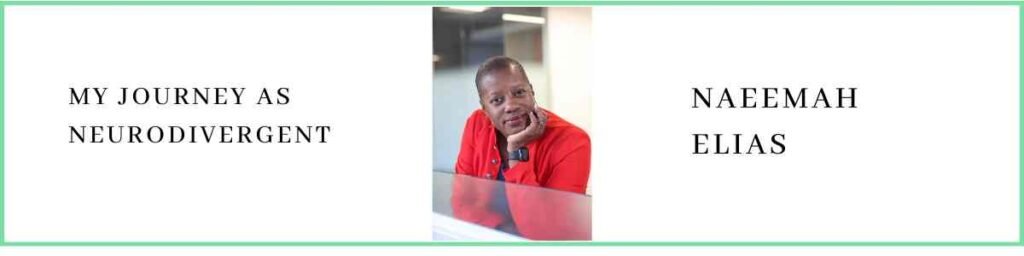
Naeemah Elias, a leadership coach, speaker, and TEDx storyteller, who was diagnosed with autism and ADHD at the age of 49, shares her experiences of growing up in a neurodivergent family, raising her autistic son, and building a successful career while understanding her unique wiring. The conversation delves into how her diagnosis brought clarity and confidence, her journey of self-discovery influenced by her children, and the challenges and advantages of being neurodiverse. Naeemah also discusses her path to becoming a TEDx speaker and the importance of embracing one’s mental health journey.
3 Takeaways
Thriving as an Outsider:
Throughout her life, Naeemah has been adept at masking—an ability to adapt and perform roles as required by her environment, honed from a young age through a love of theater. This chameleon-like adaptability has played a significant role in her success both in the corporate world and as a storyteller. Learning to read a room and anticipate what is needed has been crucial to her career progression, from managing director in corporate finance to launching her own leadership development company, Elias Presence Ventures.
Navigating Life’s Challenges:
The conversation also delved into the challenges associated with Naeemah’s upbringing in a family frequently on the move. This transient lifestyle endowed her with the skills to enter new environments confidently, yet it also came with difficulties, such as maintaining long-term connections. Naeemah discussed how these childhood experiences translated into her adult life, informing her career choices and interpersonal relationships.
The Power of Diagnosis:
Getting a formal diagnosis brought Naeemah a sense of peace and understanding. It wasn’t about changing her life but about acquiring the language and framework to understand her experiences and challenges better. This knowledge has not only enriched her self-awareness but also enabled her to better support others through her leadership coaching.
ShowNotes
Click on the timestamps to go directly to that point in the episode
[02:46] Naeemah’s Journey to Diagnosis
[05:42] The Art of Masking and Adapting
[13:19] Family Dynamics and Mental Health
[19:20] Becoming a TEDx Speaker
[26:46] Embracing Neurodivergence
Get In Touch:
If you’re interested in connecting with Naeemah Elias, you can reach her via her website, via Instagram, or via LinkedIn.
To watch her TEDx talk, check here and check out her YouTube channel
For those interested in sharing their own stories on “Chatting with the Experts,” reach out to Paula Okonneh through her website or connect via LinkedIn.
Paula: [00:00:00] Hello everyone and welcome to Chatting with the Experts, the show where I speak with amazing women from Africa, from the Caribbean, and in the diaspora. These women are professionals and or successful entrepreneurs, and they share my mission, which is to educate, empower, and inspire women globally. Today our show is called How Autism and ADHD Made Sense . I’ll tell you a bit about my guest who will be joining me in a minute. She was diagnosed with autism and ADHD at the age of 49. And in this episode she’s gonna reflect on growing up in a neural divergent family, raising an autistic son and building a career that honors her wiring. And understanding her own self, her mind brought clarity, [00:01:00] confidence and leadership purpose to her life. She’s a speaker, she’s a leadership coach and a TEDx storyteller who helps people lead with confidence, clarity, and authenticity, and has built her career through a series of bold pivots, beginning as an award-winning actress, rising to managing director in corporate finance and eventually launching her own leadership development company called Elias Presence Ventures. And with that, I welcome Naeemah Elias to the show. Hello.
Naeemah: Good morning.
Paula: As I told you offline, when I read your bio, I was like, wow, I’m privileged to be speaking with you.
Naeemah: [00:02:00] Hahaha.
Paula: Yeah. Thank you for saying yes. This is such an impressive bio, but is there anything that I left out that you would like me to touch on that I omitted, forgot didn’t elaborate on?
Naeemah: I’m a mom of three. And that sort of threads through everything I do and how I think about my life and how I approach my work. And I’ve learned a lot through parenting to help me with my leadership journey, my management journey, and a lot of different things in my life and even my autism story, and we can talk about that. Like getting to my own diagnosis for autism and for ADHD came through my journey with my children. So they are center focused in my life at all times.
Paula: Yeah. Well that’s, I really do wanna touch on that, on why did you decide to seek, you know, an assessment of autism and ADHD at the age of 49? You know, that’s significant.
Naeemah: Yeah. So it’s something that I had been thinking [00:03:00] about.
Paula: Mm-hmm.
Naeemah: And I think, you know, when I think about like my childhood journey, I was a weird kid, right? My whole life, everybody always just said, well, you know, Naeemah is a little bit weird. We just sort of accept that Naeemah is a little different. And I think I got used to being weird, right? And then as we went through the journey with my children and all three of them are neurodiverse in some way, I started to notice how I was able to communicate with my son in ways that his teachers couldn’t. I was able to help him to understand things when he couldn’t get it from, you know, from his teachers. At some point, it just occurred to me. I’m like, well, what if my brain works the same way that his does?
Paula: Mm-hmm.
Naeemah: So I got myself on a list and I was on the list. I was on a few do lists for about a year and a half, and I think it’s really hard as an adult to find an assessment, right? I think most places are interested in studying children and, [00:04:00] you know, our generation, I’m a Gen Xer. We didn’t have this right? Like this wasn’t part of our childhood experience. I think I started to be aware of ADD when I was in high school and they were looking at little kids. And so for me, like it wasn’t a part of my childhood journey ’cause it wasn’t really possible. And so then I finally had a conversation with a friend and she mentioned that she had just gotten her diagnosis and that she’d found an organization that specifically focused on adults.
And I was like, okay, this is it. Like I’m doing it. Like, let’s make it happen. And so finally, you know, got the diagnosis and there were no surprises. Right? What was interesting was the language and beginning to understand like where my challenges are and where I need support. And I think for most of it, I kind of knew. I just felt like this part’s really hard and so getting some clarity on that, getting some language around that was really vital. But really again, it came through my kids, it came [00:05:00] through understanding their experience and then starting to question my own.
Paula: I love that. I love that. And I’m happy that, you know, you’re able to, as you say, have the conversations with your children, with your son in particular, that the teachers couldn’t and then you know, understanding him helped you to understand even yourself and your childhood.
Naeemah: Mm-hmm. Yeah.
Paula: So, I mean, but through that discovery, is there any way that you can see that it’s connected in, you know, you’re an actress, you’re a TEDx speaker. How has that now raveled into or unraveled to do that. Oh, that’s why I’ve, you know, I’ve been successful at certain things like acting in the corporate world, in leadership and now entrepreneurship.
Naeemah: So I, I am really, really good at masking.
Paula: Mm.
Naeemah: I’m really good at performing.
Paula: Mm.
Naeemah: At the age of around eight, I started performing. I started pretending. I learned that if I wanted to feel safe, then I needed to be what other people needed me to be. [00:06:00] So learning really early, how do I behave so people don’t get mad at me?
Paula: Mm-hmm.
Naeemah: How do I behave so that people feel like I’m, you know, normal.
Paula: Mm-hmm.
Naeemah: That was a through line in how I interacted in the world.
Paula: Mm-hmm.
Naeemah: So really, really young I started figuring out how to pretend.
Paula: Mm-hmm.
Naeemah: And then I discovered theater and this was a space where I really kind of honed that craft. And so I think I was really successful. Or you know, more successful than a lot of other folks at masking, because I had the theater training to kind of help me to do that. And I had a driver, like the internal driver was the safety right? Feeling like I needed to get this right, if I wanted to be safe. And so that fire made me much more intentional about getting that right. So then jump forward into my adult life, at this point I’ve been masking for years. I had been, we moved around a lot when I was a kid, and so I had to [00:07:00] learn how to step into new spaces and build a persona and create safety and create relationships really quickly.
And so I’m great at jumping into new things and creating what this particular situation needs. And then you, you know, you look at me climbing the corporate ladder. Well, I was, I think better able to figure out how do I behave in each one of these situations? How do I behave in this environment? How do I deal with this manager?
Paula: Mm-hmm.
Naeemah: All of those things, because I had been masking and I had been learning how to understand people and figure out what they needed from a very early age. So I think it was really helpful for me playing through right in every step of the way. And the theater supported it, but then maybe I also had a little bit more of a natural inclination towards it.
So it was cyclical, right? And you know, and then now you know, here we are. Right? So I’ve done a lot of leadership training. I’ve [00:08:00] trained people on how to navigate spaces, but that training comes from all of my years of having to figure that out myself. And so boiling things down to rules and tips and tricks and like, what’s the quick, like efficient way to get to the best possible outcome, all of those things mean that I have a different perspective on how I interact in the world and I can help other people to kinda shift their perspective and navigate in similar ways.
Paula: You know, Naeemah, I love what you’re saying and I, it’s also because that’s something, I mean talking about and even pondering on, you know, that no journey’s ever wasted. Like I’m listening to you saying that you as a child, you moved many places, you had to adapt and, you know, get familiar, look at the situation, the new environment, and adapt accordingly. And that’s my story too, and I didn’t like it.
And from listening to you, and one of the threads that we’re running through your recounting your childhood is that [00:09:00] that safety, you know, wanting to feel safe, learning to mask and I guess during your childhood, that childhood period, you didn’t like it, but it has come into, you know, come to be helpful to you and to others because now you can help others, you know, navigate the corporate world because you understand, you’re able to assess the situation very quickly and come up with quick tips. So in some ways it’s been an advantage, even though it has been hard.
Naeemah: That’s right. And there are challenges to it as well. I spent some time with my family last week and we were talking about this, right? We were talking about like what it means to have moved around so much. And our collective superpower for all of us is that we’re really good at stepping into new environments and establishing ourselves really quickly. What we’re not good at is maintaining relationships, right? What we’re not good at is that through line, [00:10:00] that long term, that maintenance over long periods of time. It just wasn’t part of our foundation. We moved so often that you didn’t have to learn how to keep a relationship going for more than a couple of years, because you’re gonna have to go make a whole new group of friends and you’re maybe never gonna see those people again.
Paula: Mm-hmm.
Naeemah: And in my adult life, I changed jobs every year and a half to two years. And so I was constantly moving around and for part of that time, you know, 13 years I spent at one company.
Paula: Mm-hmm.
Naeemah: So while I moved around, you know, jobs every year and a half in that company. I was in the same company, and so a lot of those relationships I was able to maintain throughout the time, even if I didn’t work with the people day to day. But the same thing happened that happens whenever I leave a company, and that was when I left it. It was a lot harder to maintain those relationships because I didn’t have the built in day-to-day. That I had when I was at the company. And so what that translates to, you know, as I get a better understanding of how my brain works, [00:11:00] is that I have a deficit in object permanence.
Paula: Mm-hmm.
Naeemah: And so for little kids, if you cover their eyes, they think you’ve gone.
Paula: Yes.
Naeemah: Right? They can’t see you. They don’t know that you’re still there. And that’s why Peekaboo is such a fun game for little kids.
Paula: Mm-hmm.
Naeemah: When you take your hand away from their eyes and they can see you, it’s like you appeared and it’s kind of magical. Well, imagine having a little bit of that left in you as an adult.
Paula: Mm-hmm.
Naeemah: Where the object permanence, it exists when the person is in front of you, but you don’t necessarily, like, you’re not thinking about them in the same way when they’re not in front of you. So that becomes really challenging for maintaining friendships, maintaining relationships and it’s not intentional, right? Like, and that’s the thing that’s been a challenge for me, is that I think people get offended. They get really upset because I don’t do a great job of, you know, of maintenance, but it’s not an intentional thing. It’s a side effect of how my brain works in the world.
Paula: Yes. [00:12:00] And I get it because…
Naeemah: mm-hmm.
Paula: In a way, I’m similar to you in that, like, I’ve moved quite often and it is not that I forget my friends, but I don’t need, like, I have a niece who’s like, auntie, don’t you wanna just, you know, go back or don’t you want to go out and make new friends? And I’m like, you know, actually I’m peaceful where I am, you know?
Naeemah: Yes.
Paula: And I’m okay where I am. But as talking with you as I talk with you, I mean, I’m recognizing some things in myself too, you know, in the sense that, yeah. I keep in touch, but at the same time, I don’t hold on to things for too long.
Naeemah: Mm-hmm.
Paula: I’m very adaptable and as I’ve told my family, I can live anywhere.
Naeemah: Yeah.
Paula: But that took years to understand and be comfortable in that space, you know?
Naeemah: Yeah.
Paula: So, wow. So everything else in life, there are pros and cons and the pros in some way has worked for you. It has enabled you to help others to, you know, move up the [00:13:00] corporate ladder to… your acting. It came, it was almost like it was a innate because you didn’t have to really put on too much or learn too hard or work too hard at it. You worked at it, but it was innate. ’cause you developed it over the years, you know? So about what about some of your other family members? I mean, have they also had similar experiences to you? Because I was saying to actually I was talking to my children and saying it took me years to realize that the family I grew up with, everybody looked at their parents in a different way, even though we had the same parents.
Naeemah: Yeah.
Paula: But our experiences were different. Did you find the same thing with your family?
Naeemah: Oh, absolutely. So I have five siblings and…
Paula: Like me.
Naeemah: Yeah. And one of the things I think we realized after my father’s funeral, we were all together having lunch, talking, sharing stories. And I think that was the point that we realized that we each had a [00:14:00] different relationship with him and he had shared different stories with each person. So when we started to share stories, we realized that we each had a different aspect of his life and we’re like, we at some point need to put all this together and tell this story because he had such a rich life and he shared different pieces of it with each of us. I think my father had a whole journey with mental illness and with addiction, and so depending on birth order, you got to see different pieces of that. I think my older siblings from his first two marriages saw a very different person and by the time he found my mom he had settled.
He had become the adult that he was aspiring to be. And so they got a child, they got an evolving person, not a fully formed adult. And my mom got the fully formed adult. And so [00:15:00] we had a very different experience than our older siblings did you know, with our dad. But we did see sort of the tail end of him really settling early in my childhood. And then we also saw how he began to lose, you know, unravel and lose the, you know, the connection to his sobriety and his sort of ownership of his sanity as his life wore on, right?
Paula: Mm-hmm.
Naeemah: So we had a sweet spot. And so there’s six kids. My mom’s six kids. And the oldest and the youngest I think had different experiences with my dad than the four of us in the center. We also, I think all have our own varying degrees of challenge with, you know, physical and mental, you know, illnesses. So I have one brother who has ADHD just like off the charts and as kids, it was really fun. He was the one that. Would bring really interesting chaos and [00:16:00] we’d have great adventures together.
Paula: Okay.
Naeemah: And as an adult, I imagine that it’s really challenging for him because he needs to be steady. He is a father and a husband, and a businessman, and it’s necessary for him to maintain a steady center in order to be able to provide for his family, be a good husband, and be the person that he needs to lead, be in his family. And so I think he has a lot of, you know, a lot more challenges with that. I have another brother that really kind of struggles with depression and that’s, you know, really difficult for him.
And so I would say, you know, when we sit and we talk about it and we think about it, it is hereditary and we’ve got mental illness challenges throughout our family and I’ve dealt with a lot of different things over the course of my life. And I have been, you know, my choice was to not be medicated and I made that choice really young and I studied behavioral psychology and I learned how to use behavioral tools [00:17:00] to manage my energy and then more recently I’ve learned about food and how food affects my energy, my mood, my psychology. And so when I am fueling my body properly, I’m healthier mentally and physically. And when I’m eating junk, I spiral.
Paula: Yes.
Naeemah: Right? And so I think we’re all on our own journeys of figuring out how do we manage the various different challenges in the, you know, in the deck that we’ve been dealt and we talk openly about it. That’s really important. We share our experiences with each other and our challenges with each other. We go to each other for guidance and for feedback as we are figuring things out and we are close enough. And trust each other enough that we give like the hard feedback, right? Like I have one brother who he’ll say to me [00:18:00] occasionally, you go dark.
And I’m reminded that, you know, when I’m in the world, part of my mask is that I need to bring positive energy. Mm-hmm. And not that I’m a negative person, but I bring positive energy. I think that that’s important. I think when I share positive energy, then I receive positive energy, and that’s really strong and helpful for me.
Paula: Mm-hmm.
Naeemah: But when I’m in a safe space, hanging out with my siblings, talking about our childhood, talking about things, you know, that have happened, I’ve got some dark memories. I’ve got some sad memories. I’ve got some relationships that feel, you know, really negative. Really?
Paula: Yes.
Naeemah: And so he’ll say to me, you know, you always go dark. Like keep it light. Keep it light. But there are spaces where you talk about the things that are a little bit more difficult and family tends to be that space. And so he gets a little bit of a darker side of me than the rest of the world gets.
Paula: Wow. Wow. Yeah. I could understand that. ’cause as you say, it’s a safe space. So you let down the mask and you’re you.
Naeemah: [00:19:00] Mm-hmm.
Paula: Yes, yes. Yeah. And so, listening to you, it seems like, these experiences have helped you, like, as you said, when you’re in the world helped you kind master your way or navigate your way through the world as a leader, as a coach, and even as a parent.
Naeemah: Mm-hmm.
Paula: Yeah. So, whoa. I know you’re a TEDx speaker.
Naeemah: Yes.
Paula: Before we round up, just tell us a little about how did you get into that space, because that’s.
Naeemah: Yeah. One of the things that I realized a while ago that I do is that I declare something, right? I decide on a goal or, and sometimes it’s even a whim, right? And I’ll just say it out loud like, I’m gonna do this.
Paula: Mm-hmm.
Naeemah: And then once I say it, I create accountability. Both self-accountability, but also accountability because somebody else is like, Hey, have you done that yet?
Paula: Mm-hmm.
Naeemah: You said you were gonna do that. Like, it’s that happening. And so I create this space of both myself and other people [00:20:00] checking in and saying, did this happen yet? Because I’ve said it out loud. And the TEDx is one of those things.
Paula: Mm-hmm.
Naeemah: I started thinking about it, it was kind of back of mind. I did a like this upgrade your life in business challenge. And one of the things that they asked us in the program was, what are your goals for 2025? Right? Like, what are the things that you’re going to accomplish? And one of mine was, I just said, I’m gonna do a TEDx. And then once I, it just came out and I didn’t realize I was thinking about it. I didn’t realize it was a goal, I just said it. And maybe people had mentioned to me, oh, you should do a TED Talk and you know, and I’m like, ah, I don’t know. We’ll see. Right? And then once I said it, it started to feel like a real thing.
And then I did a goal setting program and in the goal setting program, again, they were asking like, what are you gonna accomplish next year? And I said, I’m gonna do a TEDx. So I did some research. I went to the [00:21:00] TED site and I did research into all of the TED organizations around me, which were the ones that I could get to really easily, and that was important because my assumption was that there was a physical component that I was gonna have to go to, like a weekly rehearsal or something. And so I found the ones around me. I went to all of their websites and I signed up for their newsletters and then that was it.
I was like, okay, I’ve done that and now, you know, we’ll figure it out from here. And then the first one happened and they sent me the application link. And I thought about it and I thought about it, and I went in and here what’s funny, I went in and I looked at the first two questions and it was a form. So there were questions on multiple pages, but I didn’t realize that. So I looked at the first two questions and then I sat and I spent some time with it, and I wrote my concept and I, and my concept was around this idea of thriving as an outsider and I didn’t talk about the outsider concept through the lens of neurodivergence because I wasn’t there yet.
Paula: Mm-hmm.
Naeemah: At that point, I was just thinking [00:22:00] about all of the spaces in the world that I’ve occupied as an outsider, and what that means for me in terms of how I show up in the world, but also what it means in terms of lessons for how other people can show up in the world.
Paula: Mm-hmm.
Naeemah: So I really like workshops. The answer to this question, I sent it out for feedback and got really intentional about it. And then about two hours before the deadline I was like, oh, I gotta get this done.
Paula: Oh my gosh.
Naeemah: ADHD like it I need the deadline. And so I sat down and I put that answer in and I was like, okay, I’m gonna be good. And then I go to the next page and there’s four more questions.
Paula: Oh, no.
Naeemah: So these questions got no workshopping, no outside feedback, anything. It was just this intense focused like, how do I want to answer these questions? What does this mean to me? And I just, you know, I got through them and submitted the application literally two minutes before it was done.
Paula: Are you serious?
Naeemah: And this is, you know, I had an hour long hour and a half long workshop on thriving as an outsider. I had been talking about [00:23:00] it in the world. I had been coaching about it. So it wasn’t like the content was new.
Paula: Okay.
Naeemah: But I definitely had to just like rapid fire, like organize it in a way to be able to answer these questions. So, got that done, got it submitted, and then and then I got an email. About a month and a half later saying that I had made it through the first round. And the next step for this application process was that they wanted us to do like a movie trailer style video. And so we were supposed to do, I think it was like a two to three minute video where we kind of jumped through some segments of what we wanted our talk to be.
And so that meant thinking about now, what does it look like? Sort of beginning, middle, and end? What are some of the lessons that I think I want people to learn? How do I think it closes? That kind of thing. And again, last day, so I had written the script and workshop the script and thought about what I wanted to [00:24:00] be, and on the final day, I got up that morning and did a bunch of recording, right? All the different pieces of it repeatedly, and I said, okay, I’m ready for this. And then I went out and like did a movie marathon with a girlfriend.
Paula: Okay.
Naeemah: So now again, [10:00] PM and the deadline is midnight. I’ve gotta edit this. And I had to figure out some editing techniques and there were some things that weren’t working, and of course, technical difficulties.
Paula: Tell me about it.
Naeemah: And finally got it done and didn’t process that it was gonna take time to upload into YouTube.
Paula: Oh my gosh, yes.
Naeemah: So again, a minute before it’s due. I’m hitting submit, but I work really well under pressure. That’s that, that’s a feature of how I show up in the world.
Paula: Mm.
Naeemah: And so I got it done. I got it submitted, and then I was selected, right? So for my first one. I was selected and and then we went through this whole amazing process. We had, you know, weekly meetings. [00:25:00] I worked with a coach and a partner and we sort of went through the journey together. Our cohort was eight speakers, and so we built relationships with that entire community, and we had two months where we worked really closely together to build out all of our talks.
And it was an incredible experience. It was so invigorating. It was just like, like it filled my heart. I learned more about myself and how I show up in the world. I learned about my fears and the challenges that I face. I learned about you know, the techniques that are necessary and the feedback that I need to be able to show up as my best self. I also learned what it looks like to do preparation.
Paula: Mm-hmm.
Naeemah: Like I said, my application process was all very last minute and I did some prep work, but it was all very last minute. And the TEDx prep for this organization was two months. So a month of writing and a month of practice, and I’m not used to putting that much time into a talk. I generally write them much closer to the date that I’m [00:26:00] actually delivering them. And so I got to feel like what it felt like to be a little bit more prepared, a little bit more solid on the content and the memorization part. I hate memorizing. I generally deliver based on bullet points and notes and not like a fully scripted talk.
And so that was an interesting experience for me having to memorize and having to fully rely on my brain because I always feel like my brain’s gonna let me down and I wanna have notes. I wanna be able to just kind of go with the flow a little bit more and not feel like perfect memorization is a goal. ’cause that’s always scary.
Paula: I can get you that. And here we are, ladies and gentlemen, speaking to a TEDx speaker. Oh wow. That’s why I said I was blown away when you said yes. Alright, but as we wrap up here, what message, therefore, because ladies and gentlemen, you can see in spite of being diagnosed with ADHD and autism. [00:27:00] Naeemah is here talking with us. As you can see, knowing too that, you know, these things can be a diagnosis that you can either be sad about or you can use it to your advantage. And so what message can you leave with the viewers and listeners now about embracing their own wiring and seeing neurodivergence not as a hindrance, but more as a possibility? Because I mean, just listening to you and I’m so excited to hear that, right?
Naeemah: Yeah. So I’ll say one thing, and that is that I think a lot of mothers discover our neurodivergence journey through the journey of our children.
Paula: Mm-hmm.
Naeemah: So as our children navigate these challenges, we start to see the similarities in how they interact in the world, in how we are. And so that was what guided me. That was what sort of brought me to this conversation, I would say. I think it’s really [00:28:00] important to talk about your mental health journey. I think therapists are amazing and psychiatrists are incredible, and it’s really important to be able to have open conversations about our mental health journeys because it’s gonna be really helpful for you in realizing that you’re not alone. Right?
Paula: Yeah.
Naeemah: That I’m not alone piece is really important.
Paula: Yes.
Naeemah: The other piece of it is that, our brains are wired… in theory, our brains are wired in such a way that we should be able to figure it out, right?
Paula: Mm-hmm.
Naeemah: And so it’s not a, you know, it’s not a plus or a minus, it just is, right? And I’ve been able to figure out, how do I make this work because I didn’t have a choice. I’m the oldest girl of six kids, and we know the responsibility that falls on the oldest girl. And so I was always expected to figure out and make it work. And so I did, I think. My journey is unique in that I kind of figured a bunch of things out and then later I was able to put labels on it and understand why [00:29:00] things worked the way that they did.
I think knowledge is power and the more you know and understand about yourself and how your brain works. The more peace you have with it, right? So I’m not changing my life because I got this diagnosis, but the language in this report and the language from the psychiatrist gave me a lot of insight into why things are the way they are, and my reaction to it was very similar to my son’s reaction, and that was, there are places where I’m hard on myself and there are places where I’m mad at myself, and this is giving me a better understanding of why I work the way that I do, and I have more patience. And having patience with yourself creates a level of calm and capability that was actually very surprising for me.
So the diagnosis doesn’t need to make you upset. It should bring you calm. It should help you to [00:30:00] understand why you’ve navigated your life the way that you have, why things operate the way that they do. And that for me, brought me calm and it brought me a lot of peace.
Paula: Yeah. And as you said, so I just jotted down and that patience with yourself brought peace.
Naeemah: Yeah.
Paula: Within yourself, I’m sure.
Naeemah: Yeah. Yeah.
Paula: Naeemah, this has been fantastic and woo, I could talk with you forever, but we have to leave room For those who’ve joined us, as guest members can get an opportunity to speak with you. But for someone who’s looking at this later or listening to this and who would like to engage with you, how can they find you online?
Naeemah: Yeah, so the place that I generally operate is LinkedIn and so Naeemah Elias on LinkedIn, that’s my happy space and I’m on there every day. And so you can message me, you can connect to me, and I’d love to continue this conversation. As I said, this is new for me. I just got my diagnosis a [00:31:00] couple of months ago, and so I’m exploring it with new eyes, and that’s pretty exciting. And so I would love to continue the conversation with folks and get, you know, learn more about. Other people’s experiences and how people have navigated this journey. I’m also on Instagram as Lady Elias, and if you want to look at my parenting stuff, right? So I’ve got a whole YouTube channel about parenting. That’s Lucky Mommy. So we’ll have all of that in the show notes so that people can follow and can connect and have more conversations in this space.
Paula: Thank you so much Naeemah, and just as Naeemah said, LinkedIn is my happy space. So if you’d like to connect with me and be a guest on the show, reach out to me first and foremost on LinkedIn and then you can also message me. I’m going to the contact page of my website, which is Chatting with the Experts. I’m also on Instagram. My business handle there is at [00:32:00] chat_experts_podcast. I’m on Facebook. My business page is Chatting with the Experts and I’m on YouTube. Please subscribe and like the videos that I have on YouTube.
It’s not primarily about me. It’s about these amazing women, professional women, successful entrepreneurial women from Africa, from the Caribbean, and in the diaspora who have a mission. And that mission is to educate, to inspire and empower women all over the world. Thank you so much, Naeemah, for being a guest on Chatting with the Experts. And now we’ll open up the floor to all those who joined us. And I say this every week so that they can ask you questions that I forgot to ask. I didn’t even think of asking. And so that we can continue this conversation. Thank you again.