
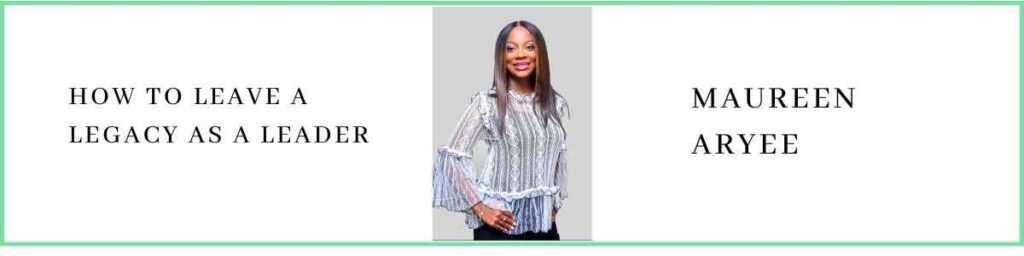
Maureen Aryee, a seasoned business and HR executive, discusses how women can advance from mere representation to influential leadership roles while maintaining purpose and long-term impact. Maureen shares her diverse career journey from IT to HR leadership roles at top corporations like Johnson & Johnson. She emphasizes the importance of emotional capacity, the ethical integration of AI in decision-making, and the significance of purpose in sustaining success and leaving a legacy. The conversation offers insights into building resilience, continuous growth, and effective leadership in both established and startup environments.
3 Takeaways
The Role of Emotional Capacity in Leadership:
A focal point in Maureen’s discussion was the significance of emotional capacity. She describes it as the ability to remain grounded and effective under pressure. Emotional capacity differs from emotional intelligence, which is about reading a room and managing relationships, whereas emotional capacity involves maintaining composure and strength in high-pressure situations. Maureen emphasizes that leaders with high emotional capacity can navigate turbulent times and set a positive emotional tone within their organizations.
Navigating AI and Modern Challenges:
As organizations reengineer themselves, the influence of AI on decision-making becomes a pivotal concern. Maureen shares insights on embracing AI responsibly to enhance productivity while ensuring ethical practices remain. She urges leaders to evolve with technology to maintain their relevance and effectiveness in leadership roles. The conversation underscores the necessity for human oversight to prevent biases inherent in algorithms.
Legacy and Purpose in Leadership:
Maureen concludes with profound reflections on legacy, anchored in understanding and living one’s purpose. She emphasizes that true legacy lies in the intangible impacts left on others, which can transcend generations. For Maureen, fostering strong leaders who continually challenge themselves and embrace growth is key to her legacy. She encourages leaders to ask critical questions about their purpose, actions, and the people they develop, ensuring their influence endures.
ShowNotes
Click on the timestamps to go directly to that point in the episode
[00:47] Meet Maureen Aryee: A Journey Through Leadership
[05:52] The Importance of Emotional Capacity in Leadership
[07:08] Navigating Organizational Changes and Emotional Intelligence
[16:59] The Role of AI in Modern Leadership
[23:59] Building a Lasting Legacy as a Leader
Get In Touch:
If you’re interested in connecting with Maureen Aryee, you can reach her via her Instagram or via LinkedIn.
For those interested in sharing their own stories on “Chatting with the Experts,” reach out to Paula Okonneh through her website or connect via LinkedIn.
Paula: [00:00:00] Welcome to another episode of Chatting with Experts where I, Paula Okonneh speak with fabulous women from Africa, from the Caribbean, and in the diaspora. These women share my mission, which is to educate, empower, and encourage women globally. And they are, that’s the, my interviewees are professionals and or successful entrepreneurs. The topic today is Thriving at the Top, and in this episode we are gonna explore how women can shift from representation to influence while embracing practices that sustain purpose, presence, and long-term impact at the top. My guest who’s gonna be joining me in a few minutes is a seasoned business and HR executive with over two decades of experience across global corporations [00:01:00] and high growth startups. She has held senior leadership roles at world class organizations, including Johnson and Johnson, GE and Bank of America, and currently she serves as the Vice President of Human Resources… With that I want to welcome Maureen Aryee to Chatting with the Experts. Hello, Maureen.
Maureen: Hello, Paula.
Paula: I hope I got your name right, Aryee?
Maureen: You did, you did. You absolutely did. Thank you for having me.
Paula: Absolutely. Thank you for saying yes. I don’t take it for granted when anybody comes onto the show because they’re sharing my mission, which is, as I said earlier on, to educate, encourage, and empower women globally. So I gave just a snippet of your very impressive bio. [00:02:00] Let’s expand on it because I know, of course.
Maureen: Mm-hmm.
Paula: You’ve had a remarkably diverse career, and so tell us a little bit about how you walked through this journey and what really guided you to do this.
Maureen: Absolutely. Absolutely. You know, my career has been intentionally non-linear. I began my career in the space of IT right out of undergrad and joined GE as you mentioned earlier. After a few years there, I decided to explore some other paths and got into financial services, and eventually decided to launch my own business in the real estate industry. And so I did that for several years, but really felt like I still wasn’t quite there in terms of my purpose, in terms of what I wanted to dedicate myself to. And so I returned to school and pursued an MBA and out of that MBA got recruited by Johnson & Johnson and ended up spending 10 years with them and [00:03:00] it was a great opportunity to really launch into the field of HR and really grow my experience in that field and launch myself, quite honestly into a number of senior leadership and global roles with that company.
And after 10 years with them, I decided to do yet another pivot and take those experiences into the biotech startup world, where I am now and this was really a decision I made to have my imprint on an organization that is being built from the ground up to be able to really shape culture, build leaders, and influence what that looks like at the start of an organization. And so that is how I’ve dedicated the last several years of my career. And, there’s been some really unique lessons I would say that I’ve learned, , pivoting throughout these companies and growing into various roles. And, one thing, if I [00:04:00] can share is, you know, I’ve come to realize that it’s not really just about talent.
Talent is key. Talent is what gets your foot in the door. , but there is quite a bit of capacity that’s required to navigate the turbulent seasons that organizations go through. There’s stamina that’s required to really influence at senior leadership roles. And then there’s also purpose. There’s a real place for knowing your purpose and having that guide to the decisions that you make into various roles and into various chapters of life. And so that I would say it’s a very high level overview of the journey that I’ve been on that brings me here today.
Paula: Wow. Say I’m speechless because I’m so impressed. You know? And but something that jumped out at me was purpose, because you mentioned that after you undergraduate, you actually had opened a business for some time and then you felt this is [00:05:00] not quite it. I’m not quite fulfilling my purpose. And that’s why you went back to do your MBA and ultimately ended up at GE for 10, GE, right.
Maureen: J and J. J and J.
Paula: J and j for 10 years. So that purpose comes with a lot of responsibility and a lot of emotions and you know, especially when it comes to leadership. And , when we talked some time ago, you had talked about emotional capacity.
Maureen: Mm-hmm.
Paula: And how that is helpful for enabling leaders to stay at the top.
Maureen: That’s right.
Paula: Can you elaborate on that? Because especially as I know you’ve had experience with startups and startups and leadership.
Maureen: Mm-hmm.
Paula: Well, they go hand in hand, but you really need to have that leadership anchored. So can you talk a bit about that?
Maureen: That’s right. Absolutely. Absolutely. Yeah. Emotional capacity I’ve found, has become one of my favorite topics because I encounter [00:06:00] it on an, on a daily basis where it exists, where it does not exist. And you know, maybe I should define it for you. It’s really the ability to stay grounded and clear and effective under pressure. It’s that internal strength that really guides your judgment. But it’s also that internal strength that enables you to show up present and calm in your presence. And it’s really what enables a leader to be relentless, , in the face of intensity when the stakes are high. I find that emotional capacity is what makes a huge difference between leaders that can mobilize teams and organizations behind them after a specific direction or course because of the presence that they carry themselves.
So that, you know, it’s a long definition, but I think you get the essence of it. I talk about it a [00:07:00] lot because I’ve come to discover that organizations, again, go through lots of turbulent seasons. An example that I love to give that most individuals that have worked in the corporate environment have faced before is that of reorganizations. A lot of organizations go through reorgs, restructures, transformations, what have you, and in those moments there’s usually quite a bit of anxiety all around. Employees, excuse me, may face anxiety around, will I have a job, do I have a future with this organization? Leaders are concerned about morale, they’re concerned about productivity. Even high performing employees are concerned around whether they’ve got a future with the organization or not. And so all around there tends to be high intensity. But in my years of experience, what I’ve come to realize is that as a leader, my emotional stability is what the organization is, what [00:08:00] my team feeds off of. And the clarity of mind and presence I have is just as important as the decisions I make in those moments because leaders set the emotional temperature of an organization. And those that have built the muscle of exercising and demonstrated strong emotional capacity, again, are able to stabilize organizations in chaotic seasons and are able to move them towards fulfilling a specific direction.
And so I think, it’s one of those that. No matter which part of the organization, you look in terms of leadership levels, you tend to see gaps. Even very senior leaders that are, you know, so to speak, at the top of their game, you oftentimes see gaps. And the ability to close that gap really determines high effective a leader can be.
Paula: Thanks for explaining that. But then where does emotional [00:09:00] intelligence that we hear so much about these days, where does that come into play with emotional capacity? Is it like a subset? Because you talked about reorganization and we are living in a time of reorganization. We are hearing it. We are feeling it. Some of us have been impacted directly with it.
Maureen: That’s right. Yeah, no, that’s a great question. And the two are interrelated, although in my mind I look at emotional intelligence speaking more to your ability to read a room, your ability to know when to pivot. Your ability to know how to manage relationships.
Paula: Mm-hmm.
Maureen: How to respond in certain circumstances, and some of them does. Some of those are also at play when it comes to emotional capacity. But emotional capacity, really, if you think about a tank being full, there are certain things that contribute to one’s [00:10:00] emotional tank being full. And, , for one individual, when that emotional tank is full, it spills over for another. When that emotional tank is full, there’s the ability to keep it from spilling over. If I can use that analogy. And so the intense pressures of a moment can either bring out strength, bring out clarity, bring out good judgment, bring out good direction in a leader. Or it can break an individual down.
It’s really how you respond is the difference between the emotional intelligence and the emotional capacity? One, an individual that does not have emotional capacity tends to break down. You hear a lot about burnout. Yes, burnout can be contributed based off of, you know, workload and lifestyles, et cetera. But I also believe that emotional capacity enables individuals. To manage certain pressures so that there [00:11:00] is less burnout. I often see emotional capacity playing out when individuals are having to respond to situations where the stakes are really high and are falling under the pressure. And so hopefully that, that kind of helps. But the two I would say are not the same, but definitely do overlap in certain areas.
Paula: I see that. I understand that now. Because we’re talking about leaders and organizations and emotional capacity, then being able to either, and I’m looking at my notes, break under pressure or be able to, you know, keep things under the wrap.
Maureen: That’s right.
Paula: For leaders that have worked really hard to get to the top
Maureen: mm-hmm.
Paula: And they get there and it seems like they’re no longer successful, how would you handle that? What makes the difference? Because there’s some [00:12:00] people who are continuously finding… there’s no ceiling for them in other words. They climb and then they see something and they keep climbing. And then there are others who’ve always had like a goal and they get there. And then there’s like the burnout comes there because like, there’s nothing else.
Maureen: That’s right. That’s right. That’s right. Yeah. You know, in my role as an HR leader, we are often placing specific individuals that have had a history of success, of accomplishments. We’re placing those individuals in critical roles because of their past accomplishments with the expectation that they will deliver similarly in, in these critical roles. And I’ve found that sometimes they do, sometimes they don’t. And one of the reasons is exactly what you just mentioned, is when we are seeking to achieve a certain level of success and a certain height, there is a [00:13:00] specific drive. There is the hunger. There is the ambition. Unfortunately though, when some individuals reach that height, that hunger is no longer as, as intense as it used to be. That drive is no longer as intense as it used to be. There’s this sense of “I have attained”, right?
Paula: Mm-hmm.
Maureen: And unfortunately, when those individuals with that mindset tend to stop growing, the key and the difference that you’re pointing out between those that continue to identify new opportunities and continue to innovate and grow and move from one opportunity to the other, is that they’re seeking for it. There’s still a desire. They are individuals that are lifelong learners that want to continue to evolve themselves as individuals to grow, to learn, to influence, to make impact, versus those that rest on their laurels , and you know, really [00:14:00] believe that their experiences speak for themselves.
Those experiences may open certain doors, but again, to continue to make long lasting impact and to continue to have a reputation of being successful leader, that drive needs to continue to be there. And the intentionality behind growing oneself needs to be there. I often compare the leadership journey to mountain climbing, right? I’m sure you’ve heard that before. It’s initially you are building muscle. You are on difficult terrain. You are learning discipline. You are demonstrating capacity, demonstrating ability. You’re on that first, what I would call that first stage of that leadership rise. But then you get to that second stage and sort of you reach in that summit as a…
Paula: Right.
Maureen: As a mountain [00:15:00] climber may and, but if you think about it, when you reach that summit, that air is often thinner.
Paula: Yeah.
Maureen: You know,
Paula: I love it.
Maureen: The environment is very different, right? Any slight misstep could be dangerous. The implications are bigger. It’s the same with leadership. The exposure is greater as you’ve reached a certain height and the turbulence can be felt because as the saying goes, the buck stops with you as the leader. And what you do there really determines the implications to a larger group of individuals through an organization or to a team. And so it’s really important for an individual to really master not just climbing and ascending. But sustaining that success once you do get there, and some of the key things are exactly what we’ve spoken about, which is the [00:16:00] emotion building that emotional capacity, but also sustaining that drive and caring about the outcomes. When you’re concerned about the outcomes that you want to deliver, you will be concerned about building whatever capacity is required to be able to deliver those results.
Paula: Yes. You really did a good job of summarizing that, but at the same time, making it so crystal clear because especially as we talk, in 2025, I mean, we are hearing so much about, we can call it reorganization of organizations. . Another way is, you know, what’s it called trimming organizations down to size.
Maureen: Mm-hmm. Reengineering.
Paula: Reengineering.
Maureen: That’s another one. Yes.
Paula: But there’s an underlying thing that everybody’s, it’s like the elephant in the room. It’s like, [00:17:00] will AI? Is AI? Or will AI…
Maureen: Mm-hmm.
Paula: Be responsible for all of these decisions being made? And how can we adapt to this new technology that’s here and is here to stay?
Maureen: Mm-hmm.
Paula: You know, while still keeping up morale and letting people know that they are still important.
Maureen: That’s right. That’s right. Yeah. I love that you go there because, you know, it’s directly connected to the point I raised earlier around will you keep evolving yourself as a leader? Will you keep learning and growing? And one of those areas is in the space of technology. It can be in the space of, you know, your emotional strength, but also in very tangible ways such as in the area of technology and now in, in the era of AI. You know, we as leaders talk about it all the time in terms of how do we leverage AI, how do [00:18:00] we not get left behind?
How do we ensure that it is a part and parcel of how we operate on an everyday basis. And so for me and my team, for example, you know, we have done analysis of all the different areas in which AI can improve our productivity, can improve our efficiency, can improve the work we do. Thankfully it is applicable in every sphere, in every function, in every, , role that an individual can be in. I do think that the key though is to really identify how each individual can actually upskill themselves in the space of AI. And so if you’re in HR, as I am in, well, what does that mean for the future of HR? What does that mean for the future of HR?
And, in addition to efficiencies and in addition to productivity, there’s also the space of ethical use of [00:19:00] AI. You brought it up in relation to decision making. I lead an HR team and you know, when it comes to talent acquisition, for example, we see a lot of technology emerging that is related to the selection and assessment of talent. But it is one of those errors where decision making cannot be left solely to technology, where it is absolutely critical that, you know, human intervention, human interpretation, human involvement is involved to understand and to ensure that the right decisions are being made. Because quite honestly, humans build the algorithms and the prompts behind AI and other technology. Therefore, biases can still be built in. And so that’s where for us as leaders, it’s critical that we are understanding where the effectiveness can be leveraged and where a line must be drawn so [00:20:00] that other disadvantages are not inherently built into the process because certain decision making is left to a system or to algorithms or machines to make. And so there is absolutely, absolutely, , critical decision making points for leaders in, in every sphere. And, I would say really, you know, the onus is on us to not only learn the technology, but understand how to use it so that it produces the right impact that we desire versus negative impact.
Paula: Absolutely. Yes. I agree with you on a hundred percent of that because probably about a year and a half I had a guest on who was talking about AI and her approach was ethical AI as she called it. And there’s something you did say about, you know, , like in the case of you being an HR, that we do have to have human beings sitting [00:21:00] on the table with the IT department or those who are in technology because these systems are indeed designed and a program by human beings. And so we need to ensure that whatever is going on, we call the behind the scenes is ethical and is not detrimental to the human race and to the organizations because organizations are made up of people.
Maureen: Absolutely.
Paula: So I commend you on saying, you know, explaining that again, because the worry is there. I mean, most people are, or most people who are either in the employment sector or are looking to be employed by the younger generation people, students, they are a bit worried about these things. But as somebody said, you know, people were worried about the internet.
Maureen: Absolutely, absolutely no I think with every new [00:22:00] technology, you know, I break it down into what can I learn about it, how do I learn to use it in a way that quite honestly accelerates my impact as a leader.
Paula: Mm-hmm.
Maureen: And everyone really needs to ask themselves that question because I’m using AI every day in personal life, on the job, in so many different ways. And it has absolutely, absolutely, compounded my efficiency and speed in so many things I do. And so if you’re not leveraging that, you will absolutely be outrun and out shone by individuals that are taking advantage of it to boost themselves. And then hand in hand with that, obviously, at a broader level in terms of how organizations and systems are being set up is the other point we spoke about in terms of the ethical usage and the governance.
Ethical usage typically is going to require that there’s also governance in place to ensure there are [00:23:00] some checks and balances, but ultimately, I do believe it will be, , just like as you said, the use of the internet, you know, 20 or so years ago that was new and we had to get familiar with it. And now four year olds, six year olds, seven year olds know how to get online and leverage the internet. And so we’ve got to embrace it, I think is, , is the underlining theme.
Paula: We have got to embrace it. Wow. So one last question before we round up here ’cause this is fascinating. I could talk with you forever.
Maureen: Absolutely.
Paula: About this, but as someone who has built leaders, you’ve shaped cultures. You’ve led transformations, just as we are talking about, how 20 years ago or 20, 25 years ago, the internet seemed like a threat and now 2-year-old, three year olds get on it in a nanosecond.
Maureen: Exactly, exactly.
Paula: [00:24:00] So, what legacy and what impact would you like to leave
Maureen: mm-hmm.
Paula: With the leaders now that you are influencing or you are walking us alongside with?
Maureen: Yeah. You know, the topic of legacy is an important one I think that every leader should be concerned about. ’cause really if you delve into , the definition of leadership. It includes not just leading in the literal sense, but it is how you’re developing others. It is how you are enabling others to fulfill to maximize their potential, right? And so when I think about legacy, I think about it in the sense that it’s the impact that my life can make as a result of my purpose on Earth. And I, as well as any other individual that’s concerned about [00:25:00] legacy, is only able to leave a legacy when they understand their purpose. And so legacy and purpose, in my mind go hand in hand. It’s recognizing that each one of us has a destiny, has a purpose, has a specific assignment, so to speak whether you wanna say here on earth, whether you wanna say in a specific role, in the city you’re living in, your family, you can define it in so many different dimensions. But I am a firm believer that we do all have specific callings, so to speak, and assignments that we need to embrace and live into.
And so when you think about that in the broader context of what legacy is, you know, for me, I’ve dedicated my career to building strong leaders. And, I am thrilled when I look back at individuals that perhaps I mentored, you know, early in their career that are now [00:26:00] operating in their own right as strong leaders in the corporate space, or even individuals I met who were already leaders put into some of those critical positions, high impact roles I spoke about earlier, but are finding themselves challenged and stretched beyond what they’ve ever been before because perhaps it’s the biggest role they’ve been in or the most critical that they’ve ever been in, and having the privilege of being able to coach as you know, as an HR leader, coach, and guide them in, here are your strengths, here are the gaps, and here’s how you need , to fill those gaps. It brings me immense pleasure , and I’m absolutely fulfilled when I look back and see those individuals that embrace the challenge and were able to make that impact.
You know, I think that every leader has to ask themselves three fundamental questions. Where am I going that will make my life matter? That’s purpose. What am I doing now that will make my life [00:27:00] matter? That’s intentional action. And who am I developing that will make my life live on? That’s legacy, you know, because we often think about legacy as something that’s tangible, you know, especially when you think about in family estates and, you know, a legacy of something that is handed over from family to family, and those are typically tangible. And if it’s tangible, it also means that it can be lost, right? But I think a legacy beyond that in the sense of what you leave within others, because that is intangible and that can be passed on from generation to generation, right? And so it’s important to number one, understand that you have a purpose. Understand what that purpose is. Be intentional about living it. That’s what enables one to leave a legacy.
Paula: Oh boy, [00:28:00] this is so good. I would love to continue this conversation with you. We probably have do that of course with the members of the audience.
Maureen: Yes, yes.
Paula: But…
Maureen: absolutely.
Paula: For those who are listening or viewing this online, how can they engage with you? Because this is such stimulating conversation. It needs to be continued.
Maureen: Absolutely. Absolutely. And I would love to engage with the audience. I can be found on LinkedIn using my name. I can be found on Instagram, social media. All of my social media handles use my full name and so easy to find me. And would absolutely look forward to engaging in this dialogue further with the audience. I find that I also have a lot to learn from these discussions. And it’s amazing some of the things that come out of these conversations.
Paula: Yes. You know, I have such a respect for people who have the growth mindset, because I say I [00:29:00] learn something new every day. And when you learn something new, I mean, it’s, sometimes it takes my breath away, but other times it’s like, it’s you know, like building blocks. You learn this yesterday and then next week you learn something else and you can connect them and say, wow, this is just so good.
Maureen: Absolutely.
Paula: That’s what I say about your conversation with me today.
Maureen: Thank you. Thank you. Absolutely.
Paula: And for those of you who are listening to this or viewing it on YouTube or wherever else you get your podcast, just like Maureen has been a guest on my show, reach out to me on my website if you’d like to be a guest, and my website is www.chattingwiththeexperts.com. I am on LinkedIn. You can look for Paula Okonneh. On my business page, which is Chatting with the Experts. On Instagram, my handle there is at chat_experts_podcast and I’m on Facebook [00:30:00] as Paula Okonneh. Even better still on my business page, which is Chatting with the Experts. And last but not least, I’d love for you to subscribe to my YouTube channel, which is Chatting with the Experts. There, you’ll be able to see so many of the interviews I’ve done with amazing women who share my mission, just like Maureen, which is to educate, empower, and encourage women globally. So now we’ll open up the floor to all those who joined us. And again, Maureen, thank you so much for this.
Maureen: Thank you, Paula. Thank you for the opportunity. I enjoyed our chat.