
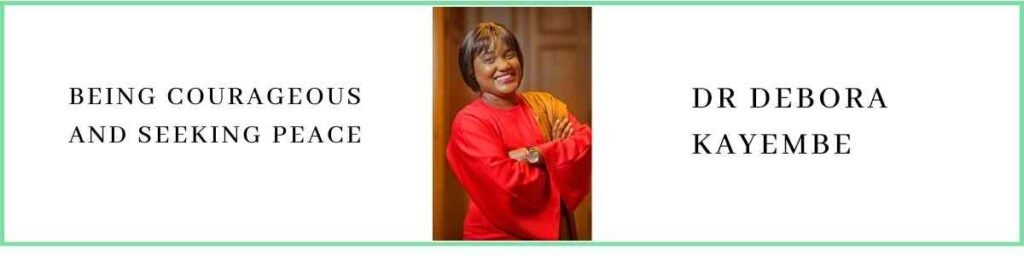
Dr. Debora Kayembe, a Harvard Kennedy School fellow and the youngest ever to receive an honorary doctorate in the Democratic Republic of Congo, shares her inspiring journey from growing up in a challenging environment in DRC to becoming the first person of color to hold a leadership position at the University of Edinburgh in its 437-year history. She emphasizes the importance of education as a means to greatness and shares her profound insights on activism, courage, and the relentless pursuit of peace. Dr. Kayembe also discusses her work with the Royal Society of Edinburgh and the Young Academy of Scotland, highlighting the need for a deeper understanding of African heritage and the critical role of women in shaping a better world.
3 Takeaways
The Power of Never Giving Up:
Dr. Kayembe explores the theme of perseverance through life’s adversities. Dr. Kayembe shares her personal narrative of growing up in a polygamic family, dealing with step-parents, and the struggles of pursuing education against all odds. Her story is not just one of survival but of thriving despite challenges, advocating for the idea that giving up is never an option. Her journey from being a young girl fighting for her education to achieving international recognition showcases the tenacity required to transform dreams into reality.
Activism and Seeking Peace:
Activism, according to Dr. Kayembe, is a commitment to peace. She shares how her life experiences, including being a child born into conflict and later surviving domestic abuse, fueled her passion for promoting peace and justice. Her move to Scotland marked a significant chapter in her quest for personal peace while also advocating for societal change. As a member of the Royal Society of Edinburgh, she has worked to reshape narratives about Africa, ensuring that the true strengths and contributions of the continent are acknowledged and celebrated.
Courage- A Cornerstone of Progress:
Dr. Kayembe passionately speaks about the courage it takes to drive change and stand up for what is right. Encouraging people to be courageous, she highlights that true courage stems from believing in oneself and being willing to face adversity head-on. Her life is a testament to this philosophy, as she shares the struggles of single motherhood, the sacrifices made for her children, and the long-term rewards of steadfast determination.
ShowNotes
Click on the timestamps to go directly to that point in the episode
[01:37] Introducing Dr. Debora Kayembe
[03:45] Dr. Kayembe’s Early Life and Education
[07:18] Achievements and Activism
[09:48] Challenges and Advocacy
[14:31] Seeking Peace and Courage
Get In Touch:
If you’re interested in connecting with Dr Debora Kayembe, you can reach her via her X, via Instagram, or via LinkedIn.
For those interested in sharing their own stories on “Chatting with the Experts,” reach out to Paula Okonneh through her website or connect via LinkedIn
Paula: [00:00:00] Hello, and welcome to another episode of Chatting with the Experts where I speak with phenomenal women, professional women, successful entrepreneurial women from Africa, from the Caribbean, and in the diaspora. And together they share with me a mission, which is to educate to empower and encourage women globally. Our topic today is We Must Make It A Better World, and my guest who will be joining me very soon says, “education is the means to greatness”. She is a fellow at the Harvard Kennedy School and she focuses on matters involving activism, political linguistic issues, human rights, and [00:01:00] international law.
My guest also joined the Royal Society of Edinburgh, the Young Academy of Scotland, representing refugee minorities in 2019 and became the first ever woman to receive a degree of Dr. Honoris Causa and was also named patron of the University of Kinshasa in 70 years. She’s also the youngest ever Dr. Honoris Causa in the Democratic Republic of Congo history. And with that, I want to welcome the phenomenal Dr. Debora Kayembe.
Welcome Dr. Debora to the show. I am so fascinated by your… woo! By your resume, I couldn’t even read everything. So what I did is what I normally do I just take some snippets of it, and this is, if [00:02:00] there’s anything that you really want me to point out, please share it with us.
Dr Debora: Thank you for having me.
Paula: And you are saying, we started off by saying education is the means to greatness.
Dr Debora: Mm-hmm.
Paula: Yes. Yes. So something that I would love you to talk about this never giving up, because I know that’s one of the things you wanna speak on.
Dr Debora: Mm.
Paula: Why do you wanna encourage people never… I mean, that sounds like something strange to say. Why are you going to encourage people never to give up? But you must have a story or a reason for saying that.
Dr Debora: Mm. Mm. Well, you know, I was brought up in the Democratic people of Congo in Africa where women rights and a woman condition are still in the backbone of our kitchens. You know, we still have to fight within our families to get out there, to get out of the streets, to get our voice within our own families. This is the family where I was born, a polygamic family. My father has two wives. And very quickly the [00:03:00] marriage collapsed since I was two years old. And then I was taken away from my mother at age two and I was being entrusted to my father’s family because this is the tradition. We are a patriarchal families. So the woman, once you divorce, you don’t have any right on your children.
So this is what happened to me, two-years old girl. And being looked after by my father who tries with very difficult stepmothers, and then that didn’t work. And then in the end, he trusted me to his own sister, younger sister who was married to another man who seems to have a much stable marriage at that time. So I lived under the care of my aunt, where everything I have to do, I have to earn it.
Paula: Mm.
Dr Debora: So if I want to earn the respect in my aunt house, I have to be a good girl, doing all the chores, being respectful when you are tired, not saying no, responding to their needs so you can have an exchange, the will to pay for your education. You know, so [00:04:00] I remember I was in primary school when the teacher says, if you are educated, no one can take that treasure away from you because education is your treasure. If you can read and write, if someone tells you a lie, but you’re still able to read and write and understand why, what is telling me is a lie.
So in an environment where my parents weren’t there, my biological parent were not there. My brother and sister were not there. They was my cousin. Sometimes they like me, some though they dislike me. My own power was my education. So in some level, in some period of time when we were grown up, my aunt has difficulties to pay my study. So she then, privileged her own children. And I said, you can go when I think I have money to pay for you. You know, you, you only have me, your aunt. I’m married here. There’s nothing I can do. So it was like, you do this to get this in exchange. But for [00:05:00] me, I will do as much as they ask me to do at home so they don’t have an excuse not to pay for my education.
Paula: Gotcha.
Dr Debora: You see? So it was that I keep on studying, but in exchange of all that, in this midst of difficulties, I was always the first in my class, the best student.
Paula: Yeah.
Dr Debora: So that encouraged them at home also, because it was like themselves feeling, oh, we have an intelligent child in the house so we can keep paying for her. We got the owner for us. So it was keeping and giving, you know. It’s in this environment of cultural backbone of girls that I was brought up in the Congo where I have to fight for everything I needed to get. And for me, there was nothing else than my own education because at such a young age, I realized that was my freedom.
Paula: And it indeed was your freedom.
Dr Debora: Yes.
Paula: It was what you’ve accomplished [00:06:00] today. Yeah. Yeah. Yeah. And so I guess that is what has given you that heart of gold to, you know, look out for people who are underprivileged, underrepresented. You know, I noticed that you joined the Royal Society of Edinburgh.
Dr Debora: Mm-hmm.
Paula: In 2019, I think you said.
Dr Debora: Yeah.
Paula: 2019. Yes.
Dr Debora: Yeah.
Paula: And it was also the Young Academy of Scotland for representing refugee minorities?
Dr Debora: Yes. Well, you know, when I continued in DRC, obviously I finished my… I graduated a university. I get to go to the bar and then there was another situation through the bar when they were saying every student who finish this year, because they come to… in the reef of Civil War, you have to go to do your… inside the country, not in the big cities. So my aunt says, okay, I don’t have anywhere to take you. I don’t know I have any friends to take you in the next town where you can [00:07:00] go to get your internship to become a lawyer. You have to fund your own ways. Again, with my own determination, I decided to go on that place where I had, my aunt was not there, my family was not there. I was on my own in the city knowing nobody, only to complete my internship to become a lawyer and to be able to pass in the bar. So I went through all this determination of if I have studies, why can I not become what I want to become? So I started to become somebody. But if at the midst of becoming what I want to become, I have to give up, it doesn’t make sense though.
Paula: Yes.
Dr Debora: I have to go to the end. So I eventually managed to get to the bar and starting to campaign for human rights in DRC. I remember the first time I came to the situation where I was doing a study on the field and I went to the poorest area of Kinshasa. When I saw a baby of three – four years old screaming because a [00:08:00] child did not eat anything for three days. I asked the mother, why your child is crying like this? Well, we have no food for three days.
Paula: Mm-hmm.
Dr Debora: I run home. I got the food that was just… in my fridge and took it and went to give to the family. And I said, from now on, if your child is starving, you have to call me. I’ll provide for you.
Paula: Yeah.
Dr Debora: I was a young lawyer that I’m working and helping and start opening my eyes around me, seeing the inequality that was existing in the Congo at that time, and it still existing today because now the country is collapsing in the Civil War. It’s a different story. But I have left Congo in 2005, fleeing for my safety because as a human right lawyer, I showcase violation of human rights throughout the years. So I was really afraid to stay in the… I settled in the UK.
Paula: Mm-hmm.
Dr Debora: In the UK with my husband came another story of domestic abuse and domestic violence, which I survived again. [00:09:00]
Paula: Oh my word.
Dr Debora: And then and the reason why I left England to move to Scotland because I was in a quest of peace.
Paula: Hmm.
Dr Debora: I needed peace after a difficult marriage. So that peace, I found it in Scotland, where again, no one around me, only me with two babies, 11 months and two years old.
Paula: My word.
Dr Debora: That I raised on my own for 20 years until this day.
Paula: 20 years?!
Dr Debora: Yes. Without getting engaged in another relationship. But coming to the Royal Society of Edinburgh, when I arrived in Scotland, it was the lack of knowledge of the African culture and African heritage in the Scottish Society. So when I joined the academy, my idea was perhaps you hear stories, but I am the witness. I am the witness of what’s happened in Africa because I was educated in Africa.
Paula: Mm-hmm.
Dr Debora: When I came into society, no one believed Congo could produce lawyers. And I said, what? There are plenty of [00:10:00] lawyers in the Congo, you know?
Paula: And here is one.
Dr Debora: Yeah.
Paula: And you said, here is one standing before you, right?
Dr Debora: Yes. Yes. And that was another challenge because there were so many stories about Africa. On this ancient society, within this ancient society was just not truth about Africa.
Paula: Yeah.
Dr Debora: There was a lot of falsification. There was a lot of stereotyping, you know, and that was the job I’ve given myself when I joined the society and I said, give me the chance to tell you what Africa is about.
Paula: Mm-hmm.
Dr Debora: Give me the chance to describe you the strength of the African woman, who lives in a society where her nature as woman is already downgraded, but she’s still fighting to raise a family, to feed the family, to go to the education. And I think that gave me this portrait being directed because it changed the Scottish society on the way of seeing Africa. Four years on [00:11:00] working on policies, four years on rewriting story, rewriting narrative about Africa made them believe this woman deserved it. Perhaps you don’t know this. The Royal Society of Edinburgh exists for two hundred and sixty seven years. It has a total of 167 portrait, all white male. Only one woman at that time arrived. That was the late Queen Elizabeth.
Paula: And your portrait is there then.
Dr Debora: And my portrait after that.
Paula: That’s commendable, Dr. Debora. Oh my God.
Dr Debora: That was the work that it’s about making the world where we’re respecting each other by first knowing exactly who is the person next to me. No stereotyping, no making ideas. But who is he? Who is her? And then where does he come from? And learn from them. And then build the [00:12:00] respect, tolerance, and dialogue around the situation.
Paula: Exactly. And that’s something I guess you helped put into place by being the example. Being the one that they could relate to being like a resource. Like, okay, do you wanna find out more about, let’s talk, even if we are not talking about the whole African continent, which is much bigger than people can even imagine.
Dr Debora: Yes.
Paula: Never represented correctly on the map.
Dr Debora: Mm-hmm.
Paula: But then say, let’s start with even my country. You know, and let what questions do you need?
Dr Debora: Mm-hmm.
Paula: You thought there were no lawyers? Here I am. You thought there were no lawyers educated in the DRC? Here I am.
Dr Debora: Yeah. Yes. Yes. But you know the headline to the media when I became Director of Investor of Edinburgh, it was every single place saying this woman was born, raised, and educated in Africa.
Paula: Hmm.
Dr Debora: You see that? So Africa has a lot to give to the world.
Paula: Oh [00:13:00] yes.
Dr Debora: Africa has a lot in term of human resources in term of whatever things you close. It’s just the whole humanity together in one single land with extraordinary people.
Paula: Exactly.
Dr Debora: But colonization, changed the history, changed the narrative. That’s where we are now.
Paula: That’s where we are now. And talking about where we are now, you mentioned that one thing that you’re passionate about is encouraging people to be courageous.
Dr Debora: Mm-hmm.
Paula: Let’s expand on that.
Dr Debora: Courage is something extraordinary. Yeah. Before you contaminate the courage to other people. You need to be yourself, the courage.
Paula: Yes.
Dr Debora: Your life, your project, everything you do has to reflect on courage.
Paula: Mm-hmm.
Dr Debora: The courage of trying, the audacity of believing in yourself.
Paula: Yes.
Dr Debora: You know?
Paula: Yeah. But in other words, you’re saying it has to come from within you. You’ve [00:14:00] gotta believe in yourself. You’ve gotta be courageous about whatever it is that you feel that you need to represent.
Dr Debora: Yes.
Paula: And then go forward with that.
Dr Debora: Yes. And that goes to you see people talking around you, let them talk.
Paula: Mm-hmm.
Dr Debora: Time will prove you right.
Paula: Yeah.
Dr Debora: Let them talk. As long as you are in the right path. Let them talk. Because time will justify you. I have something personal as a as a mother because we are women and most of us in the majority, we are mother and so many single moms around the world right now, you know? When I was raising my children, I had no one to look after them. Okay? So in order for me to escape social services or taking children into care, I have to pay substantial money to nannies and to escape the social system. And that is very common in Europe and in America.
Paula: Mm-hmm.
Dr Debora: And [00:15:00] I remember every year as we were going throughout the year, I was saying to myself, how long am I gonna be paid this? You know, I got an opportunity to travel around the world. I cannot do that. I have small children. I have to stand by them and live to by side, and I’m telling this to every woman. Don’t discourage yourself because through the end of the tunnel, there is a light.
Paula: Yes.
Dr Debora: You know, so I was just waking up in the morning and I said, oh, today I’ve got this opportunity to go to work in Japan, but I can’t go because it’s so far away from the children. They’re so young. Goodness, I can’t do that.
Paula: Mm-hmm.
Dr Debora: I managed to work and more I was living my life, excited to my children, respecting my role as a mother, even though I felt so unjust to be raising my children on my own because their father walk away. But the day I become that lady the world that was talking about, it paid off. The courage…
Paula: Paid off, yes.
Dr Debora: Taking a [00:16:00] position, the firm position of doing the right thing, the courage of standing through the right thing. Always pay in this life. It always pays.
Paula: Thank you for saying that because many a times women need to hear that, you know?
Dr Debora: Mm-hmm.
Paula: You made your children your priority.
Dr Debora: Yes.
Paula: In spite of the difficulties involved, in spite of the fact that you couldn’t progress.
Dr Debora: Yeah.
Paula: In some ways, because your first and foremost your responsibility were to your children. They didn’t ask to be born.
Dr Debora: Yeah.
Paula: You now, because of that, stood by them and I’m sure today. How old are they if you don’t mind sharing?
Dr Debora: 19 and 20 today.
Paula: 19 and 20.
Dr Debora: All three. So it this all big house on my own now.
Paula: Look at that. Look at that. It’s been worth it.
Dr Debora: Yeah It’s been worth it. So this is something I said [00:17:00] about the courage of facing adversity. It’s something extraordinary because if you are facing this kind of trial where you need to make a choice, it is now you get the glory you want to have. Or it is a long way going, but the end of the tunnel is shiner than where you can go quickly. It takes courage.
Paula: Yes, it does.
Dr Debora: It takes courage.
Paula: It does.
Dr Debora: It takes courage to choose to protect the others. It takes courage to choose to raise the voice for the others and instead yourself.
Paula: Yeah.
Dr Debora: It takes courage to forget yourself sometime and to put a cause ahead that concerns everyone.It takes that courage but it always pays.
Paula: Always pays off.
Dr Debora: Yeah. Always.
Paula: I know that you describe yourself as an activist.
Dr Debora: Mm-hmm.
Paula: And not just regional for where you are in [00:18:00] Scotland, but…
Dr Debora: All around the world.
Paula: Yeah. International law. Would you say that your life experiences that have motivated you to do that? Because I know we talked about never giving up. But I know you all, something else that you mentioned off camera to me was seek peace at any cost.
Dr Debora: Yes. Yes. Yeah. Well, activism it’s one of the thing in this world that expose you to many things. It exposse you to hatred for those who doesn’t want you to continue in the path that you’re going. But activism… most of all, you do it because you need peace around the society where you live, within your community, within your inner circle, you know? And I remember being a child who was born into conflict.
Paula: Mm-hmm.
Dr Debora: I think that exercise I started, as you say, my own life experience. I was a child born into conflict. In a [00:19:00] house where peace was not there. And then I’ve been moved at such a young age, one house to another in just trying to seek peace.
Paula: Mm-hmm.
Dr Debora: And I realized the importance of having a peaceful life when you can negotiate peaceful life for yourself and negotiate peaceful life for the others. Seeking peace in our lives is the greatest gift that we could not ever give to ourself or to other people, you know? Throughout my marriage, I was married only for four years.
Paula: Mm-hmm.
Dr Debora: I have to stop that marriage because I couldn’t find peace within their marriage. And I stayed next to the father of my children, hoping that we can live side by side and raising our children. It didn’t work. So seeking peace took me to Scotland because I was seeking peace. I was looking for a place that I can evaluate peacefully with my children. And Scotland gave me that opportunity with a job perspective that pulled me a long way to the place I was expecting.
Paula: Mm-hmm.
Dr Debora: So I think it’s important [00:20:00] in our lives to avoid conflict. Because conflict does not take us anywhere prosperous. No. We need to avoid conflict. We need to be peacemakers. And the peace that we have to make around us has to be sustainable, and it has to come from our own lived experience.
Paula: Yes.
Dr Debora: Once we have lived that experience, we can share them with the others easily because we have been through the same process. It’s very important today when I see conflict around the world, people come to me and say, Debora, if you say just one word, things will change because the testimony of my life, the testimony of the experience I have lived, gave me that notoriety to speak out. So women need to cultivate this reputation instead of money. Build your own reputation within your community first and then [00:21:00] within your inner circle because it’s important to build that. Once you build it, you earn the respect and there is nothing better in this life than to live peacefully. You’re in your living room, you fill a glass of water, you’re drinking your water, you are watching your program. You go to sleep peaceful. It’s priceless.
Paula: And that’s impactful coming from a woman like you who has experienced so much conflict
Dr Debora: Yeah.
Paula: Who’s still experiencing conflict. You know, you appreciate peace when you know, or have experienced what peace is not like.
Dr Debora: Yes. Yeah.
Paula: When you’ve lived through a war, you know what peace is like.
Dr Debora: Mm-hmm. Mm-hmm.
Paula: And you seek to keep peace at all means.
Dr Debora: And then when you realize the others are going to that term that you’ve been before, you have to fight for them to find the same peace.
Paula: Yes.
Dr Debora: You can’t just live on your own peace.
Paula: Absolutely [00:22:00] correct. Yes, yes, yes. Well, Debora, I would, Dr. Debora to make sure I address you correctly. We could talk forever.
Dr Debora: Yes.
Paula: But I know the audience members who have joined would love to ask you some more questions. But for those of you who are viewing this online, or people who are viewing this online, who would like to know more about you, find out more about what you do, get in contact with you, how can they reach you?
Dr Debora: But the best contact is of certainly LinkedIn. Because I’m in LinkedIn is Dr. Debora Kayembe. And you can reach out to me on Instagram too. Debora Kayembe, the same name, just Debora Kayembe, as well as I’m on X. Yeah.
Paula: X.
Dr Debora: Twitter?
Paula: Yeah. It’s X now.
Dr Debora: So you can reach me. LinkedIn is far better, so you can even message me directly. We can be in touch, but I would say something [00:23:00] to women today is that everything you do, don’t live for yourself. Live for the others. Live to have a space where you can share your very best to the others, your experience, your inexperience to the others. So you can build a world where there is less and less problems because the world is already difficult the way it is. You got the tsunamis coming. We got the climate change. It’s already too much for human being right now. So if us as human, we build this bridges of peace, the bridges of understanding and tolerance, and we mastermind our education for the goods, we are gonna make a better world.
Paula: Woah. Dr. Kayembe. That is so well said.
Dr Debora: Thank you very much.
Paula: So well said.
Dr Debora: Yeah.
Paula: [00:24:00] Those of you who have been impacted, what you just heard from Dr. Kayembe, if you’d like to be a guest, like she has been on my show, reach out to me on my website, which is chattingwiththeexperts.com. I’m also on LinkedIn. You can go to my business page there, which is Chatting with the Experts.
Dr Debora: Mm-hmm.
Paula: Facebook, Chatting with the Experts as well. And on YouTube, please subscribe to our channel where you’ll hear messages. Ah, I mean, I’m so excited. Messages from women from Africa, from the Caribbean, and in the diaspora.
Dr Debora: Yes. Mm-hmm.
Paula: Who are sharing with you, who are there to educate you and empower you and encourage you. Messages just like Dr. Debora Kayembe just shared with us.
Dr Debora: Mm-hmm.
Paula: Please like and subscribe so that you can be notified whenever another exceptional woman is sharing her message [00:25:00] with you.
Dr Debora: Hmm.
Paula: Thank you so much Dr.
Dr Debora: Thank you for having me, Paula. It was a real pleasure.
Paula: It was a pleasure having you too. And now we’ll open up the floor for those who joined us so we can continue this very more than interesting, this very deep and impactful discussion that we just had. Thank you.
Dr Debora: Thank you.