
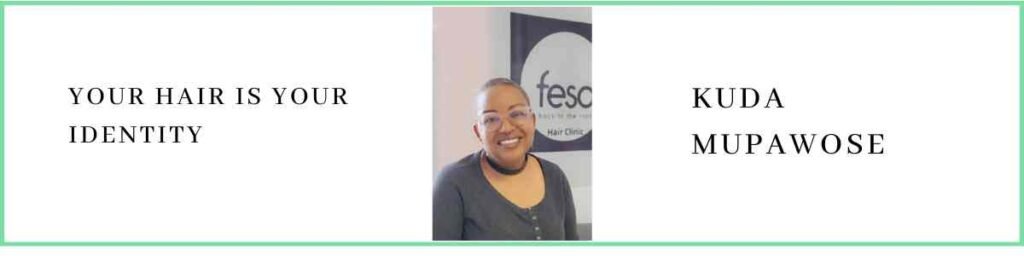
Kuda Mupawose, a board-certified trichologist, pharmacologist with over 25 years of experience in the hair care industry and founder of Feso Hair Care Brand, discusses the intricate relationship between hair and identity, particularly in the context of African and Caribbean women. She shares her journey from pharmacology to developing an organic hair care product derived from the plant Feso, explaining its benefits and the science behind it. Mupawose emphasises the critical role hair plays as a window to our internal health, linking hair health to broader physiological conditions such as hormonal imbalances and fibroids. The episode concludes with practical advice on approaching hair care and the importance of regular scalp health check-ups.
3 Takeaways
The Magic of Feso:
Central to Kuda’s brand is the Feso plant, a natural resource with significant healing properties. Initially an experimental creation from her mother’s advice, Kuda’s concoction from the plant has now become a cornerstone of her hair care line. Her products, formulated with traditional knowledge and scientific rigor, are not just about enhancing appearance—they’re about nurturing scalp health and promoting hair growth. This dedication extends into communities, as women are employed to collect Feso, supporting local economies.
Hair Loss and the Science Behind It:
Kuda’s exploration into the science of hair, driven by her quest to understand the varying effects of products, led her to trichology—the study of hair and scalp disorders. Through trichology, Kuda learned how hormonal changes, scalp health, and hair type play a role in hair loss and growth. Her clinics, located in Harare, South Africa, and soon in New York, focus on regenerating hair follicles and restoring health, emphasizing once again that hair is deeply connected to our identity.
Chemicals, Health, and a Sustainable Future:
A particularly eye-opening part of the conversation is Kuda’s explanation of how chemicals in hair products can affect systemic health. She warns against the hazards of common hair treatments that may alter the endrocrine system, linking them to potential health issues like fibroids. This revelation is leading many to embrace natural hair and reduce chemical use, reconnecting with their roots—both figuratively and literally.
ShowNotes
Click on the timestamps to go directly to that point in the episode
[01:45] Hair and Identity
[02:50] Journey into the Hair Business
[04:26] Creating Feso Hair Care
[08:20] The Science Behind Hair Care
[12:26] The Impact of Hair Products on Health
[18:47] Connecting Hair to Overall Health
Get In Touch:
If you’re interested in connecting with Kuda Mupawose, you can reach her via her website, via Instagram, via Facebook, or via LinkedIn.
For those interested in sharing their own stories on “Chatting with the Experts,” reach out to Paula Okonneh through her website or connect via LinkedIn
Paula: [00:00:00] Welcome to another episode of Chatting with the Experts where I, Paula Okonneh speak with fabulous women from Africa, from the Caribbean, and in the diaspora. These women are professionals and successful entrepreneurs, and they share with me a mission, which is to educate, to encourage, and to empower women globally. I occasionally have men as my guest, but 99.9% it’s women Today, the title of our show is Hair and Your Identity. And my guest who will join me in a minute, is a board certified trichologist. She’s a pharmacologist, she’s an entrepreneur and the founder of Feso Hair Care Brand, which [00:01:00] she’s had for over 25 years. And with that, I want to introduce to you my guest Kuda Mupawose. Welcome Kuda, to Chatting with the Experts.
Kuda: It’s an honor to be here.
Paula: Thank you so much for saying yes, because I don’t take it for granted. When these amazing women, you’re one of them, and the men join the show.
Kuda: I’m honored to be here, so…
Paula: Thank you.
Kuda: Really I do appreciate you having me.
Paula: Thank you. Thank you. Thank you. So , you said our hair is our identity.
Kuda: Yeah.
Paula: Can you expand on that? I know that this is my hair for this week. Next week is gonna be something else. [00:02:00]
Kuda: So, you know, hair is our identity. If we go back time in memorial, kings and queens, royalty, people used to wear their a certain hairstyles based on who they are, what they did, even outcast in the communities and even today actually it’s funny I’m saying time in memorial, but today people are identified by how they look based on how their hair is looking today. And so that is hair is our identity. So regardless what we can say, some people now say, hair doesn’t define me, but it actually does give you an identity. So that’s where I took the title from .
Paula: Uh-huh but I noticed you did pharmacology, you’re a pharmacologist. How did you get into the hair business? I mean, that’s so interesting to me. I know it’s very relevant, but you got into the hair business for a reason, I’m sure.
Kuda: Hair [00:03:00] has always been my hobby. As a little girl, I used to braid anything, even the grass, you know.
Paula: Wow.
Kuda: So, after college I went back to Zimbabwe. I’m a product of Zimbabwe and South Africa. And there was only pharmaceutical companies that were in Zimbabwe, so I started working for a pharmaceutical company.
Paula: Mm-hmm.
Kuda: But that time when I was in college, I was making more money doing hair.
Paula: Wow.
Kuda: And now working for this pharmaceutical company, and even in quality control, I was earning less than hair. So the choice was very easy. I needed more money. So I turned my hobby into a business. So that’s how I am in the hair. But later on, I never saw that those two industries will interdepend to each other until much later. But I did hair because it was my hobby.
Paula: Wow. So you didn’t [00:04:00] see the interconnectivity between pharmacology and hair?
Kuda: No. At that time I didn’t. And I, until one day I woke up and when I’m now doing hair, even when I started the hair products I never thought about it that way until much later. That’s when I was like, oh, okay, looks like I’m back at school and everything became what it is. I started my product line mainly because I was losing clients. So I never started because I wanted to do a product line. So one day you have a client who is in your chair, but next month she has cut her hair.
Why? Because her hair is falling or this. So I wanted to prevent that. So that’s how I created it. And before you know it, I started giving it away as just product, as free samples. And so it became pinching my, you know, my pocket in one [00:05:00] client because I, I didn’t wanna do it anymore, but it was working for her. She says, oh, okay, I’ll pay. And that’s when voila, the whole business started.
Paula: Wow.
Kuda: Yeah.
Paula: So you did not see, well first of all, a few minutes ago you said you didn’t see the connection between pharmacology and the hair business and then. Of course you were making more money from hair.
Kuda: Yeah.
Paula: So you continued doing that on the side and came up with a product that you didn’t even see the worth in until when you wanted to quit because you didn’t think it was probably, you didn’t see the how much it was impacting the lives of your clients.
Kuda: No, I saw that, but I never paid attention to what I was really doing.
Paula: Aah.
Kuda: So this client, when she would come to the salon for more, you know, could ask concoction, that’s what they used to call it.
Paula: Wow.
Kuda: And I didn’t have it because it, I needed some oils. [00:06:00] I needed to have somebody to go to the rural areas and collect the plant. So I didn’t have the resources to do that. So, then she says, you know what, I’ll pay you. And I actually asked her how much. She said it’s $20. That became the start starting price of my product. I’m sure if she hadn’t said $20, I probably would’ve started maybe a $10 or $5. I don’t know. But that’s how it started.
Paula: Wow. Wow, wow, wow. Look at that. And so you mentioned that you’d have to pay someone to go into the rural area. So this, your business is organic, is based on the plant.
Kuda: Yes.
Paula: Ah.
Kuda: So I have women that collects the plant. Unfortunately, it’s not an every day, but it says now.
Paula: Oh, okay.
Kuda: Yeah. So they would collect the plant for me, and then I saw it as a way of giving back to my community. And since then, [00:07:00] that’s what I’ve been doing.
Paula: Okay. And the name of the plant is
Kuda: Feso.
Paula: Oh, okay. Now there’s the connection Feso. Okay. That’s why your business is called Feso.
Kuda: Yeah. ’cause I didn’t have a name for this concoction, and I just said, oh, you know what? Considering that the main ingredient was Feso, I just named it Feso, and it caught on and yeah, so it’s actually a name, it’s a dialect name of one of the languages in Zimbabwe.
Paula: Mm-hmm.
Kuda: So the same plant has different names based on the area where you are.
Paula: Okay.
Kuda: So in South Africa it’s the same, but some people call it maybe Inkunzane, in some parts of Zimbabwe. In South Africa, some call it Dinda. So all this are different dialects based on where you are, but it’s the [00:08:00] same plant.
Paula: Wow. Yeah. I’m gonna have to do some research to see even what it looks like, because Yes, it sounds like it has, you know, some, what’s the word I’m looking for? But it sounds, it’s natural. That’s one.
Kuda: It’s natural.
Paula: And it has special, the ingredients that it is good for our hair at least.
Kuda: Yeah. So, initially I did not study the plant.
Paula: Mm-hmm.
Kuda: I did this plant based on hearsay, so it started when my mom said I had gone back to see her in the rural areas and I had not brought shampoo.
Paula: Mm-hmm.
Kuda: Because she knew I had a salon. So she was asking, why didn’t you bring me shampoo? Do you want me to go back to old days where we used to go and get the Feso so I can wash my hair? So that triggered the conversation and then I was like, oh, bring it. Can I see it? And it was, thank God, it was during the season of [00:09:00] Feso. And so I took a whole 50 kg bag to Harare where I was staying then. And I’ve tried to squeeze it and all that, but then it produces a slimy form. You know, and I wasn’t that much interested because it was slimy and all that. So I left it until one, you know, like maybe three, four days later, one client kept on asking me, what should I use now for my hair?
Paula: Mm-hmm.
Kuda: What should I use? And I thought, oh, let me take that. And I put it in the liquids, it wasn’t so foaming anymore, and, but it was still had a draw. So I put it in and, then I guess the pharmacologist kicked in. I, it didn’t really look appetizing, so I needed to put in oils and I would write down how much oils I’ve put and all that. And when she came back to me about three [00:10:00] weeks later asking me, what did you do? I thought, oh my God, somebody is gonna sue me.
Because remember, my education had been from America. Okay? And so I’m like, oh my God, what did I do? And when she came, finally I saw, oh, he hair was growing. So I went back and that’s how the concoction started. But it was never intended. Later on, we then did some tests. We did lab test with a university in Zimbabwe, actually have a paper published. The product actually does work, and the plant has got so many properties, so I’m only just tipping on the surface. But it’s actually a healing plant.
Paula: Oh my word. As you were talking, I went online to look at it and I was thinking when you said it was slimy, I was thinking, okay, this sounds like aloe vera, but looking at it, it’s not aloe vera.
Kuda: No, it’s not.
Paula: Oh my [00:11:00] gosh.
Kuda: Yep.
Paula: And you know, and you say it has healing properties.
Kuda: So many healing properties.
Paula: Wow. Not just for hair, but for the whole body.
Kuda: Yeah. For the whole body. I can tell you now, I’ve got some teas for I’ve made tea out of it. So for menstrual cycle.
Paula: Mm-hmm.
Kuda: If people have got issues with their hormonal, it goes, if people have got issues with gout, arthritis, so yeah.
Paula: Wow. So I see, you know, now the collision or the connection between doing pharmacology because then you’re able to look at the ingredients from a scientific point of view, combine it with your joy and your love for hair and come up with this product.
Kuda: Yeah.
Paula: That’s working.
Kuda: Yeah. That’s what happened.
Paula: Wow, that’s so interesting. So at the back of you, I can see sometimes the camera focuses on hair loss and scalp.
Kuda: Yes.
Paula: Clinic, facial, hair loss, and [00:12:00] scalp clinic. So let’s talk about the hair loss. How does that come into play now? Now you have this hair clinic, your focus is on healthy hair.
Kuda: Yeah.
Paula: With a health, with a product that has you know, ingredients that help us and are healthy for us.
Kuda: Yeah. Yeah.
Paula: So talk a little bit about hair loss, because that’s a big thing for us, for not just women, but because this is a women show. I tend to talk more of women, but for men too, you know, that are balding. Women, we too, are balding and then hormonal changes, you know, tell us about this.
Kuda: So remember I’ll take you back to when I gave it to one person. One minute the next person comes, oh, it’s not working for me. And the next to the other one, it’s working.
Paula: Mm-hmm.
Kuda: So, it actually made me want to understand why did I have those variations?
Paula: Mm-hmm.
Kuda: So, which then I think the scientist person in me came into life and now I wanted to understand why is it reacting this way to this one? Why [00:13:00] is it reacting this way to this one? And that brought me to trichology, to understand trichology. But trichology was in Africa, was a very limited subject. When you do hairdressing like, or cosmetology as they call it in America. It’s almost like just a subject and then but it’s a study of hair scalp diseases and hair loss and formulations. So I went on to the journey of trying to understand, why did I have these variations? That’s how it led me into trichology.
Paula: Mm-hmm.
Kuda: It led me to Institute of Trichology in the UK. That’s when I discovered that they also had over a hundred years in trichology, and that was a shock for me.
Paula: Wow.
Kuda: Some doctors didn’t even know what trichology was.
Paula: Mm-hmm.
Kuda: And so, but I am backed on the science now of hair.
Paula: Mm-hmm.
Kuda: It brought me to where I am. So [00:14:00] where I am now while I focus more on the healthy aspect of hair, but I actually also do work in trying to regenerate your hair follicles and growing people’s hair. And I can tell you that I have had tremendous success and that’s how I ended up turning my salons from being a salon, you know, to more of clinical. So my focus now is more on the growth of your hair. People with hair loss, how do I help them? Remember we’re talking about hair is being your identity. How it does to people’s psychology and all that. So that’s where the birth of Feso Hair Clinics came in. So I do have a clinic in Harare. I do have a clinic in South Africa. And I have also a clinic that is in progress set up for the US.
Paula: [00:15:00] Wow. I’m listening and I’m intrigued at the story of the birth of this phenomenal hair clinic. So you have three clinics you said one in South Africa, one in Harare, and a budding one…
Kuda: In New York.
Paula: In New York
Kuda: Upstate. Yeah.
Paula: Okay. Wow. Wow. So, because you’re psychol… not psychologist. I keep saying psychologist. You’re pharmacologist.
Kuda: Pharmacologist.
Paula: Yeah. Yes. Is there, I mean, let’s talk about the physiology of hair.
Kuda: Psychology of hair or the physio?
Paula: Physiology of hair.
Kuda: Okay. I’m not sure I understand.
Paula: Okay. So, when we look at hair, I mean, as you mentioned, my hair, I have a different type of hair than my daughter.
Kuda: Yeah.
Paula: There are different hair types.
Kuda: Yeah.
Paula: I’m sure because of your background, you look at the different hair types, you look at how, you know, you, I’m assuming from your conversation that [00:16:00] you customize your formula to suit.
Kuda: Oh, okay.
Paula: An individual.
Kuda: So here is the funny thing. Hair in every sense of the way, the scientific aspect hair from not what we are seeing, but hair downward.
Paula: Mm-hmm.
Kuda: There’s two kind of types. Or three maybe. But at the end of the day, they all come back to one thing, one bud. So the characteristics, the physiology of what happens to hair underneath is the same thing. So you find, because when I discovered that, that’s how I am able and I was able to come up with a product that actually fits all. So initially it was just one product that was fitting everybody. However, what then changes is on the scalp when we come now to the scalp of each different individual, it now changes.
Paula: Aah.
Kuda: ’cause like take [00:17:00] for example how your skin reacts. ’cause hair is an extension of skin, but how your skin reacts like our people, how our scalp skin is and the white person’s scalp skin and the Indian, the person’s type of skin, it differs. Why? Based on how they produce oils that come from your scalp to your hair. So naturally we are supposed to lubricate our hair by ourselves naturally.
Paula: Mm-hmm.
Kuda: But we have done so many things to our hair that you find that the scalp mantle, which is something that is on the scalp, cannot produce the oils that you want, or maybe the microbiome has been disturbed, so now you’re not getting the results that you should naturally be getting. But does the product work for everybody? Yes, it does. However, because of those disturbances on [00:18:00] our scalp and the different textures of our scalp, I had to go back in again and try and look for a product still with Feso, but different oils that would now help hydrate the scalp if say, I’ve been using relaxer and the relaxer has damaged my scalp skin, and so how do I heal my scalp skin? And so now, instead of just using one main product, which was the spray I found myself now looking for other products that would help the spray to help the scarring that is on the scalp.
Paula: Wow. This is so interesting to me. Wow. And especially what’s an eyeopener to me is you’re saying all of us, irrespective of your race, our hair underneath the scalp is the same. It’s how, when, and correct me if I’m wrong, it’s when it comes to the [00:19:00] scalp and our scalp oils, that makes a difference on how we maintain it at least.
Kuda: Yeah. So as it comes out, if you’ve got coily hair, so you’ll find that your shaft is not straight.
Paula: Mm-hmm.
Kuda: For, and that’s the reason why you find that Indians have got too much sebum coming through because their shaft is very straight. Whereas ours, it’s kind of, you know, it curves in until the hair comes out, but when we go to the bud way, it touches the blood vessels, the papillas, it’s literally the same.
Paula: Oh, gotcha.
Kuda: Yeah.
Paula: That’s a topic for another day because that is so interesting. That is so interesting because we’ve always felt as people of African descent that our hair is, you know, so different from everybody else’s hair in appearance at least.
Kuda: Yeah, in [00:20:00] appearance it’s definitely…
Paula: Yes.
Kuda: But when we come to where and how it’s attached to the body or how it has been, God created it. We are all the same, but it just then differs on how it then looks.
Paula: Got you.
Kuda: Yeah.
Paula: You know, the chemicals we’ve put in our hair, the straightness, and most of us, at least, lemme talk from myself and a lot of people I speak with, we always have thought that it just affected our hair. But I’m hearing from you, not only does it affect hair, but it also affects the scalp on our heads.
Kuda: Are you ready for this?
Paula: Tell me I am ready.
Kuda: So it just doesn’t affect your scalp. It actually also changes your endocrine system.
Paula: Mm-hmm.
Kuda: Because on the scalp we have over a hundred thousand little holes. In those little [00:21:00] holes, they go straight into our lymphatic drainage. So they go and so they get drained into the bloodstream and for whatever reason, it’s attracted to the endocrine system, which then will change our hormonal. No wonder why you then have people with fibroids. Because we are constantly changing our endocrine system by all these relaxers. So you’ve got fibroids. Ask yourself, ever, ever relax my hair? And then you find that we have little girls that are puberty early. It’s because you have put chemicals on your child and it goes and does disruptors into your endocrine system and before you know it, you’ve got different mechanism things happening to your hormonals. And now you’ve got five year olds going for [00:22:00] periods.
Paula: Mm-hmm.
Kuda: So it matures the little girls early. For older women, it changes. You’ve got cysts. You’ve got fibroids, and I mean, so many people now there’s cancer. I can’t really say I’ve I haven’t dealt in that for me to qualify and say, but I know for a fact that I’ve dealt with fibroids. I’ve tested it and I can prove it. So, that’s one of the reasons. So when you talk about relaxers and scalp and hair, yeah, that’s a so thing for me.
Paula: Whoa, whoa, whoa. I mean, we’ve kind of known that, but we haven’t really known that. I think that’s why this younger generation are going more into the natural looks, you know, and you less chemicals, more of, you know, like even the kinky looks they call it, and the cutting their hair and doing twists. And what’s [00:23:00] this other thing that I hear them talk about? Locks.
Kuda: Locks.
Paula: Yes.
Kuda: Yeah. Yeah. So you find all those things are now happening. We are going back again to our topic, identity.
Paula: Identity, yes.
Kuda: We are now accepting to be identified by how we are by our natural look.
Paula: Yes.
Kuda: So we go back to the, you know, identity.
Paula: Wow. You’ve also touched on the fact that , yes. Identity, but also the hidden dangers that we haven’t been aware of for years, you know, and that our hair is kind of like a window to our health. You know, we looked at our hair almost like separate from us and not thinking that, you know, anything that we put, I mean, our bodies are, our skin is a organ, and anything you put on the skin is gonna be absorbed internally. So that applies to our scalp and anything we put on our scalps too.
Kuda: So, you know, what I always say to [00:24:00] my clients is that when they say, oh, can you do a relaxer? And I’m trying not to bombard them with, you know, too much information, I ask them, okay I learned to do a relaxer. I’m qualified to do relaxer, but I’m not going to do it. Why? They’ll ask me. I’ll tell them, okay, I can mix the relaxer that it’s ready, the how it’s done. Are you able to eat it?
Paula: Mm-hmm.
Kuda: Because I mean like anything that you can put on your scalp, you should be able to eat it.
Paula: Mm-hmm.
Kuda: Because you’re literally in the beauty about eating it, it’s better because then it’s going into through your digestive system and it has got means and ways of separating toxins and you know, so you are safer eating it. But if you put it on your scalp, it goes directly into your bloodstream.
Paula: So [00:25:00] which one do you, would you rather do?
Kuda: So every time before you do put anything on your scalp, always remember, can I eat this?
Paula: Wow, can I eat this? That’s gonna be my mantra. Now, going forward, when I’m anything on my head.
Kuda: Yeah.
Paula: Can I eat this?
Kuda: Yeah.
Paula: Okay. You know, I’m going to, we are gonna be opening this up to those who have joined us so that they can ask you more questions because I got so many questions that I’m still thinking about. Still musing over the fact that, you know, there’s a connection because you said between like fibroids. Probably more prevalent in people of African descent and starting puberty earlier and earlier, and you’ve given me an understanding on why that’s happening.
Kuda: Yep. Also just to, you know, as to take away with is that hair is a window into your internal health. [00:26:00] And a lot of people don’t even realize it. We see hair as adornment, ’cause that’s how we have always been told, oh, if you’ve got hair you must look this way. Look that way. And so as a result, 90% of people never go to see a hair doctor because why should I? But through your hair you can actually be able to tell there’s something wrong within. So God gave us the hair to help us identify what is wrong with me. And it said that most of us, we only get to go when it’s already too late.
Paula: Mm-hmm.
Kuda: So do people even have on schedule or like, okay, once every six months I wanna go and see a trichologist so they can see what my scalp is. Or you only come to see a trichologist when all your hair is gone.
Paula: Yeah.
Kuda: And even initially when it starts falling you say, oh, let me cut my [00:27:00] hair.
Paula: Mm-hmm.
Kuda: But maybe your hair is actually telling you something.
Paula: Wow. So , an internal window to our health.
Kuda: Yeah.
Paula: Okay. We are gonna end on that note so that people have more questions to ask you about that. So, wow. How can people find you if they’re not here in the audience, how can they get in touch with you?
Kuda: We do have Feso Hair on Instagram and they can contact me directly on my Facebook page.
Paula: Mm-hmm.
Kuda: And yeah, or our website which is www.fesoafrica.com. Yeah.
Paula: What about LinkedIn? I will always say LinkedIn.
Kuda: Oh, yes. Oh, LinkedIn is my personal name. It is Leticia Kuda Mupawose. So literally if people just Google my name, it will lead them to who I am and where I am.
Paula: Okay. We’ll drop that in the show notes and in the chat.
Kuda: Okay.
Paula: And for those of you [00:28:00] who have joined us today and have listened to Kuda talk about, you know, ending on this note that our hair is an internal window to our health. If you’d like to be a guest on Chatting with the Experts, where we empower women, we educate women, and we encourage women globally, please reach out to me on my website, which is chattingwiththeexperts.com. I’m also on LinkedIn. Paula Okonneh is my profile, but you can better still reach out to me on my linkedIn business page, which is Chatting with the experts. I am also on Instagram. My handle is @chat_experts_ podcast and we are also on Facebook. We have a business page there Chatting with the Experts. We’d love for you to like and follow us there to hear more, more interesting, informative and educative substance from my [00:29:00] guest. And I also have a YouTube channel, Chatting with the Experts where you can see all the past episodes with women educating, empowering, and encouraging you. So with that, I will open up the floor to all those who have joined us. And of course, I cannot end without saying Thank you so much, Kuda, for being a guest and making me understand, oh, us understand that there’s a lot more to hair than what meets the eye.
Kuda: That’s so true. Thank you for having me, Queen.
Paula: Thank you. Yes, queen podcast. Thank you.
Kuda: All right.