
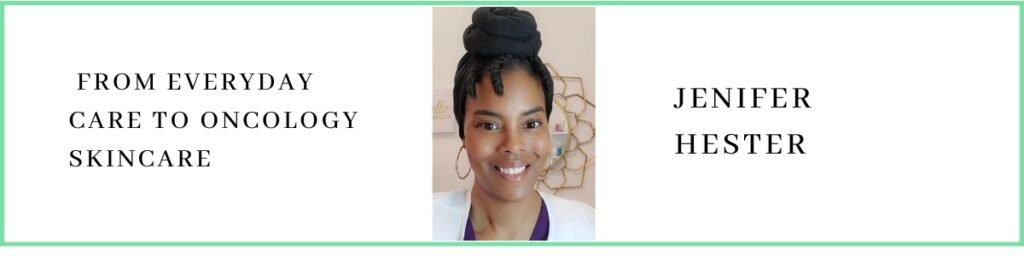
Jenifer Hester is a licensed esthetician with over six years of experience and certifications in chemical peels, oncology skincare, acne care, and holistic nutrition health. Jenifer explains that estheticians are state-licensed skincare professionals with over 600 hours of training who provide non-medical, non-invasive treatments, skin analysis, and product guidance, and refer clients to dermatologists when issues are out of scope. She contrasts estheticians with dermatologists, who are medical doctors who can diagnose and treat diseases such as skin cancer and perform surgery. Jenifer discusses chemical peels as controlled exfoliation that promotes collagen and improves acne, pores, and glow, cautioning against at-home peels without proper training. She shares her background in pharmaceutical quality work and her focus on restoring clients’ confidence. The conversation highlights oncology skincare, including prepping skin before radiation and adapting care during and after cancer treatments. Jenifer recommends preventative visits about every 30–45 days.
3 Takeaways
The Chemical Peel Experience:
Chemical peels are popular but can appear daunting due to their terminology. They’re an excellent non-invasive process to exfoliate the skin, promoting collagen production and sloughing off dead skin cells to reveal a youthful glow. Jenifer emphasises the importance of professional training to safely execute these treatments, advising against at-home attempts without expertise due to the risks involved.
Oncology Skincare- A Growing Necessity:
One lesser-known aspect of esthetics that Jenifer highlights is oncology skincare. For those undergoing treatments like chemotherapy or radiation, skin care needs change significantly. Jenifer explains how estheticians with oncology training can make necessary adjustments to skin treatments, preventing adverse effects on sensitive skin undergoing elective or medical procedures. Providing relief and support during this challenging time is vital, offering emotional and physical care that enhances the overall healing process.
When Should You See an Esthetician:
Jenifer advocates for viewing visits to an esthetician as preventative health care rather than a luxury. Regular skin evaluations can help prevent a range of conditions, including acne and premature ageing. She recommends scheduling appointments every four to six weeks to align with the skin’s natural cell turnover. Jenifer stresses that seeing an esthetician should be an essential part of everyone’s skin care routine, regardless of age, gender, or current skin condition.
ShowNotes
Click on the timestamps to go directly to that point in the episode
[01:27] What Is an Esthetician?
[02:40] Esthetician vs. Dermatologist
[04:28] Chemical Peels
[07:48] Jenifer’s Career Journey
[10:15] Oncology Skincare
[17:56] How Often Should You See an Esthetician?
[23:06] Skincare for the Whole Body
[23:58] TikTok vs. Professional Advice
Get In Touch:
If you’re interested in connecting with Jenifer Hester, you can reach her via her website, via Instagram, via Facebook, or via her LinkedIn.
For those interested in sharing their own stories on “Chatting with the Experts,” reach out to Paula Okonneh through her website or connect via LinkedIn.
[00:00:00]
Intro & Guest Welcome
Paula: Hello, and welcome to another episode of Chatting With The Experts, where I speak with phenomenal women from Africa, from the Caribbean, and in the diaspora. They share my mission, which is to educate, to empower, and to encourage women globally. The title of today’s show is Do We Need Estheticians? And to tell us why would be my guest, who’s gonna join me in a few minutes. She has been in practice for over six years, and she’s certified in chemical peels, in oncology skin care, and acne care as well. She’s also certified in holistic nutrition health. And with that, I want to welcome Jenifer Hester [00:01:00] to Chatting With The Experts . Welcome Jenifer.
Jenifer: Hi, Paula. Thank you so much for having me. I really, really appreciate the opportunity to help educate your audience and as to why estheticians are necessary.
Paula: Thank you for saying yes. I never take it for granted. And so with that, tell me why are estheticians necessary?
What Is an Esthetician?
Jenifer: So I’d like to first start out with what an esthetician is.
Paula: Mm-hmm.
Jenifer: So basically, I am a licensed skin care professional. I took over 600 hours of learning about the skin, the skin barrier, the illnesses of the skin, how to treat acne and things like that. And, also, I specialize in non- medical, non-invasive skin treatments. And my … I do also continuing education [00:02:00] rather to stay on top of the trends, that’s going on in the beauty industry to make sure that I’m providing my clients with the latest and best skin care for them. Yeah.
Paula: Wow. Latest and the best skin care for them. Yeah. That’s great. And you did over 600 hours. That’s a lot of time.
Jenifer: It sure is. It sure is. We learn about the biology of skin, the anatomy, what to do, what not to do, so it’s very important. All those 600 hours, yes, and then some.
Paula: And then some. So what are the types of things that you can help with? Because sometimes I hear I know I have heard some people ask,
Esthetician vs. Dermatologist
Paula: what’s the difference between an esthetician and a dermatologist?
Jenifer: Yeah, so I can speak to that for sure. So we all know that a dermatologist is a medical doctor. They take or they go to school for over 12 years. They have a residency. They are [00:03:00] board-certified. Whereas… and I should say also that they can do surgery on the skin. They can treat and diagnose actual skin illnesses such as like skin cancer, eczema, psoriasis, things like that. And now the difference between them and an esthetician is I am licensed by the State that I am practicing in to treat the outer layer of the skin. So I cannot go beneath that surface within my license. I can treat acne. I can identify maybe possibly the need for you to see a dermatologist. If I see something on the skin that looks like it’s out of my scope, that’s when I’ll recommend you to go to a dermatologist. I can give you facial treatments forgive me. Facial treatments, skin analysis, so I can tell you about your skin type. I can help you with selecting the proper products to treat your [00:04:00] particular skin. Along with that skin analysis, if I see acne or anything like that, just help you treat those daily issues that you have with your skin.
Paula: Hmm. All right. I see. So chemical peels. I’m always hearing that about people going for chemical peels, and these days I see a lot of women in particular doing their own chemical peels. Ooh, it always looks so painful.
Jenifer: Yeah. So
Chemical Peels
Jenifer: chemical peels are one of the best types of exfoliation-
Paula: Mm-hmm
Jenifer: that we can do to our skin without being invasive. So we don’t go, you know, in terms of surgery. So chemical peel just basically an acid that is applied to the skin. So it is a structured way of creating tiny wounds under the skin, and those wounds help the skin to actually [00:05:00] promote collagen. It sloughs off any dead skin cells, anything on the surface. It pushes everything from the inside out, so it’s creating new skin that will come from the inside and push its way out. Everything, as it’s pushing out, comes out of the skin, comes off the skin. So all the impurities. It helps with acne. It helps to minimize the pores. If you wanna get that nice glow that you, that youthful glow that you had, that you’re not feeling so much lately, that’s what a chemical peel is good for. Yeah, one of the best. I give myself chemical peels every now and then.
Paula: Uh, you saw my face, ’cause it always feels, to me, like it’s something that is invasive. You know? That probably I’m reacting to the word “chemical”.
Jenifer: Right, exactly. Mm-hmm. So it could just be different levels. I give myself light peels because I don’t have acne. I don’t [00:06:00] really have any hyperpigmentation that I’m trying to treat. I would say with that, the scariness of it being a chemical, it really depends on the level and the depth that you’re going, right? So if I’m giving you a chemical peel, mine are less… uh, I can’t think of the word. Um, they are not as strong as what a physician would give you. So if a physician will give you a medical grade peel, that one goes much deeper into your epidermis, right? So mine basically goes right under that first layer. So even though I have light, medium, and deep for that, mine is more of a superficial versus medical grade depth.
Paula: Okay. All right. All right. So when I see people doing their own, like in-house, [00:07:00] most likely they’re doing the lighter ones, not-
Jenifer: Uh, most definitely. Most definitely. Because for anyone to be able to do a chemical peel, usually the company that you get the chemical peel from will give you a training. They only give you that training if you are a licensed esthetician, a licensed nurse practitioner, or a medical professional, a physician. Usually if you’re buying it on the market, um, I may not wanna, wanna do that, and I probably wouldn’t advise for anyone to decide, “I’m gonna do a chemical peel myself,” because you could really hurt yourself-
Paula: Ah …
Jenifer: if you don’t know what you’re doing. Okay.
Paula: All right. And so
Jenifer’s Career Journey
Paula: you’ve been doing this for six years. That tells me that prior to that you were in another profession.
Jenifer: I sure was. I was in big pharma, uh, [00:08:00] corporate. I was an analyst in their quality department. So I was responsible for making sure that the medication had the proper labeling. I was responsible for making sure that other groups were following the correct protocols to ensure safety. When those medications reach the public, they need to be safe, they need to be accurate. All methods for forming the medications, all ingredients for forming the medications have to be followed. Everything has to be structured and followed to the T. And so that’s what I did with my life for the past, uh, 15 plus years. And then I decided it was time to come out of that, because this was inside of me. This was what motivated me and makes me feel good doing this part.
Paula: Let’s talk, that’s, that’s [00:09:00] purpose. You felt that…
Jenifer: yes
Paula: … was your purpose. That was your calling. That’s what made you get up in the morning and sing and say, “Yep.”
Jenifer: Absolutely. This is not work for me. This is all pleasure. I thoroughly, thoroughly enjoy being able to help women, men, children, anyone with skin conditions that take away their confidence, that take away their inner glow. It brings me such pleasure to be able to return that back to them. Mm. To make them realize that they’ve always had that glow. You know, just a little hyperpigmentation here or there doesn’t stop the show. Let’s take care of that. Let’s help you get back to who you are. Mm. That’s what brings me pleasure doing skincare.
Paula: All right, I can hear that. Just your voice changed, the inflection in your voice changed. Your eyes changed- … just talking about this.
Jenifer: Yeah.
Paula: You know?
Jenifer: [00:10:00] I love this, yes, yes.
Paula: Oh, my word. So when you do chemical… uh, not chemical. I see chemicals ingrained in my mind. You talked about big pharma and we straight off of chemical peels.
Jenifer: Right.
Paula: So, yeah.
Jenifer: Right, right.
Paula: So
Oncology Skincare
Paula: when you talk about oncology skincare, yeah.
Jenifer: Yeah, so that’s definitely something that is growing more and more, because we’re learning more and more about skincare and cancer, the big C-word, right?
Paula: Mm-hmm.
Jenifer: So when a person is diagnosed and once they start getting treatments, the skin changes because those treatments are doing a lot internally. Everything that’s done internally has to come out. Mm. It comes out through our pores, through, um- elimination. And it also comes out through the skin. So the skin does develop [00:11:00] changes, right? And as a result also, you go through surgery for some treatment, you go through radiation for other treatments. And those things also affect our lymph system and skin as well. When we’re doing skin care, you cannot do the same things for someone who is undergoing chemotherapy or other treatments that you can for someone who has never gone through that, right? So we’re learning the differences in how you treat someone who’s going through it versus someone who isn’t.
You can’t do certain types of massage movements because that could create fluid retention. We don’t want that, obviously, with anyone. But there’s also other things that you can do to help their skin. When they’re going through radiation, they get [00:12:00] burns on their skin. We have different types of treatments that will help that type of burning to prevent it from scarring, from leaving hyperpigmentation, uh, and different things like that. So it’s very important that when you’re undergoing chemotherapy or any type of cancer treatment to seek someone who does have that background, because you don’t want someone saying, “Okay, let’s do a chemical peel on your radiation burns or your surgery scars from, you know, how they had to do a lumpectomy or something like that.”
You wouldn’t want someone just applying anything to your skin. You want them to have that knowledge so that you’re getting the best care that you can. You’ve gone through a lot or you’re going through a lot, and you wanna make sure that professional understands this and knows how to treat you as you’re going through this.
Paula: Yeah, I do see that. So you said it’s [00:13:00] becoming more, um, people have become a lot more aware of the importance of their-
Jenifer: Yes. Yeah …
Paula: of an esthetician who is trained in oncology specifically.
Jenifer: Absolutely. Mm-hmm. Mm-hmm. Knowledge is power. Knowledge is power.
Paula: Knowledge is indeed power. Mm-hmm. And would you say that it’s best to have…
Well, as you say, knowledge is power. Mm-hmm. Would you say it’s best to have the, you know, this treatment done prior to the going in for radiation-
Jenifer: Yeah.
Paula: So- … or during and after, or,
Jenifer: you know? Right. That’s actually a good question for someone who- is diagnosed and they are concerned about the changes that can happen to their skin- Mm
they can seek out an oncology-trained esthetician-
Paula: Mm-hmm …
Jenifer: who will help them to prep their skin- Mm … prior to receiving radiation so that they can protect it as much as [00:14:00] possible. Of course, there’s only so much that can be done because radiation is, it could be very strong. But when you jump in in the beginning and help to prevent certain outcomes, I think that gives you a leg up, of course.
And as you’re going through chemotherapy or radiation, whatever type of therapy it is, whether it’s the pill form of chemo or the infusion form, there’s lots of things that can be done to, you know, help with the skin. And having someone who is oncology trained, they can help you from the beginning to during and after treatment.
Yeah.
Paula: Wow. It’s good to know.
Jenifer: Yeah. Yeah. It’s something- Definitely … good to
Paula: know. Yeah. With, um, so many more people I know who are being diagnosed-
Jenifer: Yeah …
Paula: This is something that I’m happy [00:15:00] that you’ve spoken about that-
Jenifer: Absolutely
Paula: … ’cause this may be so helpful.
Jenifer: Yes, absolutely. I think it’s, you know, at one time in your life where you’re going through so much mentally-
Paula: Yes
Jenifer: emotionally, and physically. And to have someone who understands all of that and is able to treat you and bring you comfort, not only physically but also, emotionally-
Paula: Yes …
Jenifer: I think that’s really important to have someone who is on your care team who can provide you with that. Yeah. Yes.
Paula: Yeah, because I mean, as you said, emotionally, mentally-
Jenifer: Mm-hmm
Paula: but a lot of times, especially, well, I was gonna say, especially women, but these days it’s both men and women. They’re concerned about the outcome, you know?
Jenifer: Yeah.
Paula: Hopefully they’re surviving, but then-
Jenifer: Right
Paula: … after surviving now- [00:16:00] outwardly, physically, what would their skin look like? Yeah. ‘Cause that’s the biggest organ, you know?
Jenifer: Yes, yes. That part, that part. You know, and when I was saying that I enjoy bringing back that glow, that inner-
Paula: Mm
Jenifer: … smile. You know, when you go through such treatments, it can really drain you of your energy, your light, right?
Paula: Mm-hmm.
Jenifer: And having someone who can truly understand this and knows the dos and the don’ts of what can and cannot be done, um, that, that can really make a difference.
It can really help to bring you back to your original happy self.
Paula: Mm-hmm.
Jenifer: Remembering that, okay, I did go through something that was very difficult, devastating even, but now I have this great person on my healthcare team.
Paula: Mm.
Jenifer: Because I am a part of a healthcare system.
Paula: Mm-hmm.
Jenifer: Right? Not just facials, not just beauty, but-
Paula: Yes[00:17:00]
Jenifer: a part of health. I help to reduce anxiety, stress, you know, trauma, things like that. So, I think this is definitely one of those services that is pretty necessary in this realm of being diagnosed with such an illness that can be very devastating to you.
Paula: Thanks for pointing out something, or throwing light on something that many people don’t associate with your profession,
Jenifer: you know?
Right. Exactly. Yeah, yeah. Yeah.
Paula: So, I know we, I won’t say we digressed, but we pointed out or we highlighted an aspect, um, your profession that many people were not aw- or at least let’s talk for myself, I wasn’t aware of. Sure. And I’m sure many people are not aware of.
Jenifer: Okay.
Paula: But then when and how often, if we’re talking, if we’re going back to the beauty side of it-
Jenifer: Mm-hmm
Paula: …
How Often Should You See an Esthetician?
Paula: when and how often should one see an esthetician?
Jenifer: So that’s [00:18:00] a great question, right? People often think of an esthetician or having a facial as, like, a luxury item.
Paula: Mm-hmm.
Jenifer: Yeah. But I’ll bring us back to being diagnosed with an illness.
Paula: Mm-hmm.
Jenifer: And I’ll add onto that and say it’s not just when you’re going through an illness. It’s not just when you’re starting to get adult acne or teenage acne or hyperpigmentation. An esthetician will serve as a preventative measure for you, right? So I think you should see an esthetician as soon as possible.
If you’ve never seen one, go see one. This is not a luxury situation here. This is one of those situations where an esthetician can help identify a possible problem with your skin. I know that a lot of people of [00:19:00] color feel like they are not prone to get skin cancer.
Paula: Mm-hmm. Mm-hmm.
Jenifer: I would like to say that this may be partially true.
Because of our melanin, we are more protected. But I will say that this sun out here is a lot different from the ’70s, the ’80s, and even the ’90s.
Paula: Yes.
Jenifer: Right? So it’s really important that we do preventative care, so that we’re not later doing, um… Oh, gosh, I’m sorry. Um, so that later we’re not doing the reactive-type care.
Paula: Mm-hmm.
Jenifer: You know? What an esthetician would do is we would analyze your skin. We’ll give you your skin type. We’ll tell you if you have acne, how’s your elasticity just different things like that. And we would put together a program that will help prevent skin cancer, help prevent acne, help prevent, [00:20:00] loss of elasticity, help to prevent aging, you know, premature aging I should say.
So you should always reach out and try and see an esthetician, you know, as soon as you can. Once you’re under the care of an esthetician, it’s up to that particular esthetician and what was discovered during your treatment, during your service, your skin analysis. So normally it would be a four to six weeks.
But I will add that our skin has cell turnover rate of 30 to 45 days. So every 30 to 45 days, the skin turns over and, we get new skin basically. So I would probably say that’s how often you should see your esthetician. If you have normal skin and you don’t have any situations, you could go on the longer side of that [00:21:00] 45 days, so say eight every eight weeks.
Yeah. But I definitely suggest that everyone should, man, woman, child, it doesn’t matter, everyone should try and see an esthetician to prevent acne, aging, dark spots, you know, any unwanted skin conditions, because they can also help guide you to a dermatologist when it’s necessary.
Paula: You know, I’m sure a lot of people have never said to you, they’re, you know, they’ve taken a child to see an esthetician.
Jenifer: Mm-hmm.
Paula: I don’t think many people consider children as possible clients of estheticians, but this, you know, I guess that’s why this is titled Do You Need an Esthetician.
Jenifer: Yeah.
Paula: Absolutely.
Jenifer: Yeah. Because
Paula: I found out some things today that I had never thought of.
Jenifer: Yeah. Yeah, for sure.
Paula: Mm-hmm.
Jenifer: Estheticians are a part of daily life.
[00:22:00] We are the preventers. We are the people who help relieve your stress and anxiety, even if it’s just for an hour at that appointment. These hands of mine, miracle workers, let me tell you. Let me tell you. It’s more than just luxury. It is a service that can help prevent you from having to react to, “Oh my gosh, I had this spot on my face and, you know, it came out of nowhere, and now all of a sudden it’s skin cancer.”
Or, you know, sometimes we have these moles that pop up, and they grow and grow and grow. You know, this could all be prevented had you gone to see an esthetician who could direct you to a dermatologist to get it removed in the first place. You know, quick things. But it’s definitely a necessary thing to add into your repertoire of caring for your body.
Because your skin, being the largest organ, is [00:23:00] also responsible for protecting what’s going on inside of the body, so we wanna make sure we’re taking care of it.
Skincare for the Whole Body
Jenifer: It’s not just the face. It’s the entire body that estheticians take care of.
Paula: That’s why we need to have more of …
Jenifer: that’s right
Paula: estheticians. Because when we hear of estheticians, we think just of the face.
Jenifer: Yeah, no. And as you
Paula: just said, it’s more than the face, it’s the whole body.
Jenifer: Yes, absolutely. Absolutely. Absolutely. ‘Cause, you know, a lot of people they’re like, “Oh, you know, I’ve been itching over here, and I don’t know, it’s not going away.”
It could be eczema. It could be, you know, something else. And a lot of us, rather than think about going to a dermatologist or even going to an esthetician, we ask our friends, we ask our mother- Yeah … we ask our pa- you know, our aunties or whoever. “What did you do? Did you ever have this itching?” And then, or
TikTok vs. Professional Advice
Jenifer: nowadays people are [00:24:00] referring to TikTok, you know, for answers, for Google and things like that.
Paula: Chat.
Jenifer: Those are not the answers. Those are not the answers. You need a professional on your healthcare team to help guide you, to help you pick out the proper products for your particular skincare needs. Everything is not a one-size-fits-all. That’s, you know, that’s one thing I do hate about, like, TikTok and, uh, Instagram, social media, things like that, because you have all these people with these beautiful glowing skin telling you, “Oh, this is what I use on my face every day, and I get these results.”
We have no idea if those people are actually using those products.
Paula: So true.
Jenifer: But if you see an esthetician, this person can guide you based on your particular skin type, your particular skin concerns and goals. They’re the [00:25:00] ones who can put you on the right track so that you’re not sitting there looking at TikTok or getting information from your friends and family and, “Oh, I’ve tried this many products and none of it works,” and this and that.
That’s what an esthetician is for. They can get you on the right regimen, the right routine, the right products, and have you spending less money on a whole. You know what I mean? By putting you in the right products for your skin at one time. And, you know, I will say that consistency of having this esthetician in your life will guarantee the goals that you’re looking for.
It will guarantee those, um, TikTok results, you know, but with real live support.
Paula: I love that. With real live support.
Jenifer: That’s right.
Paula: This is where we’re gonna wrap up and open up the floor for those who are in the audience. But for [00:26:00] those who are listening to this or viewing this on the YouTube channel,
How to Find Jenifer & Outro
Paula: how can someone find you online who has listened and has leaned in and is watching this, Jen?
How can they find you?
Jenifer: Absolutely. So my website is www.glowtheorynj.com. Uh, that’s Glow Theory, NJ as in New Jersey.com. You can find me on Instagram, Facebook, and TikTok at, uh, glowtheorynj as well. Are you on LinkedIn? Um, I am on LinkedIn. Um, but
Paula: I have to say
Jenifer: I don’t remember my LinkedIn.
Paula: Don’t worry.
Jenifer: You’ll drop that. I’ll search that and I’ll drop-
Yeah …
Paula: drop it in the chat. Oh,
Jenifer: okay. Okay, perfect. Okay. Perfect.
Paula: That’s lovely. I’ve learnt so much today from you, Jen. And for those of you listening or watching this on my YouTube channel, just as Jenifer has been a [00:27:00] guest on my show, if you’d like to be a guest, I ask you to reach out to me on my website, which is chattingwiththeexperts.com.
I’m also on LinkedIn. My page there is Chatting With the Experts. I’m on Instagram. My handle there is @chat_experts_podcast. I’m also on Facebook. My Facebook page there is Chatting With the Experts. And we have a YouTube channel that we’d love for you to subscribe to, so you can hear … not hear, but you can know when the latest episode of another Chatting With the Experts has been dropped and when another woman, just like Jen, has shared such golden nuggets like she just did.
So we ask you to subscribe to our YouTube channel. And I wanna thank you, Jen, for offering and sharing with me and [00:28:00] all those who joined us today such wonderful nuggets on why we need an esthetician, not just for our face, but for our whole body, and also throwing light on the importance of oncology skin care and the…
Jenifer: yeah
Paula: role that estheticians have in helping people who have been diagnosed with cancer. Thank you so much.
Jenifer: Yeah. Thank you so much for the opportunity. I appreciate it.
Paula: Absolutely. And now we open up the floor for those who joined us to ask you the questions that I forgot to ask.
Jenifer: Okay.