
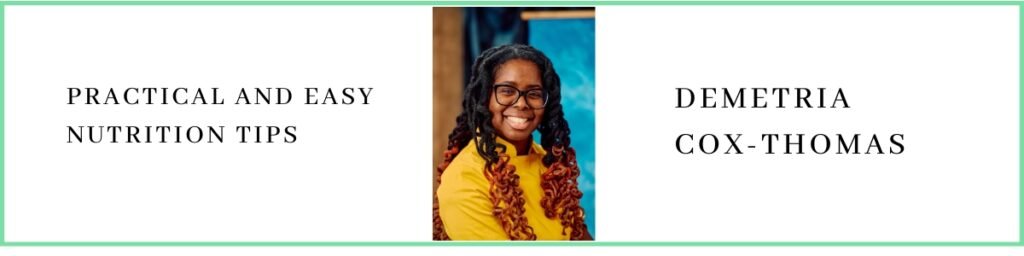
Demetria Cox-Thomas, a plant-based registered dietitian nutritionist and CEO of Dee Veggie Nutrition, discusses practical, accessible healthy eating. Demetria explains her work in hybrid group nutrition counseling, plant-based presentations, and cultural cooking classes (Ethiopian, Jamaican Ital, and Indian) that emphasize spices, flexibility, and making food enjoyable rather than stressful. She addresses food deserts/food apartheid by tailoring guidance to each client and recommending canned or frozen vegetables when fresh options aren’t available. Demetria focuses on increasing vegetable intake without demonizing meat, sharing flavor and technique tips such as smoked paprika, curry blends, cumin, berbere, herbs, coconut milk, beans for fiber/protein, citrus finishing, roasting vegetables, and improving tofu and mushroom texture by drawing out water.
3 Takeaways
Cultural Culinary Adventures:
Demetria’s cooking classes aren’t just about nutrition; they’re about exploration and discovery. With her culinary expertise preceding her journey as a dietitian, she marries these passions to make plant-based eating exciting and accessible. Her classes demonstrate that cooking doesn’t need to be stressful. Following recipes isn’t a strict rule but rather a guideline, allowing participants the freedom to experiment and develop their culinary creations.
Spice Tips and Pantry Essentials:
Central to making veggies taste great is an adventurous touch with spices. Demetria shared her pantry staples like smoked paprika, curry blends, cumin, and berbere, encouraging home cooks to expand their spice cabinets and explore new culinary landscapes. These spices can transform simple vegetables into flavorful masterpieces without a rigorous following of recipes.
Cooking Techniques That Transform:
Understanding the impact of cooking techniques is crucial. Demetria highlights that roasting can bring out the natural sweetness of greens and other vegetables, significantly enhancing their flavor profile. Techniques like salting to draw out water from mushrooms and tofu effectively change textures, making inherently tricky ingredients like tofu more enjoyable.
ShowNotes
Click on the timestamps to go directly to that point in the episode
[03:18] Food Access & Food Deserts
[05:22] Cultural Cooking Classes
[14:21] Spice Tips & Pantry Essentials
[18:43] Cooking Techniques
Get In Touch:
If you’re interested in connecting with Demetria Cox-Thomas, you can reach her via her website, Instagram, or LinkedIn.
For those interested in sharing their own stories on “Chatting with the Experts,” reach out to Paula Okonneh through her website or connect via LinkedIn.
Paula: [00:00:00] Hello, and welcome to another episode of Chatting With Experts, where I speak with phenomenal women from Africa, from the Caribbean, and in the diaspora. These women are experts, they’re professionals, and they share with me my passion. And what is my passion? My passion is to educate, empower, and encourage women all over the world.
And these women, these expert women, are the ones who do that. Today our topic is Practical and Easy Nutrition Tips, and my guest, who will join me in a minute, says she’s gonna be discussing the nuances of healthy eating patterns and how to make them accessible and adjustable to one’s lifestyle. I’ll tell you a bit about her.
She’s a dedicated [00:01:00] plant-based registered dietician nutritionist, or RDN, who’s passionate about improving health through nutritious, affordable, and accessible plant-based eating. With a mission to empower families to increase their fruit and vegetable intake in culturally relevant ways, she helps clients create sustainable balanced meals that support long-term wellbeing.
I can say so much about her, but why don’t I do this?
Meet Demetria Cox-Thomas, RDN
Paula: I’ll welcome Demetria Cox -Thomas to the show. Welcome, Demetria.
Demetria: Hello.
Paula: Thank you so much for saying yes to coming to the show. And, you know, I know that there’s a lot that I left out in your bio, so tell the [00:02:00] audience a bit more about you. I know that you are the CEO of Dee Veggie Nutrition.
What else do you do within Dee Veggie Nutrition that I… Not that I forgot to mention, but that I left out, because it’s such an impressive bio that you have here.
Demetria: Thank you. So at Dee Veggie Nutrition I do group nutrition counseling, I do cooking classes. So I focus on culinary education, and also do nutrition education through the group nutrition counseling, and I do presentations all the time just about plant-based nutrition. That’s my focus. Because, you know, when we boil down to it, we don’t eat enough vegetables. We just don’t a lot of times, at least here in America we don’t eat enough vegetables. So my company just encourages people, “Hey, this is really easy. Use your spices.” Like, we do different techniques to help you eat more of your vegetables.[00:03:00]
Paula: Right. So how does that, how does that work? I mean, we talk about eating vegetables, but a lot of us live in communities where we don’t have access to, you know, vegetables, either because we don’t have the land to plant at all, or we’re in cities, or we’re in what we call, what do we call them?
Food Access & Food Deserts
Paula: Food deserts, I think we call them.
Demetria: Yes. Or we call them, food apartheid areas.
Paula: Yes. Yeah. Yes, tell me more. Yes. Yeah. So how do we do that?
Demetria: So I do it, at least here in Charlotte, I do work a lot in food access spaces.
Paula: Mm.
Demetria: So I do have first discussions when I meet with my clients, what are you currently eating? How do you currently access food? And from there we can discuss how you can incorporate more vegetables, whether it’s me helping you getting access to them first before we have those discussions, or me getting an idea of what you’re already doing and kind of adjusting what you’re already doing to include more vegetables. So it literally [00:04:00] is catered to the individual person because we are so different in how we get vegetables, how we can afford them, you know, money, being able to get them. So I always like to say canned, you can do canned veggies. You can do frozen veggies. They don’t always have to be fresh. But we just want you to get your vegetables.
Paula: I like that. So start where you are, because sometimes-
Demetria: Yeah
Paula: … that could be, you know, that could be the obstacle to even starting, like, oh my gosh, I don’t have access-
Demetria: Right
Paula: to this. So if you have canned, if you have access to canned vegetables, start there. If you have access to frozen vegetables, start there. That’s what I’m hearing from you.
Demetria: Yes. Mm-hmm.
Paula: Okay. So, you say you do group counseling. So the group counseling, is it in person or is it hybrid or,
Demetria: So- …
Paula: virtual? How does that work?
Demetria: It’s hybrid. So I do online, group counseling, and then I’m gonna start in person really soon at the co-working space that I host my office at.
Paula: [00:05:00] Okay. All right. And then, you know, um, we talked about cooking classes. That has to- Yes Oh, I saw you light up with that, with cooking classes. Yes. I love
Demetria: doing cooking classes.
So- Tell us
Paula: more about that, because it’s plant-based. So a lot of us are like, okay, plant-based, that sounds limiting. Okay. I didn’t want to say boring.
Demetria: Go ahead. So what’s been fun, so
Cultural Cooking Classes
Demetria: my most recent course of classes was funded by the Arts and Science Council here in Mecklenburg County.
Paula: Mm-hmm.
Demetria: So what’s been amazing about that is, they’re cultural cooking classes.
Paula: Okay.
Demetria: So I explore plant-based foods, not like, you know, in the context of what we think of the sad American diet, you know, the things that we may see every day here in America, but I actually explore other cultures and how you can enjoy veggies in the context of using spices. So my first class was Ethiopian.
Paula: Ooh.
Demetria: I did Jamaican Ital.
Paula: [00:06:00] Okay.
Demetria: And then we did Indian last Saturday.
Paula: Ok.
Demetria: And a lot of times, like I had someone text me after the class, and they were like, “You know, I take like turmeric capsules for inflammation, but I didn’t think about cooking more with it or how I can cook more with it.” And my class allowed them to explore that, how they can incorporate it more in diet versus relying on a supplement. So that’s what we wanna hear, how you can bring this into your cooking.
Paula: Got you. Got you. Got you. Right. Okay. So cultural. So now you, when you do the cooking classes, and I saw you light up with that, I guess you go online.
Demetria: Mm.
Paula: You look for, you know, different recipes that are plant based, and then you offer your classes.
Demetria: Yeah, so I’m so… honestly, cooking was my first love, so I have culinary experience before I became a RD.
Paula: Okay.
Demetria: So this is me marrying two together.
Paula: Uh-huh.
Demetria: And I do. I [00:07:00] find, like I always say, for me, recipes are a strong suggestion.
Paula: Okay.
Demetria: They’re just inspiration.
Paula: Mm-hmm.
Demetria: I don’t follow recipes.
Paula: Mm-hmm.
Demetria: So the classes have been very interesting in that, you know, we’ve, like last week I missed one of my ingredients when I was packing up, very important ingredient, garam masala, with to do with the Indian cuisine. So but we had plenty of turmeric. We had ginger. We had a bunch of other things, and we had to adjust the recipes based on what I had there, and it still turned out delicious. So I do want to stress to people, like cooking doesn’t have to be stressful. You don’t have to follow all the recipes to a tee. This isn’t baking. Like baking is not, that’s not my ministry. That’s what I tell everybody, that’s not. So, when it comes to cooking and just making meals for yourself, you don’t have to worry about having the perfect ingredients and the perfect… Like it doesn’t even have to look perfect. It just need to taste good, and it needs to be something that you can provide to your family that y’all enjoy and be healthy at the same time ’cause it’s possible.[00:08:00]
Paula: You’re a girl after my own heart because I’ve always said to people- … recipes were, this is made up by somebody. You know? It started with someone who said- Hey. … “Add this, add that,” so why can’t you now tweak it, you know, to suit you? And if you’re missing something, substitute it out, you know? Like, you know, add something else. Then you come up with your own recipe.
Demetria: Right. It’s fun. Yeah, it’s fun involving your family in it. The class I did last week, I had 15 attendees, and it was very intergenerational. So we had grandmothers that brought their grandkids.
Paula: Love it.
Demetria: We had moms and daughters cooking beside each other. We had siblings cooking beside each other. We had, my daughter actually helped teach knife skills to some of the participants ’cause she would watch me all the time.
Paula: Mm-hmm.
Demetria: So it was beautiful. It was beautiful to see us coming together to cook and learn new skills.
Paula: Got you.
Demetria: Okay.
Paula: So I’m gonna ask you another question. So why plant? Why not a little bit of chicken or some [00:09:00] fish?
Demetria: So my stance, so I am plant-based. However, I’m not as a plant-based dietician, I’m not demonizing meat. I don’t … So that does set me apart from a lot of my vegan friends. I have lots of vegan friends, but they’re, you know, they will tell you meat is evil to them. I acknowledge meat’s role in our food system. I’m friends with lots of farmers, so I don’t have that same strong, like, no, no meat ever. But statistically it’s shown that over 90% of our total population here don’t get enough vegetables. And because of that, I said, “Okay, let me admit that, okay, we’re good on meat. We know how to cook meat.
We know how to enjoy meat. I don’t think that’s the issue. If the issue is vegetables, let me just focus on vegetables and how to make them taste just as good as your meat, [00:10:00] main meat.” And then for me, when I transitioned, the more I learnt how to cook vegetables and enjoy them, the less I wanted meat. So that helped my transition, but I don’t go about it trying to convert everybody. It’s like, “Look, you got this. Let me help you here.”
Paula: Ah ha. That’s an aha moment for me, so now I get it. As you said, the meat lovers or the meat recipes or everything dealing with meat, that’s already been taken care of, so. That’s already taken care of. That’s it. So you were dealing with a… you saw a shortage, you saw a problem, and you said, “Let me take care of that.”
Demetria: Yes.
Paula: Because we don’t get enough vegetables and plants and fruits, and so let’s take care of that, and that’s what you’re doing. You’re supplying, you’re taking care of a deficiency or something that you noticed in the community was lacking.
Demetria: Yes,
Paula: yes. Got you. Got you. All right. So how do you encourage people now to- make time for that healthy eating? How do you … I [00:11:00] know you said start where you are with what you have, and now how do you now make time? Because sometimes you have to go find those things that even though you have it, like okay, if you have frozen, you have to think about how to make those recipes taste good.
Demetria: Yes.
Paula: I noticed you said it doesn’t have to look good, but it has to taste good.
Demetria: Has to taste good, ’cause I don’t know if you’ve ever seen, when I make curries, I can’t make them camera pretty all the time. But they’re like the best tasting things ever. But I know one of the things I like to start with when I have conversations is like, okay, you have your frozen veggies. Great. What spices do you have in your cabinet?
Paula: Mm-hmm.
Demetria: Like, if you was to look in my cabinet, I have all kinds of spices, and to show people, hey, there’s more than just garlic powder and onion powder, which are key staples in my pantry. But there are so many other spices you can combine to create different flavors, and I encourage people to be curious. ‘Cause what I realize, some people have gotten to the part of being so [00:12:00] rigid with food and having a relationship with food that makes it stressful that they’ve taken the fun out of it, they’ve taken the curiosity out of it. I read a lot of culinary books. I follow people online. My daughter’s on TikTok. I’m not on TikTok. I can’t do no more social media platforms, but on TikTok, I see all the recipes going viral, so marry me chicken and all that. So it lets me know that people are interested in learning how to make delicious things.
Paula: Mm-hmm.
Demetria: It’s just, you know, trying to translate in that, okay, you know, you can do this with chicken, but did you know you can apply these same vegetable, I mean, these same spices and technique to cauliflower and elevate that flavor too in your sides? So just putting myself out there on my platform, showing, hey, this is easy to do. You know, plus up your spice cabinet. Grow some herbs. One of the programs I work with at one of my jobs, because I am full-time as an [00:13:00] extension agent too, we talk about agriculture and growing your own vegetables. Well, sometimes I’ll say, “Listen, with SNAP”, I work with a market that takes SNAP. With SNAP you can buy seeds, you can buy basil plants from the store, and you can grow basil in your kitchen. So even something like a small tip like that can help elevate your meals.
Paula: It’s again, goes right back to start where you are. So-
Demetria: Mm-hmm
…
Paula: You can buy basil seeds. Yeah, you can , you know, tomatoes kind of spread and you need to prop them up. I was gonna say, so tell us about these spices. You know, you said the basics are garlic and onion.
Demetria: Yeah.
Paula: So I’ll start with-
Demetria: Garlic and onions are the staples.
Paula: Yes. Those are the staples. Go ahead. I need to know about some of… let me get something to write it down because you know me-
Demetria: Yeah
Paula: … better when we’re just saying these are- Mm … the extra spices because I’m trying to eat differently now, and I’m like, “What are other spices?” Because a lot of us tend to season with, you know, seasoning salts, and we don’t think about-
Demetria: Yes, seasoning salts.
Mm-hmm …
Paula: yes, [00:14:00] we don’t think about other spices. So you talked about tips. I’m gonna write- tips.
Demetria: Yes
Paula: … write them. Hold on, I’m looking for a pencil. Where’s my pencil? Where is my pencil? Oh, can’t find this pencil right now. Okay, so I’m just gonna have to commit this to memory. Okay, start telling us some of the tips, some of the spices please.
Spice Tips & Pantry Essentials
Demetria: I would love to. So I’m gonna tell you- Yes … a secret game changer. Mm-hmm. Smoked paprika in beans.
Paula: Smoked paprika. Smoked
Demetria: paprika is like, it gives you a smoky flavor without having to add meat or bacon ’cause I know when I did eat meat, you know, growing up, we, my dad did use smoked meats, smoked meats, bacon, you know, all those things.
Paula: Mm-hmm.
Demetria: So I’ve created that same smoky feel by getting smoked paprika.
Paula: Mm-hmm.
Demetria: I love smoked paprika. And I know everybody, paprika, you know, when they think of paprika, they just think of it as the color, but smoked adds that extra smoky flavor. It’s so delicious.
Paula: Okay.
Demetria: Another [00:15:00] thing, I have Indian and Jamaican curry, and they have two different, like, people are like, “Okay, curry.” Curry can be any… it’s so many curry blends. It’s the Jamaican curry, I think Island Mountain is the brand that I use, and I use that to make tofu scramble. I use it to make tofu scramble.
Paula: Yeah, tofu.
Demetria: And I love tofu scramble, and even, and I’ma get to this, so I’ma put a pin in this after I talk about the seasonings. Cooking techniques help you enjoy your vegetables, but we’re gonna come back to that.
Paula: All right.
Demetria: But, so we got that. I’m scanning. Cumin. Cumin is amazing. I use that in my, if I’m doing a Mexican inspired dish, we do cumin. Indian dishes have a lot of cumin. Berbere, Ethiopian spice.
Paula: How do you spell that please?
Demetria: [00:16:00] Berbere is B-E-R-B-E-R-E.
Paula: Okay, berbere. Okay.
Demetria: So that’s the base of Ethiopian cooking.
Paula: Okay.
Demetria: Delicious. It has many uses. Trying to scan. Huh, so much. Your regular herbs, so your basil, oregano, marjoram. I use them, you know, not just for Italian cooking, but I may just do some green herb potato, like if I just wanna fry my own fries, ’cause sometimes I don’t buy the frozen ones, and the frozen ones are fine and you can add these seasonings to the frozen ones. But if I’m making my own potatoes, I’ll do just green spice potatoes. Trying to make sure I covered everything. Or the Indian curry I use for my curry chickpeas.
Paula: Mm-hmm.
Demetria: This is not a spice. This is an ingredient that I lean heavy on, coconut milk.
Paula: Mm.
Demetria: Coconut milk gives me the creaminess that I would get from using milk, cow’s milk. And I’m [00:17:00] visualizing my cabinet.
Paula: Okay.
Demetria: I use canned beans a lot. I love using canned beans.
Paula: Like black beans and…
Demetria: black beans, pintos-
Paula: chickpeas
Demetria: … garbanzos. Yeah, chickpeas, pinto beans. I’m from the South, so I love pinto beans too, black-eyed peas. That’s the way I make sure I get the fiber and my protein. A lot of people ask, “Where do vegans get protein?” It’s through plant-based foods such as beans. That’s the primary one. Okay. Gosh, and I go on and on. There’s so much. But yeah, those are the ones that stick out to me that I’m visualizing in my cabinet right now. That’s…
Paula: All right. You’ve given me a lot. That’s fine. I’m not gonna have you, um, uh, draw a blank on trying to remember everything in your pantry. This is quite helpful, yes, because I mean, I know for sure for me, I’ve decided to start eating differently, and sometimes I run out of ideas. [00:18:00] But at the same time, I come up with my own recipes, as I told you.
Demetria: Yes.
Paula: I don’t believe in sticking to, you know… I don’t believe in going through recipe books and just following it, you know, verbatim. I believe in, right, if I have black beans, I can add tofu. I may add a little bit of the garlic salt-
Demetria: Yes
Paula: … and squeeze some lemon on it. Um-
Demetria: Squeeze some le- oh, I forgot about the power of citrus.
Paula: Yeah.
Demetria: Citrus. I love lemon. I love lime. It’s great to finish off your roasted greens.
Paula: Mm-hmm.
Demetria: So I do wanna get into cooking techniques whenever you’re ready.
Paula: Yes. I’m ready right now, because I was giving you-
Demetria: Okay
Paula: … my own recipes, but you are the expert.
Demetria: So go ahead.
Cooking Techniques
Demetria: So the other big thing that came out of my classes the last few weeks is that people don’t realize that how you cook something can change the whole dynamic of a meal.
Paula: Mm.
Demetria: So roasted greens, roasted veggies bring out a sweetness in [00:19:00] vegetables. One of my favorite roasted recipes is roasted collard greens or roasted, um… And I wanna say collard greens ’cause I am from the South, so we love our collard greens here. And a lot of people assume, oh, kale is the thing. Kale is the thing.
Don’t get me wrong, kale is delicious, but it ain’t replacing my collard greens.
Paula: All right.
Demetria: So I roast any green that I get. I like bok choy. I love greens. Spinach is a little too delicate, so I don’t roast those. But your heartier, more wintery leafy greens, roasting them and then doing like a little bit of salt, but you squeeze a lemon or a lime on top of them when you’re finished.
Yeah. Make your own kale chips. They don’t take that long. Very delicious. Roasting potatoes, roasting broccoli, cauliflower, carrots, sweet potatoes. Like just roasting them changes the entire trajectory of that [00:20:00] vegetable. Another one that I like doing, mushrooms and tofu. So-
Paula: Oh …
Demetria: me, I didn’t like mushrooms until I learnt how to cook them. So I grew up at least 35 years not liking mushrooms. And tofu, I talk to a lot of people about tofu, and their beef is that texturally it’s weird, and I get it. But what I’ve learnt is with both mushrooms and tofu, since they hold water-
Paula: Mm-hmm
Demetria: … the goal I have is to extract the water using, um… we can do it two ways. Normally I can just salt it and I can put it in the oven and it’ll pull the water out, or you can do a air fryer and salt it and then that’ll pull the water out. Or if you do it on the stove top, same thing, just kind of put it on medium high, salt it, and it pulls the water out and it changes the texture, and that’s for mushrooms and tofu.
Paula: Okay, but if you’re, let’s say you’re hypertensive, you can’t [00:21:00] add the salt. Did you say salt it?
Demetria: Oh, yeah, salt it. Okay. I still would say salt it, ’cause what it does is you don’t… With hypertension, what you want to do is not overconsume salt, because you still need sodium.
Paula: Mm-hmm.
Demetria: Our bodies need sodium.
Paula: Mm-hmm.
Demetria: So sodium is not the culprit. Sodium is not bad. It’s the overconsumption of the hidden sodium in our meals.
Paula: Mm-hmm.
Demetria: So the way I kind of combat that is if you salt your mushrooms, you just use I’ll estimate, like it depends on how many mushrooms you have, but you’ll do like a good, just a small bit of salt. But you want enough so it can draw the water out, and then it’s not salty. ‘Cause we did it last week. And then once you do those, you pair those with other veggies that are not, you know, as salted or you use other things to season it. But like I said, with hypertension, you, it’s more of managing your [00:22:00] total diet and making sure you’re not eating a lot of ultra processed things. Because a lot of times cooking at home, you’re not using a lot of salt, as much as when you go out to eat and you don’t know how much salt is in that food.
Paula: Got you. Got you. So it’s all about managing the-
Demetria: Mm-hmm
Paula: … sodium content.
Demetria: Yes.
Paula: So when you salt it to draw the water, what do you do with the water that’s drawn out?
Do you use- Oh,
Demetria: it evaporates Yeah …
Paula: okay, it evaporates.
Demetria: Yeah.
Paula: It’s not that you’re gonna use it-
Demetria: Yeah, it just evaporates. Mm-hmm …
Paula: use it for stock or anything like that.
Demetria: Mm-mm.
Paula: Gotcha. Gotcha. This is sounding delicious. I mean, if we had time- Yeah … we should have had you, you know, actually do a demo for us.
Demetria: Do a cooking demo. Oh, I’ll have to come back. I’ll do the cooking demo.
Paula: Yes, so we have to have you come back. We have to have you come back. Oh my God. You’ve already made… You know, the question I was planning on asking you is how to make healthy eating not stressful, but you’ve already made it fun.
So you’ve answered that question. Ooh, okay, okay, okay. So, oh boy, we almost [00:23:00] out of time. Your classes, as you said, they’re hybrid, which means it cover both in person and online. So someone watching this who has already enjoyed hearing how much fun your classes can be, ’cause you’re fun.
If they are trying- Thank you … to get in touch with you, how can they do that? I mean, how can they join your class? How can they join your group counseling cooking classes? How can they get personalized support from you, Demetria?
Demetria: Okay, so right now I’m encouraging everybody just to follow my social media-
Paula: Okay
Demetria: which you will share with them. So I am on Instagram @deeveggieRD.
Paula: Mm-hmm.
Demetria: I’m on Facebook at Demetria L. Cox, and I’m also on LinkedIn at Demetria Cox Thomas. That’s where I’m sharing all my offerings. I’m inviting you to join my email list, which I’ll have the information on the social media platforms, and at my website, deeveggierd.com. So please join [00:24:00] my email list, and it’ll have all the details because the schedules vary. I tell people I’m doing this but I’m also working full-time as extension agent, what allows me to do food and nutrition programming in the community in another way. So I’m doing both at the same time. I’m also a adjunct professor at Johnson & Wales for their nutrition program, so I’m doing a lot of side quests. But to just keep up what I’m doing, I update my social media. I’ll keep you in touch. Please join my email list, and I’ll make sure that, that you’ll have the information.
Paula: Oh my word. As I said, this is really all the… when I say this, Chatting with the Experts is all about encouraging, empowering, and educating women all over the world. And so if you would like to be part of the community that encourages, empowers, and educates women all over the world just like Demetria did, please reach out to me on my website, which is [00:25:00] chattingwiththeexperts.com. I’m also on LinkedIn. Just go to my business page there, which is Chatting with the Experts.
I am on Instagram @chat_podcast_experts. That’s my handle there. I’m also on LinkedIn. I just said that. You can also follow me on Facebook on my business page, which is Chatting with the Experts, and we have a YouTube channel. Subscribe to us there, and you will be able to hear other just as amazing women just as Demetria, where you will listen to and view them, of course, talk about the so many, so many, so many, so many inspiring topics way beyond what I can list today.
So now, Demetria, we will open up the floor to those who have joined us so that they can have an opportunity to speak with you and [00:26:00] hear more in depth about all the ways you’re helping the community in which you live and those all over the world who can tune into your hybrid classes online, through social media.
You don’t have a YouTube channel yet, do you?
Demetria: Not yet. We’re working on it. You’re working on it. So please stay tuned.
Paula: Thank you so much, Demetria, for making this such a fun conversation. I’ve learnt, I’ve taken down all these reci- not recipes, but all these spices and, yes, cooking techniques.
I’m gonna try them, and I’ll get back to you and let you know how successful they have been. Thank you so much.
Thank you