
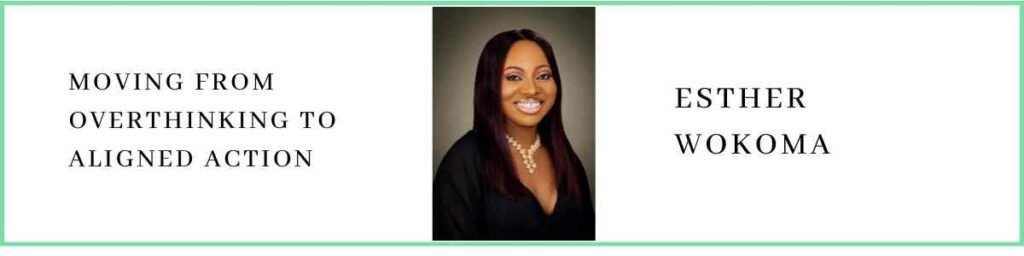
Esther Wokoma, founder of EvolveLumina, a confidence amplifier coach and strategic engineering and operations leader with 18+ years in the energy sector, argues that many people don’t lack clarity but lack alignment and self-trust, and explains how identity shapes decisions because people act in alignment with who they believe they are. She shares how she helps teens and women overcome fear, external expectations, hesitation, and self-doubt by reinforcing their uniqueness and value, and teaches her 3C framework—clarity, confidence, courage—supported by a RISE process (review, identify, step forward, expand). She emphasizes consistency, small repeated actions, and not waiting to feel ready, and highlights her 31-day confidence journal inspired by conversations with her teen daughter.
3 Takeaways
Understanding the Real Barrier- Alignment Over Clarity:
Esther kicked off the discussion by challenging the common perception that lack of clarity is the primary obstacle in our lives. Instead, she suggested that a lack of alignment and self-trust can be more significant barriers. Our ability to trust ourselves and align our actions with who we are plays a crucial role in moving forward in life.
The Importance of Identity in Decision Making:
Esther highlighted how seeing oneself as confident can significantly impact the decisions we make. If we fail to identify as capable, hesitation and self-doubt often follow. This observation led to a thought-provoking discussion on how individuals often revert to their comfort zones due to fear or external expectations, even when they know which steps to take.
Empowering Teens by Laying the Foundation Early:
Having worked with various demographics, including teenagers, women, and professionals, Esther shared her passion for empowering teenagers. She emphasized the need for young minds to recognize their uniqueness early on. By helping teens embrace their identity and value, Esther aims to set them on a path where they boldly step into their potential without succumbing to societal pressures.
ShowNotes
Click on the timestamps to go directly to that point in the episode
[02:17] Clarity vs Alignment
[03:31] Identity Drives Action
[04:52] Coaching Teen Identity
[06:41] Helping Women Self Trust
[07:58] Three C Framework
[09:28] From Corporate to Coaching
[14:20] Teens Sweet Spot
[17:40] Stop Overthinking Start Acting
[18:53] Consistency Builds Confidence
[21:32] Confidence Journal and Joy
Get In Touch:
If you’re interested in connecting with Esther Wokoma, you can reach her via Instagram, via Facebook, or via her LinkedIn.
Her LinkTree is here.
For those interested in sharing their own stories on “Chatting with the Experts,” reach out to Paula Okonneh through her website or connect via LinkedIn.
Paula: [00:00:00] Hello and welcome to Chatting with the Experts podcast, where I speak with phenomenal, amazing, fantastic. I’m running out of adjectives, women from Africa, from the Caribbean, and in the diaspora. These women are experts at what they do and they share my mission, which is to educate, empower, and encourage women globally.
Today’s topic is Clarity, Identity, and Courage, Becoming Who You Were Meant To Be. And my guest who will join me in a minute or two says, what if the real barrier is not lack of clarity, but rather lack of alignment. She will share how identity, self-trust, and courage shape the decisions that we make and the lives that we create. And this conversation will challenge you to stop waiting [00:01:00] and rather to start moving. She is the founder of EvolveLumina. She’s a confidence and amplifier coach and a strategic engineering and operations leader, with over 18 years experience in the energy sector. She empowers teams, women and professionals to gain clarity, build confidence and take courageous action through coaching, leadership frameworks and transformational programs. Her bio is impressive, ladies and a few gentlemen who will join us. So I’m gonna do this. I’m gonna invite her to join me right now. So welcome to chatting with the experts, Esther Wokoma. Thank you, thank you, thank you, thank you. Thank you for saying yes. I don’t take it for granted when any woman or [00:02:00] man, I have a few men who join us. So whenever anyone says yes to being a guest, I’m thrilled. So thank you for joining me today. Is there anything I left off from this, your impressive bio?
Esther: No, you did everything. You said everything. Thank you so much, Paula. I’m really glad to be here. And one thing I’ve consistently seen, whether in leadership or coaching, is that many people don’t actually lack clarity. They lack alignment and self-trust. They know what to do, but they are not doing it. And sometimes it’s not because they don’t want to, it’s because something else is louder in that moment.
Paula: And…
Esther: we’ve all had those moments where we know exactly what to do and still don’t do it.
Paula: So how do you help us? Because a lot of us go down that road. I know I still go down that road in some things. I mean, some things I’m totally clear on and some things I’m like, ah, [00:03:00] so how do I move from overthinking to aligned action?
Esther: Okay. So sometimes the real issue is not what’s competing with that clarity, because it could be fear, it could be self-doubt, external expectations, or even comfort.
Paula: Mm-hmm.
Esther: Because sometimes we know what to do, but doing it will disrupt our comfort. And we’re like, maybe not today. So the question is not always, what should I do? It’s what’s stopping me from doing what I already know, and that’s where identity becomes really important.
Paula: I’m musing over that. That’s where identity becomes really important. Okay, so let’s drill in that. So the role of identity and confidence, how, help me, help me, help me go through that. How does that identity become really [00:04:00] important? Help me with that.
Esther: Okay. So it’s important because your identity shapes your decisions.
Paula: Mm-hmm.
Esther: If you don’t see yourself as confident…
Paula: mm-hmm.
Esther: You’ll hesitate.
Paula: Mm-hmm.
Esther: It’s like trying to be a different person.
Paula: Mm-hmm.
Esther: Your mind will pull you back to who you think you are.
Paula: Mm-hmm.
Esther: So for example, you could act like a CEO in one moment.
Paula: Mm-hmm.
Esther: Everybody’s looking at you, wow, this is a fantastic person. And then you go right back to, Hmm, I’m not sure I can do this. The next moment you’re there. So it’s not only about knowing, it’s about who you believe you are. Because you will always act in alignment with your identity.
Paula: So, alright. So I know you work with teenagers.
Esther: Mm-hmm.
Paula: You work with women, you work [00:05:00] with professionals. So because every woman and every professional has been a teenager at some point, let’s start with the teenagers. How do you help them see their identity? Because as teenagers, I remember myself as a teenager, I didn’t quite know who I was, so let’s start there.
Esther: Okay. So a lot of times when I’m talking with them, I try to ask them what they are mostly afraid of. And a lot of times they’re afraid of the expectations of people, what they think about them. And so that puts subtle pressure on them. And then I remind them that they are unique. They were created with a purpose and nobody else can do what they can do, so be you and believe that you are valuable. So every time I tell them, you are valuable, it is like a light bulb moment for them. You are unique and you are [00:06:00] valuable, and people are waiting to hear your voice. And so when people start to see that. See who they are, their confidence that’s building, and they stop overthinking or second guessing themselves.
Paula: Gotcha. So you start with the teenagers. That’s why I asked you that. So when the teenagers, you re keep reminding them they are who they are. They are valuable. The world is waiting for them. After all, they are the generations who will take over from the present generation at some point. So the world is indeed literally waiting for them and so walk in who they have been called to be.
Esther: Yes.
Paula: All right, let’s go to the women now. I’m a woman.
Esther: So for the women, a lot of times it’s about hesitating.
Paula: Mm-hmm.
Esther: So you want to do things. You know that you are capable.
Paula: Mm-hmm.
Esther: But then you stay stuck because of the [00:07:00] hesitations around you’re second guessing yourself. You’re doubting yourself. And then I’ve also been there where, you know, I needed to, I know what needed to change, but I kept hesitating, not because I lacked clarity, but because I wasn’t trusting myself to make the right decision. And so that’s what happens to a lot of women. The self trust, you’re not trusting yourself and you’re like, no, maybe this will be wrong. Maybe this will be perceived differently. You know, all the maybes, maybes, maybes, and then you don’t do what you need to do. So it’s building back that confident in themselves that you can do what you say you can do. It’s not about not knowing what to do. You know what to do, so let’s get you to believe in yourself and let’s do it.
Paula: Building back that confidence. I love that. Building back that confidence. And then let’s get you to be what you called to do and, and do it. Okay. So there’s certain frameworks you [00:08:00] must put into play.
Esther: Yes, yes. And so it’s, so I call it the three C framework. So it’s clarity, confidence, courage. So clarity to see who you are. And confidence to believe in it, and then courage to move. So I take people through that framework. Yeah. And then so those are the pillars. And then it’s built on a Rice Framework. So when you’re reviewing, you are identifying, you are stepping forward and you are expanding. So by the time you expanding, you’re like, yes, the self leader in me has reason and I’m moving.
Paula: Loving it. Loving it, loving it, Esther, so I missed out on the first clarity. I know. Confidence and
Esther: Courage.
Paula: Okay. And courage. What’s the first? Clarity. Clarity. So
Esther: Clarity. Clarity to see who you are.
Paula: To see who you are. Okay.
Esther: Yeah.
Paula: All [00:09:00] right. Confidence to believe who you are.
Esther: Yes.
Paula: And then courage to move into who you are.
Esther: Yes.
Paula: I love that. Absolutely love that. And that’s where the confidence amplifying coaching. Business, I mean coaching coach. Yes. That’s where you are. That’s who you’re that,
Esther: yes. Yes. That’s where it came from. And then I know you talked about, you know, I was in corporate and everything.
Paula: Yes.
Esther: And then because you paused and you had this smile like, wow. But then by transition it was more about deeper alignment. So I had spent about 18 years in a junior and operations leadership. And on the outside everything looked strong, results, responsibility, progression. But what I kept seeing not only in myself, but in others, was that people were capable. People could be capable. And you still feel stuck.
Paula: [00:10:00] Mm.
Esther: So you have the skills, you have the experience, but there’s still that hesitation. There’s that self-doubt. There’s that lack of clarity around who you are truly meant to be and what you want. And so that stayed with me. And so that transition into coaching was really about answering that deeper question, how do I help people move from knowing to actually becoming?
And so that’s how evolved when I was born, to help people gain clarity, build confidence, and take courageous action in alignment with who they are. It’s really about who they are, because remember, God created every one of us for a unique purpose. And so remembering who you are and believing in it helps you move forward.
Paula: You are very perceptive because yes, I did have a smile because when we, your, your bio is so, as I said, very impressive where you, not you go, [00:11:00] but reading it as you know, the founder of EvolveLumina, your confidence, amplifier coach, but you also. Came from a background of strategic engineering, operations leadership.
It, you know, there’s like, hmm. There’s a transition there. So you are doing this based on your experience in a way, because you had, as you said, everything pointed to success, but there was still that bit of a gap and, and you identified that gap. And so you are working from that gap in helping people say, this is who you are.
Mm-hmm. And because this is who you are. I can help you be who you are, but because I recognize that, because that was me.
Esther: Yes. Yes.
Paula: Esther, I get it now. I get it. That’s why you’re so good at what you do.
Esther: Thank you. Yeah, because it’s, it’s conviction. I’m aligned so I can see it when I’m talking with them. [00:12:00] And you mind talking with people, especially from the teens to, because I’m talking with women a lot and I see the questions they’re asking, so that’s why I want to help teens to prevent, you know, us getting to that point where you are. You almost wanting to give up. Like I’m making all the efforts, I’m doing everything, but it’s not working. You know, so let’s help the next generation, you know, and not be where some of the women and professionals are.
Paula: I love what you’re doing. I really do. You know, when you start with this, with the teens as we said a few minutes ago, that they are the generation to come. They’re going to step into our shoes, but when they know who they are. I mean, they’ve been created, as you said, in God’s image. They have a purpose. He’s got a purpose for them. But if that’s not realized early enough, when they don’t even know who you know, they can’t see it and someone else can see it, if they’re [00:13:00] not guided properly, then that gap is there, and then there’s that dissatisfaction and that niggling feeling of failure to launch, failure to launch, failure to launch because they’re not in the right. Um. You know, it’s like, what do they say? Fitting in a square into a round hole.
Esther: Round hole. Yeah.
Paula: Yes. And that’s where you come into play because you are like, okay, there’s a round hole and you are round, so let’s fit you there. As opposed to…
Esther: exactly,
Paula: you are square. There’s a round hole. I tried to fit you in there because this is what you should do. Because that is where we think you should go, whereas that’s not you in the first place.
Esther: Yeah. And so that’s why I also remind them that, you know, they have the passions, they have what they like, and those things were placed there for a reason.
Paula: Mm-hmm.
Esther: So you could translate those passions into, you know, fulfilling your purpose. So what are you good at? What do you like? Not what somebody tells you you should [00:14:00] like, but what do you like? So you like helping people, you like teaching people, you know, how do we translate that into, you know, something you’re going to do to help the world, to help you know, the people around you. And it’s always very exciting when you see them light up and like, yes.
Paula: So, as I talk with you, this is what I’m hearing. Talking with you, I know you said teens, women professionals, but when you talk about teens, you come alive. You really come alive. That’s the Esther I see playing on your word, Lumina. You illuminate. When we talk about teens, and I’ve seen that there’s another young lady I know when children come, when did she talks about other things? Yes, yes. But when it comes to children, she comes alive. I saw that with you. We talked about teens and I was Woo. Women, yes. Professional, but teens. [00:15:00] So that seems like that’s your sweet spot.
Esther: That’s my sweet spot because you can mold them. There’s an excitement they come with. There’s that energy. And it’s sad when you see, you know, them drifting because a lot and they’re trying to fit into a mold that is not them. But when you are talking with them and they’re very, what I like love about them is that they see it as an ease. So the filters, they don’t have the filters like we already have put in. So they’re saying this, like in one of the sessions I was having with the team during Next Gen Rising once said that, I already don’t think it will work. So why do I need to make the effort? Why do I need to put in the effort? So imagine that mindset from its team and how that would translate. And so I had to reframe, you know, the mind and no, put in the effort. You can do it. You are already good. So because you failed it one time doesn’t make you a failure.
Paula: Yes.
Esther: It’s [00:16:00] an event. And so overlook that event and bring the real you out. So it’s exciting when you see that.
Paula: Uh oh look. Got tears in my eyes. Yeah. It’s an event. I love that. As opposed to that’s where you are. So just, you know, accept it.
Esther: Yeah.
Paula: But knowing that. Even that experience does not define you. It was an event. There will be other events. So this event that could have been, you know, that happened then, but it doesn’t mean that that’s gonna be the next event you go to. And so that comes, I’m going right back to the name of your business. Evolve.
Esther: Yes.
Paula: Lumina. So you are a founder of a… this almost sounds like a movement. So that they are evolving.
Esther: Movement. Yes, yes. Or making them evolve, like, you know, and the bright lights that is in you. Let’s make it [00:17:00] glow.
Paula: Ah. Loving it. Loving. Really, really, really. And then the confidence amplifier. Ah, I love it. I love it. I love it. And so coming back to, so then you talking about that teen, I’m just thinking if you weren’t there, how they might have walked around in that wrong thinking and you know, and sometimes I remember as a teen, you walk around in that wrong way of thinking and then you start overthinking.
Esther: Exactly. Yes. And a lot of people are overthinking. So you’re thinking, you’re researching, you are planning, and you are still not moving.
Paula: Yes. Because you’re in the wrong space in the first place. You are overthinking the wrong thing.
Esther: Yes. You’re overthinking. And at some point it’s no longer preparation because you know how we [00:18:00] come with what we’re like, oh, we’re trying to get everything together. We’re making sure we are fully prepared. You know? So at that point, it’s no longer preparation. It’s avoidance. Yes.
Paula: Yeah.
Esther: It’s avoidance and you don’t think your way into confidence.
Paula: Yes.
Esther: You act your way into it.
Paula: Mm-hmm. Mm-hmm. So how do we do that? Because if we don’t think our way into confidence, when we act our way into it, so we are moving, in other words, from overthinking into alignment. How do you help us? How do you help the teen? Let’s go to the teens because I know you love the teens. How do you help those teenagers move from overthinking into that aligned action? Because there’s a movement in that we are moving from overthinking into aligned action. Give us a tip.
Esther: Okay. And so that’s where consistency comes in.
Paula: Mm-hmm.
Esther: So it’s in those daily or small habits that you make [00:19:00] consistent. So those 30 minutes every day you put in. So that’s why I encourage them. You’re not waiting to have like three hours block and then you read, but that daily and consistent 30 minutes today, 30 minutes tomorrow on becoming a better person. You, so you’re learning something new, you’re doing your assignments, you’re focusing on building that skill. So that consistent effort is what would build you. And so that takes me into the confidence and consistency.
Paula: Mm-hmm.
Esther: So where people think that confidence comes when they feel ready.
Paula: Mm-hmm.
Esther: So they’re waiting to be ready. But if we waited to feel ready, most of us will still be waiting, including me. We’ll still be waiting. We won’t start. I won’t start. If what we’ll be like, we will just sit down because they’re like, oh, I don’t have, some people will go like, oh, I don’t have the master’s, I don’t have the PhD. I don’t have the qualifications. They’ll give all the reasons why they can’t move forward.
Paula: Mm-hmm. [00:20:00]
Esther: Because they were waiting.
Paula: Right.
Esther: So that’s, that’s really what I encourage people don’t wait to feel ready because confidence comes in the action. You get better. You know, like there’s a statement of people somebody has made where great is the enemy of good. So you’re waiting to be good and then you don’t start because you’re like, oh, I need to be great first. But then start from where you are, be good. And then with your consistent practice, you become great.
Paula: So true. The longest journey starts with that first step.
Esther: Yes.
Paula: Step one, step two, and you’re closer.
Esther: Step three. Exactly. And so that’s what I remind them. So you’re building confidence through the small, repeated actions. And so you give yourself a promise, you fulfill it. You tell yourself, I’m going to study for 30 minutes every day. You fulfill it. You are building that self-trust, so you’re beginning to believe in yourself. That once you say you do something, you do it, and [00:21:00] then you move it to maybe one hour you’re studying for one hour, or if they called you to come and speak somewhere, you are going there and you know, you do the first one. They’re like, oh wow. So that’s self-trust coming back. Remember always said, I said about the women where we don’t trust ourselves, we don’t think we can make the right decisions, but then those consistent and repeated, you know, small actions help you build self trust.
Paula: It’s so true. So true. Oh my word. I could keep talking to you forever, but everything, every good thing has to come to an end. But before we go, I gotta show off your book, my copy showing off on both ends. So I bought your copy. You gotta book. Tell us about this.
Esther: Yeah, so on your story, it’s a 31 day confidence impact journal. And if you notice on the cover you see my daughter, she’s also a teen, she also has published her book as well. And so this is about, yeah, she has like three books now and they’re all bestsellers. Yes.
Paula: [00:22:00] I’m gonna be zooming it in and out. Can you see it? Is it the right way?
Esther: Yeah. The right way? Yes.
Paula: Okay.
Esther: You can see it? Yes. So this, this book came about, you know, with conversations, not the regular conversations where you’re like sitting down to wait for conversation. So conversations in the kitchen, conversations when I’m dropping her in school, and just creating the space where she could ask questions, where I could encourage her to believe in herself.
Paula: Mm-hmm.
Esther: So it was still tied to confidence, clarity, courage.
Paula: Mm-hmm.
Esther: And she’s very curious, and I think that’s why I like teens a lot because their curiosity is interesting. They would ask you questions where you are like, Hmm, okay, that’s a good one. And you don’t do the generic answer. You’re like, okay, so let’s, let’s discuss it. Because they’ll just tell you, no, that’s not right. You know, they’re very bold, this generation. So for example, recently my daughter told me that. When I’m talking to you about my day.
Paula: Mm-hmm.
Esther: I don’t expect you to do coaching in that moment. [00:23:00] Listen, because I’ve already had a long day. I’ve been with people like I haven’t really liked, and so I don’t want to come and start here. Oh, you should have done this, you should have done this. And I just listen. And then later we could do the coaching. And so that space created that space where you could reflect. You could, you know, think about what you want?
Paula: Mm-hmm.
Esther: And what’s stopping you? What’s making you stay in that hesitant state or lack of self-trust. So those were reflections. And then there’s a guide every day where there’s a poem that you reflect on and then you ask yourself, how is it tying to the mindsets that you have? So this is me trying to build clarity into people and make them reframe their mindset to believe in the possibility, to believe in who God says they are.
And take those courageous [00:24:00] actions in alignment with who they are and live with deep joy. You can see that I’m always happy. I’m always smiling. Yes. So I, I want people to, you know, live in that deep joy.
Paula: Yes, yes. Yes. That’s part of your bio, part of your bio. It says create meaningful, impact and live with deep joy.
Esther: Yes.
Paula: And I align with you on this because I tell everyone, well, who wants to listen? I choose joy. There’s so much sadness in the world. There’s so much unhappiness. There’s so much destruction. You know, the news. You just turn on in the news, and you can hear so many things to be distressed and despair over, but I choose to be joyful. So I love you.
Esther: Exactly. I like what you said. It’s a choice.
Paula: It’s a choice. It’s a choice. And, I’m gonna end with this. A young man was speaking to me recently and he said to me, Ma, happiness is based on the circumstances, but joy comes from within. And I said to him. That’s why I like you because I [00:25:00] choose to be joyful. It’s not based on the circumstances because many of times the circumstances, I’ve not been happy, but I am joyful in them. So Esther, we do have to wrap up, but you know, of course there are people in the audience who wanna speak with you, but this also is gonna be on YouTube and of course the audio will be on Spotify and Apple Podcast. How can people listening or viewing this on YouTube, how can they get in touch with you?
Esther: Okay, so I’m on LinkedIn as Esther Wokoma, and so that’s why I do the thought leadership. I’m also on Instagram, so there’s Evolve at Evolve Instagram, so we have the community, you know, giving the insights, giving the leadership nuggets. There’s also my email esther@evolvelumina.com. I can be reached through that. Yeah. Yeah.
Paula: You’re on Instagram.
Esther: It’s the [00:26:00] link tree in the, you know, comments so people can connect with me. Yeah.
Paula: Absolutely. Absolutely. Yes. And for those of you…
Esther: journal to help them, you know, like 31 days, build your mindset. Yes.
Paula: All of that. I’ll drop that in the chat. And also that will be in the show notes on my website where there’s the link to the audio. Which, as I mentioned, is on Apple Podcast and on Spotify, and also there’s a link to the my YouTube channel, so all of that will be there. And for those of you who. Join us in the audience and who are watching this or listening to this later on, if you’d like to be a guest, just like Esther has been, please reach out to me on my website, which is chattingwiththeexperts.com. I’m also on LinkedIn. My business page there is Chatting with the experts, or you can reach out to me on my profile page, which is Paula Okonneh. I am on [00:27:00] Facebook now. I didn’t always, I wasn’t always there.
My business page on Facebook is Chatting with the Experts or, you can reach out to me on my personal page, which is Paula Okonneh. I am on. Instagram my handle there is at chat_experts_podcast and we have a YouTube channel. We asked you to subscribe to it because every week we have a phenomenal woman there, educating, empowering and encouraging other women just like us on the topics that they are experts on. So please join us every Wednesday at [1:00] PM live for the live audience, or if you miss out on that. Why would you though? You can catch up with us on the YouTube by subscribing or on Apple Podcast, or on Spotify. [00:28:00] And now we’ll open up the floor to all those who joined us live so that they can have a chance to speak with the amazing Esther Wokoma. Thank you Esther, for saying yes to being a guest on the show.
Esther: Thank you for having me.
Paula: Oh, you are amazing. Amazing. Absolutely amazing. Thank you.