
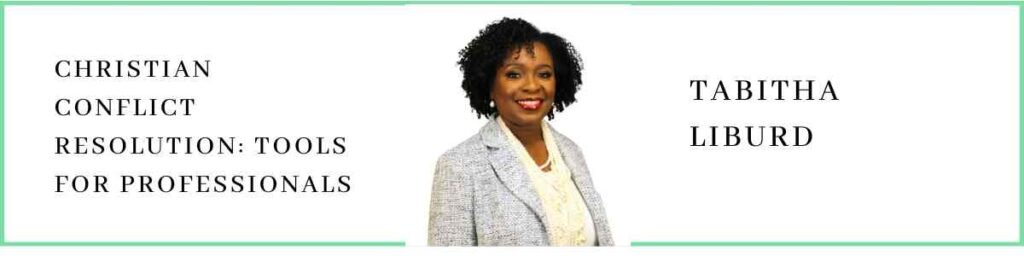
Tabitha Liburd, a conflict management strategist, discusses managing conflicts as Christians within organizational and personal settings. Tabitha shares her expertise on internal conflict resolution, emphasizing the importance of self-reflection, kindness, patience, and active listening. She references scriptures like Matthew 5:9 and 2 Timothy [2:24] to underscore the biblical approach to conflict. The conversation extends to handling conflicts in the workplace and business partnerships, highlighting the necessity of godly counsel, accountability, and the application of biblical principles. Tabitha also introduces her conflict resolution toolkit, designed to provide practical solutions for various types of conflicts. The episode concludes with resources and contact information for obtaining further guidance and the toolkit.
3 Takeaways
Understanding Inner Conflict: A Starting Point:
Conflict resolution begins within. Tabitha emphasizes that how we handle our internal conflicts significantly impacts external relationships. Referencing Matthew 5:9, “Blessed are the peacemakers,” she encourages believers to embody peace through kindness and patience.
Key strategies include active listening, mirroring others’ words, and gaining perspective before responding. Recognizing that conflict may stem from within us can lead to more peaceful interactions with others.
Applying Scripture at Work:
Navigating workplace conflict requires love, privacy, and accountability. Drawing from Proverbs 16:7, Tabitha advises against vengeance and grudges, urging mercy and peace-making. She recommends cooperative conflict resolution techniques, aligning with Matthew 18’s guidelines: address issues privately first, then with witnesses if needed.
In workplace settings, leveraging conflict resolution resources such as HR protocols or conflict resolution frameworks can be crucial. Dialogue, understanding, and scriptural foundations ensure believers reflect Christ’s teachings even in challenging work situations.
Business Partnerships: Balancing Professional and Personal:
Business partnerships often intertwine professional and personal stakes, elevating the potential impact of conflict. Tabitha emphasizes listening with God’s heart and speaking with His words. James [1:19] -20 underscores the importance of being slow to anger and quick to hear as partners navigate disagreements.
For Christian business owners, seeking godly counsel is pivotal. First Corinthians advises consulting qualified saints to find resolutions before escalating to legal measures, preserving both relationships and professional integrity.
ShowNotes
Click on the timestamps to go directly to that point in the episode
[02:11] Understanding Internal Conflict
[03:17] Biblical Guidance for Conflict Resolution
[06:04] Practical Strategies for Managing Conflict
[09:17] Real-Life Examples of Conflict Resolution
[12:19] Conflict in the Workplace
[22:17] Handling Business Partnership Conflicts
[29:02] Seeking Godly Counsel and Final Thoughts
[34:19] Conclusion and Resources
Get In Touch:
Tabitha’s expertise comes with a valuable toolkit for managing conflicts. It outlines types of conflicts and suggests specific remedies, allowing believers to prepare for real-world scenarios.
For those interested, her toolkit is accessible via her website or through LinkedIn. This resource is designed to guide Christians through conflicts in a way that aligns with their faith.
For those interested in sharing their own stories on “Chatting with the Experts,” reach out to Paula Okonneh through her website or connect via LinkedIn.
Paula: [00:00:00] Hello, and welcome to another episode of Chatting with the Experts TV show where I speak with amazing and impressive women from Africa, from the Caribbean, and in the diaspora. Our mission is to educate, empower, and inspire women globally, and that’s what these amazing women do with me week after week. I sometimes have a few men join us, but typically it’s women.
So today, it’s gonna be a very interesting show because our topic is When Christians Have Conflict Within Organizations and Within Themselves. And the person who will be doing, who will be joining me soon to do that is Tabitha Liburd. And I’ll tell you a bit about her. She’s a conflict management expert, [00:01:00] and so she will address the complex reality of navigating conflict as a believer in the workplace. I told you she’s a conflict management strategist, and she’s also a trusted advisor to senior leaders who navigate high stakes workplace challenges. Through her signature program, Resolution, Tabitha provides leaders with the tools to resolve disputes before they escalate to command authority without aggression and also teaches them how to create alignment without unnecessary friction. And so to do that is Tabitha Liburd. So welcome to the show, Tabitha.
Tabitha: Thank you very much, Paula. Thanks for having me. And hello everyone. [00:02:00]
Paula: Thanks so much for saying yes, I’m truly blessed when I say I have the best guests join me. And of course you are no exception.
Tabitha: Thank
you.
Paula: So we are gonna be talking about When Christians Have Conflict Within Organizations and Within Themselves and How to Cope with This. How do we do this? Let’s start off with ourselves. How do we as a Christian, make decisions within a situation when there’s internal conflict, as in within ourselves? How do we do that?
Tabitha: Paula, that’s a great question. You know, I always say that the road to conflict resolution starts within ourselves.
Paula: Mm-hmm.
Tabitha: Because whatever we determine to do can affect the outcome.
Paula: Mm-hmm.
Tabitha: Now, usually there’s someone else involved, but even if there’s more than one person involved in [00:03:00] the conflict or another person, we can determine our approach based on how we take care of ourselves internally. That is often very big contributor to how we manage conflict. And why I like to remind people when we are facing internal conflict and we know that we have to get to a place where we’re dealing with people. We can always help ourselves by remembering what Jesus says in Matthew five, nine. Blessed are the peacemakers, or they shall be called sons of God.
When we reflect on this, we can remind ourselves that if we actively work to restore peace, and we do that consistently, it’s a blessed calling. And so I like to advise [00:04:00] people to remember to approach conflict with kindness and with patience. Even when we are dealing with difficult people and when it’s time to take action, and you’re looking for a solution, you could look for strategies like active listening. Sometimes you’re afraid to say something because you don’t know what you are going to say, because remember, you’re dealing with conflict within yourself. And because you’re not quite sure what you may say in the moment, active listening helps to put you in a place where you’re focused on the other person. So if you’re listening, you’re not speaking right?
Paula: Mm-hmm.
Tabitha: Which means that you’re engaged with them. You can mirror what they say so that they repeat something back to them. Ask clarifying [00:05:00] questions so that you know that you understand them. And then you can take their perspective. So perspective taking, looks like trying to understand where they are coming from even before you decide what you are going to do.
So there’s conflict within you. Reflect on being a peacemaker. You can even put a little distance between your feelings and the response. Using active listening, mirroring, perspective taking, trying to understand where they’re coming from. And if you do that, it is easier to build your resilience, to help you to be patient, especially if you’re dealing with difficult people while you, yourself, Paula, have that internal conflict [00:06:00] that you’re trying to calm.
Paula: So trying to understand where the person is coming from before jumping to conclusions, in other words.
Tabitha: Yes, yes. Because many times we, especially if we are very experienced in the areas that we are working and dealing with, we sort of can understand what happens from beginning to end.
Paula: Mm-hmm.
Tabitha: In a process. And so by the time the person starts explaining, we begin to filter that information through the knowledge that we already have, but the end that we are anticipating might not be the end that we will arrive at. If we just sit with it for a while and sit with the person, we may be able to take in additional information that is [00:07:00] also important to coming to that decision, and that listening puts us in a place of rest and focus on the issue and on the person.
Paula: Okay. So you mentioned a scripture because we are talking about Christians. We mentioned Matthew, Blessed that the peacemakers.
Tabitha: Yeah.
Paula: For the child be called sons and daughters of God. But that’s as a peace. It is like blessed that the peacemaker that sounds like from the outside. So you are given a solution to people. But if we are. Having the conflict inside of us ourselves, you know, the conflict is within.
Tabitha: Mm-hmm.
Paula: Is there another scripture? That’s what I’m trying to, should be. I know there’s one up there about being kind and patient
Tabitha: To dig for people. Second Timothy 2 24. [00:08:00]
Paula: Thank you.
Tabitha: We can ask God to help us be kind and patient with difficult people.
Paula: Mm-hmm.
Tabitha: You know it’s in the scripture because he knows that it’s going to happen, and so he can direct us if we ask him and if we listen to him. And if we wait on him and we trust in him, he can show us how to be kind, how to be patient even when people are being difficult. Yes.
Paula: Yeah. Thank you for that answer. How to be kind, how to be patient even when people are being difficult.
Tabitha: Amen.
Paula: Mm-hmm.
Tabitha: Even when people are peopling.
Paula: I like that even better. People will be people whether we like that, whether we want them to be or not. I mean.
Tabitha: Yes.
Paula: All of us can be like that.
Tabitha: Well, I was about to say that [00:09:00] sometimes I’m like that. And when that happens, it’s such a blessing when someone extends grace to me.
Paula: Yes, yes.
Tabitha: And they’re kind of patient with me. And help me to resolve, you know, there’s some times when something may go wrong. I remember quite recently we had issues with the wifi after we switch providers, and I was not happy at what was happening because we were not getting what they promised us, and it was showing up in the way my recordings were when I go on Zoom, when I try to use multiple devices, and I was not kind and patient with the customer service rep. I was demanding the service that I was paying for and I was making sure that she heard me.
Paula: You displeasure, right?
Tabitha: Yes. And she was very kind and very patient with me [00:10:00] and at the end of it, I felt such an appreciation for her, which I shared with her. And then I also did a review because she extended grace with me when I was interrupted in the middle of my workday with this problem and realized that we were not really getting what we were promised and we’re paying for yes.
Paula: Yes. Understanding it from the other person’s perspective, you know?
Tabitha: Yes.
Paula: Yeah. And knowing that you too could be like that. I mean, when I say you, I mean any of us, because I’ve had to think about that recently. Someone was telling me about a situation, excuse me, where she went to her hairstylist, who was, she thought was being rude, but she was a Christian and she decided rather than, you know, say, okay, I’m gonna take my business elsewhere. She prayed and asked the Lord for guidance. Mm-hmm. [00:11:00] She was surprised when she opened her mouth and was saying some more pleasant things than she would’ve thought. And at the end of the service, the woman, it was so different, the woman was calling her darling and you know, sweetheart and offering her things and she said, you know, that was a clear answer to her that you know, when you ask God for help. He does help. And the woman was experiencing some difficult things in her life, but extending grace to her made such a difference. And now the relationship is different. I mean, yes, the hairstylist could have been more professional, but we are called to be the light.
Tabitha: Yes, we are. We are, and scriptures like this can really help to ground us in who we are called to be.
Paula: Yes, yes, yes. So what about [00:12:00] when, well, I just gave you an example of this young lady who said she went to a stylist and had, you know, ran into a very unpleasant person and at the end they were good friends because of she having to ask the Lord to help her. And of course, God gave her grace that she was able to extend to someone else. So now what about now when we are at work and/or yeah at work or in a business place?
Tabitha: Yeah.
Paula: What do we deal with conflict then?
Tabitha: Mm. Well, I like to say that as much as we don’t really like to hear this, conflict is inevitable.
Paula: Mm-hmm.
Tabitha: It can come in relationships, it can pop up in how we use or how we agree to use data. There can be conflict in the role that we have. We may be doing [00:13:00] something that we think is a part of our role, that it’s not. You know, it can be conflict in our systems, our processes. There’s so many opportunities for conflict to pop up at work, and what I always say is when this happens, look for instructions on how to address them with love, privacy, and accountability. And the instructions that I have at hand come from Proverbs 16:7.
Paula: Hmm.
Tabitha: Help us not to take vengeance or bear grudges even if we think we are right. Even if we know we are right at work, even if we are senior to that person.
Paula: Mm-hmm.
Tabitha: Who might be doing something wrong. Even if every single office policy on the subject says [00:14:00] that they were wrong, still help us not to take vengeance, be merciful in how we’re dealing with someone. Help us not to bear grudges if it were that others are at odds with us. Help us to love those who hurt us as ourselves. Help us to heap coals of fire on their heads. We can ask God to help us so that in our reactions to conflict, they’re pleasing to him, so that we can make even our enemies be at peace with us.
Paula, if God did not know that these situations would happen. He would not have put them in his word. There’s so much in his word, so much richness. So [00:15:00] many opportunities for us to take instructions when we facing conflict in our work. There’s another scripture, Matthew 18, and in verses 15 to 17, we see a roadmap for what to do if someone sins against us. It says, if your brother sins against you, go and tell him his fault. Let’s do that first between you and him alone. If he listens to you, you have gained your brother. But if he does not listen, then step two. Take one or two others along with you because you have witnesses so that every charge or every wrongdoing may be established by the evidence of two or three witnesses.
So [00:16:00] here, Jesus is giving us a way to resolve conflicts and we can do that at work. There is something that I advise businesses and entrepreneurs to put in their employee handbooks, and I’m actually embedding that into an employee handbook for a client today, and that is cooperative conflict resolution, and it really does parallel this scripture. It says, if there is a problem, work it out among yourselves. Do your best to discuss it first.
Paula: Mm-hmm.
Tabitha: And it gives you a little roadmap on what to say, and we train people on this. So I may not come to you and say, Paula, this is your fault. The scripture says, I must tell you this is your fault. You know, [00:17:00] but I may reflect it differently to you. I may say, Paula, you know, yesterday we were both using this resource and at the end of the day, you closed up and you left. I wasn’t quite finished, you see? So this is me telling you how what you did affected me, and if you listen to me, I have gained myself a sister. And if you decide that you’re not going to listen and you don’t agree, then we take one or two others. I could then go and I could speak to HR. And I could take someone with me and they could say, Paula, would you like to come along? We’re going. I don’t necessarily have to go behind your back and make it an issue.
Paula, I would like to discuss this with you in the presence of someone else. Are you okay talking about with it HR? We might need someone else to speak into this and help us. Yes?
Paula: Yeah.
Tabitha: [00:18:00] So I like to say when things like this happen. We have places to look for solutions, and when you are in conflict with someone in work or in business, you can speak to that person. If you can’t speak to that person or you don’t know what to say, you can talk to a therapist, a coach, a trusted person. Or you can even talk to me and I can help you frame language, frame neutral language on how to raise that conflict with someone at work or in business.
Paula: Good answer. So it’s all about… you said something about frame. Framing your answer, framing your reaction, your words. [00:19:00]
Tabitha: Mm-hmm. Yes. And it takes time. You know, Paula, it takes time and you don’t always get it right the first time. Maybe not the second or third time, but I believe that the other person would appreciate the effort that you take, because the fact that you’re ready to frame your answer and not just pop off shows me that you’re actually concerned about how I feel. And I would appreciate that. Yes.
Paula: The workplace, I’m just trying to picture, you know, the resources that are there, or people in general, but we are talking about Christians. So you know, you mentioned getting a therapist. So even talking to someone like you, a conflict resolution manager. I think I got that right. Yeah.
Tabitha: Yes. And just get a [00:20:00] second opinion on what happened, what you plan to say, how you were going to say it. Sometimes, the person who is not involved in this situation can see things from a different angle.
Paula: Mm-hmm.
Tabitha: Or even a little clearer than you are, and someone who is trained might be able to see issues that because you’re so personally involved, you are not able to see it. I do that, Paula, I talk to someone when I need help, if there’s an issue that I’m very, very close to.
Paula: Mm-hmm.
Tabitha: And it concerns me. I don’t always seek clarity and I talk to people. I seek help. I talk to a coach. I’ve, I’ve spoken to coaches, I’ve spoken to therapists, I’ve spoken to trusted friends.
Paula: Yeah. And as a Christian, you also revert back to scripture too, [00:21:00] right?
Tabitha: Absolutely. Yes.
Paula: Yes.
Tabitha: Always, always, always our blueprint.
Paula: Always a blueprint.
Tabitha: Yes.
Paula: Proverbs 16.
Tabitha: Yes.
Paula: Verse seven, I think.
Tabitha: Yes.
Paula: Help us not to take vengeance or bear grudges but to love those who hurt us as ourselves because we love ourselves.
Tabitha: Yes.
Paula: That’s the short about that. Wow. But it can be hard.
Tabitha: Yes, it is not easy. It’s not easy and I certainly would not say that it is. I know it has been hard for me to love people who hurt me as myself. It has been hard. I’ve had many, many opportunities to do that and to work towards that and it’s always a journey. Paula, for me personally, it’s always a journey. I don’t start where I’m I want to be, you know? So there’s a part of me, I start where I am and I [00:22:00] say, God, this is where I am.
Paula: Help me.
Tabitha: Help me.
Paula: So we spoke about dealing with inner conflict within ourselves. We talked about as a Christian, when you are in a workplace or business and conflict arises, how to go about doing it. Now what about now you are in a business partnership and conflict arises? It’s a little different when you know there’s HR and you are not the owner of the business, or you’re not in partnership. I mean, you’re an employee.
Tabitha: Yes.
Paula: That’s different. How do we deal with situations like that?
Tabitha: Well, Paula, first I just want to acknowledge to you and everyone else who’s listening, how difficult that situation can be.
Paula: Mm-hmm.
Tabitha: Because businesses are created to serve, [00:23:00] to live out our passions and our purposes, and also to provide for our needs.
Paula: Mm-hmm.
Tabitha: And so when there’s a conflict with our business, we face a conflict with our business partners. Sometimes, we can feel as though that is getting to the very root of our existence and sometimes it’s actually happening and I just wanna acknowledge that and let you hear from me that I don’t take it lightly because I understand how complicated that could be. A business partnership is a relationship that we enter into when we are at peace with each other. And so when there is conflict, depending on the level of conflict, sometimes those relationships are broken. And there’s a lot of [00:24:00] hurt that comes when relationships are broken. And when a business partnership relationship is broken or is hurting or is affected by conflict, I like to encourage that we listen with God’s heart, not ours.
I like to encourage that we speak with God’s words, not ours, because when we were in a good relationship with our business partner, that’s how we were speaking. And we understand that God wants us to be in relationship with each other. There is nothing that he has asked us to do that will be destructive to godly relationships, [00:25:00] to purposeful relationships, to relationships with people who are our purpose partners. In James chapter one, verses 19 to 20, God says, know this, my beloved brothers let every person be quick to hear, slow to speak, slow to anger. For the anger of man does not produce the righteousness of God. And when we reflect on this Paula, we understand how God wants us to address these conflict relationships. And I understand that sometimes we could be the party who has been wronged. Sometimes we may be the party who has done some wrong.
Paula: Yes. That’s about us, about that. [00:26:00] Because you know, many times we look at situations from our perspective, you know, this is what I meant, this is what I intended. Why did they take it this way?
Tabitha: Yes, yes, yes. And you know, I take it even a step further, sometimes we know that we have contributed to the problem, but we are defensive.
Paula: Mm-hmm.
Tabitha: So if I put myself in that position, I know that Paula and I are in a business relationship where I am supposed to pay Paula $500 a month. I have not done that for three months. And I owe Paula $1,500. And she comes and she says to me, sister. And she starts to ask me, I’ve been waiting for a while and I now have responsibilities. What I have to be careful is not to become defensive [00:27:00] to the point where I am finding reasons to be angry with Paula or I don’t like how she spoke to me. Yes, I know her. I owe her money, but I don’t like how she spoke to me or, yes, I know I owe her money, but she didn’t have to tell me that when so and so was around.
I don’t want anybody knowing my business. See where I’m going with this. Paula, if I owe you money, that’s a conflict with our business partnership. I should be the one to come forward and say something to you. I should be doing my due diligence and I should have you actively involved in this because this is a burden that I am now placing on you. You know? And so when you approach me, Paula, I must use this blueprint [00:28:00] in James one 19 to 20, and I must be quick to hear you. I must be slow to speak, and I must be slow to anger. Because my anger does not produce the righteousness of God. No?
Paula: Yeah. Sounds good. But you know, sometimes it’s, we know what to do, but we don’t do it. You know, I guess we have to be reminded.
Tabitha: Yes.
Paula: And we have to be intentional to say yes. Especially if, I mean, yes, we, this is all about Christianity and being the Christian in the workplace, so we have to remember who we are.
Tabitha: Yes. So true. That is so true. Yes, we do. We do. And there are times when we may need [00:29:00] encouragement. And there is a blueprint I found for that in first Corinthians.
Paula: Hmm. Yes. Can you share that please?
Tabitha: It’s in chapter six, verses one to two. And here’s what it says. It encourages us to seek godly and righteous counsel from qualified saints before going to law. Or before going to the authorities of our community. Seek godly and righteous counsel from qualified Saints. So if I know people who are qualified and I know that they’re godly, I should seek counsel from them. And Paula, in the scenario that I created with you and I, and me owing money. If I were to apply this blueprint, I would [00:30:00] seek godly and righteous counsel for someone who is qualified in whatever area I’m failing at, so that I can restore myself and meet my obligations that I have with my business partner with you.
You see? So if I need a financial advisor, if I need someone to help me with marketing, you know, if I need someone to help me with sales, whatever support I need so that I can meet my obligations, because a business partnership, Paula, is an agreement that we made. That’s an obligation that I can’t turn away from if I know whose I am, you know?
Paula: That’s, yeah, yeah, yeah. I’m thinking in particular when, I think I mentioned [00:31:00] that earlier, when you are the Christian, because you may be in a relationship though, the Word does say do not be on equally yolked, but it could be an instance where, you know, both of you were not Christians. You became business partners. Then you became the Christian, and now you’re in a situation where, well, you’re the one that’s Christian and let’s see, you act in a Christian manner, you know?
Tabitha: Yeah.
Paula: Yes.
Tabitha: Yes indeed. Yes, indeed. And when that happens, sometimes I should. Do a little digging. I always advise people who are in these situations where you’re in a conflict with your business partner, examine the situation.
Paula: Examine it.
Tabitha: Examine that situation. Take your blueprint, which is your Bible. Take your journal, spend some quiet time with God, because if you ask [00:32:00] him, he can show you what the root cause of that conflict is with that business partner.
Paula: Mm-hmm.
Tabitha: And when he shows you that root cause, you try to resolve it before you approach the courts. Because you know, we had our earlier scripture where we talked about in Matthew 18. If your brother sins against you, go and tell him his fault, and then if he listens to you, take another and along, you know, so we, we are looking at this from all of the different pieces of blueprint, Paula, all of the different aspects.
So find out the root cause. What’s the root cause of this conflict with my business partner. Involve your business partner in that discussion. Try to resolve it before you go to court. Once you [00:33:00] have discussions with your business partner, you go to qualified saints. You ask for advice, you get mentoring, you get coaching, you get counseling, whatever support you need. You know, Paula, we can never be too proud.
Paula: Mm-hmm.
Tabitha: To seek help. It doesn’t work well, it doesn’t end well.
Paula: Yes. Never be too proud to ask for help. We don’t know everything.
Tabitha: No.
Paula: But we know the one who does.
Tabitha: Amen.
Paula: I say that I don’t know everything, but I know the one who does. So I go to him. I humble myself on his mighty hand, and he says he will in due time, he will raise you up.
Tabitha: Amen.
Paula: Oh boy. You know, we could talk. I’m sorry.
Tabitha: I said, and I have experienced that. Yes.
Paula: Or maybe because of time. We probably can [00:34:00] discuss that more, I mean, with the audience who have joined us. But I know because can you believe it? We, we’ve almost covered 30 minutes of conversation. They say when things are good, you don’t even notice time is going by, right?
Tabitha: That’s so true. Time flies when we’re having fun.
Paula: It flies when we’re having fun. So do you, I know we’ve spoken about these three different instances. Because I know also that you’re a conflict management expert. Do you have a toolkit that you can share with us, that we can use, that we can have access to? Because yes, we may hear this today, but, Hmm. Probably tomorrow. In fact, after the show, we may now run into a conflict. At that time we’d like, what did she say again?
Tabitha: I do. I do, Paula. I can share it with you so that you can share it with listeners.
Paula: Mm-hmm.
Tabitha: I created a lovely toolkit that identifies the different kinds of conflict for you. It [00:35:00] even gives you a little definition, so if you’re not too sure what’s happening, you can read that definition and match it up against the circumstances that you’re facing. And even better yet, once you’ve done that, you have solutions for each kind of conflict. So the toolkit actually tells you if you see this happening, do this. If you see that happening, do that. And it gives you different options of strategies that you can use if you see the conflicts happening. So it’s a really great toolkit that you can keep handy close to you and just consult it if you run into anything and pick one of the solutions, pick whichever one feels right to you at the time.
Paula: I love it. I’ll drop the link in the chat. Yeah, and for those who haven’t been able to join us, but are watching this recording on either the TV show [00:36:00] or listening to the audio on my website and my audio podcast, or watching this on YouTube. Where can they find you online and get access to this toolkit?
Tabitha: You can go to my website, marshalldukellc.com and that’s Marshall with two Ls. That’s my family’s names, marshalldukellc.com. Or you can just connect with me on LinkedIn, Tabitha Liburd, and just message me. Hey Tabitha, I heard you talking about this toolkit. Can I have it and I’ll get it to you?
Paula: Thank you so much, and for those of you who joined us, either in the live audience or are listening to this, if you’d like to be a guest on the show like Tabitha has been, you can reach out to me on my website, which is chattingwiththeexperts.com. I’m also on LinkedIn as Paula Okonneh. I am on Instagram. [00:37:00] My handle there is at. I always forget this at chat_experts_podcast, and I’m also on Facebook as Paula Okonneh and we now have a YouTube channel. So reach out to us on YouTube. Just Paula, not Paula Okonneh for Chatting with the Experts has a YouTube channel and you can contact us there and we’ll take it from there. Thank you so much, Tabitha, for all your time today and for letting us know those of us who are Christians, how to deal with conflicts that will arise, not if, but when they do arise within organizations and also within ourselves. Thank you.
Tabitha: Thank you, Paula.