
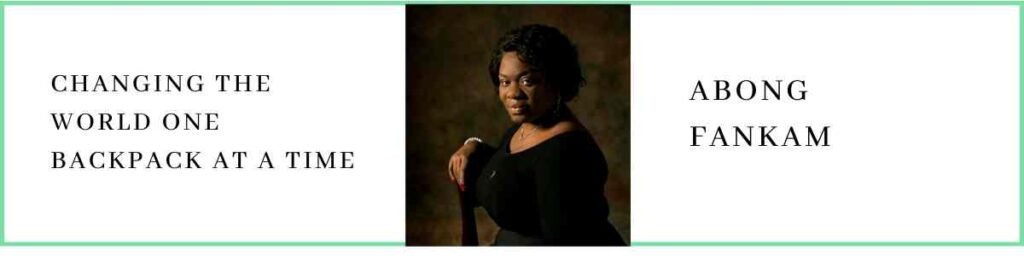
Abong Fankam discusses her work with the No Backpack Day Foundation. Abong shares the inspiring story of her daughter, Mongai, who at the age of eight, initiated the movement to help children in Cameroon by collecting backpacks and school supplies. This movement has since expanded globally, impacting thousands of children. They also discuss Abong’s own nonprofit, A Place of Hope, which focuses on aiding orphans affected by HIV/AIDS in Africa. Additionally, a fundraiser event featuring Dr. Auma Obama is announced for April 26, 2025, aimed at raising 10,000 backpacks for African children.
3 Takeaways
The Beginning of a Movement:
Abong’s journey began when her daughter, Mongai, recognized a gap that many overlooked. She saw countless children attending schools without the necessary tools for learning—tools that many take for granted. Motivated by the desire to improve educational experiences for these children, Mongai embarked on an initiative that would do more than provide backpacks; it would inspire hope, dignity, and opportunity.
Spotlight on Abong Fankam:
One of the notable contributors to this cause is Abong Fankam. As an advocate for educational accessibility, Abong has played a crucial role in amplifying the mission. Through collaborations and community engagement, she has helped bring attention and resources to the effort, ensuring more children receive the support they need.
No Backpack, No Problem:
As Paula succinctly puts it in her conversation with Abong, “No Backpack” doesn’t have to be a permanent narrative. It’s about flipping the script from limitation to empowerment. By supplying backpacks, Abong’s initiative does more than just provide physical items. It offers a sense of belonging and readiness that can transform a child’s approach to education.
ShowNotes
Click on the timestamps to go directly to that point in the episode
[03:40] – No Backpack Day origin
[06:15] – First school participation
[07:50] – National media spotlight
[08:30] – Global initiative growth
[10:10] – Purpose and vision
[11:30] – Inspiring other children
[13:10] – Fear of success
[14:30] – Power of saying yes
[15:20] – Place of Hope mission
[17:00] – Upcoming fundraiser details
Get In Touch:
For those interested in donating to the No Backpack Day Foundation, check out their website . For any further questions, reach out to Abong Fankam at abong@nobackpackday.org or Mongai Fankam at mongai@nobackpackday.org . Abong can also be reached through social media on LinkedIn, Facebook & Instagram.
For those interested in sharing their own stories on “Chatting with the Experts,” reach out to Paula Okonneh through her website or connect via LinkedIn.
Paula: [00:00:00] Hello everyone, and welcome to another episode of Chatting with the Experts TV show with me, Paula Okonneh, as the host. Every week I bring to you dynamic women from Africa, from the Caribbean, and in the diaspora, and what they do is together with me, we inspire, we motivate, and we educate women globally. My guests are always, I say they’re dynamic. They’re amazing. I love that word amazing. But even more importantly, they are professionals and successful business owners. They are women who are striving in every which way to make a difference in the world. So today, we are going to be talking about changing the world one backpack at a time, and with me to do that will be Abong [00:01:00] Fankam.
Before she comes on, let me tell you about her. Her story is one of faith, resilience, and unwavering dedication to children and families. She’s a passionate advocate and stands as a voice for the voiceless, spreading a message of hope, love and truth. She’s a devoted Christian and is an inspiration to those seeking God’s love, and she holds a special place in her heart for children. She believes in the unique power within every child because she sees them as lights of the world shining in God’s glory. Abong is the co-founder and vision keeper of No Backpack Day Foundation. I could tell you a lot more about her, but why don’t I welcome her to the show? So Abong, please join us on the show.[00:02:00]
Abong: Good morning, Paula.
Paula: Good morning. It’s great to have you here. I said. I always say snippets of my guest bio because people always have such incredible, and you know, such long bios with all your achievements. So if there’s anything that I left out, please feel me and my listening audience, or my viewing audience in with that.
Abong: Alright. Well, you did a good job with the bio, the introduction. The other thing is I like to let people know, even though I live in the United States, but I am a proud born Cameroonian. I am from Cameroon. Yeah. 2, 3, 7, it’s me. Yeah. Currently in Charlotte, North Carolina, and a mom to an amazing 22-year-old daughter.
Paula: 22-year-old daughter. Wow. You too young to have a 22-year-old.
Abong: That’s what I hear.
Paula: What’s too young? I thought your daughter was like 13.
Abong: [00:03:00] She is 22.
Paula: Wow. So you are the co-founder and vision keeper of No Backpack Day Foundation. Co-founder means there’s another founder. So tell us, give me the story, please, or give us the story behind No Backpack Day Foundation.
Abong: Hmm. Sure, I’ll be glad to do that , Paula. Like I said, I have an amazing 22-year-old daughter, and this is really her story. Her dream that God placed on her heart. I have been somebody who truly believes in the power of helping other people, helping other people exist, and, just sharing my gifts and sharing the things that God have blessed me with the least fortunate. So when my daughter… she’s called Mongai. When she was three years old, I took her on a trip to Cameroon, to help children that had lost their parents to HIV and AIDS. And that was my passion and vision at that time to help children that had lost their parents to HIV and AIDS.
So Mongai and I did what I call like annual trips to [00:04:00] Cameroon. And while I was out helping the kids in the different villages and different households, making sure that their needs are being provided for and they have a safe place to live. God was actually using Mongai in a different way, even though she was three at the time and younger. One thing that Mongai picked was that the kids not only walk long distance to school, but that they had to walk to school carrying their books in their hands or in plastic bags. And so God was gradually putting that into Mongai’s heart without me knowing that that was his plan for Mongai. As a mother, I thought, well, I’m just going to share my home country with Mongai for her to get to know where I come from, for her to have that connection with Africa.
But God, of course, had another plan for her. So when Mongai was eight years old, that was 13- 14 years ago. When she was eight years old , that’s when she birthed the stream. When it came to [00:05:00] fruition.
Paula: And she was eight.
Abong: Yeah, when she was eight. She was eight years old, a third grader at the time, and without my knowledge, without having any conversation with me, Mongai went to the school and told her teachers about the kids in the rural area of Cameroon that have to walk to school carrying their books in their hands in plastic bags. So the school decided that they were gonna help her get backpacks to those kids in Cameroon. And Mongai decided to challenge them to say, yes, we can get the backpacks, but why don’t we walk a day in their shoes? So why don’t we come to school one day without our backpacks and carry our books and school supplies in our hands or in plastic bags? So we get to feel, because it’s one thing about just giving, but when you get to feel, you get to have that experience of what it means [00:06:00] for a child not to have a backpack for nine months and they have to carry their books, they have to walk and sometimes it’s raining and they have to hold their books in your hands.
And even if it’s not raining, the more you hold it on your hands, the more it gets ruined. So their notes and all of that, they get lost. So the school decided that, yeah, we’re gonna do what we call now, no backpack day, where they’ll come for a day without backpack and carry their books in their hands or in plastic bags. That’s when the school contacted me. They’re like, Hey, we’re getting ready to do a no backpack day. I’m like, what’s a backpack day? And they explained the whole thing behind on what Mongai has been doing. Like for a whole week I’ve been sending my child to school. And during her lunchtime, she’s going from one class to the other and telling them about the kids in Cameroon that do not have backpacks. And so, I was like, okay, yeah, that’s a good thing. But I was skeptical, thinking that, well, these American kids, I don’t think they’re gonna want that experience to show connected, but lo and behold, I was surprised out of 900 students [00:07:00] in that school, 800 kids came to school that day without their backpacks carrying their books in their hands or in plastic bags to raise awareness.
Of course, the news was there, the TV crew with the, the televised Mongai, and she was on the news and other schools got whim of it. And they were like, oh, we wanna do a No Backpack Day. So in that first year itself, we had eight schools that did a No Backpack Day and donated 500 new backpacks and school supplies that we took with us that summer of 2012 to Cameroon and gave out to kids in need. And since then, 2012, this is 2025, 13 years after more than 100,000 backpacks have been collected, more than 50 schools have done a No Backpack Day, and backpacks have been sent to close to 20 countries, including Nigeria. Yes, Nigeria. 20 countries [00:08:00] in Africa. So that’s the whole story. It’s just like one little dream. This say one dream can change, a world can change a nation. And that is what she’s doing now. Changing the world one backpack at a time.
Paula: It’s so impressive.
Abong: Thank you.
Paula: Wow. Wow, wow. At eight years old.
Abong: Yes.
Paula: She had a dream. She had a purpose and she went about doing it. And what even is so impressive to me is that she did it without you, you know, without telling you about it. She got…
Abong: Exactly, exactly all on her own. All on her own. She surprised me. Yes.
Paula: Yeah. Wow. It would’ve been wonderful if we, if she could have joined us, but …
Abong: I know, yeah. But she’s at school. Yes. Busy with school at this time. Maybe another episode will be with her. Yes. [00:09:00] Mm-hmm.
Paula: So, you know, so talk about, you know, I mean, she had a dream and a purpose. Talk about, you know, the impact of following your dreams and your purpose. You know, now that you’re the co-founder, how have you seen that, you know, like unravel into some of the children that you’ve probably impacted in the Cameroon and how they in turn are able to follow their dreams and their purposes?
Abong: Mongai’s story has really been inspiring to a lot of younger children. And I think also I’m one of those people that I strongly believe that we are not in this world by accident. That God created us for a reason and for a purpose. In life, we all have a purpose. We come into the world with our hands closed, and I believe in that hand carries your dream, your purpose, but it’s now for you to find out what is your dream? What is your purpose in life? What did God create you to be? And for me, it was at the time in my life, I was a social worker at one time and I did the most difficult and challenging part of being a social worker [00:10:00] was doing investigation on child abuse and negligence. So I saw everything that it contains children, and children are special parts of my heart.
But then it was also overwhelming. So I started questioning myself. What is my mission? What is my purpose? And then came across a lady that really helped me to identify what it was and to write was, what is that one thing that if money is not an issue, that you would do it wholeheartedly? And to me, it was just children in need. It was children in need. So from there, I had a nonprofit on the site that was called A Place of Hope, and that was giving hope to children that had lost their parents to HIV and AIDS. And of course. through that, going back to Africa, Mongai has been able to also identify her own dream of giving back and making the world a better place for other children and inspiring other children.
Like when we go to these African countries and we meet children, they hear her story and they say, oh, this [00:11:00] is what I would like to do. You have encouraged me. There’s some kids that have come along. And done No Backpack Day in different countries so they can raise the backpacks and give to children in their community. The kids that have started something on the side because of what they’ve seen Mongai doing.
Paula: Wow. I’m still blown away by, you know, the impact of an eight year old’s dream.
Abong: I myself, I’m blown away. Every day I look at it, I cannot believe because yeah, she’s my child. I’m proud of her and what she’s doing. But I’m also happy that God is using her in a mighty way to give hope to children. And it’s just amazing how much recognition because when I look at her accolade, I’m like, wow. You are just 13. You are just 15, you’re just 18, you’re 22. And look at all of this. She’s had the support of Leymah Gbowee from Liberia who won the Nobel Peace Prize as she has endorsed her.
She’s had the support of African First Ladies. She’s [00:12:00] been to the Senate to talk to world leaders about, she’s been to the UN and I’m like, wow, just this little voice. Just this little dream. And that’s the importance of dream because it never goes away what you are called to do, it’s your choice to say yes to it or to say no. But it will never go away from you.
Paula: Right. You’re called, but it will never go away.
Abong: It doesn’t.
Paula: Yes.
Abong: Yeah. Yeah, we struggle with it. Fear. We are afraid to fail. Hmm. And sometimes we’re afraid to succeed. Yes. ’cause when we succeed, it puts us in a different level, right?
Paula: Yes.
Abong: And then when you succeeding, you come to realize that your tribe is shrinking. It’s shrinking. And because you don’t want to be in a small tribe, you wanna be in a big tribe. So you are afraid to succeed, to say what? Because you’re thinking, what are people gonna say? People are gonna start running away from me. So there’s a fear of failure. I don’t wanna [00:13:00] fail. And then there’s also the fear of succeeding, because when you succeed, it means the times that you’re gonna be all by yourself. But hey, you are called by God. You’re called by God to do it. Yes.
Paula: Indeed, there’s your strength and your source and you put those dreams and purpose. Purpose is in us, you know, and as Christians, we know that, you know, we can depend upon him.
Abong: Mm-hmm.
Paula: Guide us, to lead us, to instruct us, to show us the way to go and it takes a while, but sometimes when we understand that the purpose and the talents it comes from him, then we can depend upon him to do the guiding and hold our hands. That we’re not alone.
Abong: That’s right. That’s right. It does. To a younger child like Mongai, yeah, it took a couple of years. But the people that takes 20 years, it takes 30 years for them to finally identify what their purpose is in life. So, which every, it depends on each individual. Yeah.
Paula: Yes. So one of the things, I know you mentioned your own nonprofit, Place of [00:14:00] Hope. I know we are talking about changing the world one backpack at a time. But tell me a little bit about that, because that, that you are the founder of that one. Yes. Mm-hmm.
Abong: Yes.
Paula: So tell us a little bit about that.
Abong: The Place of Hope was founded in 2005. Yeah. And that’s when HIV and AIDS was a pandemic in Africa and children were losing their parents with HIV and AIDS. You had households that were being headed by minor children, and that really, really did break my heart. And again, just that my love and passion that I have for kids and being able to help kids here. And then thinking about the kids in Cameroon and different parts of Africa that do not have mommies and daddies. How can we help them? So I founded this organization called The Place of Hope, and the whole idea was to help children that had lost their parents to HIV and AIDS to make sure that they live in the house that is headed by an adult. And also that they enrolled in school [00:15:00] and their tuition are being paid for. So with that, we were able to raise enough tuition that we paid tuition for 758 orphans. And also was able to build a school in one of the villages in Cameroon. So that’s my life. That’s my story.
Paula: And what it makes me realize is that, you know, the apple doesn’t fall too far from the tree. So Mongai…
Abong: That’s what I hear.
Paula: So Mongai had you as a visible, you know, like a mentor or someone to look up to and…
Abong: Yeah.
Paula: Follow in your footstep because what she’s doing is, you know, very similar to what you are doing.
Abong: Yeah, exactly.
Paula: Overall, the same purpose. To help.
Abong: Yeah. To help. To help, yeah. Yeah. But again, it’s, yeah. One thing I’m happy, it’s she’s living her dream. She’s living what God wants her to do because there could definitely be an apple there [00:16:00] that she’s watching, but like, no, I’m not gonna do that. That’s your thing. I’m going away. But yeah, it’s like, yeah.
Paula: Absolutely. That’s so right. So I know off camera we talked about there’s something special happening in April.
Abong: Oh yes. So because of Miss Mongai, again, like I said, she’s had the connection and the endorsement with a lot of world leaders, First Ladies. She’s been invited to different African countries by African First Ladies. So now she is having a fundraise on April 26th. The goal is to raise 10,000 backpacks. We’re calling it 10,000 Dreams, 10,000 Backpacks. That will be sent to five different African countries. And the keynote speaker is gonna be Dr. Omar Obama. She is the sister of President Barack Obama. She lives in Kenya, but she’s coming here. She’s endorse Mongai and she’s coming to be the keynote speaker for the event. Thank [00:17:00] you.
Paula: So impressive. This is gonna be held in Charlotte. I’m assuming, or one…
Abong: It’s gonna be in Charlotte, North Carolina. The NASCAR Hall of Fame? Yes.
Paula: Alright, so those of us who are not in Charlotte, is there going to be a virtual version?
Abong: Hopefully, yeah. We’re thinking about doing a link. Yeah. And I can send you the link, and those who will not be able to make it in addition to that, feel free to support. You can still make a donation or a contribution online. Yeah. To help a child in need.
Paula: The link is gonna be in the chat so everyone who has joined will be able to look at it.
Abong: Okay.
Paula: On their own.
Abong: Okay?
Paula: Yes.
Abong: Amen. Thank you.
Paula: So, you know, all good things have to come to an end, unfortunately. So if anyone wants to get in touch, well, I put the link in the chat, but anyone wants to get in touch with you or with Mongai regarding this phenomenal job that she’s doing, changing the world, one backpack at a time. [00:18:00] Where can they find you or her, or who do you want them to contact? Her or you, or both of you? You’re the co-founder.
Abong: Yes, both of us, but more me because now she’s in school and getting towards the end of the semester and all of that. So I will be the appropriate person to reach out to now, but then the summer, of course it’s gonna be Mongai. And I can give you my email address or I’ll give you our email address.
Paula: Okay.
Abong: Which is, Abong that’s my first name. abong@nobackpackday.org. Okay. And then for Mongai, it is also mongai@nobackpackday.org.
Paula: Okay. And we spell Mongai M… Go ahead.
Abong: M-O-N-G-A-I.
Paula: Ok, mongai@nobackpackday.org [00:19:00] and you are abong@nobackpackday.org. Okay.
Abong: You got it? Yes.
Paula: Social media? Are you all on social media?
Abong: Yeah. Social media? No Backpack Day.
Paula: Okay.
Abong: On Facebook? Yes.
Paula: Okay. I guess LinkedIn and Instagram?
Abong: Yes.
Paula: Okay.
Abong: Instagram, IG? Yes. Yes. Yes.
Paula: Awesome. Well, yeah. Those of you who are listening and those who have joined us, I always say my guests are the best. Oh, that rhymes.
Abong: Thank you.
Paula: My guests are indeed the best.
Abong: Thank you. And you’re the best too.
Paula: Thank you. And so if you are a woman and I do also have men join us and would like to be on the show, please reach out to me on my website, which is chattingwiththeexperts.com. I’m also on LinkedIn. I love LinkedIn, as Paula Okonneh. On Instagram, you can contact me and my handle there is at [00:20:00] chat_experts_podcast. I’m on Facebook as Paula Okonneh. And I also have a YouTube channel. Just look for or subscribe to our channel, which is Chatting with the Experts with Paula Okonneh and, Mongai, not Mongai. I’m now calling you Mongai.
Abong: Abong.
Paula: Abong, thank you so much for telling us about this phenomenal foundation that you and you are co-founder of the founder being the phenomenal, wonderful inspirational Mongai. Thank you for joining us today to spread the word. And again, remind us about the date of the fundraiser. Is it fundraiser?
Abong: Yes, it is April 26th, 2025. NASCAR Hall of Fame, Charlotte, North Carolina from [6:30] PM to [10:30] PM. Come and have fun. Yes.
Paula: Thank you. Thank you so much.
Abong: [00:21:00] You’re welcome. Thank you, Paula. I appreciate you and Thank you for giving me this opportunity.
Paula: You are welcome. You’re welcome. And of course now we open up the floor to all those who joined us, ask you any questions that I might have missed out on so that you can tell them more about how to change the world, one backpack at a time.
Abong: Sure.