
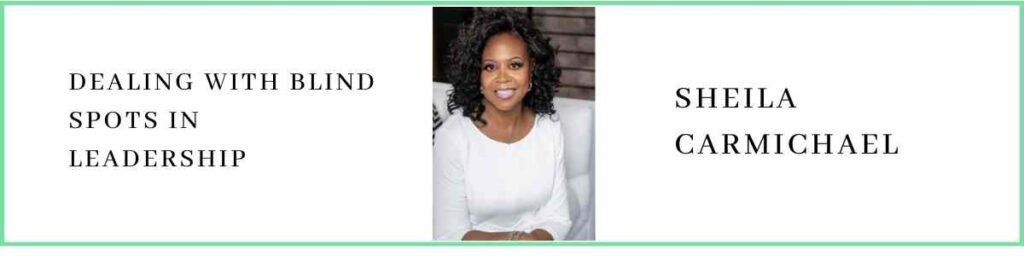
Sheila Carmichael, a strategic advisor and Master Certified Coach, known as the “Blind Spot Strategist,” discusses how leadership blind spots affect leadership presence. Carmichael describes common derailers for directors, VPs, and C-suite leaders: relying on the old competency playbook under stress, focusing on performance instead of influence, and waiting too long to speak up to avoid rocking the boat. She explains how promotions often shift scope, collaboration demands, and expectations without clear guidance, leaving leaders to “figure it out.” Carmichael discusses how “nice-nasty” cultures and vague feedback widen perception gaps, and how external coaching can help through diagnostics, self-assessments, and 360 reviews (including stakeholder interviews at senior levels). She shares her signature reframing question, “What is that situation asking of you?”
3 Takeaways
Common Leadership Blind Spots:
Sheila identifies several blind spots that professionals often encounter. One prevalent issue is the reliance on outdated competency playbooks, particularly among VPs and directors. Leaders often default to past strategies under stress, which may not align with current needs. Another frequent blind spot is the perception gap, where leaders focus too much on performance rather than influence and guiding team performance. The fear of disrupting the status quo and being perceived negatively can also hinder leaders from making a significant impact.
Diagnostic Tools for Leadership Enhancement:
To aid individuals in uncovering their blind spots, Sheila employs various diagnostics, including self-assessments and 360-degree assessments. These tools compare a leader’s self-perception with feedback from peers, superiors, and subordinates, highlighting discrepancies and unrecognized strengths.
Strategic Leadership and Organizational Culture:
Sheila also discusses how organizational culture influences leadership progression. The decision to promote often hinges on observed skills and the ability to tackle specific challenges at critical times. However, the rationale behind these decisions is not always communicated effectively to the individuals being promoted.
ShowNotes
Click on the timestamps to go directly to that point in the episode
[02:23] Top Leadership Blind Spots
[05:04] Promotion Without Playbook
[07:58] Why Sheila Does This
[08:54] Nice Nasty Feedback
[11:04] Neutral Outside Coach
[16:51] How 360s Reveal Gaps
[22:21] Internal vs External Coaching
[25:32] Signature Question Neuroscience
[29:33] Where To Find Sheila
Get In Touch:
If you’re interested in connecting with Sheila Carmichael, you can reach her via her website, via Instagram, via Facebook, or via LinkedIn.
For those interested in sharing their own stories on “Chatting with the Experts,” reach out to Paula Okonneh through her website or connect via LinkedIn.
Paula: [00:00:00] Hello and welcome to another episode of Chatting with the Experts where I speak with phenomenal women from Africa, from the Caribbean, and in the diaspora. We speak with a few men, but most times it’s women. And these women share my mission, which is to educate, to empower, and to encourage women all over the world. My guests I said they’re phenomenal. Yes, they are. Their bios blow me away and today’s there’s no exception. The title of the show today is Blind Spots in Leadership. And my guest who will join me in a few minutes says, your blind spots are impacting your leadership presence. My guest is a strategic advisor who helps directors and VPs [00:01:00] turn career limiting blind spots into leadership advantages.
With 30 years plus across seven Fortune 500 industries, more than 7,000 professionals coached, and with the master certified coach credentials representing the top 5% worldwide, she brings insider knowledge of what separates those who advance from those who plateau. Oh my gosh. She is phenomenal. And why don’t I do this? Why don’t I invite her to the show so she can talk with all of you about what she does. Welcome Sheila Carmichael, to Chatting with the Experts.
Sheila: Hello. Hello, Paula. Thank you so much. Well, what a beautiful introduction.
Paula: Oh my.
Sheila: Thank you for having me.
Paula: Oh my word, as I [00:02:00] said. Oh my guests. Your bios are so impressive, and yours of course is one of those You are named as the Blind Spot Strategist. I love that name.
Sheila: Mm-hmm. Mm-hmm.
Paula: So, and you mentioned that you’ve coached over seven, well, 7,200 to be precise professionals. So what’s that common blind spot that you see that keeps derailing them?
Sheila: Oh, my, there’s, you know. There’s so many that folks have, and they’re very unique to the person based on their own experiences, their culture, that internal dialogue that they’re having, the environment they’re working in. But there are quite a few common ones, and I’ll just name a few here. One of which, when I think about, VPs, directors, and even C-Suite, they’ve gotten to these roles and they’re playing to their previous competency [00:03:00] playbook. The playbook, the success playbook that got them there. And it needs to be re-engineered to fit at this higher level.
So that’s a common one there. When there’s stress and under pressure, they’re defaulting to what worked in the past. And that doesn’t always work well in the present. Another one deals with, the perception that they’re, what they’re dealing with, and I call this their perception gap, and this is really about, let me just perform, let me just do, if I just, if I just, I’ll figure it out. Just perform, perform, perform. And this level isn’t asking them to perform. It’s asking them for a higher level of influence to help others perform with the excellence that they have demonstrated over the years they got them there. Right? And then another one is sometimes, you know, human nature, Paula, we wanna be kind, we wanna be courteous, we wanna be respectful.
And again, [00:04:00] depending on your culture and your background and the environment that you’re working in and your mindset. I don’t wanna hurt anybody’s feelings. I’m just gonna wait before I jump in. Especially in corporations, you know, I just got this job. I wanna make my mark. I don’t wanna disrupt so much, and I don’t wanna rock the boat. And I don’t want people to see me as being the mean, vulgar, you know, whatever kind of leader. I want them to see me as a professional leader, and that gets in the way of them having more of an impact, influence. They’re waiting for the right moment to strike, and while they’re waiting, someone else is scooping up that opportunity to showcase what they bring to the table.
So that, those are the top three, I would say there’s many, many others, but those are the ones I see the most that come up. If only I can just wait. I’m waiting, Sheila, I’m waiting. You know, what do I need to do? What do I need to do? And you know, I know what I need to do. I just need to do what I’ve done in the past. It worked [00:05:00] before. It’s like, no. Those are common ones.
Paula: So what I’m hearing really and truly, like there’s not much preparation. So I mean, you are promoted based on what you were doing such a good job at. Yes. And suddenly you are in a position where they don’t want you to do what you did before. They don’t want you to enhance the performance of those for where you came from or those, you know, your subordinates and you don’t know how to do it.
Sheila: No. No, they didn’t give you an instruction book for it. And here’s the other thing, this is another common one that comes up that they forget that they were promoted because they did such a great job in the past. They were able to get things done, they were able to make it happen, and they collaborated with others at their appropriate levels for the level they were in to get that done. And like you just said you get to the higher level, the next level up, and sometimes it’s two or more. The scope and the [00:06:00] responsibility changes. The players in which you have to collaborate changes. The objectives are sometimes not always clear, so now you are trying it’s like you’ve been so accustomed to playing soccer. I am gonna use that as an example, right? You’ve been so accustomed to playing soccer and now we just threw you on a basketball court.
Paula: Oh, I love it.
Sheila: It’s a whole different uniform, different skill sets, different size ball, how you make your goals and the ways that you can make your goals. It’s so much more different. But nobody told you the rule book. Nobody gave it to you. Like, what’s your position? They gave you the title, but they didn’t give you any instructions around how do you play the difference between a point guard and a center? How do you play the difference when we’re defense or offense? They didn’t give you any guidance around [00:07:00] that. They are assuming because you figured it out before, you’re gonna figure this out now at a higher level. They have belief in you and a lot of times, they forget that they were chosen. I’ve been in these meetings where we discuss, you know, who gets slotted for the next role as it comes up, what are the things we need to do to accelerate their development, to be successful in that role, but the conversations to say, Hey, here’s where the gaps are that you will need for this role. Oh, they’ll figure it out. They’ll figure it out, and they’re not figured out. Some do. I won’t say all. Some do who can kind of help them when there’s a misstep or something like that, but many, quite many don’t have that.
Paula: And that’s where you come in.
Sheila: Yeah, I helped them get it.
Paula: So something must [00:08:00] have led to you seeing that in yourself there. You could see what’s wrong, something probably what stood out to you. I mean, you saw the problem and you realized, I can see the problem, but my colleagues don’t seem to be able to see that.
Sheila: Yeah.
Paula: What kind of got you there?
Sheila: You know, it’s a great question and I love it because I’ve experienced it myself. And there were roles in which I had some amazing mentors that would pull me aside and say, Hey Sheila, we need to have a talk. Right? And they were honest. They were candid, they were caring and compassionate. It wasn’t delivered the feedback like a sledgehammer, it was more to advantage me versus disadvantage me. It wasn’t given to strip me down. It was provided to build me up and I made an assumption that everybody got that in certain organizations I worked for, it was true that most people receive that.
Right? But in some other organizations, no, [00:09:00] it was more the reverse. Where people were not sharing, not mentoring, not delivering feedback in a way to advantage you. They were more so keeping quiet for their own blind spots. We don’t wanna tell them and make them feel this way. This nice culture, quote unquote, nice culture that I’ve seen in quite a few organizations.
Paula: Mm-hmm.
Sheila: I have a phrase for that, Paula. It’s like nice nasty.
Paula: That’s very propriate. I think,
Sheila: you know, it’s nice nasty. They think they’re doing something good and it’s like, it’s professionally wrapped, but what it’s really doing is taking away your own confidence. They’re not giving you enough or they’re not giving you anything, especially when you start receiving feedback like, oh no, you’re fine. This is how that always, it is not enough substance around it, and that’s two ways, as far as fault is concerned, the person [00:10:00] asking for the feedback is not asking specifically, and the person giving it is not giving it specifically. So now you’ve got this kind of casual light, nice, nasty conversation going, regardless of the motives it’s not helping.
It truly is not helping, but they think it is and it’s not on both sides. So what I do is I come in and I help them to really, you know, when it’s coaching to the individual or coaching for the team, the executive team. It’s really just to help with understanding and raising their awareness to understand what’s really going on. And it’s interesting when you bring somebody from the outside in, all ears are open. When the people on the inside try to communicate this, people shut ’em down.
Paula: Hmm.
Sheila: And I know that firsthand.
Paula: Hmm.
Sheila: I know that firsthand though, when you pay for someone to come in from the outside, [00:11:00] it gets heard. It gets heard. Yeah.
Paula: And I can see why.
Sheila: Yeah.
Paula: Because like from the inside, it’s almost like, okay, so you don’t like me or you are just, being extra picky or you want, you are jealous.
Sheila: Yeah.
Paula: But when someone from the outside comes in, they’re like, okay, this is neutral. I will listen. Because whatever they bring, they don’t know me from Adam and… yep.
Sheila: Exactly. Exactly. And I think that you’re so on point with that, Paula. The relationship you have internally, depending on where that’s at, can determine if that communication is gonna be good or not.
Paula: Mm-hmm.
Sheila: If it’s gonna be effective. If it’s gonna resonate. Right? And there’s a phrase, you know, a halo horn effect. Depending on how the receiver’s getting that information, they may anchor to it because they’ve seen you do some amazing things and they give you the halo effect. Like anything that you touch is gonna be gold.
Paula: Yeah.
Sheila: Then it could be the other, [00:12:00] maybe you had this one little misstep, hiccup and they’re holding onto it like a grudge. That’s the horn effect. Well, because they did this, she did this, he did that, whatever it might be, they’re anchoring to that versus seeing the person more holistically of what they bring to the table and that can interfere with communications. Evoking awareness of what’s the realities of going on inside the organization or for the individual, and even when I’m coaching them one-on-one, I can hear that same perception, that Halo Horn, you know, well, they never did like me. Well, they may not, but what if that’s not the case?
Paula: Right.
Sheila: You know, I’m coaching the person, you know that situation, so to speak, because I believe in the person, and I also believe Paula, I’ll say this and, and, and go ahead and pause. We all have unique gifts that we bring to the table.
Paula: Absolutely, yes.
Sheila: And when you have the right [00:13:00] mentor, the right coach. The person who’s got your back because they know you’ve got this from within, and that’s truly where my belief systems are, then you could help uncover those and see them and just re-engineer them in a way to be more strategic in how you want to choose to show up versus having it as a default that I just need to act this way and behave this way because that’s what I’ve always done.
Paula: Yeah.
Sheila: And I’m not trying to change you. I’m just trying to help you. Just like a car going in to get, you know, diagnostic repairs to see what belt needs to be adjusted or air in the tire or gas in the tank. I’m helping you to understand, to diagnose, what is it that you need in order for you to run at optimal speed, optimal performance.
Paula: So that brings me back to this question. So [00:14:00] now, are you able to help or see what it is that the powers that be I’ll just say that they saw in that person, what did they evaluate in that particular person that they felt that they needed, that that person needed to be promoted, that they now don’t seem to be able to nurture.
Sheila: Mm-hmm.
Paula: What is that?
Sheila: It could be so many different things based on the company’s culture, their processes for evaluating talent. Many times it’s anchored to their skills, knowledge, and experiences, and they kind of put them into a sheet or whatever format they use for their talent reviews, and they go, okay, based on what this job is needing, this next level is needing, who has most of what we need to fit into this? Also, based on the timing. If it’s an immediate thing that they have to come in and hit the ground running, or is there some [00:15:00] leeway to get them up to speed based on where their gap is? So it’s usually so many different things that can influence that decision. It could be that the reason they want this person in there, you know, sometimes they bring people in to turn it around.
Paula: Yes, true.
Sheila: Sometimes they bring people in to take what’s already there as a foundation and build it up. Sometimes they bring people in to blow it up, you know, so understanding the rationale behind the state of the organization and the skills that they observed from what was being demonstrated to say, okay, this is why this person was chosen. And I love that question, Paula. Because here’s the next question. Did they share that with the individual?
Paula: Just about to ask? Yes.
Sheila: And most times they don’t. I wish I could tell you there, I’ve worked for a few companies in [00:16:00] which it was revealed. But there’s, I don’t know what’s going on in some companies. I wish I could tell you it’s a cultural thing. Some companies err on the theory of, yes, we share folks where they are in our nine box framework that they use and where they’re at. And if they’re ready now, ready in 24 months, are ready, you know, 24 to 36 months, and here’s why we see them ready in their readiness level in other organizations, Paula.
Paula: No, no, no.
Sheila: We don’t tell no, Sheila. You’d be surprised what I say. Well, what have you shared with the individual to let them know about their readiness gap or, you know, where there’s opportunities for growth? Oh, oh, no, we never share the nine box placement. Well, what do you share?
Paula: Yes.
Sheila: You don’t share anything.
Paula: Now, so you come in, I know you’re a coach, so it can either be individual coaching or team coaching, right?
Sheila: [00:17:00] Mm-hmm.
Paula: So for the individual, how do you help them uncover that blind spot that no one has shared with them? You know?
Sheila: Yeah.
Paula: Because if it’s a team, then, you know, it could be, it’s a team. So we are talking… everybody’s there, but with the individual who just like feels there’s something amiss, I don’t even know what I’m doing wrong.
Sheila: Mm-hmm. Mm-hmm. Yeah. Like how do they uncover what it is?
Paula: Yeah.
Sheila: You know, the first thing is our body and our brains and the neural network that we hold. It is amazing. Something’s going off. Intuition is telling you something’s not quite right.
Paula: Something…
Sheila: You’re feeling this stress physiologically in your body, your mind is thinking. So I try to get some understanding around that. And then depending on your level and depending on the timing in the role. We will probably do a couple of different diagnostics, some assessments, some that might be self assessments, [00:18:00] just to understand who you are, how you operate, what’s innate for you, and where there may be ways in which to leverage the things that are not quite your comfort zone to get them more comfortable. And then we’ll also probably do what’s called a 360 assessment. So that’s your world, the way you see it in a self-assessment. But let’s check that against the way others are seeing it in multiple different areas. Let’s check it against the way your reporting leader sees it and possibly their the next two boss, right? Your boss, your boss’s boss. What about your peers who you have to interact with?
Paula: That’s good.
Sheila: Who you need to support you. And then what about the team that you’re expecting to help execute against your vision? So now we’ve got this kind of paneled mirror. If you’ve ever had something that needed to be tailored, I use this analogy all the time, and you go to the tailor and you’re trying to adjust the [00:19:00] suit or dress or whatever, and you’re standing on the pedestal and you’ve got these different panel of mirrors. So we need to check to see what’s the view from each of those mirror. Taylor’s seeing it one way you’re feeling and seeing it another, but what about the window of the boss and the boss’s boss? What about the mirror panel of your peers? What about the mirror panel of your direct reports and what about others who maybe you interact with in a different capacity to have a common perspective, maybe for projects or clients or customers or whatever it might be. And let’s see, based on those individual panel perspectives, what they see in you, does that match up the way you see it in yourself? And a lot of times, I’ll tell you, Paula, they have no idea.
They see some amazing things that they didn’t realize where they’re expending a lot of energy and things that maybe if they had placed it [00:20:00] somewhere else, it would help line up those perspectives better. But you need a coach to help you with that. Your boss can’t do your 360 and give you the interpretation. Right? And depending on the level, I then would recommend one of two options. There’s an online version. Then there’s also interviewing some key stakeholders. So depending on your role and your level, based on my experience, you know, the higher you go, we probably wanna do more interviewing style versus an online.
If you’re at the director and possible VP, depending on the structure of your organization, then that’s where you may wanna do an online. Depending on the role too and the scope of the role, a VP can go either way, depending again, but C-Suite, definitely, I usually do interviews with some key stakeholders just to get a diagnostic around that. And then I pull that information. It’s anonymous. There’s a difference between anonymous and [00:21:00] confidential. A lot of people say, oh, it’s confidential. No, I’m gonna share with my client themes and patterns, but I’m not gonna let them know where that came from. That’s anonymous. That’s how it also shows up on the online version too, if you’re using a reputable 360, which there are tons out there.
So it’s just a matter of knowing that this is strictly for the coach and their person who they’re coaching their client, and they’re going to look for those themes and patterns, build together a solid action plan, and then monitor and track to see how we’re, you know, executing against that plan and if there’s any adjustments that need to be made along the way. So you need a coach for that.
Paula: You too. You need to.
Sheila: A neutral person, not tainted by the culture of the company. Not influenced, by positions of power. [00:22:00] You need a coach for that.
Paula: Yes. And the coach as I think has to be someone that you bring in, like from an outside. Because you mentioned not being tainted by the culture.
Sheila: Mm-hmm.
Paula: And by…
Sheila: yeah.
Paula: Interpersonal relationships and…
Sheila: mm-hmm. Now, I will say I have worked as an internal coach in one of the Big Fours and other Fortune 500 companies.
Paula: Oh really?
Sheila: And it can work if the processes and communications are in place.
Paula: Hmm, okay,
Sheila: It can work. But there are certain levels in which I would not personally recommend an internal coach because of the sensitivity of that role. And if that person’s working there, and let’s say coaching a C-suite individual may be challenging, you’re gonna get influenced by that.
Paula: Absolutely.
Sheila: Yeah. So there are certain levels that that, [00:23:00] director, VP and C-suite, depending on how the organization is structured. That’s why I focus on that. It may benefit the organization more to have the external neutral versus someone who could be influenced, have a bias. Because they work there.
Paula: Because they work there. Yes.
Sheila: And it may be unintentional, it may be unintentional. But you’re not positioning your coach to be the best. If the communication strategy is not in place, the policies are not in place. The marketing of that function is not in place. If you’re approaching it, the Oprah Effect, everybody gets to coach that, that, that’s a… you can outsource that. Okay? Don’t do… don’t give that to a highly trained, skilled coach, that’s not what they need to do.
Paula: I agree.
Sheila: That’s my opinion. [00:24:00] There may be companies who are doing that just fine and God bless you, but when you’re working with these higher levels, these more strategic, influential levels, my opinion, I don’t think that’s where you best utilize your internal coaches. You use them for other things.
Paula: I would agree with you 100% on that.
Sheila: Mm-hmm.
Paula: It can get, I can see how it can get messy.
Sheila: It can get a little sticky unintentionally.
Paula: Unintentionally.
Sheila: By no fault somebody in the organization’s gonna reach out to that person, say, Hey,
Paula: can …
Sheila: You gimme some insights of what’s been going on in the coaching conversation? Like really? We went through this. No. And then what happens to the internal coach when they don’t, you know, release…
Paula: Certain…
Sheila: confidential information?
Paula: Yes. I think that it gets sticky.
Sheila: It gets sticky? Yeah, it gets very sticky. [00:25:00]
Paula: So, my God, this is so interesting. As I mentioned offline, when I first met you and spoke with you, I was leaning in and I’m still leaning in because this is how the world works. Corporations work this way. Organizations work this way.
Sheila: Mm-hmm.
Paula: And you know, for things to function properly, you’ve got to have someone like you being able to, point out just a little thing or it sometimes it could be the big thing.
Sheila: Yeah.
Paula: That’s in your blind spot.
Sheila: Mm-hmm. Mm-hmm.
Paula: So we are close on this. I know you mentioned to me that your signature question is always, what is that situation asking of you?
Sheila: Yes. Yes.
Paula: Why do you ask that question?
Sheila: Oh, Paula it’s, you know, ’cause I’ve studied a lot around neuroscience, not just within business, but in coaching.
Paula: All right.
Sheila: I’m just a geek around it because our bodies are amazing in the way they [00:26:00] process what we’re going through, and we actually have a default neural method that’s going to constantly be on looking for, is this safer, is it not? We’re just designed that way so I can, this question is not unique. I think it good coaches use this type of question and it’s to help you just kind of pause that default thinking of, are you safe into really exploring, coming more into your prefrontal cortex and saying, okay, let me think higher. Let me think differently because when I’m stuck in this, oh, I got to, I have to, I need to, you are reinforcing this stress behavior, stress thinking, but if we can shift you out of that place, it’s a transformational question.
And it can be used in different situations, whether it’s [00:27:00] personal or professional, to help you think differently, shift your thinking to get a different result. But if you’re caught and I don’t know, just take a moment. And I know people say, oh, that’s corny. Breathing is important. Your brain needs oxygen to think. So take a moment. Do whatever deep breathing exercise that you found works best for you, and ask yourself, what is the situation really asking of me? Is it asking for me to use a skill that I already have. Is it asking for me to learn something different? Is it asking me to apply what I have in a different way?
A coach can help you with processing that question more holistically versus just in your world based on what you feel is going on right now and I gotta react. [00:28:00] No, you can pause. Now, I’m not suggesting you do this when your house is on fire or you know, for safety reason, I need you to get out. Right? But at a work, work environment is the house really on fire here? You could take three to 30 seconds to pause with this question and let us sit with you and you’ll be amazed at how that just really pivots your thinking.
Paula: The deep breaths, as you mentioned, it may sound corny, but scientifically it has been proven that when you get more oxygen in…
Sheila: Mm-hmm, mm-hmm.
Paula: Oxygen supports life.
Sheila: Yeah.
Paula: Your brain needs that oxygen sometime, and the pause can be powerful. That helps you to think
Sheila: Yes, it does. When we’re in stress mode, Paula, we’re not breathing properly.
Paula: [00:29:00] At all.
Sheila: We’re trying to hold onto whatever oxygen we have to get ready to fight. Take it out, right, or run or whatever. Right? Fight, flight, freeze and fawn. We’re trying to do something to protect ourselves, but when your neural system and nervous system is at ease, it’s not worrying about that. Now you can think more openly. You can explore what are some other options to deal with this.
Paula: Other options.
Sheila: Mm-hmm.
Paula: They always are. They always are other options.
Sheila: Mm-hmm.
Paula: Well, my, but Sheila, I’d love to continue this conversation, but because we have people who have joined us and who would love to talk with you one-on-one, I’ll give you the opportunity to let people know who haven’t been able to join us, let people know where they can find you online. So that this conversation can be continued with you.
Sheila: Yes.
Paula: ’cause it’s needed.
Sheila: Yes.
Paula: So if we will, if someone was looking to [00:30:00] get in touch with you online, where can they find you?
Sheila: Oh my number one spot is LinkedIn.
Paula: Mm-hmm.
Sheila: You can reach out to me there, you can go to my website, which is sheilacarmichael.com. I’m also on Instagram and Facebook, but primarily, I will say it’s my LinkedIn profile as well as my site, my website.
Paula: Thank you so much, and for those of you who are in the audience or who are listening to this later on, just like Sheila has been a guest on my show, I’d love for you to reach out to me on my website if you’d like to be a guest, which is chattingwiththeexperts.com. Similar to Sheila, I love my LinkedIn, so you can reach out to me on LinkedIn as well. I’m also on Instagram. I handle this at chat_experts_podcast. On Facebook, I have a business page, so that’s Chatting with the Experts. [00:31:00] And please, please subscribe to channel, which is Chatting with the Experts. There’s so much you can learn. I have been learning. You can learn because the whole mission of this show is to educate, to encourage and to empower women all over the world.
Sheila: Yes.
Paula: Thank you so much, Sheila, for everything that you have shared. And now we’ll open up the floor to those who have joined us online so that they can speak with you and find out a lot more, much more than what I could have asked.
Thank you.
Sheila: Thank you.