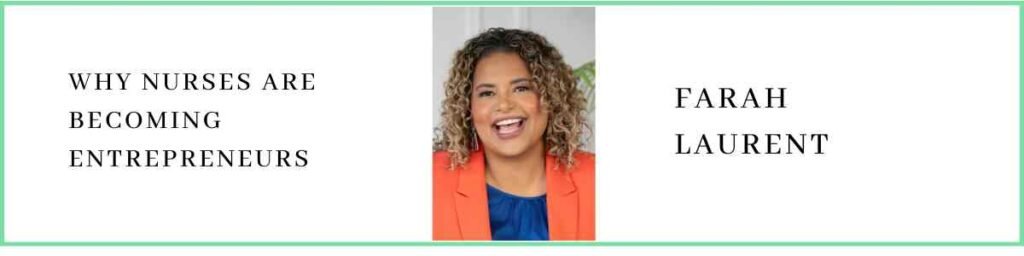
Dr. Farah Laurent, a trained nurse, nurse career coach, keynote speaker, and podcaster, talks about why nurses are moving into business and the many career options beyond bedside nursing. Farah shares her journey from Canada to New York City, including being discouraged from emergency nursing as a student, securing ER roles, working in the ER for 13 years, and later advancing into nursing education leadership (including roles as nurse educator, NYU clinical instructor, director of education, and associate dean). She explains that workplace politics, resistance to advocacy, and being laid off three times in five years pushed her toward entrepreneurship, which she defines as identifying market gaps and creating solutions. She describes building a nurse career coaching business to help nurses land specialty and six-figure roles, earning her doctorate while working full-time and raising young children, and becoming focused on business skills, personal branding, and visibility. Farah outlines business paths nurses pursue (coaching, consulting, education, speaking, private practices, telehealth, aesthetics/med spas, and IV hydration) and notes legal considerations in some models. She emphasizes business acumen, personal development, market research (including wait lists and being “oversubscribed,” citing Daniel Priestley), and community through mentors and masterminds, recommending multiple mentors inside and outside nursing. Farah discusses self-publishing her 2023 book “Nurses Making Money Moves,” launching the Nurses Making Money Moves Conference in under three months with attendees from 20 states, and announces the renamed Nurses Making Business Moves conference on March 6–7 in Tampa, Florida.
3 Takeaways
Overcoming Challenges and Discovering Entrepreneurship:
Farah recounts her experiences as an emergency nurse and educator, navigating through challenges and resistance in leadership roles. These obstacles eventually pushed her towards entrepreneurship. She explains entrepreneurship as innovation, problem-solving, and creating solutions, which aligns with her experience mentoring new nurses.
The Role of Education and Continuous Learning:
Discussing her academic and professional growth, Farah shares how she pursued her doctorate while juggling work and family responsibilities. She underscores the need for business acumen and personal development, particularly for nurses looking to transition into entrepreneurship.
The Future of Nurse Entrepreneurship:
With more nurses embracing consulting, coaching, and creating educational services, Farah underscores the potential for nurses to leverage their skills in business settings. She highlights various entrepreneurial paths, such as starting private practices and offering specialized services, demonstrating that the opportunities for nurse entrepreneurs are vast and varied.
ShowNotes
Click on the timestamps to go directly to that point in the episode
[01:23] Farah’s Origin Story: Proving She Belonged in the ER
[03:57] From Canada to NYC: Growth, New Opportunities, Bigger Vision
[04:40] What Nurse Entrepreneurship Really Means (and How Layoffs Sparked It)
[07:57] Building the Brand: Doctorate, Business Skills & Transferable Nurse Strengths
[11:19] Business Paths for Nurses: Coaching, Consulting, Private Practice & More
[13:01] Market Research 101: Waitlists, Validation & Avoiding Costly Mistakes
[18:37] Visibility & Trust: Personal Branding and the Nurses Making Business Moves Conference
[20:13] Community & Mentorship: Finding the Right Support System
Get In Touch:
If you’re interested in connecting with Farah Laurent, you can reach her via her website, via Instagram, via Facebook, or via LinkedIn. You can also book for her upcoming conference.
You can get a copy of her book here.
For those interested in sharing their own stories on “Chatting with the Experts,” reach out to Paula Okonneh through her website or connect via LinkedIn.
Paula: [00:00:00] Hello, and welcome to another episode of Chatting with the Experts Show, where I speak with fabulous women from Africa, from the Caribbean, and in the diaspora. They have one thing in common with me, which is it’s all about educating, encouraging, and empowering women globally. Today our topic is Why Nurses Are Moving Towards Business, and my guest who will join me in a second says, because you are a nurse, it doesn’t mean that you have to stay at the bedside forever. She should know this because she’s a, she is a trained nurse and she’s an also a nurse career coach. She’s a keynote speaker, a podcaster, and lots more. There’s so much to say about her, but this is what I’m gonna do. I’m gonna let her join me. And so with that, welcome Farah Laurent to Chatting with the Experts.[00:01:00]
Farah: Hi, I’m so excited to be here. Thank you so much for having me. Can’t wait to dive into this conversation. Thank you.
Paula: Yeah. You said because you’re a nurse or someone is trained as a nurse doesn’t mean you have to stay at the bedside forever. And you are saying that there are lots of options beside the bedside. Let’s talk about that.
Farah: Yes, yes, yes. So, you know, traditionally I think nursing, not even just within the US or Canada, ’cause I started my career in Canada, I think globally. The perception of nurses, when you see nurses, typically in the media or just the perception of nurses is they typically work in the hospitals, right? And this is what I want nurses to know and people that wanna get into nursing. There’s much more to nursing than just bedside nursing, right? So that’s, you know, part of my journey is what. Led me to want to [00:02:00] educate the public and also educate future nurses about their opportunities in nursing. So when I started in Canada, I had a clinical instructor. You know, very traditional old school. And when I, you know, she asked me, Farah, what type of nurse do you wanna be? And I said, I wanna be an emergency nurse because I love all the stuff, the action. And she literally laughed in my face and was…
Paula: oh no.
Farah: Yeah. And she said, Farah, you are too unorganized. You’ll never be an emergency nurse. You should go to medical surgical, which is typically where they tell new nurses to go. So in my head for a moment, I was like, wow, like how could she say that? Like she’s trying to crush my dream. So of course. I didn’t listen to that, and in my head I was like, wow, okay. Watch me lady. I will become an emergency nurse. And that was always my tenacity in my spirit. I’m like, [00:03:00] you know, you can’t tell me what I can and can’t do even as a student. And that’s where it all started. So not only did I secure an emergency position, I got two offers as a nursing student before I even passed my boards, my licensing boards in Canada. And then I started working in the ER two days after graduation.
Paula: Wow.
Farah: When all my friends were still just looking and applying. I was already working in the ER and this has kind of been the journey. And why I promised myself I would later become an educator and be a cool, fun educator to educate the next generation and inspire them. Yeah.
Paula: I love that. The cool, fun educator. Ooh, those three words, cool, fun, or two words. Sometimes people don’t associate that with nursing, but you are obviously the outlier. You’re showing them and letting people know it can be done.
Farah: Yes, yes, yes. And you know, when I went into the ER, [00:04:00] I worked in Canada for five years, left Canada and moved to New York City. I was like, I wanna go to a big city. So went to New York City. That was probably one of the best decisions I ever made. Because it took me out of my comfort zone, it made me grow in different ways and it really opened up my eyes to the opportunities not only just in nursing but beyond, you know? And that’s when my mind started looking at different options. Yeah.
Paula: Alright, so listening to you and having talked with you off camera, I know you’re very much into nurse entrepreneurship.
Farah: Yeah.
Paula: What is that and why should people consider it?
Farah: Yeah, so you know, going along in my career, I always did what was expected, right? Go to school, get the next degree. You know, I thought I would be in the ER for, you know, I stayed in the ER for 13 years, then I wanted to go into education, so I got the next degree, education degree. It took [00:05:00] me quite some time after I graduated from my Masters to get into education ’cause there was a lot of politics. It was very difficult navigating the job search, even though I was extremely qualified on paper. I realized quickly. You know, if you didn’t play the game, you know, if they didn’t really take a liking to you, it was very hard for you to get promoted.
So, you know, I moved around, finally got the opportunity to be an educator, moved along the ranks to become a leader in education. So I became a nurse educator. Then, I worked for NYU as a clinical instructor, which I love nursing students. Then fast forward became the director of education and that was my dream job.
Paula: Mm-hmm.
Farah: And that’s when I realized, wow, there’s a lot of challenges. The higher up you go in leadership and the impact you wanna make is not as easy as it seems. So there is a lot of [00:06:00] roadblocks. From an advocacy point when I would try to advocate, I was met with a lot of resistance and I’m someone who loves to… loves to talk in the C-Suites. You know, I would be the one, Hey, I have an idea. I don’t think we should do this. This is not safe. So I felt like my advocacy didn’t make me that popular, right? A lot of times I had to stand alone and stand firm, and that eventually actually led to me getting laid off three times in five years.
Paula: Oh no.
Farah: So it’s almost like entrepreneurship… I was pushed into entrepreneurship. So you ask the question, what is entrepreneurship? So to me, it’s innovation and it’s constantly looking at the job market to see what is the gap, what is the problem that really fires you up to say, Hey, I have a solution and I can bring this forth and create something out of nothing. [00:07:00] And that to me is entrepreneurship is really being business savvy. So what I saw is I always mentored new nurses and they kept coming to me for interview help and coming to me for the same issues that I had as a new nurse. So I was mentoring them, obviously for free and then I said, well, I could actually turn this into a business model.
And that’s where I started with the nurse career coach. I didn’t have that 20 years ago. No one heard of a nurse career coach, and that’s what I started doing. Was taking these nurses, helping them land six-figure roles right outta school, getting into specialty areas that they’re, you know, they keep being told that they can’t get into by recruiters. Almost like helping my younger self… you know, help pave the way for them and facilitating this for them. Yeah. But it was a lot of learning along the way.
Paula: Mm-hmm. Yeah. Talking about a lot of learning, because you are [00:08:00] actually Dr. Farah Laurent, not just Farah. So you didn’t stop at getting your Masters, you went on to get your doctorate.
Farah: Yes. Yes. And it’s funny because everyone thought I was crazy. I was in school for my doctorate working full-time as a director. My daughter had just turned a few months old and my son was four. And as I was seeing these challenges in the workplace, I thought, wow, you know, I got all these degrees, I got all these certifications, I’m doing the right things, but there’s no job security, right as you climb up the ladder. So that’s when I said, you know. I don’t want to have to depend on one employer anymore and let it like be uncertain, so let me build something of my own. So I started creating content to help these new nurses. I started building my brand, right, my personal brand, and then I [00:09:00] started really diving into business, business skills so that I could learn the fundamentals of what, you know, how do you grow a business?
Even down to the terminology, because it’s very different, obviously, than the nursing industry. And that’s when I was obsessed, you know,
Paula: Say obsessed.
Farah: Obsessed with business because you know people, you know, traditional. Traditionally, they’re like, oh, you have young kids, like, I don’t know, you’re going to school and you’re trying to start a business. But as you know, right, when you have kids, I feel like you have a different drive that really kicks in. And to me, I was just of being told what to do and didn’t wanna work for anybody anymore.
Paula: So there’s a trend here. Don’t tell Farah what to do. Tell her if you want to get her started, tell her not to do it and she’ll show you that she can.
Farah: Yes, [00:10:00] yes. I think that’s a big drive. And I find a lot of critical care nurses like ICU nurses and emergency nurses, all nurses, but for some reason. Those two type of nurses because we’re very adaptable. You know, we deal with life or death, so we’re really comfortable under pressure. So I think these types of nurses do really well in business because we’re so adaptable. And if you think about all the nursing skills, people skills, problem solving, they’re all transferrable to business. And this is why I think so many nurses are now just taking their skills and transferring it over to starting their own businesses.
Paula: I love that. Taking what you are being trained for and then applying it, because business really is about seeing a problem and solving it.
Farah: Yeah.
Paula: Problem solving. Looking to see, okay, what is it that the people need? I’m giving it to them. And you saw that [00:11:00] through nursing. You know, as you mentioned earlier on, you had a lot of young nurses or student nurses coming to you and asking you like how to go about, you know, certain things, passing the exams or…
Farah: mm-hmm.
Paula: Whatever might have been. And you saw a business opportunity there.
Farah: Yeah. Mm-hmm. Mm-hmm. Yeah. And you know, a lot of nurses are also doing you know, different options in business or consulting.
Paula: Mm-hmm.
Farah: And coaching because those are easy businesses to start because they’re service-based business. There’s not a lot of overhead to start. A lot of nurses or just people in general have misconceptions about business. They think that you need a massive amount of money to start a business, but that’s not necessarily true. Literally it could just take a couple hundred dollars for you to register your business, right? And then also from the clinical side, a lot of nurse practitioners are starting their own private practices, telehealth practices, which is [00:12:00] helping with primary care, which is, you know, a big issue in the US. And then they’re also going the aesthetic route. There’s a lot of med spas. A lot of these IV hydration businesses which is very a little bit more complex because some states require you to have a physician and, you know, so there’s a lot of legal aspects to business as well if you do wanna start a business. But for me, I think the easiest way is to do consulting, coaching, or some type of education where you could just provide already what, you know, your intellectual property. And then also speaking, a lot of nurses are getting speaking engagements where they’re getting paid. So yeah there’s a lot of options out there.
Paula: Oh, great. Because I was just about to ask you how to go about that. So thanks for answering…
Farah: Yeah.
Paula: That question, the importance of having business acumen and investing in personal development.
Farah: Mm-hmm. Yeah. Yeah, that’s [00:13:00] absolutely necessary. You know, when you first start in business, you might have a business idea and you keep thinking it over, like, I’ll give you an example. So the third time I got laid off was I was an associate dean of a nursing program. And it was kind of unexpected. I was only in the role for a few months. I won’t even get into details, but I almost felt like it was, they did me a favor by letting me go.
Paula: Look. I said it, I said it. Don’t ever challenge Farah. She will prove you wrong.
Farah: But, you know, let’s take it back to God in faith for a moment. I truly believe that sometimes some doors close because you’re being redirected to your purpose and I truly believe. I joke about it, I’m like, I think God is trying to push me more into entrepreneurship and telling me, Hey, you have something bigger to share, a [00:14:00] bigger impact and you need to do it in a different way. And the third time that it happened, I actually started laughing and I just couldn’t believe it. And I said, whoa, okay. And I said, alright, so what’s next? You know, because that’s the type of mentality that nurses have. Specifically as a ER nurse, you know, we have to just keep it moving and do what’s next.
So when I got laid off and we were moving actually to Tampa, Florida, I knew no one in Tampa, Florida. I said, well, what can I do? So I continued my coaching, but I said, you know, I’ve always wanted to do an event for nurses. So many nurses have been coming to me asking me, Hey, how did you start your business? How did you become a nurse career coach? Do you have to get certified? Did you have to go to business school? So I wrote a book called Nurses Making Money Moves in 2023.
Paula: Let me write that down and we’ll drop that in the show notes,
Farah: [00:15:00] Oh, yeah I have it right here.
Paula: Ooh, that’s so.
Farah: And I self-published because I looked at publishing options. It was too long, too costly, so I just did it myself, and I did it literally in a couple weeks and had it published for a conference I was speaking at. So based off that book, I always said I wanted to do a conference. People kept saying, you can’t do it. It’s gonna take a year. Like you can’t just pull it off on your own. So then in December of 2024, something just kept nagging and it was like, do it. It was like I just couldn’t fall asleep. And then I was like, okay. Literally within two weeks, I called a couple people and I was like, what do you think? They’re like, yeah. They’re like, that’s a good idea. And then there was one lady who was in business for a long time. I was excited to talk to her and she said, yeah, you know, if I were you, I wouldn’t do it. She said, you need a year. It’s [00:16:00] the holidays, it’s Christmas, new Year’s is around the corner. No one’s gonna come. But she’s like, you know what? I don’t parade. Go ahead if you think it’s gonna work. But if I were you, I wouldn’t do it. So I hung up the phone. I was like, cool, I’m doing it.
Paula: What did I say? Don’t tell Farah she can’t do it. And you did.
Farah: So literally within two weeks I had the venue booked, all the speakers booked. And started selling tickets and it was called Nurses Making Money Moves Conference. And it happened in March, literally in less than three months, I planned the conference, had 20 different states represented, and about 80 nurses and other entrepreneurs showed up. And that’s how that was born, right? From your question I hope I answered it, but that was the example because a lot of times we want to start businesses that we want to start, but before you start it, [00:17:00] you have to do some market research.
Paula: Yes.
Farah: And ask some questions and see who the viable potential clients are before you go and invest all this money to do the business. Somebody that I love to follow is Daniel Priestley. I don’t know if you’ve heard of him, but he’s a serial entrepreneur. He’s based out of the UK. But he talks about something about creating wait lists and he talks about the concept of being oversubscribed. So he says, you know, he’s built his multiple businesses to like millions and millions. And he also coaches other millionaires and he says, before you start a business, put out a waiting list to see if the people want that type of whatever business you’re launching. And if you get at least 150 people who sign up for your wait list, then that gives you an indication and a signal that, hey, people [00:18:00] are interested. Go ahead and, you know, write the book or do the launch or whatever. And I think that’s a great idea because you know, you have to have some type of data before you go on and create something nobody wants.
Paula: I love that. Put out that waiting list ’cause and see if people are interested. I think that’s market research 101. Business 101.
Farah: Yes.
Paula: Don’t put all your eggs. And you know, just because you love it doesn’t mean it’s a problem that is out there that people want solved. You may think it’s…
Farah: right.
Paula: I love that.
Farah: Yeah.
Paula: And I’m sure that’s what you teach and you
Farah: coach.
Yeah. And yeah. And the other bit of it is ’cause I do mentor some aspiring nurse entrepreneurs. Of course, the conference again is happening in March, March 6th and 7th. Nurses Making Business Moves. I changed the name. Some people were upset, but I changed it just because I thought maybe for sponsorships, people might understand it a little better. Nurses making business moves [00:19:00] so that they understand that it’s educational, you know, giving nurses entrepreneurial skills and mindset, whether it’s in their career or starting a business. But nurses need to understand too that you can have a business idea. It could be great, but if no one knows about it, no one’s gonna purchase. So this is why platforms like yours, having a podcast, building a personal brand, speaking on stages, going to conferences, you have to be visible.
Paula: Yes.
Farah: And you have to create a personal brand so that people can know you. And the foundation of all that is to create trust.
Paula: Yes.
Farah: So that people can get to know you and see, hey, yes, I like the, you know, this person’s values and I wanna support, or I wanna be a part of what they’re creating or building. Yeah.
Paula: Because that like and trust factor is a [00:20:00] big part of business success. People have to, even if they don’t know you, they have to like you. And then when they like you, then they follow you and they get to know you. But there has to be trust. And that brings me to my final question about community.
Farah: Mm-hmm.
Paula: I know that, you know, whenever, when one has a business and one has a business like yours where you are coaching and budding nurses to go into business to become self-employed.
Farah: Yeah.
Paula: It helps if they sometimes are in a group setting.
Farah: Mm-hmm.
Paula: So how can you encourage them to, you know, find a community that will help them grow?
Farah: Yeah, so definitely you know, I’m always a big advocate of finding mentors and not just having one mentor. I believe people should have multiple mentors, and if you are a nurse, I think you should have mentors outside of nursing, [00:21:00] right? So…
Paula: Like that.
Farah: A couple of people have described multiple mentors, right? But you should have someone in all aspects of your life. Like you should probably have a mentor that’s more like a relationship or you know, type of mentor that kind of guides you. And then also financial, somebody who’s really good with finances. And then, you know, obviously from the clinical standpoint, that can help guide you along your career. And that’s where I come in, you know, I’m a mentor and also a nurse career coach that helps nurses to make the right career path decisions so that they don’t waste time and to think, you know, oh, I have to wait before I can do this. No, you don’t have to wait. You could just jump right in and do what you want.
Life is so short. Why would you want to wait forever? So mentorship is important, and investing in coaching is important like I mentioned. Whether you wanna start a business or you want to grow in your career, not only do you have to do personal [00:22:00] development and nursing like skill wise. We do CPR, we do this and this, but we also need career development and that other type of growth. And that’s how I’ve grown as a nurse and as a business leader. And also being in community. A lot of times when we start businesses, we do it on our own.
Paula: Yes.
Farah: But once we start getting into business masterminds, getting coaches, and this is why I built the community, Nurses Making Business Moves.
Paula: Businesses. Love it, love it, love it.
Farah: On social, yeah, on social media, I create a lot of content. Eventually I’ll do a proper community. But that’s what it is right now.
Paula: And on that note, for those who are listening to this or viewing this after the live stream, how can people get in touch with you, Farah?
Farah: Yeah, so the best way to contact me, I would say, is through LinkedIn. That’s where I’m always very active. So you could just send me a direct message. [00:23:00] Or you can also go to nursefarah.com. There’s a section there where you can actually book a call if you wanted to book a call with me. And if you’re a new nurse, I also do a weekly webinar. It’s a free webinar and you can subscribe to see when the next webinar happens. Go to newnursejob.com where you can sign up and join me in my free webinars and of course, nursesmakingbusinessmoves.com. You can come meet me in person at the conference if you’re able to March 6th and 7th in Tampa, Florida.
Paula: Lovely, lovely, lovely. And for those of you who just heard that she’s having this event in March, March 6th and seventh, I also want you to know that she’s going to be on my summit, which runs from March 9th through the 14th. She’s gonna be one of our speakers, and this summit is a virtual summit, and it’s primarily for women. So it’s for you [00:24:00] if you’re a woman and you wanna step into leadership. We’re all shrinking back as you’ve heard, Farah talk. If you want to increase your income without burnout, it’s also for you. You want to build bold visibility and speak with authority just like Farah did. And last but not least, be in a community with other powerful, professional and even non-professional women ’cause we have entrepreneurs in the community as well. If this is you, make sure that you join us for the virtual summit called Empower to Excel, a virtual summit for women entrepreneurs and professionals, and it runs from the 9th of March through the 14th of March. I will drop that link in the chat. Thank you so much, Farah, for being a guest.
Farah: Thank you.
Paula: On Chatting with the Experts. And now let’s open up the floor to those who have joined us in the live audience and want to have a chance [00:25:00] to speak with you. I won’t be selfish. I’ll share you with them. Thank you so much.
Farah: Thank you so much for the opportunity. I really appreciate it and I’m excited about your event. Thank you again.
Paula: I’m blessed to have you and everyone who has joined us today. Thank you for joining.
Farah: Thank you.