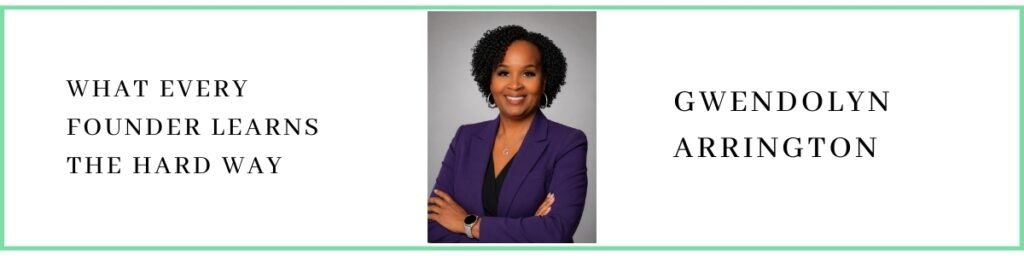
Gwendolyn V. Arrington, founder and CEO of Arrington Innovative Solutions, talks about scaling businesses by addressing the real bottleneck: the owner. Arrington explains that growth stalls when all execution and approvals run through one person, and advises operating like the larger company you aim to become by delegating, hiring the right people, training, documenting repeatable processes, and empowering teams with trust rather than shifting the bottleneck to approvals. She also discusses her commitment to increasing girls’ confidence in STEM through camps, scholarships honoring her aunt Jimmie Nell Perkins, and potential internships, emphasizing the power of exposure and positive impact. Arrington adds that AI is a “friend” that boosts efficiency and communication skills, urging “always be learning” based on her experience from early wireless technology through 5G.
3 Takeaways
Understanding the Bottleneck in Business Growth:
Gwendolyn stresses the importance of recognizing that often, as business owners, we become the bottleneck in our business’s growth. The conversation highlights that if every decision and process flows through one individual, that limits the business’s ability to scale.
By building a capable team and learning to delegate, business owners can overcome this challenge. Gwen notes, “Your business can only grow as far as your capacity if everything relies on you.” This emphasizes the role of strategic delegation and trust in a team to foster lasting growth.
The Power of The Right Team:
A significant part of overcoming bottlenecks involves picking the right people. Gwen advises, “If you’re the strongest person in your circle, it’s time to get a new circle.” This means regularly evaluating your team to ensure a dynamic environment that supports growth. Gwen’s analogy of the fishbowl illustrates this well: expand your circle to expand your growth potential.
Empowering Women in STEM:
Gwendolyn is deeply passionate about mentoring young girls and women in STEM. She reflects on her own experiences growing up, noting the lack of encouragement for girls to pursue STEM careers. She emphasizes the importance of representation and mentorship, like the influence her aunt had on her as a young girl. Through initiatives like scholarships and STEM internships, Gwen actively changes the narrative for future generations.
ShowNotes
Click on the timestamps to go directly to that point in the episode
[02:58] You Are the Bottleneck
[04:45] Delegation and Building Trust
[05:56] Hire the Right Circle
[07:45] Operate Like the Future
[10:00] Document Train Empower
[13:22] Women in STEM Mission
[15:09] Aunt Jimmie Nell Legacy
[18:24] Scholarships and STEM Camps
[24:47] AI Is Your Friend
[28:00] Tech Evolution Lessons
Get In Touch:
If you’re interested in connecting with Gwendolyn Arrington, you can reach her via her website, via Instagram, or via her LinkedIn.
For those interested in sharing their own stories on “Chatting with the Experts,” reach out to Paula Okonneh through her website or connect via LinkedIn.
Paula: [00:00:00] Hello folks and welcome to another episode of Chatting With The Experts where I speak with phenomenal women from Africa, from the Caribbean and in the diaspora. Every week we meet and these women share my mission which is to educate, empower and to inspire women globally
Our show is titled
Scaling Your Business: Understanding the Real Bottleneck, and my guest will be joining me in a few minutes. She says that you are the bottleneck impacting the ability to scale your business. She is the founder and chief executive officer of Arrington Innovative Solutions, an AI and enterprise, enterprise technology firm that transforms complex business and operational challenges into practical, [00:01:00] scalable solutions.
She’s had more than
.30 years of leadership across utilities, telecommunications, smart grid, advanced metering infrastructure, cybersecurity, analytics, software engineering, and enterprise transformation, and she has led multi-million dollar portfolios and, uh, delivered measurable operational and financial results.
I could say so much about it. Like all of my other guests, her bio is impressive. Welcome Gwendolyn V. Arrington to Chatting with the Experts.
Gwen: Hello, hello.
Paula: Oh my word, you’re another one of these amazing women. Look at your bio. Oh my gosh.
Gwen: Thank you. It’s just, you know, and it’s so funny ’cause when you hear somebody else talk about [00:02:00] it or read it, you don’t realize the impact that you’ve had or the contributions that you’ve made until somebody actually says it like that, so.
Paula: You’re so right. You’re so right. Sometimes we need to hear it to believe it, and then when you, you know, and when you hear it and keep hearing it, you’re like, “Wow, that was me.” So all- Yeah … all those years you spent doing and getting all these credentials have been worth it. I commend you.
Gwen: Thank you.
Thank you. Thank you very much. It’s been a long journey, a fun one ’cause I’m, I’m still a nerd and a techie at heart, but I also like leading and empowering people and helping them grow. So it’s been, it’s been a wild ride, and I’m still on it.
Paula: That’s what we need, to be still on it and to be loving it as you’re still on it.
Gwen: Yes, that’s true. That’s very true.
Paula: So one thing that [00:03:00] you said is we, as small business owners, and even those who are not small business owner, people who are aspiring to be small business owners, they are the bottleneck impacting the ability to scale. Tell us more.
Gwen: So, um, and I’ve been guilty of it, and it depends on what…
I’m, I’m still a little guilty of it, but you and, your business can only grow as far as your capacity if everything that you’re doing or everything that your business does relies on you. So if everything has to go through you, you have to do everything, and that’s the cycle, like when you’re first starting out.
You’re kind of building. Mm-hmm. You’re doing everything. You’re figuring it out. You’re figuring what out, what works, what doesn’t work, um, what services you wanna offer. Like, you can [00:04:00] have a thousand skills, but what are the skills that, just because you have all of these skills does not necessarily mean that your business should be offering those skills.
Um, So you need to figure out what’s the best thing to do, what works, what can be sold, and what is scalable. But you can’t make everything rely on you. And so the whole phrase of you are the bottleneck, it means that if you, if everything in your business pipeline flows through you, then you’re gonna be the reason.
Your business can only grow as far as you can.
Paula: Mm-hmm.
Gwen: So to solve that or to address it is you have to be comfortable with delegation. You have to be comfortable with trust, like building, you have [00:05:00] to build a team. Mm-hmm. Um, and so part of that is that we’re so scared to move out of that comfort zone into, okay, I need to bring people on, but my business is not there yet.
Paula: Mm-hmm.
Gwen: But it won’t get there if you don’t. So you have to kind of, um, you know, figure out your strategy, lay out your roadmap and your plan, know where you’re going, put those pieces into place, and trust the process. And in that, trust the people.
Paula: All right, I’m gonna push back and say it’s so easy to say, but how do you do it?
How do you identify the decisions? How do you identify the approvers? How do you identify the processes and the responsibilities that, you know, you look at it and you’re like, “I know all these things need to be done.” They seem so overwhelming. How do we do that?
Gwen: Training. So you have to, A, [00:06:00] pick the right people.
Paula: Pick the right people, okay.
Gwen: Pick the right people. if you’re the strongest person in your circle, it’s time to get a new circle.
Paula: I love that.
Gwen: If everybody in your circle is coming to you or looking to you and you don’t have that same person or people that you can go to, um, then you need to expand your circle and get, and find those people that will help you grow.
It’s like the fishbowl. You know what I’m saying? Like- Mm-hmm … the fishbowl where you’re only gonna grow as much as your environment. So if you got a small fishbowl, like this big, if, you’re only gonna grow this much.
Paula: Mm-hmm.
Gwen: But if you put that same fish in the ocean, he’s gonna grow exponentially.
So find the right people, and have that discernment to know that everybody is not the right person, and [00:07:00] be okay with that. Yeah. But find the right people. And just because they’re your friend, and y’all are cool, and you, you know, you hang out on Fridays don’t mean they should be working in your business.
That means you should be hanging out on Fridays. So evaluate the same way you would evaluate somebody if you were in corporate America and you were having an interview, and you’re interviewing somebody to see if they were good, a fit for the role at the company. You are a company. You are a business.
You need to be making the evaluations the same way. You should be just as serious about evaluating for your company as you would be for an enterprise company.
Paula: That’s a great point. You know, I started out by saying small businesses, you know, you are the bottleneck. So in other words, we need to remove the word small and look at yourself beyond small.
Look at yourself like where you wanna get to.
Gwen: Yes.
Paula: And then start operating from where [00:08:00] you wanna get to and not where you are right now.
Gwen: Exactly. Put deeper… Set the prize, set the goal, set the bar, and move in that fashion. You know, the old, um, advice, or, or the old adage that they used to say, what they say, “Dress the part of where you wanna be”-
Paula: Mm-hmm
Gwen: “not where you are.” It’s the same thing.
Paula: Mm-hmm. Mm-hmm.
Gwen: So, but you’re not dressing, you’re operating. Operate in the capacity of where you’re trying to go. If you’re trying to be a $5 million company then that’s not depending on one person. So- So you have to operate in the capacity of where you’re trying to be so that when you get there, you, you’ve already moved past that capacity and you’re operating towards the next capacity.
So that would be my advice.
Paula: Okay. Okay. So following up with that thought. Mm-hmm. So looking to where you wanna get, [00:09:00] thinking ahead,
Gwen: Mm-hmm …
Paula: thinking of, you know, not where you are, dressing the part of where you wanna go so that when you get there, you’re ready you know, prepared. You have to kinda look at outcomes, right?
Gwen: Yes, and impact. Yeah. If you think about it, people, when you’re working in corporate America, if you’re a individual contributor, you have to be functioning in a role. You have to be functioning at that level before they promote you- Mm … to be a manager. Like, you already have to be working as a manager before they actually give you the title.
Mm. It’s the same thing. It’s the same thing. So you, you know, you have to be working as a CEO or as, uh, a Fortune 500 company if that’s where you’re trying to be. If you’re trying to stay small business, then keep all the processes, keep everything revolved around you. Keep that circle around you small. [00:10:00] But you definitely have to scale by evaluating what talent you need and getting that talent on board, but also training them, because people will say, um, “It’s just easier if I do it myself.
It’s so much faster.” Mm. But who are you helping? You’re not helping them because you’re not showing them what to do. Or not even what, because it could be a simple task, you just want it done a certain way. So take that time to show them how to do it. To teach a man how to fish. Um, And then
you trust their judgment.
Paula: Mm-hmm.
Gwen: If you are giving them this responsibility and you’ve given them the tools to execute, then give them the trust to know that they’re executing with the [00:11:00] standards and within the capacity that you have laid forth. So give them the room and let them do their job.
If, if you hire a team, but everything they do, they still have to come back to you for approval or come back to you to ask, you just switched the bottleneck from you being execution to you being approver. It’s still a bottleneck.
Paula: Oh, okay. So what I’m hearing from you is train, train, train. But, um, turn that, whatever the task it, what task is, make it a repeatable outcome so that you can relinquish it, right?
Gwen: Exactly. Yep.
Paula: Turn it over. So document, train-
Gwen: Document, document …
Paula: document and train.
Gwen: Yes. Um, and empower- And empower … you know?
Paula: Yes.
Gwen: Yes. And empower your team and trust your team to, to deliver on what you’ve asked them to do. But also be [00:12:00] ready for, you know, when there’s questions.
Paula: Mm-hmm.
Gwen: Um, and to help them when there are failures. You know, learn from it and, and pivot. Okay, well, this is what happened, so let’s put this procedure in place so that if this happens again, we catch it early, and we can pivot, and we won’t end up where we are today.
Mm-hmm. Mm-hmm. So, and definitely processes and procedures, ’cause that’s the only way it’ll be continuity. If you think about a bakery with, with recipes, right? Mm-hmm. Everybody’s making the cake the same way. McDonald’s, they were the ones that pretty much came up with the model and the standard of every McDonald’s needs the same menu, and everything you do has to be done the same way.
So if you go to McDonald’s in Chicago or you go to McDonald’s in California, your burger is the same.
Paula: Mm-hmm.
Gwen: And that’s the [00:13:00] key and the benefit of documenting your processes and procedures. Everybody knows how to do it. And if you get somebody brand new, the document is robust enough where they can pick it up and do it, too.
Paula: The power of documentation
Gwen: It’s key. It’s critical.
Paula: Yes. Okay. So I also know that You’re, you’re an educator.
Gwen: Mm-hmm.
Paula: And you’re very much committed to helping women, whether entrepreneurs or leaders, to embrace STEM.
Gwen: Yes …
Paula: and to embrace it with confidence.
Gwen: Yes. Yes, yes, yes. Absolutely.
So, um- Girls are not, they don’t push young girls- Mm-hmm … into STEM fields-
Paula: Mm-hmm …
Gwen: like they do young men.
Paula: Mm-hmm. Yes.
Gwen: Uh, and you know, back in the day when I was in school, I’m not gonna date myself, [00:14:00] but, you know- … they had home, they had Home EC class. So what were they teaching the girls how to do? Cook-
Paula: Cook
Gwen: and bake
and make cake rolls. Yes. Yep. They were not teaching them how to code. They were not teaching them how to, explore science
Paula: Mm-hmm …
Gwen: and technology. They were not telling young girls, “You can be an engineer.”
Paula: Mm-hmm. “
Gwen: You can build things. You can make new things. You can be an innovator.” They weren’t telling girls that, and I’m not even confident that they’re doing it now.
Um, So that’s why every opportunity I get, I try to engage young girls. It’s been several times where I was the only woman in the room.
Paula: Tell me about it. Okay. Yeah, the-
Gwen: Let’s keep
Paula: talking. Yeah …
Gwen: yep, the only woman in the room, and Lord, the only Black woman-
Paula: Mm-hmm …
Gwen: in the team, in the department, you know?
So, um, for me, it is critical for them to see [00:15:00] people like them, like young girls, but especially young girls. Mm-hmm. Especially young girls who grew up with limited resources, like I did. Mm. And I don’t know, I think I wanna attribute me to my aunt. So my aunt was a math and science teacher in rural Mississippi.
Paula: Wow.
Gwen: So she actually, um, she… even serviced in giving back, like she instilled that in us growing up. But the dots didn’t connect for me until much later in life that she was the influence for me to go into technology. When I was young, she had us in 4H and doing all these different things and, um, doing community service and Girl Scouts.
But I, I was like, “I, I don’t know what I wanna do, but I know I wanna work in computers.” And then I think also, uh, I had met a, a Black woman who [00:16:00] lived in a high-rise condo in downtown Chicago, so that was the thing that set the bar for me.
Paula: Mm-hmm.
Gwen: Like, that was, that was the guiding light, the North Star. Like, “You can do that, too,” and that’s the things that I strive for.
Paula: That is such a story of inspiration, you know, that your aunt, your aunt really showed you what you well, not what you thought was impossible, but she was an example, a living example to you that women, women who looked like you could be involved in STEM and- Yes … to give back. Yes. And you, you saw it.
It’s not that someone told you. You saw it. You saw her. Mm-hmm. She was a living example. It-
Gwen: Yes.
Paula: Is she still, I mean, is she with us? Is that s- I mean-
Gwen: No, she’s, she’s not with us anymore, and- Oh … I have her grandfather clock, so, [00:17:00] ooh, child, I don’t wanna cry.
Paula: Oh.
Gwen: But she had a grandfather clock, and I remember this clock from when I was a kid.
Paula: Mm-hmm.
Gwen: And so, um, I actually have the grandfather clock now, and I didn’t realize it would mean as much to me as it does, but every time I hear it chime, I just, I, I think about my aunt. Um, And when I got it, ’cause it was in Mississippi, so when I got it, so I rented, we drove down there, we rented a U-Haul trailer so we could go get this clock.
Mm-hmm. And I remember this clock being so big.
Paula: Mm.
Gwen: And then we get there, I’m like, “It’s big. I didn’t need this big old trailer.” But it’s a piece of my aunt. I, and I didn’t realize, ’cause I always had grandfather clocks, like, small ones-
Paula: Mm-hmm …
Gwen: but I didn’t realize that that was her influence too. She had a really big influence on me.
Um, And I just wanted to be the best I could be, uh, to make her proud, so.
Paula: Thank you for giving a shout-out to her. I mean, her [00:18:00] memory lives on through you.
Gwen: Yes, ma’am. Yes, ma’am.
Paula: Do you mind mentioning her name? Is that okay?
Gwen: Oh, yes. So her name is Jimmie Nell Perkins. Can you spell that? And we actually… J-I-M-M-I-E.
Her middle name is N-E-L-L.
Paula: N-E-L-L.
Gwen: And her last name is Perkins, P-E-R-K-I-N-S. Mm. And I sit on the board of a non-profit organization, um, that’s based out of Mississippi- Mm … and we have a scholarship in her honor for women in STEM.
Paula: That is… Ooh, that is touching my heart.
Gwen: Oh my gosh. Yeah, we came up with this scholarship so we can encourage young women to be, like, help, like, we…
And it’s not just engineering- Mm … or, or things that I study, like, we gave scholarship to a young lady who was studying to be a veterinarian. Like, I would’ve never thought about [00:19:00] that, uh- Mm-hmm … ’cause I don’t, I don’t do pets, but it’s STEM, you know?
Paula: It is STEM.
Gwen: It, it, it is STEM, so just to see this young lady going out there for her dream to help pets. It’s amazing.
But then of course, the ones who were studying like computer science, I was all excited about them. So this year, I’m actually trying to position Arrington Innovative Solution to be able to offer a couple of internships, uh, over the summer. So crossing my fingers that I will be able to offer some STEM internships.
Paula: I absolutely love that because I know one of the things that you mentioned offline, like, ’cause you and I spoke before this, was your work is grounded on one belief. That is innovation matters only when it creates meaningful, usable impact.
Gwen: Mm-hmm.
Paula: And so with what you plan to do in the next summer, um, of [00:20:00] 2027, of course, ’cause we are, um, I know it’s going to impact those girls.
I’m assuming it’s for girls, right? Is it-
Gwen: Yeah. I’m gonna do, uh, young women, but young women … like I have a Minds in Motion STEM camp.
Paula: Mm-hmm.
Gwen: And so it’s for younger kids who, um, I partner with a local daycare in the area. Mm. And I work with her kids over the summer to do, uh, a STEM camp with them.
So like I had them, uh, creating like structures with spaghettis and marshmallows. We built like robotic cars. I had them, uh, create like circuit diagrams, um, with, like they colored a picture and they made the light come on. So just, and, my goal was to basically expose them to several areas, so electrical engineering, civil engineering, mechanical engineering, so they can see the different things.
Like, I’m not a electrical engineer, but I worked at utilities.
Paula: Mm-hmm.
Gwen: [00:21:00] I still had impact.
Paula: Yes.
Gwen: So yep. So those are ways that I try to give back.
Paula: And those ways. I mean, you know, you said something that, um, like the grandfather clock that your, that your aunt had- Mm-hmm … in your mind’s eye as a young girl, it looked huge, you know?
Gwen: Yes.
Paula: Because of the impact she was having in your life. Yes. And so these things that you are doing may seem, like you said, you’re not an engineer, but the lives that you are touching, somebody somewhere sometime later in life will say, “There was a lady who came and did this with us, and I’ve never forgotten.”
And
Gwen: that- It’s so funny you say that, because at the end of the STEM camp last year, when it was our last day, and one of the young girl and, uh, she resonated with me because you know, I was a little chunky girl.
Paula: Mm.
Gwen: And, And she was the little chunky girl like me, [00:22:00] and she had the little pigtails and all that.
Like… And at the end of the camp, when she realized that they weren’t coming back, because they would come to my office.
Paula: Mm …
Gwen: and we would do camp there. And when she realized they weren’t coming back, she was crying. Mm. And that’s, and they asked her, you know, “What’s wrong?” And she was like, “We’re not coming back anymore.”
Mm. I didn’t know that the impact that I had on her. I, I was just being me. So you never know how you touch somebody or how you, the impact that you have on people just by the little things that you do. That’s why it’s always important to whatever you do, you do it well.
Paula: Yes.
Gwen: But, and you be nice.
Paula: Yes.
Gwen: And you’re positive.
Paula: Yes.
Gwen: Because words impact people, good words and bad words. Yes. So that, that really showed me, because I w- And it didn’t even, I, it didn’t even dawn on me [00:23:00] that I had that impact on her until then, because I wasn’t even sure she even liked the camp. And for her to be, like, see tears streaming down her face ’cause she wanted to continue to do camp at Arrington Innovative Solutions, and that was the thing I said, “I gotta do this all the time.
I can’t stop.”
Paula: Can’t stop.
Gwen: Yep, innovation. Well, I call it Gwennovation. Gwennovation.
Paula: Gwennovation. Look at that. So even you were able to take your name and integrate it into-
Gwen: Yeah … what you’re doing. Like, I actually just, I actually posted on LinkedIn, uh, late last night ’cause I had, I, I accomplished something huge.
I can’t, I’m not talking about it yet, but I posted, I said, “Gwennovation at work.”
Paula: Look at that.
Gwen: Yep. Look at that. So, like, for me, life is all about innovation. What is it that you can do to leave it better than what it was before you came?
Paula: Ah, yeah. And we need to hear [00:24:00] more of that, because my own story is that I wasn’t good at math, but I had a mother who, whose friend was a math professor, and she was like, “She’s gonna coach you.”
Gwen: Yeah, you gonna learn today.
Paula: Yep. And she coached me to the point that I’m a mathematician now. See? I have an undergrad in math because of that auntie who would just- Mm … take me under her wings and say, “You know what? What did you learn in school today? What? That’s so easy.” Mm-hmm. And she just made it fun.
Gwen: Yeah.
Paula: So it’s sometimes- Yeah, that was the case
Gwen: with my aunt.
Paula: Mm-hmm. Yeah. Sometimes we just need a little, just someone to believe in you.
Gwen: Yep. And a little exposure.
Paula: A little exposure. Yep. A little exposure.
Gwen: Yep.
Paula: Wow. So before we round up, there was something else that you said to me. You said AI is your friend.
Gwen: Absolutely. So a lot of people, um, [00:25:00] are, you know, you don’t know what you don’t know.
Paula: Yes.
Gwen: And when you don’t know, you’re nervous. Mm-hmm. Or people are slow to change.
Paula: Mm-hmm.
Gwen: So people have this theory that AI is gonna take their job.
Paula: Mm-hmm.
Gwen: And the reality is, is that if you embrace AI, it strengthens your positioning.
So it’s not taking your job, it’s making you more efficient, it’s making you do things better, and you’re learning new ways to do it. A lot of the, the AI education that I’ve been doing is teaching people how to communicate with AI.
Paula: Mm-hmm.
Gwen: Because in, in turn, what that does is if you learn how to effectively communicate with AI to get the outcomes that you’re looking for, it makes you realize how to communicate with [00:26:00] people.
Paula: Mm-hmm.
Gwen: Because I’ll give you an example. When I was raising my son, I would ask him to do something. In my head, it’s clear. But when he does it, it’s nowhere near what I asked him to do. It’s like, “Whoop, what are you doing?” But working with AI is almost the same thing. Like, it, it’s interpreting what you said, but if you know how to, uh, formulate your instructions, it makes you a stronger communicator, not only for AI but for people.
So AI is your friend because, one, it makes you more efficient.
Paula: Mm-hmm.
Gwen: You save time, you save effort, you save energy, and it frees you up to explore other things and to [00:27:00] do other things, or to strengthen your positioning so that now you’re doing it better than somebody who did not embrace AI. And by you embracing AI, you’re not the one who is on the chopping block, per se.
So if somebody is okay sitting around answering phones all day, and they’re not doing anything to enhance their skills, and this is in general, not just for AI. If you’re okay here and you never do anything to grow, eventually society is gonna outgrow you. It’s gonna leave you behind, and you’re gonna be in a situation where you gotta pivot or suffer So ABL, always be learning.
Paula: ABL, always be learning.
Gwen: Always be- I know that’s Southern- Mm-hmm … but always be [00:28:00] learning. I, I’ve always had that, even when I worked in telecommunications. Like, I started supporting wireless technology when it was TDMA, like the big phones. Mm-hmm. By the time I left, um, that telecommunications vendor, I was supporting 5G.
But as the new technology rolled out, I wasn’t waiting for the old technology to become obsolete. I was on the teams where they were learning, um, they were doing the new technology. They were setting the road map. They were doing the path. They were in the lab figuring out how to make it work. I’ve always been that person.
So when AI came along, it was a natural fit for me to learn and be inquisitive about it in the beginning versus being resistant and saying, “Oh, no, it’s gonna be taking my job.” No, I’m just gonna learn how to use it with my job to make me better at what I do, so that’s the key.
Paula: I love [00:29:00] that, because as you said, you started with the…
Gwen: TDMA
Paula: okay.
Gwen: Yep. Yes.
Paula: TDMA. And then when you saw… I mean, that means you saw all the, the new tech, the new, um, co- telecommunication things being rolled out, and-
Gwen: Like texting. Um- Yeah … I was one of the engineers that worked on texting wireless, like bringing, uh, the internet to your cellphone. To your
Paula: cellphones, yeah.
And
Gwen: bringing the internet to your home. Like, all of those things I worked on, um, by working for a telecommunications vendor, so it was fun to be able to work on things that actually had an impact on society because thinking back then before texting came along, you know, and when it first came out, I was like, “You know, I worked on that,” so it was fun.
Paula: Look at you.
Gwen: Yep.
Paula: And the thing is, when you think about the history, how we went from, as you say, CDMA, where we had those phones and you’d be pressing those keys, d- did, did, did- Yep … like, A, you know, [00:30:00] to, like, when, um, we actually had those keyboards that you can now text, you know, like this-
Gwen: Yes, yes, yep
and that was it. Or you hit, you hit a number three times-
Paula: That … to get a
Gwen: letter.
Paula: Yes, I remember that. To now, to, to then when it was voice-to-text, you know- Yeah, exactly … where we are now.
Gwen: Mm-hmm.
Paula: Right? And now- Yep … it’s this predictable text. Before you even say it, it has predicted-
Gwen: It’s letting you know what, what it thinks you wanna say.
Paula: Yep. What it, it thinks you wanna say. Mm-hmm. So you have seen things,
Gwen: Gwen. Yes.
Paula: You have seen things. No wonder you, you say AI doesn’t scare you. AI is fun. It’s your friend, ’cause you’ve seen- Yeah … things. You’ve seen the progression from CDMA to where we are now.
Gwen: That is so true. Now that you say that, that is so true.
That’s probably why I’m not scared of technology like that- Mm … because I’ve always been in the trenches when it’s change on the horizon.
Paula: Yes.
Gwen: Yep, that is so true.
Paula: Oh my word. Do you know we’ve been talking for 30 minutes? Have [00:31:00]
Gwen: we?
Paula: Oh, my word. Oh, my word. So those of you who are in the audience and those who are listening, if you’d like to get in touch with Gwen, Gwen, tell them how they can do that.
Gwen: So you can reach me on LinkedIn.
Paula: Mm-hmm.
Gwen: Um, so if you can just search for Gwendolyn Arrington. So my LinkedIn profile is linkedin.com/in/gwendolynarrington. You can always… You can find me on Facebook, Gwendolyn, if you search for Gwendolyn V, like Vanessa. That’s not my middle name, though. So Gwendolyn V.
Arrington, and I’m also on Instagram, gwendolynvarrington. That’s how you can find me.
Paula: All right. And I’ll drop all of that in the chat, and then we’ll, of course, have that in the show notes.
Gwen: Yes, ma’am.
Paula: And what I’m gonna say is what I say every week. I have the best. I get the- Yes, you
Gwen: do …
Paula: best, the best of guests.
As I started off the show, I said I have women who [00:32:00] inspire, educate, empower, and encourage other women, and we got that in Gwen today. So for those of you listening or viewing this, if you’d like to be a guest just like Gwen has been, you can reach out to me on my website, which is chattingwiththeexperts.com.
I’m also on LinkedIn. My business page there is Chatting with the Experts. I’m on Instagram. My handle there is @chat_experts_podcast,
and we have a YouTube channel I’d love for you to subscribe to. This episode is gonna be there, as well as all the past episodes with women just as powerful as Gwen has been.
Gwen: Wow, I can’t… Yeah, I’m, I’m so excited and happy to be here. You just don’t know.
Paula: Oh, thank you so much. You have made me happy, and I know those who are in the audience are waiting to hear from you and ask…
Not hear from you, but they’re waiting to ask you questions next. [00:33:00]
Gwen: No, I’m ready for it. I am ready, ready, ready. Whatever questions, bring them on, ’cause I’m gonna tell you. Keep it real and keep it in the raw.
Paula: All right. All right. You guys have heard her, right? So just keep it in the raw, Gwen.
Keep it real.
Gwen: Yep.
Paula: All righty. So let’s open up the floor so that they can talk with you. Thank you.
Gwen: All right. Thank you.