
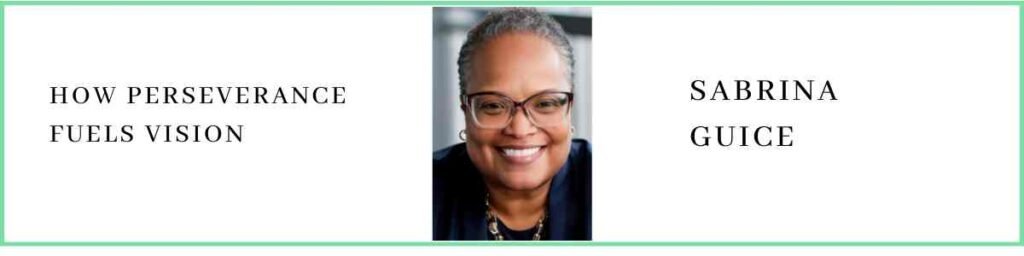
Sabrina Guice, an Atlanta-based entrepreneur with extensive experience in marketing, entertainment, and finance, shares her journey from working in finance to founding her own businesses, including a digital marketing franchise and the Create Georgia Entertainment Alliance. The conversation delves into the importance of perseverance, strategic planning, and knowing when to pivot in achieving entrepreneurial success. Sabrina also outlines the criteria for evaluating film and TV project pitches, emphasizing the need for thorough preparation and realistic budgeting. The episode concludes with practical tips for women entrepreneurs on leveraging free resources and the importance of writing down and detailing their business plans.
3 Key Takeaways
The Role of Perseverance in Success:
Sabrina emphasizes believing in oneself, especially when others might not, and describes her transition from ministry to entrepreneurship as a “walk of faith.” Her perseverance saw her through economic challenges and personal doubts, driving her to become a publicist and later a significant figure in film and television consulting.
Sabrina’s pivotal moment came when the economy crashed, but instead of succumbing to despair, she adapted. She moved north, took on a freelance contract, and eventually started her own publishing company. This flexibility and foresight illustrate how perseverance doesn’t just mean enduring tough times but also means knowing when and how to pivot to new opportunities.
Navigating the Film and Television Industry:
Sabrina’s story is also one of mastering the business side of the entertainment industry. She discusses the challenges faced by creators in securing investment and how her experience as a broker at Edward Jones and JP Morgan Chase equipped her to break new ground. Understanding investor psychology and finance enabled Sabrina to assist filmmakers in presenting their projects appealingly and appropriately.
Practical Insights and Future Goals:
The conversation reveals insights into what continues to drive Sabrina: her goal to build a film fund. As she prepares to launch an angel investing syndicate in 2026, Sabrina wants to support filmmakers financially by creating a global network of accredited investors focusing on alternative investments like film and television projects.
ShowNotes
Click on the timestamps to go directly to that point in the episode
[02:48] Sabrina Guice’s Background and Career Journey
[05:02] The Importance of Perseverance in Entrepreneurship
[07:41] Navigating the Film and TV Industry
[12:20] The Role of Finance in Entertainment
[23:18] Advice for Aspiring Entrepreneurs
Get In Touch:
If you’re interested in connecting with Sabrina Guice, you can reach her via her website, via email, or on LinkedIn.
For those interested in sharing their own stories on “Chatting with the Experts,” reach out to Paula Okonneh through her website or connect via LinkedIn.
Paula: [00:00:00] Welcome, welcome, welcome again to another episode of Chatting with the Experts where I speak with women from Africa, from the Caribbean, and in the diaspora. And these women are professionals and successful entrepreneurs, and today will be no exception. One thing is they share with me my passion, which is to educate women globally. And of course, included in my passion, we inspire, educate, and empower women globally. I’ve had a few men join me, but for the most part, it’s always women. Our title today is How Perseverance Has To Be Your Visions Foundation, and my guest who will be joining me soon is an Atlanta based entrepreneur with two decades of experience in the marketing, [00:01:00] entertainment, and finance spaces.
That’s really special. Her name is Sabrina Guice and she brings a wealth of diverse experience holding a bachelor’s degree from the HBCU Fisk University, where the late John Lewis and the poet who passed away recently, Nikki Giovanni attended. She specialized training from Temple University’s early entrepreneurial incubator and she also holds a certificate from NYU’s Tisch School of Arts’ ” Business of Entertainment” Program. She also completed the 2024 Inaugural Goodie Nations Angel Wings Cohort program for angel investing. In 2023, she demonstrated her strategic vision by acquiring a digital marketing franchise from global leader WSI, underscoring her commitment [00:02:00] to cutting edge client solution.
I can go on and on about her, but there’s one thing I don’t wanna leave all, which is that coming back to 2024, she founded the Create Georgia Entertainment Alliance to support creatives in Georgia’s expanding film, television, music, and gaming industries. And she is in pre-development for film and television projects for clients. Wow. Wow, wow. I’m always Impressed with my guests and so why don’t I welcome to Chatting with the Experts, Sabrina Guice. Sabrina. Wow. I could have kept reading your bio, but you know, I said, you know what? Why don’t I let her complete whatever it is I left out that you would like to share with the audience.
Sabrina: Oh, Paula, first of all, I want to thank you so much for having me on your show. What you’re doing is phenomenal. You’re giving a platform from women like myself and others who have, you know, we’re in the trenches and we’re [00:03:00] doing a lot of work, but with your platform, we can… our voices and our stories can be heard throughout the world. So, I wanna really thank you and much continued success to you and what you’re doing. In regards to myself, I’m pretty eclectic and you know, as, as you were reading my bio, I’m like phew I’m tired. Oh, I’ve done a lot. Oh my goodness. My story is an interesting story. Started out in the finance industry coming outta college. Worked for a company called Prudential Insurance. Worked with them in sales and then as an underwriter, transitioned from there worked in ministry actually for a number of years in the communications area. That’s how I ended up in Georgia. I was a communications manager for a very well known global minister, traveled the world with him. And , one thing he would always preach over the pulpit is. You know, you’re not really if you really wanna walk in and all that God has for you, try to create something that you own. And I took that to heart. So I only stayed with him for two [00:04:00] years and I said, I’m gonna start my own business.
I literally worked myself out of a job and I went into PR and that started me on the road for entertainment. And that’s really where I am right now, film and television consulting. We also consult with people in gaming and music as well. And last summer started the Create Georgia Entertainment Alliance me and two other women here in Atlanta. I had lunch with them and they say, Hey, whatever you decide to do we are here to support you. Both these women are in film and tv. I’ve known ’em for a while and a year later, we started last August, a year later. We’re now in pre-development for 10 film and television projects on behalf of other creators, whether they’re writers, directors or their producers we’re consulting with those, and two of those projects were getting close to getting funded. So I’m really glad to see that all that I’ve gone through is now really paying off and I can pour that into others and help them [00:05:00] fulfill their dreams and their visions.
Paula: Wow. You know, the thing is well, we are gonna be talking about how perseverance has been your vision’s foundations and that’s the theme. But, you know, I always say to people, you see people’s success, but you don’t know the story behind it. And there’s so many ups and downs that people go through. And finally, a breakthrough or a series of breakthroughs and people get to know them, but they don’t know. So, you know, I love it that, you know, we are talking about perseverance has to be one’s vision foundation. Why do you say that though? I mean, I know we just said that it’s necessary, but you, when I spoke with you, you were like, yeah, that’s what you wanna talk on .
Sabrina: It’s your persevere. And you know what, Paula, if you’re an entrepreneur, first of all, if no one else believes in you, you have to believe in yourself.
Paula: Mm-hmm.
Sabrina: You have to believe in yourself. You have to know that you’re called to do what you’re doing. And no matter what, you’re [00:06:00] going to continue on that path to fulfill your dreams and your vision. When I left ministry, it was truly a walk of faith. I live in a state where if you’re fired for, I wasn’t fired from my job. I walked off from working in ministry. But if you’re fired from your job and if you lose you, it is a hard probability that you may get unemployment insurance. So you gotta really, if you’re gonna leave that job, you gotta really know that okay, God is your provider and your resource.
So when I left out of ministry, I remember my last check from the ministry. I remember I had taken a week off. I didn’t get paid for that week because I had, lemme back up. I had started getting clients while I was still working there, and I needed to take a week off to begin the transition out while my last check was under a hundred dollars. So I walked out. I remember coming into my place. First thing I did was I hit my knees and said, God, it’s me and you. I am believing God for this. I believe in [00:07:00] you for my provision, and I am not going to go off this path. That was in 2003.
Paula: Hmm.
Sabrina: 20 years later.
Paula: 22 years ago.
Sabrina: Now I’m starting to walk in the harvest of that. Paula, when I tell you it ain’t been easy, it has not been easy. All the economic up and downs that you have to go through all of the, you know, you’re chasing checks from clients that owe you money, those type of things, you’re doubting yourself.
Paula: Mm-hmm.
Sabrina: You’re like, huh, damn, I really supposed to be doing this. So I was able to do that for 15 years. I didn’t have any outside work. I was in public relations. My first film project, I was introduced to an old Hollywood producer. He’s 87 now. I had a conversation with him last week. His health is in decline, but he still adores me.
Paula: Mm-hmm.
Sabrina: He’s done about 70 film and TV projects, and the first project he put me on was a [00:08:00] huge film, Passion of the Christ, that was produced by Mel Gibson. So he really,
Paula: that’s a huge one.
Sabrina: That’s a huge one to get your feet wet, right?
Paula: Mm-hmm.
Sabrina: He was on the PR team for that. So I had to facilitate interviews. I did some interviews had to talk with some of these huge pastors that you see on television and that you hear about work with them and help get them on the radio and TV and things like that. So. I didn’t get paid a dime for that, but I got the experience for it. Yeah. ’cause I knew that experience was going to come in handy for me one day, and it did. And that’s launched me into the film and TV arena.
Paula: Wow.
Sabrina: Yeah.
Paula: That’s big.
Sabrina: Yeah.
Paula: That’s huge.
Sabrina: That was huge. Yeah. And that was back in early two thousands. And let me tell you one thing about, and this quote ties into perseverance. As a business owner, as an entrepreneur, and as a visionary, you have to know when to pivot as well.
Paula: Yes.
Sabrina: And you understand this as a [00:09:00] business woman, you gotta know when to pivot. You gotta know when to tap into another gift that you may have. So here I was doing well, had contracts, then in around 2008, 2009, just before Barack Obama came in the office. The housing market crash.
Paula: Yes.
Sabrina: And it hit every nation. It wasn’t just an American problem, then it hit Wall Street.
Paula: It was just global,
Sabrina: which reverberated everywhere. It was a global crisis. So I end up losing three corporate contract, one after boom, boom, boom.
Paula: That’s not fun.
Sabrina: Did I give up? No. I said, okay, I gotta pivot. So I went, I moved back up north. I got a freelance contract with the literary PR firm, and I had a contract for two years, and that’s when I got exposed to the literary community as a publicist. And I said, you know, and I started seeing more and more people trying to self publishing, not have to deal with the publishing houses because people were losing their jobs [00:10:00] and so they had to learn to pivot. They said, well, let me write a book and sell my books. So we were marketing those books. We were promoting those books.
We did work with some clients for major publishing analysis, but the independent writers were primarily our clients. And I said, you know what? I can do this again, going back to pivoting, perseverance. So I’m a good writer. I could do this. I’m gonna start my own publishing company. And I did that and I ended up ghostwriting 35 books for clients over an eight year period. While it, yeah. When that was happening, meanwhile, in the background, the TV and film industry in Georgia was building up, building up. I said, okay, and I’m gonna get back and film, economy’s stable. Okay. I’m doing great. I wanna now transition back into film and tv. ’cause I was just getting my start in it when the whole housing market crashed.
So I came back to Atlanta. I mean there were some movies being made. All over the city of Atlanta and with the TV and film industry is a a [00:11:00] matter of you have to know people to get through some doors. You have to persevere to get through some doors and that’s what I did. Yeah, I knew people but unfortunately didn’t help me get through some doors, but myself,
Paula: I’m not laughing at you. I’m just thinking that can be a big reality. You may know people. That doesn’t mean you’re getting through the doors.
Sabrina: Honey, and in this industry you may know ’em, but they see you as competition and then that gonna make that introduction. So again, it goes back to your faith and your perseverance. So, I saw the barriers right of entry for me. I said, so I started studying the industry again as a business owner. Know your industry, know every element of your industry. I knew I didn’t wanna be in front of a camera. I had no interest being an actress. I knew I didn’t wanna be necessarily right behind the camera as a producer, director. I wanted to get into the business side of it. That’s when decisions are made, the finance side of it. So me being the [00:12:00] analytical woman that I am, I said, Hmm. I said, what can help me get through that door and get a seat at the table? I know what I’ll do. Let me go back and finance the industry I first went into when I came outta college.
Paula: Mm-hmm.
Sabrina: This time I’m gonna get my broker license as a stockbroker and I wanna learn how wealth is produced, how the mind of the investor works, how investments work. So now you’re gonna laugh at this. One day I got in my car, I went down the street to a broker’s office as he was with the investment firm, Edward Jones. I just looked him up. I said, let me go here, walk up in there. I’m sitting in the lobby. And then he had just finished with a client. He came outta the secretary, said, you can go back and see him now. And I walked in his office. I said, sir, I’m not here to invest with you. I wanna know how I could get in your [00:13:00] seat and become a broker just like you. He sat back in his chair. He said, Hmm, people don’t come in my office and say this kind of stuff. Tell me a little bit more about yourself. Honey, I had confidence.
Paula: I just thinking, you walked in there, you walked in there confident, you walked in there, but you are a Christian. So you walked in there knowing you’re not alone.
Sabrina: Yeah.
Paula: That’s a purpose.
Sabrina: Yeah. I knew my purpose, right? So, I start telling him about myself. He was very impressed. He said, okay, so you were you ran your own business. You endured the economic crisis. You knew how to reinvent yourself. I said, yeah, but see, he did what he didn’t know at the time. I knew I wanted to get the experience for what I’m gonna do in film and tv, right? So I went through the whole process with Edward Jones. I sent him my resume. He sent it up the channels. So I got into their training program. It was very stressful. You have to, even to [00:14:00] be interviewed, you gotta go through a 10 step process. And the last process, you’re on the phone and in front of a computer and they call a day in the life of a broker. So you have people on the other end who are pretending they’re customers, and you got emails, fake, you know, pretend emails coming through.
Paula: Yes.
Sabrina: And you gotta know how to handle all of that going on at once. Paula, I didn’t know at the time until afterwards, and I pass it with flying colors and that’s when they…
Paula: Wow!
Sabrina: In a position. But the people who were on the phone were and I don’t know the formal name of it, but they were like vocational psychiatrists. They were analyzing us or psychologists. They were analyzing us. How do we handle pressure? Or how do we communicate? They were scoring us on that. And if you didn’t score high, they wasn’t gonna offer you, they weren’t gonna give you an opportunity to study for the broker license. So I passed it and they offered me opportunity. So then that was just this beginning. Then I went through intensive studies for my series seven. I was literally studying from Monday through [00:15:00] Saturday. They gave you a schedule, eight day hours a day. Just study and study and study. You have to sit for this test. I sat for what they call the top off test. Passed that.
Okay, now you can go to the Series seven Study. Study. Study. Series seven is a four hour test. You can’t have any notes or anything. It’s monitored. You’re in a room, they’re watching you, and you gotta memorize about 20 formulas, financial formulas, how to figure things out, how to figure out how do they price stocks and things like that. So I had that, was writing that stuff, boom. Passed. Then I had to sit for my series 66, which is the law. They call it the blue sky law. So you have to learn the laws of the industry. Passed that. Became a broker, exceeded my goals for two years with Edward Jones, me being the competitive woman, and I am, I said, okay, Edward. Remember my goal was going back in entertainment. They didn’t know that though.
Paula: So you had a plan.
Sabrina: Right. That wasn’t, I knew what I was gonna do. Two years, I said, okay, that’s [00:16:00] enough. Let me go to a bigger company. So I went to JP Morgan Chase, got hired.
Paula: Stop right there because one thing you haven’t shared with my audience is that you were a former VP of Investments.
Sabrina: Yes.
Paula: And private client advisor at JP Morgan.
Sabrina: At JP Morgan Chase. Got the job at JP Morgan Chase. So once you get in that position, you have the designation of being the vice president of investments. So I work with, at Edward Jones, I had a client base about 250 people. JP Morgan, I had a client base a little bit over 300. So I have sat down and had communication and talk and conversations with close to 500 investors anywhere from the small investor who has just a couple of hundred to maybe open up an IRA for retirement to those with tens of millions of dollars are looking for some estate planning and other strategies.
So it gave me a good glimpse into the world and a mind the investor, again, I know when I go back in entertainment, I wanna go on the business side. [00:17:00] Did that for two years. I said, okay, bye JP Morgan Chase, I’m out. Now I’m ready to go back into the film and TV industry. But now I got my designation, my experience, and I can work with people and filmmakers. ’cause the biggest hurdle that they have is funding their projects. They don’t know how to talk to the investor. They don’t know how to package their projects. That’s what we do now. That’s what I’m doing now is working with those filmmakers to help them with that. Where we get paid is if I secure funding for them, I get a commission on that. Plus there is a consulting fee. A lot of them don’t have the money to pay us the full consulting fee upfront, so we may get it on the backend. With some of the, well, the bigger projects, I get a, about on average, between three to five films pitched to me every week. I may [00:18:00] select maybe one out of those maybe one. A lot of times people come to us, I know we can’t do anything for them, but I will give them guidance and say, well, you need to do this. You need to do this, you need to do this and give you some guidance.
Paula: So you said something a few seconds ago, not minutes ago. About three. You get at least three to five people coming to pitch the ideas to you, but you choose one. So what’s the criteria you’re looking for?
Sabrina: We’re looking for, there’s a list, but I’ll tell you right now. We would love to see a script. Most people do have a script, how well written it is. Also has the script and what we call in the industry covered. That means it has gone through this or a, a company that has read, reviewed the script, and they do they make grading and some recommendations. You make the corrections and then they will grade the script for you. Typically we look for grade 90 and above.
Paula: Okay.
Sabrina: So those are pretty good. So it tells you the probability that this is a good script, it should [00:19:00] do well, or when you film it or when you tape it. And then, you should do pretty well. The audience would react pretty well to that particular script.
Paula: Mm-hmm.
Sabrina: So we wanna look at the script. Do you already have a distribution agreement in place? If not, what is your plans for distribution? ’cause you remember any investor, if they wanna invest in a anything, how am I gonna get my money back?
Paula: Money back.
Sabrina: When am I gonna get my money back? So show me, Mr. Producer, how do you plan to pay me my money back? A smart producer or director has that in black and white. Oh, we are going to do this. We’re gonna have we’re gonna go to this network of this streaming service. We have this door open at this streaming service, or we’re gonna pitch the streaming service. We wanna see that because before we go to any investor, that’s the first thing they’re gonna ask us. Is there a plan of action, a marketing plan, distribution plan. So they wanna see that.
Also, if you have any attachments, and what I [00:20:00] mean by attachments, what actors are attached. What producers are attached? You may not have a well-known actor right now, but you may have a really sharp producer who has some great credits, and then we know that they can get to some of those actors and bring them on. ’cause they may know some casting directors to help them bring that on. So it’s just not a matter of, oh, I got a great story. I need a million dollars to make this story. You gotta have a criteria for us. And there’s a list of about 10 items that we have, but those are probably, and the budget. That’s very, very important. The budget.
Paula: Yes.
Sabrina: You gotta have the budget we want. ’cause an investor wanna say, okay, you need this money. Where’s it going to? Is it realistic? Is your budget really realistic? Are you underpricing your project? Or are you overpricing it? Where’s my money going to? So we wanna see some of those things.
Paula: You know, this is an not an eyeopener, but this is good to know because, you know, you see, I always have wondered how did [00:21:00] this, you know, movie or TV show, how did it get to where it is?
Sabrina: Mm-hmm.
Paula: And how, what was the criteria for the investors? So this has been an eyeopener for me.
Sabrina: Mm-hmm. In a lot of ways it is. It’s you look at something on TV and you’re like, oh, that’s a great series.
Paula: Mm-hmm.
Sabrina: I tell you, there’s a lot of work that goes on behind the scenes to get it there
Paula: to that ‘
Sabrina: cause The majority of projects that are pitched to these streaming networks are rejected.
Paula: They don’t make it
Sabrina: majority. Probably about 90% of them get rejected.
Paula: Wow. Wow, Sabrina, we’ve been talking for 30 minutes. I can’t believe that. But what I wanted to, you’ve told us about the importance of perseverance because you definitely persevered and you always had a plan in mind. You didn’t just, it wasn’t just, you know, impulsive. You always knew what the next steps were and you prepared towards that.
Sabrina: Right. My ultimate goal is to build a film fund.
Paula: To build a what, sorry? [00:22:00]
Sabrina: Film fund. A fund for films and build a film fund. That is my ultimate goal. It takes a lot to do it. But the first step that we are going to be doing in 2026 is we creating an angel investing syndicate. That’s why I went through that angel investing training program for six weeks last year. To build a syndicate. So we will have other accredited investors around the world. It’s not just American base, even though I’m here in America, but global base accredited investors. Who are interested in looking at alternative vehicles to put their money for investment.
And one of those alternative investments would be film and television projects. It is high risk, that’s why they have to be an accredited investor. So we’ll have the films presented to them if they wanna be a part of it, whether it is a development stage, pre-development stage, a production stage, or post-production. What we can make the introduction between the investor [00:23:00] and the filmmaker that way. But we’ll have a community of investors that we can now send our films through and that would lay a foundation for that plan to launch that next year.
Paula: Because I know we always have a very interactive audience.
Sabrina: Yeah.
Paula: But not everybody can, of course, is in our audience. What is one tip, one parting tip you can leave so that whoever looks at this episode later on will say, I learned. Well, of course there’s was a, you said a lot, but just one parting tip.
Sabrina: One important tip is to me is keep your eye on your goal and write it down.
Paula: Ooh.
Sabrina: Don’t just have it in your head. I had a mentor tell me this about 25 years ago. He said, Sabrina he had an MBA from Harvard. Very smart man. He says, I don’t take an idea serious unless it’s written down.
Paula: Mm-hmm.
Sabrina: If you haven’t written your vision [00:24:00] down and you have seen it on paper and you haven’t written out, okay, well these are my vision. How am I gonna get to the vi? How am I gonna allow this vision to unfold? This is a milestone. My milestone may be getting my LLC. My milestone may be getting a mentor, a business coach. My milestone may be getting funding. Put realistic milestones for your vision, a couple of milestones, and as you reach your milestone, okay, I did that. Check that off. Check that off. But unless you write it down, it’s just an idea. I have written so many business plans. I have revised so many business plans.
You have to do that. Write your business plan out. Or even if you can’t, even if you don’t know how to write a business plan out, at the very least, write the executive summary. The executive summary will help you. And for those women who are listening to this who are American based, I’m gonna give you a resource which is free, that can help you from A to [00:25:00] Z to get your business going. It’s a small business development center. Every major city has these, they go through the different state university systems here. Georgia State has one. It is a uni, it is a government backed entity. These are retired entrepreneurs who work through these entities and serve as mentors and coaches for these business leaders. And they can help you with marketing research, helping you get your two to three year financial projections in place. You don’t have to pay anything. So look for that. Look for whatever country you are. Look for free resources, especially from the local universities. They may have resources for entrepreneurs.
Look for women organizations. Call them, contact them. Even if they can’t help you. Say, well ask them. Hey, well, do you know who can a mentorship program in this program? Oh yeah, I do. We do have a program we can refer you [00:26:00] to. Closed mouths don’t get fed. That’s the saying that we like to say here in the south, closed mouths don’t get fed better. Open mouth.
Paula: It’s the truth.
Sabrina: You better open mouth.
Paula: It’s the truth. Even literally.
Sabrina: Yeah. Resources are out there. I know it’s a hard time for women right now.
Paula: Mm-hmm.
Sabrina: But there are resources out there for us. Do your research and with AI, AI can help you to find those resources. You go into AI, chatGPT or whatever tool you use, tell it. Tell it. Write a prompt of what you’re looking for.
Paula: Okay.
Sabrina: It’ll spread out all this information.
Paula: Mm-hmm.
Sabrina: Then you could ask it more. Those kind of things. And as a gift to your guest, any woman that reaches out to me, if they’re interested, I have a database of private equity funders and VC funds that fund women-led companies. You gotta have your stuff together to approach them, but at least it is something that you know you can use and start with. [00:27:00]
Paula: That’s absolutely fabulous. And a good note to end on.
Sabrina: Yes.
Paula: I was gonna ask you where you can, well, you said they can reach out to you personally.
Sabrina: Yes.
Paula: And ask you for those resources. Yes. So just can you just tell us where you
Sabrina: Yes, ma’am.
Paula: They can find you. Do you have a website? Are you on I no, IG? Well, what, are you on social media or can they get in touch with you?
Sabrina: My LinkedIn is Sabrina Guice. My name is S-A-B-R-I-N-A, first name. Last name Guice, G-U-I-C as in cat, E. My email address is, and I prefer email is sabrina@creategeorgia.com. I have two websites, but I’m gonna give you the one that we really, the company we talked about today.
Paula: Mm-hmm.
Sabrina: creategeorgia.com. That is our website. You can go on there and you can take a look at some of the projects we’re working on, and we have a little promo video on there as well. So those are the three ways that you can reach out to me and I’ll be more than [00:28:00] happy. Just let me know that you heard me on the program.
Paula: On Chatting with the Experts.
Sabrina: And that way I can give Paula a shout out and email her back. Say, Hey, I, everybody’s from somebody. This is to reach out to me and I want to thank you. So I’ll be more than happy anybody that reaches out to me through my email or through LinkedIn, just make sure you gimme your email address if you want that list of those VC and those private equity firms. But why not?
Paula: That’s phenomenal. I’ll drop it in the chat too for those who have joined us, and as I say, every week, if you were I get to speak to phenomenal women and Sabrina is one of them. And if you are a woman and I also speak with a few fabulous men, if you’d like to be a guest on the show, please reach out to me on my website, which is chattingwiththeexperts.com. You can also contact me on LinkedIn. I am on Instagram. My handle there is at chat_experts_podcast. I’m also on Facebook these days and I say these days because I wasn’t [00:29:00] much of a Facebook person in the past, and we have a YouTube channel. So there are various ways to get in touch with me, and for those of you who are in the audience. This is now a great opportunity to ask all the questions or comments on what I learned and you have learned from Sabrina. And one last word from Sabrina is that closed mouths never get fed.
Sabrina: Okay? That’s true.
Paula: That’s the truth.
Sabrina: Those ladies, you have what it takes. Don’t be silent.
Paula: Don’t be silent.
Sabrina: Mm-hmm.
Paula: Thank you so much, Sabrina. And we’ll open up the floor now to those who have joined us. Woo. This is good.
Sabrina: Thank you. Thank you. Thank you.