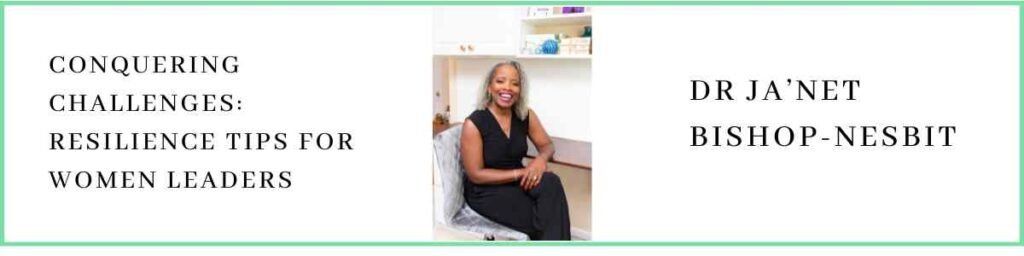
Dr. Ja’Net Bishop-Nesbit, founder of Boots to Breakthrough, LLC, which has evolved into Thrive Well Consulting LLC, discusses the transformative power of resilience for women in leadership, emphasizing the importance of emotional, mental, and social resilience. Dr. Ja’Net shares her journey, including the loss of her husband and career transitions, and offers practical strategies for cultivating resilience, such as practising self-care, setting realistic goals, developing a growth mindset, seeking feedback, and establishing boundaries. Additionally, she elaborates on the eight dimensions of wellness that contribute to a holistic and joyful life.
Some Key Takeaways
Types of Resilience and Their Importance:
Dr. Ja’Net shared insights on three primary types of resilience vital for women leaders:
1. Emotional Resilience: The ability to manage emotions during tough situations.
2. Mental Resilience: Maintaining a positive mindset and perseverance through obstacles.
3. Social Resilience: Building strong support networks and relationships.
These facets of resilience enable women to thrive in leadership roles by transforming challenges into opportunities for growth.
Strategies for Cultivating Resilience:
Dr. Ja’Net outlined several strategies to enhance one’s resilience:
– Practice Self-Care: Prioritize emotional, mental, and physical well-being through exercise, mindfulness, and rest.
– Set Realistic Goals: Break down large objectives into achievable tasks to maintain motivation.
– Develop a Growth Mindset: Embrace challenges as opportunities for growth.
– Seek Feedback: Continuous improvement through constructive feedback.
– Establish Healthy Boundaries: Learn to say no to protect time and energy.
Implementing these strategies not only enhances personal resilience but also fosters a positive culture in teams and organizations.
ShowNotes
Click on the timestamps to go directly to that point in the episode
[04:13] Embracing Resilience: Types and Importance
[15:00] Strategies for Cultivating Resilience
[25:18] The Joy in Your Journey
Get In Touch:
If you’re interested in connecting with Dr Ja’Net Bishop-Nesbit, you can reach her via her website, via her email, on Instagram, on Facebook, or on LinkedIn.
For those interested in sharing their own stories on “Chatting with the Experts,” reach out to Paula Okonneh through her website or connect via LinkedIn.
Paula: [00:00:00] Hello everyone, and welcome to another episode of Chatting with the Experts with me, Paula Okonneh, where I speak with women from Africa, from the Caribbean, and in the diaspora. Every week I bring on women who are experts in either the service products. Or whatever it is that they do. And I also have a few men who join us and our mission is to educate, empower, and inspire women globally. This week is no exception, and our show is called Embracing Resilience, Empowering Women Leaders to Thrive. And what we’ll do is that we’ll dive into the transformative power of resilience for women in leadership and explore actionable strategies that highlight the journey [00:01:00] of embracing challenges and turning them into opportunities for growth.
My guest who will be joining me shortly is Dr. Ja’Net Bishop-Nesbit, and she is the founder of Boots to Breakthrough, LLC, which is a virtual wellness coaching practice. She’s an education consultant, certified wellness and life coach, a certified grief coach, speaker, as well as a best selling author. In 2016, Dr. Ja’Net lost her husband to a fatal heart attack, and her life changed immediately, widowed in midlife with an empty nest. She relocated from Georgia to South Carolina to be closer to family, and she also [00:02:00] transitioned careers. Look, I can say so much about her, but as I said, she’s gonna join us. And anything that I’ve left out in her bio, she’ll talk about. So welcome Dr. Ja’Net to Chatting with the Experts.
Ja’Net: Hello, blessings. Thank you so much for having me, Paula.
Paula: Oh, absolutely. I’m thrilled. I’m thrilled. I’m thrilled to have met you and invited you to the show and you said yes. Oh my gosh. I don’t take it for granted, so thank you.
Ja’Net: Oh, thank you so much. You know, I believe that as we go through this journey that we call life. When everything falls into alignment, to me that’s a reflection that that’s exactly what’s supposed to happen at that time. And so I just feel so fortunate. And thank you for all that you do to inspire women globally and internationally and nationally. ’cause I’m here in South Carolina.
Paula: South Carolina. I know. Yes. I lived in a literally walking [00:03:00] distance from the border. For many years from the border from, I was in North Carolina, so I should explain.
Ja’Net: Yes.
Paula: I lived in North Carolina and I could walk to South Carolina literally by just walking probably like five minutes and I crossed.
Ja’Net: That’s amazing.
Paula: So yes. So you were my neighbor for years without actually knowing me, without actually meeting you.
Ja’Net: Isn’t that amazing? And look at how now our paths are crossing to be able to impact women and I’m so inspired by you with what you do with this channel and touching lives and giving women hope. So kudos to you, and I feel so grateful to be a part of it today.
Paula: Oh, thank you so much. I, of course, I don’t hesitate to say I don’t take any of this credit. I’m a Christian and I give all glory and praise to my Lord and Savior, Jesus Christ.
Ja’Net: Yes.
Paula: He’s enabled me to do this because me, Paula alone, nah. But with Him, I can do all things.
Ja’Net: Amen. Amen to that. [00:04:00] Oh goodness. So, did you what would you like me to do? Would you like me to say Yes as we get started?
Paula: Yes, I know we, we can talk forever. So let’s talk about, you know, let’s go with what we said. This is we embracing resilience and empowering women leaders to thrive. So what are some of the types of resilience that you’ve noticed that, and what do you help, what type… can’t even speak today. What type of resilience do you encourage? Women leaders to undertake and why is it important?
Ja’Net: Thank you so much for that question. It is so timely. And in fact, when you were introducing me, you mentioned my LLC, Boots to Breakthrough.
Paula: Mm-hmm.
Ja’Net: And that has actually evolved into Thrive Well consulting LLC, because thriving and building resilience has really expanded. And so, for those who may be wondering, well, what’s her background where she can talk about resilience and thriving and what does that look like for women [00:05:00] leaders? You know, I’m a native of New York City and I joined the military. First joined enlisted, then I became an officer. And so I’m an Army veteran officer and that experience also led to me working in nonprofits when I got out of the military was honorably discharged, and I worked at the Augusta Child Advocacy Center where I was advocating for young people who had experienced abuse and testifying and leading in their court cases.
And then that opened up the opportunity for me to enter a different leadership role in the school setting. So I’ve been a school counselor, middle high, and alternative school counselor, and one day a former principal of mine said, Ja’Net, you ever thought about going into school leadership? And I said I don’t think so because I’ve been in the military and I know that being a leader can definitely be exhausting. But one of the things that the military really did for me was help me to build not only my mental resilience, but my physical resilience. So in the course of the [00:06:00] 21 years of me being in education, I have been an alternative school principal and a high school principal. And so I often joke with my sons who were students at a school that I was an assistant principal at, and of course they said I ruined their high school experience, but I told them, Hey you, you survive.
You’re gonna be resilient going through this. But they’re so supportive. But you asked such a poignant question when you mentioned the types of resilience. And why it’s important for women leaders? Well, the research shows that the three primary types of resilience are emotional resilience, mental resilience, and social resilience.
Paula: Mm-hmm.
Ja’Net: Now, emotional resilience allows leaders to manage their emotions effectively, especially during challenging situations. We also have mental resilience, which involves maintaining a positive mindset and perseverance and overcoming obstacles. And then that third resilience that I [00:07:00] wanted to bring to your audience’s attention is the area of social resilience. And this highlights the ability to build strong relationships and networks which provide support and services. So that’s why a channel like yours, I believe really supports this concept of building resilience, particularly for women leaders so that they can thrive. Because to be emotionally resilient is so key.
When I became suddenly widowed when my late husband had a heart attack, I was a principal of a school, and my emotional resilience really was affected at that time. But I had staff, faculty, students who are still depending on me to do my job, lead a school and impact the school culture and climate. When we look at social resilience, that’s why I love your channel as well, because in social resilience, we’re highlighting building strong relationships and networks. And when we think about what you do through your channel impacting women globally. It really [00:08:00] involves being able to have that network. So what does social resilience look like from a networking perspective?
Well, it’s realizing that when one door closes, it is laying the foundation for another one to open, right? It’s not the begin all and end all. It may just simply be the pathway to something bigger. And then again, of course when we look at that mental resilience, keeping that positive minds. At the beginning of your program today, you mentioned how you know you are a Christian and I’m a Christian and a believer as well, and I really do believe that as women leaders, we cannot have a positive life focusing on negativity.
Paula: Mm-hmm.
Ja’Net: And mindset is so powerful for us. So when we are looking at mental resilience and we are maintaining a positive mindset, it enables us to persevere and overcome obstacles. You know, for some of us that may mean not getting the funding we had hoped to get. For others, it may mean ageism. For some, it may mean sexism and for some it may [00:09:00] mean not necessarily having the people closest to you to support you with these new goals that you have. So let’s just be reminded that resilience is more than just physical resilience when it comes to being women leaders. It’s the emotional resilience, the mental resilience, and our social resilience.
Paula: Wow. Thanks for expanding on that. And you know, you said something that is crucial and some people, a lot of women struggle with that because in some ways we’ve been socialized to look for approval, you know?
Ja’Net: Yeah.
Paula: And when the approval is not coming from your family, as you said, it may not come from close family. That can be hard to take, you know, because if your family’s not supporting you well. You know, what else is there to do?
Ja’Net: Yes, yes, yes. And then you begin to question yourself.
Paula: Yes.
Ja’Net: Am I going down the right path?
Paula: Mm-hmm.
Ja’Net: Or you may end up having feelings of being fearful of the success because the more you [00:10:00] evolve and the more successful you become, you have this fear that it’s going to isolate you from your loved ones.
Paula: Mm-hmm.
Ja’Net: And so I firmly believe, and that’s something that I’ve had to adjust to from the mindset of, not wanting to leave others behind, but then realizing that perhaps there was a season, perhaps their role in my life was for a reason and for a season, and that role has already been fulfilled. And so now as I’m moving onward, it’s important for me to be the best representation of what the Lord will have me to do because guess what? Our skills and our talents it’s unique to us. You know, you have this amazing program that impacts women globally, but is your program the first program that’s ever done this?
Your program is the one program that Paula Okonneh has developed that touches the lives of women. So it’s a matter of us. All being our own authentic self and realizing that sometimes on that journey of success [00:11:00] or evolution in our journey as women, it may not mean that everyone can come with us. It may mean that they can stand beside us, or it may mean that they’re not ready yet and they’ll come on board at another time.
Paula: I absolutely love that they may not be ready. Yes, they can stand beside us and sometimes I say they can even stand behind us and push us forward. You know, like encourage you, come on. You know?
Ja’Net: Yes.
Paula: I can’t do it, but I can see it in you, so I’ll be there. You know, just, you know. When you’re weathering the storm to just keep you balanced and upright, you know?
Ja’Net: You know, I’m so glad that you said that because I can remember when I was in undergraduate school and think I had to take an extra year, right? So instead of finishing in four years, I had to go to five years because I transferred to another school and I remembered this is too hard. I don’t wanna do this. And my dad, who is now with the Lord, he says, he said to me. Don’t stop, keep going because you never know [00:12:00] who is looking to see that if you did it, they can do it too. And I had cousins, you know, at that time I’m the oldest and only girl in my family. I have two younger brothers, but I, and I come from a family that have a lot of male cousins. But when my dad said that to me, I said, you know what, that’s right.
What made me want to become a army officer? I saw a black female major. And I said, what? And that image of her, with her rank on her shoulder at the unit that I was assigned to, yes. Made me realize what made me think that I can be a school principal, not of just one, but of two schools. It was the fact that someone else. Saw it in me and I thought, well, if they saw it, then maybe I can do it so that then someone else can see it so that they can do it. So you are absolutely right and that sometimes it may be hard for us in moving forward. But you said something to me at the beginning of the program before we aired, which was, you know, if [00:13:00] you feel passionate about something, do it. I firmly believe that all of us have a purpose in life, and our purpose is that the Lord has us here so that someone else’s life is better because they crossed our path.
And when we are working within our gifts and our talents, people see that and they gravitate towards it, and then we get to pour into it. Much like what your program does for the rest of us, it pours into us in order to create that better version of ourselves.
Paula: I love it. I love what you said, and thank you for that compliment because as I was telling you, as you rightfully said I don’t do this for myself. I do this for others because we can’t be what we can’t see. You know what I mean? If you hadn’t seen that woman the African-American woman, you said a naval officer.
Ja’Net: Oh, she was a major, she was an Army officer. Yes.
Paula: She was an Army officer. If you hadn’t seen her, you couldn’t even picture yourself going down that road. You know?
Ja’Net: That is correct.
Paula: Impossible. So…
Ja’Net: yes.
Paula: You [00:14:00] absolutely are all right. Because many times we are doing things and we don’t know that people are looking at us. Your dad was so wise to tell you keep moving.
Ja’Net: Yes.
Paula: Keep going ahead and
Ja’Net: yes.
Paula: Don’t know how many lives you are impacting with what you are doing. Awesome.
Ja’Net: Oh, thank you so much for that, paula. You know, we all have a responsibility because we’re here and we will all go to see the Lord at some point on His time. We don’t know when that time is, but we’re all here, I believe, to leave this world better than we found it. And so if we are working in the gifts and talents that the Lord has given us. We really need to use those gifts and talents in order to make the world a better place, and that may simply start within our own homes.
Paula: Yes.
Ja’Net: In our own communities.
Paula: Yes. Yes, yes, yes. I agree. It may start within our own houses, our own homes, within our own communities. [00:15:00] Yes. So what are some strategies that you can share with us for cultivating resilience? I know we’ve talked about, you know, how taking your case is your dad.
Ja’Net: Yeah. Oh my I tell you, it’s so important that we take into account strategies that cultivate and build resilience. You know, Maya Angelou was quoted as saying once she’s the famous, you know, Nobel Laureate poet. Who is with the Lord now as well. And she one of her famous quotes was, “we don’t know what we don’t know until someone points it out to us.” Right.
Paula: And so I’ve never heard that, but I love it. We don’t know what, we don’t dunno.
Ja’Net: Yeah. We don’t know what we don’t know until someone else points it out to us. Much like I didn’t know that being a female black officer was an option until I saw that other female black officer. And I said, oh, because the images that I saw as a girl growing up were. Images of individuals who didn’t look like me.
Paula: Mm-hmm.
Ja’Net: And so [00:16:00] growing up in the projects, it was not my frame of reference that it was possible for me as well.
Paula: Mm-hmm. Mm-hmm.
Ja’Net: But when we look at strategies for cultivating resilience, you know, I said earlier how when I went to basic training in Fort Jackson, South Carolina. It built my mental resilience and my physical resilience. I left that eight week training program feeling like I was superwoman. Like there was nothing that I couldn’t do, right?
Paula: Mm-hmm.
Ja’Net: But then as I age gracefully, and of course things work a little differently than they may have physically back in those early years of my adulthood I’ve come to realize, especially with the books that I’ve written and some of the research that I’ve read, that cultivating resilience really involves some actionable steps. And so here are four key approaches that I would like your audience to take into account. One is to practice self-care. And by that I mean prioritize our emotional, our mental, and our physical wellbeing through [00:17:00] activities like exercise, mindfulness and getting adequate rest.
Paula: Mm-hmm.
Ja’Net: This is so key because as I was building my career, whether it was in the military or as a wife and mom or in the school setting, I would burn the candle on both ends. And what happens to us as women leaders is that we end up burning out in the middle. Or it ends up affecting our relationships, whether that’s with our loved one, our partner, or with our children. And we end up finding out that stress begins to debilitate our wellbeing from the inside out. And so when we practice self-care emotionally mentally and physically, you know, what does that look like? Okay. Try just 30 minutes of exercise in the course of the morning, or if you’re an evening person, I’m a morning person, and what I have found, Paula, is that when I just go for a simple walk, and that’s an exercise you can do no matter what chapter of life that you’re in, it clears my mind. I’m one with nature, I feel [00:18:00] one with the Holy Spirit, with my Lord, and it is so cleansing.
Take into account also mindfulness for those of us who pray, and I pray every morning, and I also participate in maybe one to two minutes of guided meditation on an app that I have on my phone. But what it does for you in terms of practicing that form of self-care is that it makes you become centered and balanced. Don’t be one of those individuals where as soon as you wake up, you’re going through your social media because that really raises the adrenaline, it raises the blood pressure. And when we start our day in calm, you actually begin to think more clearly and you can end up making more decisive decisions. Make more clear, well thought out decisions about how that day is going to go, and then the adequate rest. Now, I was of the generation that said, Hey, I can rest later on in life. Right now. If I got two, you two,
Paula: I prided [00:19:00] myself.
Ja’Net: Good. But you know, there is so much research out there that shows that inadequate amounts of rest actually negatively impacts our longevity. So yes, there’s the thought that try to get eight to nine hours of rest a night, and in complete transparency, I can average. Six solid hours. But remember that when we rest, whether it’s taking a nap, midday or resting at night, that is the time of being able to be still and to rejuvenate ourself. so that’s one of the four key things that I want them to take into account. Practice self-care.
Next is set realistic goals. Break down your larger objectives into achievable tasks, to maintain motivation and to prevent overwhelm. You know, sometimes we just overextend ourselves. But here’s a technique that has worked for me as I’ve continued on this life journey. Just choose one to three things that you’re going to achieve that day. Yes, there may be lots of things you wanna [00:20:00] work on, but ultimately what I have found very beneficial to me is when I select one to three things of that day, and then I look at my calendar and have block scheduling for it. And then also now as a new entrepreneur, well, relatively new entrepreneur. I’ve always been in nonprofits, right? I set aside. One to two days out of the week. That is just my admin days, follow up days, et cetera. So anybody in your audience who is an entrepreneur blocks scheduling time block scheduling, and setting aside that time for you to really work on the business is key.
Point number three for cultivating resilience is develop a growth mindset. That’s another reason why I love your channel, because the only time that we stop growing, right, is once the Lord calls us home from this level. Okay? And so when you have a growth mindset, you’re able to see opportunities and see failures even as learning steps for your growth in moving forward.
The next strategy is seek feedback, right? [00:21:00] You know how many businesses have surveys to ask you, how did we do well? Seek feedback from your colleagues, from your friends, maybe even family members in terms of how is this working? And then finally, establish boundaries. And that’s something that I’m still working on because it’s so hard, you know, as women, we have been socialized to be there and do everything for everybody, and then we end up being the last one on the list. But I’m here to say that it’s so important as women leaders that we learned as. Say no and set limits to protect our time and our energy, because then this allows us to be able to focus on those things that are important to us right then, and that truly matters. And when I’ve presented to women entrepreneur groups or sororities, I always remind them, guess what?
No is a complete sentence. And it doesn’t mean that you’re a bad person, right? It just means that. You have the same 24 hours in a day like Oprah Winfrey, Warren Buffet, [00:22:00] Sheryl Sandberg, who is over, you know, Facebook and such.
Paula: Mm-hmm.
Ja’Net: So what are you gonna do with your 24 hours in order to achieve your goals?
Paula: Yes.
Ja’Net: And that may mean saying no. And so for those of us who have struggled over the years with being able to say no and wondering how anybody else is gonna look at us and think we’re not a team player, I always say, “by you getting more comfortable with saying no, opens up your universe to say something yes that really lights you up and helps to move you forward.” So those are the tips for cultivating resilience. Practice self-care, set realistic goals, develop a growth mindset, seek feedback and establish healthy boundaries. These strategies not only support your personal resilience, but it has a ripple effect, right?
Paula: Yes.
Ja’Net: Because it influences the culture of either your team, you know, you mentioned having a team.
Paula: Mm-hmm.
Ja’Net: And those who are in the schools and school district, it impacts the culture and climate and those who are in corporate settings, it [00:23:00] impacts the energy of your organization to be more productive and efficient.
Paula: Yes, yes. You know, you mentioned no is a complete sentence that the first day I heard that, that changed my life because I was like, yeah. By saying no, you clear your schedule and you open up opportunities for saying yes.
Ja’Net: Yes, absolutely.
Paula: And learning to stick to that, I mean, has changed my life in that I don’t have to say yes to everything because I can’t be everywhere and I can’t be everything to everyone.
Ja’Net: You cannot. And with the expertise and the talent and skills that you have, if you are not available, then when it is a great opportunity for your schedule, it’ll come back around.
Paula: Yes.
Ja’Net: You know, if it was meant to be for you to be the one to do it, it’ll come back around and maybe your schedule opens up at that time. But it’s amazing how when we feel more comfortable [00:24:00] setting boundaries, we actually minimize the stress. And our leadership in the projects that we’re working on becomes more fulfilling because we don’t feel so pressed. I remember having a client previously who had said, you know, it was difficult for her to set boundaries, you know, both in personal life and in professional life. And she was very involved in the church and you know, you could be involved in the church and end up having a third job.
Paula: Yes.
Ja’Net: And so you got really mindful of that. But she shared how. When she was overextended and overstretched and overstressed, she was irritable. She found herself getting angry easily, short with people in her responses, and it was because she was feeling overwhelmed and she didn’t feel as though she was thriving. And more importantly, she did not feel well. And even though initially it wasn’t comfortable for her to set those boundaries, when she began to set boundaries and participate in those projects that she really enjoyed and loved and she can maintain [00:25:00] time constraints around, she was living her best life and so I encourage all of us to continue to be a work in progress in that area.
Paula: Absolutely. Ja’Net, we can talk forever. But there’s something, there’s a book I forgot to mention because I said, your bio is so impressive that I couldn’t say everything. There’s a book you wrote.
Ja’Net: Yes.
Paula: How much joy is in your journey.
Ja’Net: Yes. Yes.
Paula: Could guide to your fearless vision.
Ja’Net: Yes.
Paula: Talk a little bit about that, joy in your journey.
Ja’Net: Oh my. Thank you so much. You know, joy is different than happiness, right?
Paula: Mm-hmm. Yeah.
Ja’Net: Joy comes from the inside.
Paula: Yes.
Ja’Net: And it’s not based on the superficial surface things that happen that may make us happy. And so when I wrote that book what’s interesting is that I was going to launch that book with the March of Dimes. They were having an event at a venue close to where I lived in Augusta. And so the launch was happening on [00:26:00] a Saturday. That Sunday I was MCing a military program for a local organization and when I came home, my husband had said, listen, I know this book is gonna be successful. It’s almost summertime. He was a middle school assistant principal at the time I was a building principal. He said, listen, keep next weekend clear on so that we can plan our summer vacation. We were new empty nesters. We were about to get it on and popping and join this empty house, but it was that Sunday that he had that conversation with me, and that Monday, the Lord called him home at 52 of a fatal heart attack in our home on a Monday.
And so I never got to promote that book. And when I was going through my two grief recovery programs, a minister had said, “Ja’Net, maybe now that book has even more relevance about how much joy is in your journey because it can change.” And so in that book it was a self-coaching book, particularly for leaders actually. And it focused on [00:27:00] the dimensions of wellness. Back in 1970s, the early 1970s, the National Wellness Institute was tasked with researching what does it mean to live a holistic life, and it’s a holistic life. One of joy was the question that I asked because there I was pursuing degrees and certifications. I’m married, I’m a building principal, I’m involved in my church, I’m involved in the community, and I’m building all of these things on my resume. But what does joy really look like? And so when I looked into that research, they ultimately identified five areas of wellness that contributes to your joy.
And over the years, it’s evolved into eight. And part of them is these eight dimensions of wellness that I’ve written about in subsequent books because it was so transformative for me. So when we ask ourselves how much joy is in our journey, the question becomes, well, what is it in your journey? And so the research talks about living your holistic [00:28:00] life involves eight dimensions of wellness, your emotional wellness, right? Which we talked a little bit about. And emotional wellness deals with involving understanding and managing your emotions and expressing them effectively. It also involves our occupational wellness, right? And some people say, well, you know what, Ja’Net, I’m not working a job that I’m really feeling I’m really loving and I remind them, but you know what can make you feel occupationally well? Let your nine to five pave the way for your five to nine. So many folks have that side hustle, right? That thing that they really enjoy. And they’ll wake up early and do it for no money. But the goal is to be able to have a return of investment on it.
Paula: Mm-hmm.
Ja’Net: So that occupational wellness, what is it about your current occupation? That you can find joy in. You know, we’ve heard that phrase when you have lemons, make lemonade.
Paula: Mm-hmm.
Ja’Net: Well, I firmly believe that when you are in a place, it might not be the place you wanna be occupationally, but bloom where you are planted, thrive where you are [00:29:00] planted. Because I firmly believe that our Heavenly Father is preparing you for that next thing. The third of the eight dimensions is physical wellness, which of course I talked about that earlier. And that involves how is your life manifesting joy through your physical wellness? Right? Are you eating in a nutritious way? Are you staying hydrated? Are you getting enough rest? Then we look at social wellness and sometimes folks think that our social wellness is based on, you know, are we going out partying and having a good old time?
What the research talks about is your joy from being socially well, involves the extent of your personal relationships and your professional relationships. Is your interaction in your personal and professional relationships bringing you joy? And if not, then that’s something to explore and look at. And are those relationships in alignment with your personal values? Then we have intellectual wellness. Right. How does your intellectual wellness [00:30:00] bring you joy and give you joy in your journey? Well, I encourage folks, we are definitely machines as human beings, right?
Paula: Mm-hmm.
Ja’Net: But to be intellectually well and manifest more joy, make sure from time to time you read something that lights you up. For me. I happen to love reading self-improvement books. Other people love reading nonfiction, you know, nonfiction material or love stories. You know, when I was growing up, there were the Harlequin romance and all that kind of good stuff, right? Oh my. So that’s the intellectual wellness, you know, bringing joy into your life by learning more, whether that’s pottery, whether that’s for me it was learning this year how to become yoga certified, right?
Paula: Mm-hmm.
Ja’Net: And learning more about mindfulness. Then you have spiritual wellness, and oftentimes individuals think that spiritual wellness may mean which religion, denomination you ascribe to. But the research talks about spiritual wellness is how do you find purpose and meaning in your life? And of course, our religion [00:31:00] pours into that. It may also include your personal beliefs, your values, and how do you promote inner peace? So how some people promote inner peace. For me, it’s daily prayer. For many, it’s guidance and I’m sorry, it’s mindfulness and meditation, guided meditation. So looking at your. Spiritual wellness. Then the seventh of the eighth, and they’re not in any particular order, Paula, because many of them are really interconnected. All of them can be interconnected in many ways. But when we look at environmental wellness.
Paula: Okay.
Ja’Net: What is it in your space, whether it’s your workspace or your personal space that really pours into you? When I was a principal in the school setting, my environmental wellness was situated in such a way where I always had calming mood music. Because as a principal, oftentimes you have to deal with discipline or parents who may not be as happy with their kids’ outcome. So I didn’t have fluorescent lights in my office. I had two or three lamps so that the [00:32:00] lighting was low. ’cause research shows that soothes the spirit. I had oftentimes the sound of a water stream in the back. That’s soothing to me, and I have found that to be soothing to others as well. And in the school setting, you can’t burn candles, right?
That’s a fire hazard. But I would always have some kind of aromatherapy going. For many folks it may be inspirational phrases on their wall. It may be pictures of your loved one, a grandparent who said, girl, you can do anything you wanna do and have that, I have this one picture it, well, it was in my office at every school I went to. It was a picture of a African woman. Slim athletic build, holding a oh goodness, a vase on top of her head, and she was so statuesque. There was no face to her. It was an oil painting. As soon as I seen it, it really resonated with me. And then finally, bringing joy into your life is impacted by your financial wellness, right?
Yeah. And oftentimes as women, we may [00:33:00] not be as in tune to our financial foundation as we need to be, especially if we’ve had partners in our lives who handle that for us, and we trusted them to handle that for us. But when we look at our financial wellness. How does it bring us joy? Well, there is joy when you feel stable. There is joy when you can feel that your bills are being paid.
Paula: Yeah.
Ja’Net: So to your audience, what were those eight dimensions of wellness again, that can contribute to building resilience and joy in your life? They are emotional wellness, occupational wellness, physical wellness, social wellness, intellectual wellness, spiritual wellness, environmental wellness and financial wellness and all of these dimensions can really promote a holistic approach to you creating more joy in your life, more wellness, more self-care, and most importantly, to be able to thrive and build your resilience to achieve all that you want to achieve.
Paula: [00:34:00] Wow. Wow, wow, wow. Whoa. Oh, that is so good. I was, you saw me looking to the side. ’cause I was writing down those eight dimensions. That’s awesome. Awesome. You know, we could talk forever, but now I wanna open up the floor to others who have joined us for those listening in, or those who are viewing this later on YouTube, how can they get in touch with you so that they can find out a lot more?
I mean, I can read everything that you told me that you do, and from your books to the co-authoring that you’ve done in anthologies.
Ja’Net: Mm-hmm. So, oh, wow. Well, thank you. Thank you for that opportunity. Yes. I’ve written several books. How much Joy is in your Journey that you just mentioned? I’ve written Eight Dimensions of Self care, for those navigating through the grief process and now I’m realizing may not be pronouncing all of my book titles, but the key thing is that if you just put my name in Amazon, they’ll all come up. You can reach me through my [00:35:00] website at www.drjanetbishop.com. That’s www dot dr. J-A-N-E-T-B-I-S-H-O-P.com. And I’ve also passed along to you the link for my digital business card, which will help folks to get connected with me on social media as well.
Paula: Awesome. Awesome, awesome. And so, again, to my fabulous audience and viewing audience and those who are joining, who are with us today, I wanna say thank you for, you know, sitting there with us and now you have heard from Dr. Ja’Net Bishop-Nesbit. If you would like to be a guest on this show, Chatting with the Experts, reach out to me on my website, which is chattingwiththeexperts.com. I’m also on LinkedIn as Paula Okonneh. I am on Instagram. My handle there is at [00:36:00] Chchat_experts_podcast and I am also on Facebook. I tend to forget Facebook. How could I’m on Facebook. We also have a YouTube channel that I’ll encourage you to subscribe to so that you can see all the empowering and the, oh my gosh, fantastic experts that I’ve had over the years. All women from either Africa, the Caribbean, or in the diaspora who share my mission of inspiring, educating and empowering women globally. So Dr. Ja’Net, this has been fantastic. Let’s open up the floor now to all who joined us so that they can ask you or comment on some of the things that you just shared with me. Thank you again from the bottom of my heart for saying yes.
Ja’Net: Yes.