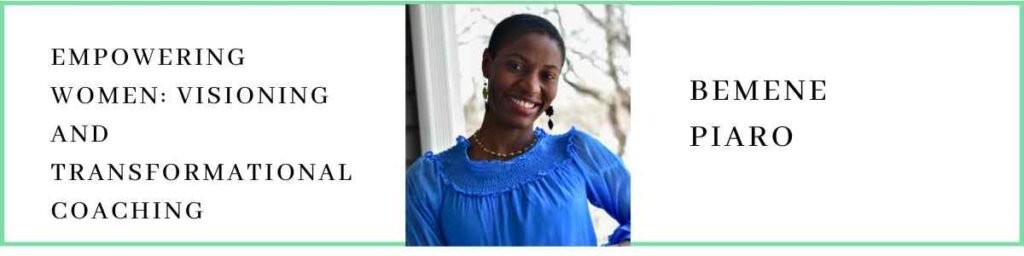
Bemene Piaro, a Certified Life Coach and the founder of the Wholeness Center, discusses her mission to inspire, empower, and educate women of color through her coaching practice. Bemene shares how her visioning workshops and one-on-one support help women reconnect with their courage, agency, and freedom. The conversation explores the difference between visioning and reflective coaching and delves into how coaching can be transformational rather than merely motivational. Bemene also introduces the FlipIt tool, a creative process to help individuals define and work through their challenges. The episode emphasizes the importance of self-trust, agency, and examining internalized beliefs within different systems.
3 Key Takeaways
Visioning vs. Reflective Coaching:
In exploring the nuances between visioning and reflective coaching, Bemene emphasizes that while all coaching involves reflection, visioning specifically focuses on imagining the future. Her process allows women to set goals and create actionable steps towards a desired outcome that aligns with their authentic selves.
Transformational vs. Motivational Coaching:
Bemene explains that transformational coaching offers deeper, internal motivation rather than relying on external forces. This approach helps women understand the ‘why’ behind their actions, making the change more sustainable. It empowers them to make decisions that resonate with their true desires, free from the guilt often associated with traditional motivational methods.
Addressing Inequitable Systems and Internalized Beliefs:
The discussion moves to the challenges women of color face due to various inequitable systems. Bemene acknowledges how these systems, including family and cultural beliefs, can lead to internalized limitations. Coaching provides a platform to identify and challenge these beliefs, offering women the opportunity to redefine their self-concept and reclaim agency over their lives.
ShowNotes
Click on the timestamps to go directly to that point in the episode
[03:42] The Power of Visioning Workshops
[07:14] Transformational vs. Motivational Coaching
[12:03] Overcoming Internalized Beliefs
[18:20] Holistic Coaching Tools: FlipIt Framework
[25:09] How to Connect with Bemene Piaro
Get In Touch:
If you’re interested in connecting with Bemene Piaro, you can reach her via her website, on Instagram, on Facebook, or on LinkedIn.
For those interested in sharing their own stories on “Chatting with the Experts,” reach out to Paula Okonneh through her website or connect via LinkedIn.
Paula: [00:00:00] Hello everyone, and welcome to another episode of Chatting with the Experts with Paula Okonneh. That’s me, where I speak with women from Africa, from the Caribbean, and in the diaspora. These women are experts, they are professionals, they are successful entrepreneurs, and they share a mission, which is my mission, and that mission is to inspire, to empower and to educate women globally. Today, the title of our show, or my show is Coaching Women Towards Wholeness, Clarity, Courage, and Next Steps. And in this inspiring conversation, Certified Life Coach Bemene Piaro, shares how her coaching practice supports women of color in reconnecting with their courage [00:01:00] with the agency and freedom.
And she does this with or through visioning workshops and also one-on-one support. Bemene is a certified life coach and the founder of the Wholeness Center. She was born in Nigeria, raised in the United States, and has traveled to more than 20 countries, which has deepened her understanding of diverse cultures and perspectives. She also holds a master’s degree in public health and certifications from the International Coach Academy and the International Coaching Federation. If you have been watching or listening to my show, you’ll hear me always say that my guests have such impressive bios. So, and I can never speak enough or read out all of their bios.
So what I’m gonna do is invite her now to join me and so [00:02:00] she can talk a little bit more about herself before we dive into the show. So welcome to Chatting with the Experts, Bemene.
Bemene: Hello. I’m so happy to be here. Thank you..
Paula: Thank you for saying yes, because you share my mission, which is to inspire, educate, and empower women globally.
Bemene: Yes.
Paula: So I read a bit of your bio, but I know I didn’t cover everything. Is there anything else that you’d like people to know about you?
Bemene: I actually think you did a wonderful job.
Paula: Thank you so much. Thank you. I always say, wow, these bios are so impressive. So, so we are gonna be talking about how to coach women towards wholeness, clarity, courage, and next steps.
Bemene: Mm-hmm.
Paula: Tell me, first and foremost, why did you choose women of color? Any reason?
Bemene: Yeah. Yeah. That’s a great question. I chose women of color because I am a [00:03:00] woman of color, and I do think there is a power in shared identity and similar experiences in creating a space before you even have that first conversation. At least there’s a hope there of maybe some understanding, some safety and some empathy that may very well exist when there’s not shared identity, but you have to figure that out. Whereas in sometimes when you see someone with shared identity, you feel more encouraged, more hopeful. And so I lean into that to provide my clients that sense of empathy and safety.
Paula: Love that. I love that. But so one of the ways that you do that you said, is through visioning workshops and also one-on-one, or one-to-one support. So what’s the power of visioning and, okay, let’s start with that. What’s the power of visioning?
Bemene: Yeah, thank you. [00:04:00] So visioning, what I love the most about it is that it gives us the opportunity to kind of suspend disbelief temporarily at least, so that we can imagine and vision the reality we would really like. I think sometimes we can be so limited by what we think our circumstances are or what they may very well be. What we already currently believe about ourselves, what we’ve been told, and we can forget what really matters to us, what we really want, and kind of lose that connection to like dreams and hopes. And so what I like about visioning and the process I take people through is like we spend time just kind of reconnecting with ourselves, getting grounded, inviting ourself into a space of possibilities.
Paula: Mm-hmm. [00:05:00]
Bemene: And then we’re just like, Hey, do you know what, no one is denying your reality. No one is denying all the limitations that may be in place, but for now, let’s just think about what you would like. Let’s just think about what would be possible if all those things weren’t there.
Paula: I think what you would like and what is possible if those things weren’t there. Mm.
Bemene: Yeah.
Paula: So is there a difference between visioning and reflective coaching?
Bemene: That’s a good question. So visioning is, well they’re both processes, but visioning workshops specifically is a process. When I think about reflective coaching, I think of all coaching really as reflective.
Paula: Hmm.
Bemene: I see coaching as a space where someone is helping you to hold up a mirror to yourself in a good way, right? To hold up a mirror to what your values are, what your deep down desires [00:06:00] are, so that you can look and say, do I like how that look? Or no, that’s not really what I thought I looked like. Let’s change that. But like, you can make those adjustments based on what it looks like to you and whether or not you like it. So, we’re asking you like, whatever you bring up, whatever your challenge is, well, what is important about that to you? You know, what values of yours are being impacted? You know, what frame of reference are you looking at that through, right? So it’s just helping you to really think about the you beneath the situation or the circumstances or whatever it is in a way that we can sometimes not do because we’re so going, going, going all the time.
So it’s a space to really reconnect with who you are. So both off of that coaching I think does that in general, visioning is really more specifically about setting your future. It’s more about like envisioning the future, what you want in the [00:07:00] future. It may lead to goal setting and action items, but first getting at it from like kind of bigger, broader picture of what you want your future to be, what you want your life to look like.
Paula: I like that. I do indeed. So I know you’re also off camera sometime back, we talked about how, why coaching is a transformational space and not necessarily a motivational one. Let’s dig deeper into that. We believe it transforms you as opposed to motivates you. But a few minutes ago when we talked about, you know, when vision where we are looking to the future and picturing what that would be like. Isn’t that motivation or not necessarily?
Bemene: Absolutely, it is. I would say that coaching is a transformational, not only motivational. So one way to think about it is motivation. Oftentimes the way people deal with motivation is how do I force myself to [00:08:00] do that thing that I think I should do or have to do or just get it done or just get to the next step? Whereas in coaching, it is really about helping you to understand you, helping you to understand why, helping you to understand what is getting in your way. So, you know, if I, here to motivate you or here to be a concern to you, and you’re like, oh, I can’t do this.
I might be like, okay let’s figure out how we make you essentially do it, right? Like, can we come up with your to-do list? Let’s put the calendar invites in place. Like what are the tools, and this is good to help you do it, but if I’m offering you transformational coaching, you might realize that, oh, I actually didn’t wanna do that to begin with, right? So and so told me I needed to do that, and now I’m over here trying to make myself do that. I don’t wanna do it. My body’s telling me, my energy’s telling me it’s hard to sit here and make myself do it. I’m not excited [00:09:00] about doing it. And so it’s like, well, what are you excited about doing? What do you wanna do?
And so when you are like, know what you’re excited about it, know what you wanna do, then it might be easier to do it, right? So it’s like, okay, well so when do you wanna do that? You know, what would help you do that? And letting you come up with those answers from within yourself, rather than me externally trying to get you to do anything or trying to get you to a quick fix. It’s also transformational. I think really one of the key reasons is transformational is because it’s coming from within you.
Paula: Mm-hmm.
Bemene: And so you are more likely to do it. You are more likely to change what you need to change. To get to where you want to get to, where you need to get to, and it also allows for it takes time. It’s a process. It’s a journey. It’s not about the immediate, right? [00:10:00] There may be some immediate results, but then a challenge may come up again. But now you are in a journey and you understand that.
Paula: So the motivation is internal. It comes from within you.
Exactly.
Paula: This is, you know, from the coaching, you realize that hey. It’s not an external force, it’s not somebody else, but this is something I’ve been contemplating and now I can see the possibilities and how I can go about and achieve that.
Bemene: Mm-hmm.
Paula: And so I guess that the end result is more sustainable. It’s more something that person feels I can actually do because it came from within.
Bemene: Exactly. And you remove guilt, I think too, right? Like when it’s like I just have to get it done, then you’re beating yourself up if you didn’t get it done? You’re feeling guilty and you are driven by more so negative emotions versus when you allow yourself to really be with the emotions and understand what they’re trying to tell you. Well, maybe it [00:11:00] really is. Maybe I do wanna do this. I’m the one who wanna do this, but I’m tired.
Paula: Mm-hmm.
Bemene: Well, okay. What do I need now, right? Like maybe I need to rest and I will do this so much better and with so much more ease after that. Or maybe I need to understand, well, how am I getting tired? What am I choosing at the times when I’m most energized, right? Like, so, so much comes out of just giving yourself that space to be with the emotions, to be with, again, what’s coming up for you rather than just trying to force your way through it.
Paula: I can see yes to do what’s coming up for you. So there’s clarity in that. Understanding yourself, understanding what motivates you, understanding why you wanna do what you wanna do, and then going for it.
Bemene: Exactly.
Paula: And I like the part you said, and there’s no guilt because it’s not, you don’t feel like you’re disappointing somebody. ’cause it’s not external, it’s internal.
Bemene: Mm-hmm. [00:12:00] Yeah. Exactly. Yeah.
Paula: So let’s talk also about self trust and agency you know, we talked offline again sometime back about systems being inequitable. And how that sometimes leads to internalized beliefs that are not positive, that are not helpful. Sometimes they can be, like you said, when the transformation comes within yourself, then that’s positive. But sometimes when we internalize beliefs about ourselves because of a system that has been in place on us.
Bemene: Mm-hmm.
Paula: How do you help with that?
Bemene: Yeah, and I just wanna be like very clear that it can really be… we’re all living in, in systems all the time. It can really be any system. It can be the huge ones that we all know of, the ISMS. All of those have an impact. But it could also be just your family culture, your family tradition, your basically your environment and [00:13:00] circumstances. And experiences can lead to sometimes us holding some beliefs about ourselves that are not very empowering, right? They’re very limiting like, if you don’t think you’re smart enough or intelligent enough, which is most likely not true, but something led you to feel that way. Maybe you looked around at all the people that were doing something that you were doing because you were smart and none of them looked like you, and then you maybe had one instance where you didn’t do as well and you thought, oh my gosh, it’s because, you know, it’s because of who I am or how I look, rather than, you know, this was something challenging and you know, and I was challenged by it, right?
And so now you’ve taken that message and you’ve internalized it, and you have some beliefs about yourself that are in fact not true. And we all have different circumstances like that. And so what coaching offers is the [00:14:00] opportunity to just begin, ask yourself, right, what is it that I believe? What belief am I holding in this instance unknown to me probably ’cause I developed it a long time ago? That is making me believe that I’m this way or I have to do this this way, or like this will not work or whatever else. Like, when we don’t examine our beliefs or kind of our thoughts like, what is driving us? Then they just drive us.
But if we take a moment to examine and it’s like, well, who said that was true? Do I still believe that to be true? Can I look now over my history and look for examples of where that wasn’t true? Or, you know, what? Can I make the determination now that you know what, that’s not what I want. So I’m gonna just do something different in the future. But first you have to really, truly understand what is happening. What is the real problem, right? Like, what [00:15:00] is the deep, underlying thing that is causing whatever emotions that I’m having and why I even recognize that I’m having these emotions or am I just looking at the outcome of it? And thinking that, you know, it’s something I’m powerless against.
Paula: That’s food for thought, because I like how you went back and said, you know, all systems are never equal. You know, so it doesn’t really matter whether it’s an external system per se, or even internal in the sense, as you say, it could be family, it could be culture. Most families are, you know, nuclear, mother, father, and children, and then extended family. And so those family cultures come into play because typically the child is impacted by, you know, the environment in which they are in.
Bemene: Mm-hmm.
Paula: And that, as you rightfully pointed out, can lead to these internalized beliefs, which may not be healthy or may be healthy, but [00:16:00] may or sometimes are healthy but when put in another environment, they’re not healthy there.
Bemene: Exactly. Exactly. Exactly. And and what you maybe even believe is true about like whatever category you belong in, right? Like what you think, oh, you know, Nigerians do this, , or you know, whatever else. Well, that could have come from a lot of different places, right? Maybe it came from media or maybe it really came from somebody said that to you, who is well-meaning, right? But what if that’s not what you want to do? Right? So yeah. So, there are many things like that that like you said they may not inherently be bad when examined, right? Like you can take some encouragement from it, right? Like you can learn something from it. And there can be very many positive things about it. Once you, again examine it and determine, okay, well how does this actually work [00:17:00] for me in this context? And if it’s no longer serving me, I’m gonna let it go. Doesn’t serve me. It’s not true anymore. Even if it was true at some point. And then we’re gonna move on.
Paula: Yeah. Yeah. Yeah. That sometimes takes some help. Sometimes it takes a lot of maturity to realize that, yes, this was true within this space, but now I’m outside this space. It’s not that it’s not true, but just within this other space, it’s no longer true.
Bemene: Mm-hmm.
Paula: It takes maturity.
Bemene: Yeah.
Paula: It takes sometimes guidance. It takes sometimes, as you said, coaching, it takes examining yourself and asking yourself, what do you really want?
Bemene: Mm-hmm. Exactly.
Paula: Mm-hmm.
Bemene: Sometimes we’re not even asked that. We’re not always getting asked, what do we want? And we don’t always ask ourselves what do we want?
Paula: And it takes some processing, I mean. Asking yourself that [00:18:00] question can also be unsettling because you may not want the answer that you hear bubbling up inside of yourself and you’re like, really?
Bemene: Yeah, like that? That’s gonna be work. I don’t know. I’m ready for that.
Paula: Am I ready for that? That’s so true. So true. So true. So I know that you have a holistic coaching practice. And you mentioned the tool that you use FlipIt is I think one of the tools you mentioned offline. Tell us more about that.
Bemene: Absolutely. So I appreciate your framing of it as a holistic coaching practice because a tool is just as a tool and there are many wonderful tools in coaching for different purposes. The FlipIt framework came through the International Coaching Academy, which is where I got my certification and what I really appreciate about it. So it’s a essentially a set [00:19:00] of images, values, feelings cards and a process that basically allows the coachee, the person getting coached to go through a process of being able to really define their challenge that they’re experiencing, being able to truly understand the challenge so that the next steps kind of flow naturally for them. And it takes you through, a really creative way of defining that challenge and teaches people basically we are all the artistic directors of our own lives, which is not something everybody knows, right? Like, it’s like you see your life through a lens and a frame, whether or not you are aware of it, and someone else sees the exact same set of experiences through their own lens and their own frame, and that kind of determines how they feel and how the decisions they make going forward.
So helping you to understand what is the frame through which you are looking [00:20:00] at your experiences. So, one way does that say it provides you images if you are having a hard time defining how you’re feeling or like what your challenge is. Okay, well let’s get out of the words. Let’s get out of our head. Here’s a set of images. Does one of them kind of help reflect where you are and what you’re feeling right now? And if not, what image comes to mind for you for, you know, whatever this challenge is, how you’re feeling. And that kind of gets people out of their own head and just kind of more connected again with the creativity. Like it’s a little bit externalizing. So it can be a process for people who are maybe not as great with using words to define and talk about their, their experiences. So then we move from that to, okay, well what does this image mean for you? What feelings does it bring up? And we can give you a set of feelings if you’re somebody who is having a hard time to look at and react and be like, oh, I feel that way.
I feel that way. Or maybe not that I see that. I [00:21:00] think I’m feeling this way. And moving from that we go into okay. So, are there some values maybe that you hold that are getting impacted in this situation? Because sometimes when we have negative feelings, it’s ’cause some deeply held belief or value of ours is being impacted. Even if we’re not aware, like something we believe to be true or the way we think people should behave or whatever, or we should behave or whatever in a certain situation. Being, it’s not being met. But we’re not always aware that that’s happening. We think it’s the other person. We think it’s the circumstances, but it’s like, why do those circumstances and that person impact you in this way?
So, again, there’s a list and you can always go, that’s not my list, but here’s one that I come up with as a result. And the very best part is you get to look at, well, what lens are you looking at this true? Because you can have lenses that are empowering. Right. Like you can have lenses that are like [00:22:00] optimistic, that you know, are confident, that are curious. Or you can have ones that are like fearful and limiting towards yourself. So it’s like, well, what lens are you looking at and how is that impacting how you go about this situation and how you react to people and how people react to you.
And then why I like this particular tool is this fast part. It’s like, okay, are you ready to try on a different lens? Right? Like, what is the opposite of this? And if you try that on and we’re just talking about it, you’re like, that’s not quite right. Let’s try on another lens like this is a safe space where you could imagine what is a different way that I could be other than the way that I’m being now, and find one that excites you and you just get to try it on. It’s like a playful way of being, about making the shift and the change that you need.
Paula: Awesome. That’s neat. That’s really very holistic, because you start it off by [00:23:00] saying it can be very helpful to people who find it very hard to express themselves verbally for whatever reason it could. I mean, for whatever reason, and it gives them a chance to try on, I look at things, I almost say try and, because I was thinking about that, you know, like trying on different hats or looking at it through different, as you say, lenses and understanding, okay, you may be looking at it in this lens or fearful lens, but if you consider it and you know, more cheerful or, you know, gleeful or playful. Hmm. Look at it, you know? I like that. I like that. And it’s not limited to, well, to a certain age group of people. I mean, I assume it’s probably for adults or can you have a five yearold? ’cause I’m just thinking like even just developmentally a 5-year-old may not be able to express themselves as…
Bemene: Yeah. In the same way. And I will full disclosure, I’ve never coached a 5-year-old [00:24:00] in a formal coaching setting, so I have no clue.
Paula: Oh my gosh.
Bemene: I imagine possibly the image side, right? Or the opportunity to draw or create something that represents how they’re feeling could be good right? So to, I could see it being very helpful because they don’t have to express it in words.
They can draw it or they can say, this image one, I said, well, what does this image mean to you? Or, you know, you know what? Where do you feel it? Right? Like, if they’re like, well, it’s like this. Okay, well, where does it hurt? Where does, where do you feel that? So I could see it working, but I’ve never used it there. But it’s not topic specific. It’s not like you have to have this particular issue and it’s not gender or, and it is not any of those categories. It’s just really a process that is really mirroring regular transformational coaching process, but just gives a tool to do it.
Paula: Absolutely love this. [00:25:00] Yeah. Because of time. I had another question, which was apart from FlipIt, is there another tool? But that’s probably something we can talk about when the live audience joins us. Okay. You know, so that when there’ll be a bit more time, but for those listening or viewing later, is there any way they can get in contact with you online?
Bemene: Absolutely. Anyone can certainly go to my website at any time and actually book a complimentary discovery session where we basically identify what is the best thing for them in terms of the support that they’re needing, and I’m always happy to answer and educate about coaching as a tool itself. So oftentimes people are not really clear what coaching is. They know they need some kind of support, and so that’s a great space to ask questions and talk about what it is you’re looking for and what might be the best help for you. So that’s always available. So in addition to doing visioning workshops at the beginning of every year or at the [00:26:00] end, I also do quarterly check-ins and I see them as an opportunity again, to celebrate wins and also release some of that energy or disappointment or guilt or whatever people have gathered from that quarter. Whatever they think they didn’t get done that they wanted to get done, and then to reset and realign. And envision their next quarter.
Paula: Awesome. And of the social media platforms.
Bemene: I am the Wholeness Center. It’s on Instagram. I’m also on LinkedIn and on Facebook.
Paula: Awesome. And so to my fantastic viewers and listeners, I want you to know that just as has been a guest, you too can be a guest. And how do you do that? If you reach out to me on my website, which is chattingwiththeexperts.com. Can contact me there. I’m also on LinkedIn. I love LinkedIn as Paula Okonneh. I also [00:27:00] have a business page Chatting with the Experts. You can find me on Instagram. My handle there is at chat_experts_podcast. I’m on Facebook as Paula Okonneh and we have a YouTube channel that we’d love for you to subscribe to. ‘Cause every week. I have incredible dynamic women who share their expertise so that you can be encouraged, inspired, and motivated by whatever they’re the expert on. So thank you so much, Bemene, for coming on to Chatting with the Experts.
Bemene: Thank you.
Paula: And now we’ll open up the floor to all who joined us so that they can ask you any question related to what you’re talking about. Of course. Thank you again.
Bemene: Thank you.