
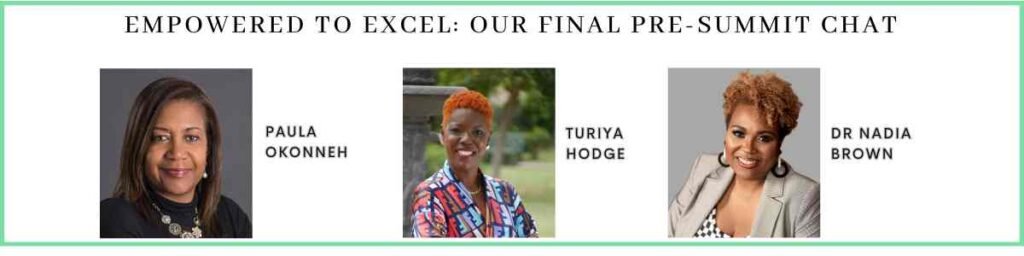
Paula collaborates with co-host Turiya Hodge and guest Dr. Nadia Brown to discuss the upcoming ‘Empowered to Excel Virtual Women’s Summit.’ The May 30th and 31st summit aims to provide actionable strategies in business, leadership, finance, marketing, and wellness for women entrepreneurs and professionals. Dr. Brown, a leadership and sales strategist, emphasizes the importance of leading with confidence and negotiating courageously. The discussion also highlights the power of the pause in sales and decision-making, as well as the need for maintaining integrity and authenticity in business interactions. Audience engagement includes sharing personal experiences and appreciating practical advice. The episode concludes by urging registration for the summit and promoting the VIP package for continuous access to resources.
3 Key Takeaways
A Gathering of Incredible Women:
This year’s summit features an extraordinary roster of dynamic speakers, including Paula’s co-host Turiya Hodge and Dr. Nadia Brown. They are poised to lead captivating sessions during the two-day virtual summit scheduled for May 30th and 31st. The summit is designed not just for women entrepreneurs but for leaders and professionals keen to adopt actionable strategies in business, leadership, finance, marketing, and wellness.
Insights into Social Media and Sales Mastery:
In a lively discussion, Turiya Hodge acknowledged Paula’s vision and her relentless efforts to bring women of color together to discuss what it means to be business leaders. Turiya herself, a social media strategist, expressed anticipation for diving into the summit’s themes, particularly highlighting the importance of aligning social media with strategic business goals.
Meanwhile, Dr. Nadia Brown, a leadership and sales strategist, emphasized the importance of leading with confidence and earning with courage—a keynote that is bound to resonate with every participant. She shared insights into overcoming fears around sales, discussing negotiation strategies and the need to align sales conversations with personal values.
The Power of the Pause:
The session introduced a powerful concept known as “the pause,” which emerged as an essential tool both in business and personal interactions. Whether negotiating prices or navigating challenging conversations, the pause allows space for genuine thought and engagement.
Members of the audience, like Constance, shared personal anecdotes, reinforcing that pauses can lead to more meaningful dialogues and decisions, rather than rushed or emotionally driven responses.
ShowNotes
Click on the timestamps to go directly to that point in the episode
[05:18] The Power of the Pause in Sales and Negotiation
[06:19] Summit Highlights: Leadership, Marketing, and Storytelling
[15:50] The Importance of Listening and Creating Space
[28:34] Navigating Sales Conversations and Building Relationships
[31:21] Acknowledging Human Emotions in Sales
[31:41] Introducing the Courage Diary
[32:46] Handling Rejection in Sales
[33:15] Pre-Call Strategies and Vetting Clients
[35:18] Understanding Different Buying Styles
[36:49] The Importance of Social Selling
[41:33] Communicating Your Value and Pricing
[47:24] Promoting the Empowered to Excel Virtual Summit
Get In Touch:
For more information or assistance, please register for all the details and contact information on the summit at our registration webpage.
Upgrade your experience with our VIP All-Access pass, which includes early access for networking, lifetime access to all recorded sessions, and exclusive resources from our speakers.
For those interested in sharing their own stories on “Chatting with the Experts,” reach out to Paula Okonneh through her website or connect via LinkedIn.
Paula: [00:00:00] Well, hello everyone and welcome to yet another episode of Chatting with the Experts, the TV show where I speak with women from Africa and the Caribbean and in the diaspora who are successful entrepreneurs and professionals. They share with me a mission. And what’s that mission? The mission is to educate, empower, and to inspire women globally through their products or their services. Today is a little different in that, in this episode, I am gonna have with me, my co-host and one of the dynamic speakers of my upcoming summit. Which is called Empowered to Excel Virtual Women’s Summit. When is that? That is on Friday, this coming Friday and Saturday. That is May 30th and 31st from [9:00] AM through [2:00] PM Eastern Standard Time, [00:01:00] and it’s a two day virtual summit for women entrepreneurs, for professionals, for leaders who are focused on actionable strategies in business, in leadership, finance, marketing, and wellness. So without much ado, I will invite my co-host, another dynamic speaker Turiya Hodge to join us and also Dr. Nadia Brown, who is one of the speakers on Friday. Thank you so much, both of you, for joining us.
Turiya: Awesome. Welcome. Thank you so much, Paula, for the invite to sit down with your audience and Chatting with the Experts. I am once again, Turiya Hodge, social media strategist and I am super excited for the Empowered to Excel, two-day virtual summit. And one of the things I’d like to do is congratulate you once again for being obedient to the vision. And so when I take a look at your work and what you do in bringing women, [00:02:00] all women of color all throughout the diaspora together, and to have a conversation on what it means to be business leaders in our respected professions, and just bringing everybody, you know, together to share what they have to offer so we could all, you know, do this thing called life, do this thing called business in a way that it benefits us all, not just us, but the people that we are purpose to serve. So thank you so much for that, Paula.
Paula: Absolutely. I couldn’t have done this without you and all the other speakers who said yes to being on the summit. And so, today I’m going to introduce, I’m gonna let Dr. Nadia Brown introduce herself. She is one of our dynamic speakers. I’m so excited. So, Dr. Nadia, would you mind telling those who have joined us, who you are, what you do, and what you are going to be sharing with them on the summit?
Nadia: Yeah. So I’m Dr. Nadia Brown. I’m the founder of the Doyenne Agency and Doyenne means standout woman leader. So I’m as leadership and sales strategist, [00:03:00] and on Friday I get to share my message, if you will. My training will be lead with confidence, earn with courage. A lot of times we as women are afraid to talk about the money. Whether you’re in corporate and is negotiating your salary or a raise, or you’re a business owner and it’s making sure your rates are at a good place and making sales and generating revenue. Either way, this is gonna be a dynamic session for you.
Paula: Oh, thank you. Thank you. Thank you. So, you know, one reason that I decided to do this is because, well, first and foremost I’ve always wanted to do a summit, but my story has always been one of podcast, coach encouraging of women, empowering women. But I thought the summit would just be an ideal way to bring together even more women to hear the… oh my gosh, the voices of the professionals that I don’t always have an opportunity to have a one-on-one show [00:04:00] with, but to have it now, the platform to speak with women globally about what it is that their experts are, how things have impacted their life, and even more so for business owners, women business owners, because that’s something that, you know, we don’t always have the opportunity to experience. So, what are we going to be teaching on or sharing that day? I mean, what do people expect to learn from this? Turiya, do you wanna answer that?
Turiya: Yeah. And before I answer it, I just wanna give a shout out to Dr. Nadia because as I was sitting here and, and I’m super excited, you know, to listen to her message and I have to just share, I’ve had the opportunity to work with Dr. Nadia several years, but one of my fondest memories, and she talks about, um, leading, selling with courage, is that I actually had Dr. Nadia work with me on my sales script in my sales training and I still have it, Dr. Nadia.
Nadia: [00:05:00] Wow.
Turiya: I still do. Okay. And I remember the very first time implementing that sales training along with the sales script. You know, I got my script right in front of me I’m on the call. And then inside of the script, Dr. Nadia actually has, after you ask the question. Pause. We’ll wait for the answer. She actually wrote those things in there, and I remember going through the script on this one particular call, and I gave my price, the investment, and right underneath that, Dr. Nadia says, pause. And when I tell you that pause seemed like an eternity, but I was like, no, I’m gonna remember the training that Dr. Nadia taught me. She taught me to pause, and as I pause. Like, it felt like an eternity. But the lady turned around and she says, oh, okay. Um, I’ll be able to do that. And I was just like, wow.
If that pause was not there, I would’ve probably talking [00:06:00] myself out of the sale. So as I’m sitting here, Dr. Nadia, that’s one of my fondest memories of you and the work, you know, that you do. And so I’m super excited that you’re gonna be part, you know, of the summit. And I can’t wait to hear, you know, what are the gems that you’re gonna drop on the summit as well. And so, along with Dr. Nadia, Paula and myself, we have amazing speakers like Suzan Hart and Suzan Hart. Hart’s talk is gonna be leadership mastery, navigating challenges in and inspiring teams. Like how do you do that? And how do you do that in times as these? And so a lot of us are faced with different challenges, whether you are here in the US, you’re in Canada, or even globally, times are changing.
So what does it mean, you know, to navigate leadership, navigate teams in spite of all of the different changes that we have going on? Then we have [00:07:00] Dr. Linnette Montae, and when I tell you, Dr. Linnette Montae, I always say be prepared when she takes the stage. Because she does some stepping on some toes. She is one of the straight up, no-nonsense business coaches out there. And so she’s gonna talk about your million-dollar bottleneck. And time is not your problem, your authority is. So I can’t wait to hear her message on that. And then we have none other than the DeKesha Williams, the webinar queen. She’s gonna talk about how to attract your ideal clients using webinars.
Then we have Dr. Gloria Sloan, who’s also gonna be gracing us, and she’s gonna be talking about storytelling for success. So what it means to share your journey, to build emotional connections along with others. And so when I tell you we have an action-packed two-day summit, come prepared. [00:08:00] Bring your notebook. Come ready to learn, take notes, invite a business bestie along with you, because I’m gonna tell you, these are all of the challenges that we see as entrepreneurs, we see as business leaders and it’s how do you navigate it? So we’ve put together a team of experts to help answer some of those burning questions and provide strategies that would allow us to move forward.
Paula: Thank you so much Turiya, for expanding on that. And I know we have a lot more speakers we can, you know, we can elaborate on and what they do and what expertise they’re gonna be sharing. But I wanna come back to Dr. Nadia Brown. When I read her bio, wow! You mentioned just how helpful she was in helping you craft your message. And, you know, when I read her bio and Dr. Nadia Brown, you’re right here and I’m talking to you in the third person because it was so impressive that you [00:09:00] are a sales strategist but you have a background in engineering and a doctorate in organizational leadership. But you know, one thing that drove you to being successful and for starting your agency was around your own fears about sales and success, and now you’re able to teach people how to live with confidence and to sell what they are. Tell us a little bit more about that, because you know that always resonates with a lot of us business owners.
We step into this and we are like, I’m so afraid. Like for me, let me give you an example. I was afraid of public speaking and here I am 13 years later in front of the camera on a podcast, audio podcast first, and then video podcast. But it came from my own pain. It came from my own uncertainties. It came from my own saying, oh, I wanna do this, but I’m afraid. So tell us a bit about you.
Nadia: Yeah, so I think I am probably in the majority, most women start their businesses because we are excited or passionate [00:10:00] about a particular population or particular topic. And so when I first started my business, it was, I was really focused on helping women leaders, primarily those who had been in or who worked in male dominant industries because that’s where I’d come from, right? And one of the things that I quickly realized though, that as a business owner, I needed to learn how to sell. However, I didn’t like the way I’d been taught to sell or the ways that I had seen sales demonstrated throughout my life, and just different interactions. So it made it very difficult to be very passionate about helping these women but not knowing how to engage with them in a way that allowed me to truly serve them.
Paula: Mm-hmm.
Nadia: So that was part of my own journey, was how do I sell in a way that feels not only in alignment, but also within my values and it feels like I’m operating in integrity. Because I find it very [00:11:00] interesting that sometimes you’re taught that you’re gonna work with someone, you almost bully them to work with you, and then you want to then build this close working relationship and you wonder why it’s not working. Well, the way things started were a hot mess, so I had to figure out a way that I could engage with people that I wanted to work with. But we could start off on good terms, not feel like I go into this conversation to do battle. And so when I meet women and they’re like, well, I don’t like sales because I feel like I have to convince people to work with me. I’m like, that’s not at all what you get to do when you’re having a sales conversation.
It’s actually an invitation to support them and help them achieve a goal that you have the ability to help them solve. Right? And so then it’s like, oh wait, that whole reframing of it, or like when Turiya talks about the sales script, which I shifted because a lot of times we don’t like scripts. So you’ll hear me often refer to those as conversation guides. You’re having a conversation with someone and, but you also have this [00:12:00] tool to help guide the conversation because you’re going somewhere, right? And so how do you do that in such a way? But part of the reason why she has that pause there or silence is because what do we do when we get uncomfortable? We talk ourselves out of it.
Paula: Mm-hmm.
Nadia: So she had the opportunity where she stated that investment and there were stories going through her head, am I right, Turiya?
Turiya: Oh yes.
Nadia: There were things going through your head. And I’m like, Uhuh, don’t let the stories drive the conversation. And when she did that, then the person that she invited to work with her, said yes. And so it’s all those different things, but a lot of it is that mental piece. How do we do this in a way that allows me to show up as me? When you get to know me, I love to have fun. I love to giggle. Turiya tell you, we laughing all the time. That’s how, if you were to have a sales conversation with me, that’s likely what it would be like. And that’s who you get to work with, if you say yes to working with me. It’s not like that whole bait and switch. Oh, I thought you were one way and I’ll work with you in your different way. And so, those are the things that I get to work with [00:13:00] women on. And then even if you’re in corporate, because I know we have a blend of women attending the summit, I remember, I can’t remember the stats.
I need to look it up before Friday. I’ll get some new data. But the stats in terms of the number of women who negotiate their salaries, it’s terrible. And I knew this stat and I still had trouble asking for what I knew. That I should be making. I had the data, I knew the salary range, I knew this, I knew that. And still, when that moment presented itself, I hesitated. Why do we do that? Like, what is that that fear about? So that’s what I get to talk about because it’s a real thing that even people like myself, we have the data, we’ve done the research. I did a whole dissertation on women in leadership. Like I get it.
And still when it is time for the rubber to meet the road. And you to really stand in that you still sometimes may start sweating, your voice may start shaking. You may like it’s a real thing. And so how do we move past that fear that we have around money and really [00:14:00] standing in our power and demanding and commanding what it is that we know that we bring the value we bring to an organization, whether we’re working in a corporate organization or we’re leading our own.
Turiya: Yeah.
Paula: Yeah.
Turiya: Absolutely. Amazing. Thank you for bringing that back, Dr. Nadia, that it’s not a sales script, it’s a conversation guide. And I’ll share with you like how far your influence has ran for me, because one of the things like you said, is being able to show up in a way around that conversation to invite people to journey along with you, you journey along with them to achieve the desired goal. And so, of course, you know, I’m in the social media space and one of the things that I take a look at is like, what does it look like? And so a lot of times is just a reframe and one of the reframes that, you know, I had the opportunity to make in that vein instead of in content and I’ll use connecting conversations. So what are your connecting conversations [00:15:00] that you’re having out there in the marketplace with the people that you’re purpose to serve? So thank you so much for that.
Nadia: Yeah, you’re welcome. That’s juicy. I like that.
Turiya: Yeah, I’ll be sharing more of that on Friday. So I’m actually gonna be talking about social selling mastery and like what does it mean in these day and times, you know? So, yeah.
Paula: Well, you know, it’s interesting coming back to what Turiya, you said. Dr. Nadia helped you do, which was…
Turiya: Mm-hmm.
Paula: Pause, silence. You know, pausing before we do the next step, because I’m hearing a lot of that from people. It’s interesting that more so this week, you know about the power of silence, pregnant silence. How many times, you know, we talk ourselves out of, or talk ourselves into things because we haven’t just paused. And so I wanna pause right now and ask any members of who have joined us, of the audience, if any of them can relate to this. You know, where there’s been a time in their life where they’ve had [00:16:00] to pause before they made a decision, and how that has impacted them. Is there anyone who’s willing to share or ask a question about that? About the pause?
Constance: You know, I use the pause quite a bit when I’m talking to clients. And also I have to say, I use it a lot in my personal life, you know, when I’m talking to friends or even with my sisters, especially when we get to a, you know, I’ll just tell you when. You know, it may be contentious with my sisters and I’m very close with them, but one of ’em will say something that I will immediately interpret as negative. And I’ve learned to just have her say more. Sometimes it’s just a matter of, say more about that, you know, and then she will go on to explain exactly, you know, what her intent was and whatever, whatever it is she [00:17:00] said, or what the real meaning was. Sometimes we just misspeak and I find that when we take a pause and calm ourselves, kind of calm my system down, there’s a much better ending to the conversation.
Turiya: Yeah.
Constance: For me and for the other person, you know, for me, because I didn’t jump to conclusions and you know, walk away, you know how you walk away and you have the imaginary conversation.
Paula: Mm-hmm.
Constance: Like, I should have said this, and you know what? I should have laid her out. You know what I mean? So I don’t have those internal imaginary conversations. Whatever the confusion is isn’t lingering on in my mind and in my spirit. And so, you know, how it just leads to a whole lot of other things. It’s not just what they said. It’s the effect of what they said. So pause has worked very effectively for me and I think the hardest thing people [00:18:00] struggle with is they think a pause means it has to be like five or 10 minutes. Right. A pause. Sometimes a pause is just, you know, 30 seconds.
Paula: So, right. Five or 10 or 15 minutes when a few seconds can be just as impactful. Because I remember I had a guest on the show and she talked about a negotiation that she had to do with a potential employer and how, you know, she was about to say yes. And then she paused and thought it through and then she negotiated and she said it was when she paused that she could think through, wait a minute, I may have some other options. Why not put those options on the table? And if memory says me, well, she walked away with much more than she would’ve had, you know, in terms of her salary than if she had just said outright yes without that pause. [00:19:00] So, yeah. That five to 10 seconds pause can really change. Change a lot of things.
Turiya: Yeah.
Paula: Dr. Nadia, I see you nodding your head.
Nadia: It really can. I think that, you know, not being afraid to pause and to Constance’s point, sometimes it doesn’t take all that, like it doesn’t take a long time. It was, you know, 32nd pause compared to a five minute pause. But even in that 30 seconds. It gives you that moment to, like she said, calm yourself, quiet any of the doubts, the insecurities to really kind of bring you back and like in your example Paula, it was like, oh wait, I may have some options. And sometimes the easiest thing to even do that, to buy you some more time is to ask a question. You know, do some more probing, some digging. Like tell me more about this and have you thought about that? Or what about this? And then as that person is talking, you gather yourself. So then you don’t have to have the walkaway conversation.
’cause not all of us think of all the things [00:20:00] right in the moment. I’m that person too Constance. I walk away or I wake up in the middle of the night. That’s usually my worst one. Absolutely. I wake up at [1:30] AM and then I have the greatest comeback ever. But of course everyone else is asleep. So, you know, learning those different tools and tricks to one pause, take a deep breath, and then also ask more questions sometimes to give you a moment to not only gather more information, but to also just give you a second to kind of get your bearings and to kind of think through what it is that you wanna ask for, what you wanna say before you just outright say yes. And I think sometimes as women, we’ve been conditioned, a lot of us that we are, you just say yes, even when you wanna say no, even when you know it’s a no or it’s not a right fit. We’ve been taught to override that gut feeling. And just say, yes, to be agreeable or to keep the peace, or whatever the reason is. But I’m, I’m glad more of us are taking that pause. We’re learning boundaries. We’re also learning what we will and what we won’t stand for. And we’re training, you know, our daughters now to make different [00:21:00] choices.
So I’m excited about that.
Turiya: Yeah, I love that.
Constance: You know, I think back also that the pause gives you leverage. I just remember my days in corporate when something was thrown out, especially in negotiations, and you just look at the person, you know, and then they feel a little, oh, you know, you look at the person with that. Mm-hmm. You know, that’s BS, right? It’s almost like what your mom did when you were growing up. You know, she, you’d say something and she’d look over at you and you’d know, okay, that was the line, and I need to back away from it.
Paula: The look.
Constance: The look, the look.
Nadia: Oh yeah. We all know that look.
Paula: That look.
Constance: And that’s all it took. That’s all it took. And it made you, you know, you got the look and they didn’t say anything, and you started doing a whole lot of rambling.
Nadia: Mm-hmm. Yep. My husband and I were watching a show recently, I can’t think of the name of it, and it [00:22:00] was an investigator and it was so funny because she did exactly that Constance. She would sit there and she would ask a question. Or sometimes she wouldn’t ask a question of the person who was a potential suspect and she would just sit there and look at them and it would get so awkward. And then they would just start telling and they would say stuff and they’re like, I know what you’re thinking. And I’m like, do you? Because she said nothing. And then they would start talking and then she would say nothing. She just really mastered the power to pause. And then they would pause and then she didn’t say anything. They would just keep going. And so she got so much information out of them just by pausing and being quiet. So yeah, definitely a powerful tool.
Turiya: Yeah. You know, and I wanna add to that because I just saw. Is it Ade? Am I pronouncing it correctly?
Paula: Ade, yes.
Turiya: So we’re thinking along the same lines and we’re talking about sales. So I love Dr. Nadia that you opened up the conversation in [00:23:00] sharing that as we position to work with others, whether it’s in our business or we’re in companies, that we actually get to invite other people to who we are. So we shouldn’t be out there pretending to be other than we’re not. And as we’re talking about this conversation about pausing, one of the things that came up for me, and I don’t know if this is the same thing that Ade was thinking, but this is what I was thinking.
So sometimes we could be so much like on our own agenda in our mind, like when we sit down to have these conversations and we know that we’re gonna say this, we’re gonna say this and we’re gonna ask this question, and then this is gonna follow up next. And so sometimes we could be so anchored into what it is like we think is the outcome versus just creating the space, the pause to have other [00:24:00] people fill in what they’re thinking and where they’re at. And so we’re talking about pausing and it’s reminding me of just Monday I had the opportunity to spend some time with a client and I went to the client and I had my agenda in my mind. And it wasn’t until I unpacked this that I realized what was happening.
So I had my agenda in my mind, what I want to accomplish, what the outcome is gonna be, how we’re going to get to the outcome, all of this stuff, because I’m prepared, right? And then I got there and then it wasn’t going the way how I anticipated going in my mind. And in right there, I had to once again incorporate the power of the pause to let the space be open, to have that person [00:25:00] tell me exactly where they are, what is it that they need at the moment to move forward to the next step.
So sometimes the pauses can be, like you said, like the 32nd pause. Or sometimes the pause can just be, you know, a few hours to give people just the opportunity to work things through in their mind. So I love it that we’re talking about creating the space not just for them to give a response in a short time, but for them to really unpack things for themselves too. And so sometimes it might not be a response, it might just be a question, you know, from them. And how well are we able to hold that for them and then lean into not just what we want the outcome to be, but what would be the best thing to help serve them? So that’s what came up for me in the power of the Pause.
Paula: That’s so powerful. That’s so powerful. And it, that goes back to what [00:26:00] Ade has here in the chat. In the chat, that the power of listening is very important. I always say, you know, there’s a reason why we have two ears and one mouth.
Nadia: Mm-hmm.
Paula: You know, so that we can listen a lot more than we can speak. Because once those words go out of our mouth, we can’t take them back. They’re out there. And now that we live in a world where, you know, everything, nearly everything is being recorded. I’m a podcast coach, so I encourage people to record, and then of course we’ve got video where it’s being visually recorded. You can’t take it back. You can apologize. You can say sorry, you can try and take it back, but it’s out there forever. These days where data is so, you know, is stored everywhere. So, yeah. That story you gave and then of course Dr. Nadia talking about the power of the pause is priceless. We need a sales personnel, as you know, entrepreneurs, to know the importance [00:27:00] of that silence when speaking to our clients. Let us find out what they want and not what we think they need or think they want. Sometimes it’s so different.
Turiya: Yeah.
Paula: So different. So again, I’m gonna open up the floor to anyone else who may have a question or a comment as on what we have spoken about so far. Because this is in a sense, it’s given you a glimpse as to how our summit is gonna be. The conversations we are gonna have is really going to be impactful for women, women entrepreneurs, women professionals, whether you’re in leadership, you’re in coaching, you’re in sales, whatever walk of life, or even if you are not in any of those things, but you want to just better yourself. Because I know for myself, I learn something new every single day, no matter how small it is, and I cherish it because it means it’s something that I didn’t know before. And now I’ve added that to my knowledge bank. So again, I’m gonna [00:28:00] pause, pause, that’s the keyword today, and ask any of the audience members if they would like to, you know, contribute to this conversation that we are having right now. And you don’t need to switch on your mic, I mean, no, your camera. If you’re not comfortable with that, and you don’t even need to switch on your mic, you can just type, put it in the chat and we’ll address it. All right. Doesn’t seem like we have …
Turiya: Constance is…
Paula: oh, sorry, Constance, go ahead.
Constance: Well, I was really intrigued with how you turn the sales conversation around, because I have to say that’s probably my weakest point. You know, I have a script in front of me and we go through like, what’s your problem? And, you know, what have you tried and all of those things. But I don’t, you know, I get down to the point where they want to know about [00:29:00] pricing, you know, and i’ve stalled long enough. I stalled probably isn’t the right word. I mean, I’ve gone over the why do it and you know, all of that kind of thing. But really it comes down to, I feel people are like… I dunno what to say. I feel like I’m not catching, I’m not weeding them out early enough. Right?
Nadia: Mm-hmm.
Constance: And I’m going through this whole spiel and it comes down to money, which to me says they weren’t at the point where they could make a decision.
Nadia: Mm-hmm.
Constance: Right?
Nadia: Mm-hmm.
Constance: And they were wasting my time. I’m being very blunt with you guys. Like I would never say this. I would never use those words, but that’s truly how I feel. I feel like…
Nadia: mm-hmm.
Constance: You know, I’ve invested the 20 minutes or whatever, and I realize that people need to shop [00:30:00] around. But I take myself, for example, if I’m gonna buy something, I’ve already done the research, I’ve already test you out, and I’ve test you out, and I’ve gone to your site a gazillion times and I’ve had my sisters go to your site. You know what I mean? I did all the camouflage. So, by the time I talk to you, I know that you are, I’m gonna sign you up. But I feel like people. What’s frustrating for me is I think people want a coaching session.
Nadia: Mm-hmm.
Constance: And not a relationship. Does that make sense?
Nadia: Yep.
Constance: And so…
Nadia: a couple, oh, go ahead. I want you to finish.
Constance: You let me that. So I was just intrigued about how you turn it into a conversation, and you don’t feel cheated at the end. Regardless of the outcome, like I’ve said to [00:31:00] myself, divorce yourself from the outcome. I’ve tried that strategy. I’ve tried the, you know, just kind of give them a little bit of coaching and then circle back around and so there I am. I think that’s enough for you to work with, right?
Nadia: Oh my gosh. This is good. And it’s common. It is common. Okay, so first I want to acknowledge. That you are human. And no matter how many times we may say it’s just business, it’s not personal. It feels personal.
Constance: Yes.
Nadia: Right?
Constance: Yes.
Nadia: Like it just is what it is.
Constance: Yes.
Nadia: And we just have to figure out how to work through that.
Constance: Yes.
Nadia: How to acknowledge our feelings. One of the resources I created, I’ll be sure to have one with me on Friday, for show and tell is the courage diary. And it is a resource that allows you to not only track your sales conversations, but one of the questions that I put in there during your post call debrief is what emotions came up for you? Those are important. We [00:32:00] are emotional people. Let’s just acknowledge it and embrace it. That is part of our superpower.
Constance: Yes, yes.
Nadia: But also be our kryptonite if we’re not careful. So I just first wanted to start there because I get it. And as much as I do sales, I still have my days when I’m like, oh, that sucked. Like that was just really hard and it hurt and it, you know, I’m like, okay, Nadia.
Constance: Mm-hmm.
Nadia: What’s going on? But also, how do I take care of myself? So that I don’t allow myself to stay in that place.
Constance: Mm-hmm.
Nadia: But I also don’t beat myself up for going to that place because I’m human just like everyone else. And there are some days where it just rolls off my back and I’m like, next. And there are other days when I’m like, oh, everything just felt personal today. I don’t know what’s going on, but it feels personal. So I wanted to start there because we’re all human. And there’s nothing wrong with having feelings or emotions about doing sales. And part of sales that makes it so hard is you will get rejected. People will say no. No matter how great you think they are, no matter how much you know you can help them, no matter how cheap it is. You’re like, oh my God, like I can’t go even lower like it is [00:33:00] none of that. Somebody is going to say no. And it’s gonna hurt. Like that’s just part of the process. So I wanted to start there.
The other thing, stance really quick though, is I don’t know your business. I’m gonna just throw out a bunch of things and grab what may work and discard the rest. So one is before people get on a call with you, if you don’t already, look at implementing some sort of form that allows you to gather information, but it also allows you to do some level settings. So there’s some strategic ways that you can do that in terms of just, people don’t just get to go straight to your calendar. They have to take an extra step, and doesn’t have to be complicated, but it is a way to help get rid of some of your tire kickers.
Constance: Yes. Yes. Because I’m just here an excellent idea. Yes. So I’ve noticed that I have had to do that.
Nadia: Mm-hmm.
Constance: It’s like, wait a minute, you know, do you have a budget for this?
Nadia: Mm-hmm.
Constance: You know, how, where are you in the pro? Oh, that’s an excellent, and I don’t know why. [00:34:00] I do it. I do it as a consumer, but I didn’t think to do it as a business owner.
Nadia: Yes. So that’s one. And then two, either, probably both places in the form and in the questions that you’re asking. Some of the questions you ask are vetting questions. Is this someone I even wanna work with?
Constance: Mm-hmm.
Nadia: So it is not just focused on the solution, that’s part of it. But another part is I’m interviewing this person, like, are you going to give me and or my team a hard time? And you’re gonna be that client and none of us wanna be bothered with? So part of it is they’re vetting you. That’s an interview. But it goes both ways. It’s kinda like a first date. Do I like you because I don’t know. If I don’t like you, then I get to turn you down. Another thing is during that conversation, when you start, and Turiya can attest to this, before we even start the conversation, you set the tone.
Constance: Mm-hmm.
Nadia: So the reason that we’re gathered here today is because we’re having a conversation about us working together, right? Like that’s the essence of [00:35:00] that. So we’re not, I’m not here to do free coaching. I’m not here to do consulting. I’m not, whatever it is you thought we might be here to do, that’s not it.
Constance: Okay.
Nadia: This is why we’re here. And level setting so that people understand that this is the purpose of this conversation and the goal is by the end of this conversation to see if we are a match.
Constance: Mm-hmm.
Nadia: So those are just a couple things. One thing I will add, because you talked about our buying styles are very similar, so I get it. However, not everyone buys the same.
Constance: Mm-hmm.
Nadia: So there are different buying styles. Like my husband is very different. He’s gonna do all the research and go to the website, talk to you, and still need to sleep on it. It’s a legitimate part of his process, but once that brother buys, he is like one of your most loyal customers. So it’s just one of those things. So how do you adjust your process to accommodate the different buying styles?
Constance: Mm-hmm.
Nadia: Because not everyone is there kicking tires, but there are things you can do to kind of weed those folks out.
Constance: Thank you. Those are really good suggestions and I’m going to implement them. [00:36:00] ‘Cause I think that will really help my mindset as I go into conversations and it will help the outcome as well, I believe.
Nadia: Mm-hmm.
Constance: So thank you. I appreciate that.
Nadia: You’re welcome.
Turiya: Oh, ooh. And I wanna chime in.
Nadia: Hey, girl!
Paula: I’ll say you can too because after all you’re the social selling mastery. Mastery is the word, but still because. You know, so Yeah.
Turiya: Yeah.
Paula: Go on about that, please.
Turiya: You know, once again Constance, I’m gonna applaud you for your transparency. So not everyone would be willing to share the emotions that come up and be honest about what it is that they feel when we are in these positions. When we are doing these calls, we’re asking people like this is my word, asking people to journey, you know, with us, as you could tell, like nothing about me is a hard, pushy [00:37:00] salesperson, right? But one of the things that you said that I found what’s so interesting is that you said, I’ve already done my research and to Dr. Nadia’s point, I wrote that down, like not everyone does that type of research or you never know, they’re still doing their research and part of their research is being on that call with you. And so I don’t know what space you’re in, but I work a lot with coaches and consultants. That’s my niche.
And one of the things that stood out for me is, oh my gosh, how do we tell where people are in the buyer’s journey, in their journey. So a lot of times we know what, you know, our journey looks like. We know what we want them to do, we know where we’re leading them to and all of that good stuff. But the question is, how well are we able to assess like [00:38:00] where they are in their journey? And so one of the stats that I found was very interesting, and I heard this a couple months ago, is that it takes for someone to consume seven hours of content, 11 touch points across four platforms, before you’re able to convert that person who’s just a prospect, that person who’s interested into a paying client or paying customer. Okay. And when I heard that stat that changed the way, how. I look at things because people are doing their research.
Paula: Mm-hmm.
Turiya: And so the question becomes how well are we able to put in front of them the things that they need to allow them to make that buying [00:39:00] decision? And so when I take a look at social media, this is why I talk about social selling, like it’s a whole entire process and we get a chance to use social media as the wonderful tool that it is to do all of this research, you know, to do all of the listening, to provide the touch points, to take people along, you know, the journey. So ultimately, by time we’re in the conversation because I get it Constance, like that’s your time right there and you want to make sure that you give you and that person the best opportunity to move forward when you’re in that conversation.
So it’s all about what are the other things that they get a chance to experience before they get on that call with you. So when you’re on that call, it doesn’t turn out to be an investigative call where they’re trying to vet you because that’s [00:40:00] what people are doing, right?
Constance: Mm-hmm.
Turiya: Just like how we’re vetting them.
Constance: Mm-hmm.
Turiya: They’re vetting us. They’re like, well, how do I know? Like they say that they’re gonna do what it is they say that they’re going to do or they can do.
Constance: Mm-hmm.
Turiya: So it’s how do we create that environment beforehand, so when we get on a call, we have the best possible outcomes for everyone. So I love that. I just wanted to commend you on your honesty and your transparency for bringing to the cost.
Nadia: So good.
Constance: Well, thank you for breaking down that, you know, for both of you alerting me to the fact that everybody doesn’t buy the way I buy. And I appreciate that because I’m thinking you are me, you know that client is me. So I appreciate that. Yeah, I’ve gotten away from the sting of rejection, but I think that I’ve gone too far in the other direction. You know, I kind of like come to the call like, Connie, you realize that they may [00:41:00] not buy your services and that’s okay. Especially when we get to the money.
Like, I’m really sensitive about that because what I’ve found is that the people who hire me don’t even hear my price. Right? They don’t hear that. What they hear is, you can help me, and whatever that cost is, I’m buying it. It’s like those shoes at Nordstrom’s, you know, I can’t afford those shoes, but I’m buying them. Right? I want you guys to speak on this. When it comes to like asking for your worth, like, I’m firm on that now, but that’s a sensitive, you know, that’s a tough hurdle to jump over.
Nadia: Yeah.
Paula: Yes.
Nadia: So first I wanna add a refront. Well, really quickly before I dive into that stance, I just wanted to add to Turiya’s data. And I just got this today so it’s fresh. Remember that only 3% of your target market is actually ready to buy now.
Turiya: Ready? [00:42:00]
Constance: Wow, wow.
Nadia: That only 3 percent.
Paula: 3 percent.
Turiya: That’s a whole nother 97.
Nadia: Yes. That are at different stages. The only 3%,
Constance: Oh my gosh.
Nadia: Are ready to buy right this second. So that really starts to reframe. And again, going to Turiya, that’s why you’re, the content you put out the marketing and all of that helps those others work through their process. 3% are ready to buy right this second.
Constance: Wow. 3%.
Nadia: Yeah. That’s it.
Turiya: Yeah.
Paula: Isn’t that scary? Isn’t that…
Constance: Yes. Yes.
Paula: I don’t wanna say worrisome.
Nadia: It helps to reframe even, you know? And I get it. You have those conversations, you want people to be ready. That’s why the work that three does is so important because all of that really is part of the selling the sales process. It’s not just that conversation. So all the things that you’re doing prior to that help impact the results or the outcome.
Constance: Right.
Nadia: Of that. So, yeah.
Constance: Wow.
Nadia: But to your money question, one of the things that I want to say is we [00:43:00] talk a lot about charging what we’re worth and that whole money thing, but I want us to remember and write this down if you must, that we can never charge what we are worth. We are priceless. We can never charge enough.
Paula: I love that stage again.
Nadia: We can never charge enough. We can’t do that. So we have to learn to separate our self-worth from the work that we do.
Constance: Yeah.
Nadia: Now I know that that is easier said than done, so that’s why I want you to write it down and repeat it as many times as you need to till it hits your soul.
Paula: Getting it done.
Nadia: I can never charge what I am worth because I am priceless.
Constance: Yes.
Nadia: So then that leaves, how do I communicate the value of the work that I do and the impact that it has on my clients so that they understand that value and then the investment to work with me is a no brainer, right? Those are two different conversations. My word, you can never charge enough [00:44:00] for me.
Constance: Right.
Nadia: But I do bring this value to the table and the work that I do has this impact. So think about how your client’s different. How does that ripple effect happen? Because a lot of times we not only take what we learn, but then we share that with others, whether it’s our children, our families, like, I don’t know the work that you do, but I know that there is some sort of ripple effect that happens even from you working with a single client.
Constance: Mm-hmm.
Nadia: So start looking at how are people different? What are all the different ways that they are different? And start to tie that back and to the value that your products and services provide to them.
Constance: Mm-hmm.
Nadia: But that is separate from constants.
Constance: Mm-hmm. That’s excellent. Thank you so much.
Nadia: You’re welcome.
Constance: Is indeed excellent.
Nadia: Mm-hmm.
Paula: And going back to our keyword, we are gonna have to pause probably till Friday, but before we pause to continue on [00:45:00] Friday, May 30th and Saturday May 31st. I wanna still give the audience, we have had some great interaction with Constance, but I’m just wondering if there’s anyone else in the audience who may have a question. Before we do that longer, pause till Friday. Yes. No?
Constance: I love it.
Paula: All right, so Constance, thank you so much for all those questions you asked. They are indeed priceless. I love what we heard from Dr. Nadia. We can never charge enough as business owners for what we are worth because we are priceless. But there’s a difference between the value bring and our worth. We need to understand that. And you know, I as a podcast coach, tell that to my clients all the time who are like, how can I start a podcast? What will I speak about? And I always say to them, you know, think about your value. Think about what you are bringing to the table. Think about the conversation that you can have.
Like this in [00:46:00] itself is a podcast, but we’ve spoken about things that are valuable to each one of us here and the audience. And so as a podcast coach, one of the things I tell my clients is to embrace authenticity and imperfection because people wanna hear that. They don’t want you to be too scripted. They don’t want you to sound like you have the answer to everything, because then why will they listen to you? They listen to you to feel that, oh, they’re someone who understands me, but I can learn something from they listen to you because. You’re bringing them a service that probably they’ve been looking for and they haven’t been able to find.
They listen to you because they can relate to you, they can identify with you. And so as a podcast coach, my session on now is gonna be Saturday because we had to have make a change. It’s the Power of Storytelling: Communicating your Value with Impact. Impact is important, but your values even more so because people always do [00:47:00] business with those. And Turiya always finishes this off for me ’cause I always get it wrong to those who they like and who they feel comfortable with. There’s a business phrase. Turiya, you always remind me.
Turiya: They know, like and trust.
Paula: That’s it. I knew you would do it for me. They do business with people who they know, like, and trust. That’s a big part. A very big part. So before we close off today, again, I want to thank all of those who joined. And also the reason that we came on today is to encourage people, those listening, ’cause we are gonna put this out to join us on Friday and Saturday. That’s May 30th and 31st from [9:00] AM until [2:00] PM Eastern Standard Time for the Empowered to Excel Virtual Summit, which is a two day virtual event for women. Men can join us too. Don’t feel that we are excluding you, but we only say women because there’s more of us women here, right? [00:48:00] So it’s for women entrepreneurs, for professionals and leaders who are focused on actionable strategies in business, leadership, finance, marketing, and wellness.
And Dr. Nadia Brown joined us today so you could get a taste of what to expect on Friday and Saturday. We have so many speakers. I mean the three of us here because each one of us here is gonna be speaking, but they’re 11 more who will be speaking on either Friday or Saturday. So please join us to have as invigorating, exciting, and empowering conversations like you had today. We are going to drop the link in the chat for those of you who are here with us.
Turiya: Oh, it’s already there. Gotcha.
Paula: Oh, you’ve already dropped it in?
Turiya: Yep.
Paula: Alright. And also, have you dropped in for those who count attend, who are listening or who are in the audience and who are saying, oh my gosh, this is gonna be [00:49:00] so valuable, but I can’t be there. We also have a VIP package. Turiya, have you dropped that in the chat?
Turiya: I’m gonna do it right now. I got it.
Paula: This gives you lifetime access to all the recordings, the workbooks, and access to the speakers. And she’s about to drop that in the chat. Oops. It’s two o’clock already. So for those of you, again, I’m pausing. In the audience, is there a parting word? Is there a question that you’ve been burning to ask but you just haven’t had a chance or haven’t felt the courage? ‘Cause I know coming from a background where I was petrified of public speaking and sometimes I still get nervous, giving you an opportunity to ask the question related to the summit and if not related to the summit, related to life that we can address. Of course. Don’t ask any medical questions, please.
Anybody? Okay, I see the three. [00:50:00] Okay. These are what you have put in here. Okay. Ade, you say Thank you for so much the knowledge. This knowledge is relevant in all aspects of our lives and business. These techniques are very helpful. Thank you. You said you’ve definitely learned a lot from this session and I’m looking forward to the summit lesson. Thank you, Ade. We are looking forward to you joining us, and please invite as many people as possible because you know, as I said, , I learn something new every day and I’m sure everyone else does. I’m not that different am I? So thank you. Dr. Nadia, thank you so much.
Nadia: Thanks for having me.
Paula: So happy you, I’m so excited about Friday. Your talk on Friday.
Nadia: Thank you.
Paula: And Turiya, the social seller mastery person expert. Thank you. Thank you. Thank you for being my co-host on this summit. I couldn’t have [00:51:00] done it.
Turiya: Awesome. You’re welcome.
Paula: Thank you. So if there are no more questions. Should we say bye?
Nadia: For now, it’s just a pause.
Paula: Yes. It’s just a pause. A pause. Friday.
Turiya: And Friday.
Nadia: Yes.
Paula: Yes.
Nadia: Till we meet again.
Paula: Till we meet again. Thank you.
Constance: Thank you ladies.
Paula: Thank you.
Turiya: Thank you. You’re welcome.
Paula: Thank you Constance.
Turiya: We’ll see you Friday and Saturday.
Constance: Yes. Take care.
Turiya: Alright. Take care. Bye-bye.
Paula: Have I forgot anything Turiya? Anything else you wanted to add?
Turiya: Oh, no, just like you said, make sure to register, grab your VIP all access pass because I’m pretty sure I could stake on it. We have some amazing women. They’re all givers, so the resources and everything will be boundless. So these are things that you could not just take away for the two days, but you could implement as time goes on. I’m pretty sure that we’ll all be able to call on the resources that will be shared over the two days of the summit. So make sure you [00:52:00] register, make sure you tell your friends, your colleagues, your business besties. Get them on here because it’s gonna be life-altering.
Paula: It’ll be. Thank you again, everyone. And bye for now till Friday.
Nadia: Till Friday. See you Friday. Bye-bye.