
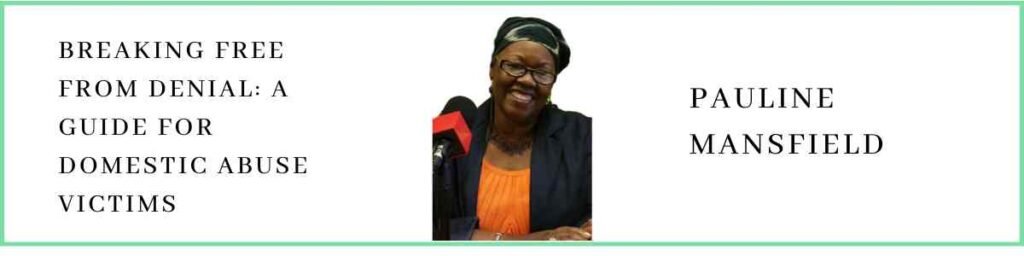
Pauline Mansfield, a passionate advocate for victims of domestic violence, shares her personal journey of overcoming denial and escaping an abusive relationship after 30 years. She highlights the importance of acknowledging abuse, creating a safety plan, and seeking help from available resources. The conversation also touches upon the crucial role of community support in empowering victims to reclaim their lives. Pauline provides key insights and offers her contact information for those seeking guidance.
3 Key Takeaways
Developing a Plan:
Pauline stressed the importance of acknowledging the problem as the first step. She explained that having a plan tailored to individual circumstances is crucial. For some, this might mean knowing the resources available or having a physical escape plan. She highlighted the importance of confiding in others, overcoming shame, and identifying one’s support system.
Empowerment and Strength:
The conversation turned toward empowerment, as Pauline shared how vital it is to find strength within oneself and through the support of others. She spoke about the transformative power of community and mentorship, insisting that no one should have to face these challenges alone. Pauline’s poignant reflections on her own growth into a person who loves and values herself were truly powerful.
Recognizing Dangerous Situations:
Pauline recounted a tragic story of a friend and former colleague, a reminder of the real and immediate danger involved in these situations. She advocated for vigilance and action, urging that individuals not only trust their instincts but also act on them. Support networks can play a pivotal role in aiding victims and potentially saving lives.
ShowNotes
Click on the timestamps to go directly to that point in the episode
[02:28] Understanding Denial in Domestic Violence
[02:48] Pauline’s Personal Story of Denial
[04:03] The Turning Point: Recognizing Abuse
[06:19] Developing a Plan to Escape
[07:47] Challenges and Realizations
[08:41] Empowerment and Support Systems
[10:39] The Importance of Resources and Support
[15:26] The Long Journey to Freedom
[21:15] Advice for Women in Abusive Situations
Get In Touch:
If you’re interested in connecting with Pauline Mansfield, you can reach her through her website, email, LinkedIn, or Facebook.
For those interested in sharing their own stories on “Chatting with the Experts,” reach out to Paula Okonneh through her website or connect via LinkedIn.
Paula: [00:00:00] Well, hello everyone and welcome to another episode of Chatting with the Experts where I speak with women professional, women, successful solopreneurs and entrepreneurs from Africa, from the Caribbean, and in the diaspora. These women share my mission, which is to educate, empower, and inspire women globally. Today, we are gonna be talking about Overcoming Denial- One of the Biggest Hurdles for Victims of Domestic Violence. My guest who will be joining me in a few minutes says that. Domestic violence is a never-ending epidemic and that it is crucial that there is an ongoing effort to inform, support and [00:01:00] educate the public on all aspects of this issue.
Uplifting and inspiring others is one of her life’s goal. But writing is her passion and she translates that passion into life stories. My guest says that she writes books, does presentations and public speaking to educate, to enlighten and empower others, suffering from broken spirits. She has presented to local groups and national organizations on subjects related to family history, domestic violence and mediation, and is a community Advisory Board member for The Emory/Grady Nia Project whose mission is to empower women who have had a history of adverse childhood experiences and [00:02:00] also intimate partner violence. And with that, I want to welcome to the show, Pauline Mansfield.
Pauline: Thank you very much. I’m honored to be here, Paula.
Paula: Thank you. Thank you. Thank you for coming on to them to talk about something that, you know, it’s global. Domestic violence. Oh my word, so I know off camera, we talked about how many times domestic violence victims do not recognize signs of abuse? What do you mean by that?
Pauline: Denial. It’s such a huge word that we don’t really think about. I wanna share a short story. I’ll keep it short about how I found out how much in denial I was. I had lived with a man who was very [00:03:00] controlling, with growing abuse through the years and I just thought I could fix it. You know, I gave every excuse that everybody else has given who finds themselves in this situation, and I just took it day by day by day. I was an employee advocate at a hospital, and my job was to help employees be better employees no matter what it involved. And many times employees brought their issues into the hospital, into the workplace. You couldn’t park it in the parking lot and go to work.
Paula: Mm-hmm.
Pauline: You brought it right on in and I saw some very horrible things related to domestic violence and somehow I separated that from what I was dealing with totally. They sent me to a training to improve my resource skills, to refer people to places. If they had to go to a shelter, if they had to leave the job for a short [00:04:00] time, how to go on leave, et cetera, et cetera. As I was sitting in that seminar, taking notes, you know, wonderful to learn something new, the person who was presenting started with, these are the signs of abuse. They started listing them one by one, and I was writing, listening, writing number one, number two, number three, and as I wrote, a light went on and I’m thinking, oh my God, this is me! There were probably 10 to 12 things listed. I was every single one, and I just, tears came to my eyes. I think, oh my God, I’m a victim of abuse.
I’d never given it a name. For me, it didn’t need a name. People always saw me as a very strong woman. I saw myself as a strong woman. I was [00:05:00] educated. I was bringing in the bacon. You know, I just had confidence about my job, but there was a deficit somewhere, denial of what was really happening to me. And that was my introduction to Pauline, you have a problem. Not only a problem, you have a huge problem that needs to be fixed. And that’s where the journey started for me. So they gave a list of things we needed to do, we needed to tell employees to do, to get started on the journey to safety, to freedom. And that’s where it began for me in recognizing denial.
Paula: Wow. Wow. [00:06:00] I see your passion. And I know this isn’t easy, this isn’t easy for anyone in that situation.
Pauline: No.
Paula: How do you overcome that denial? How do you separate yourself from, you know, what is happening and what you are telling yourself?
Pauline: Yes. First is knowing that you’re in trouble. And once you recognize that, the second thing I learned in that seminar, you have to have a plan. And the plan may be a short-term plan or it may be a long-term plan. Everybody’s situation is different. You know, I was a working woman, I had a car, I had money in the bank, so I was in much better position than someone who depends solely on their mate for bread. [00:07:00] My children were pretty much grown.
Paula: Mm-hmm.
Pauline: And many people have babies, they have pets, they have no car, they have no family. So it depends on the situation. What situation are you in? And some are far worse than mine, but I had a very difficult time getting out. It was like busting out of prison.
Paula: Mm-hmm. And yet you said you had all these things, but it was difficult. Tell us about that. Why was it difficult? What made it difficult? ’cause I know that’s, sorry, go ahead. I don’t wanna…
Pauline: oh, that’s right. It was difficult because I had given over my control to somebody else.
Paula: Hmm.
Pauline: And anyone who does that, loses [00:08:00] themselves totally.
Paula: Mm-hmm.
Pauline: And for some reason, I allowed that. I’m still as here all of decades later. I’m still asking myself, who was that person who allowed that? I don’t even know. She’s dead now. She’s gone.
Paula: She’s gone.
Pauline: But you have to decide how much you love yourself. Paula. I think it boils down to that. Do you love yourself enough to bring your own joy? I was letting someone else dictate every piece of my life, every single piece, and so we have to become empowered. I think that’s number one. And again, [00:09:00] how we get there is different for every single person. I mean, there have to be sisters who mentor other sisters who have to be a listening ear for sisters to hear what they need, whether it’s advice, whether it’s financial support, whether it’s a hide away for a moment, whatever it is. So the journey is a difficult one. I think that’s why this problem, it’s taking so long to go away. It seems to get worse. I mean, the statistics are horrible. So, I hope I answered your question. I kinda went on a little down a rabbit hole, but that I tell you, Paula, when I started talking about it, that’s what happens.
Paula: I don’t think you went down a rabbit [00:10:00] hole. I mean, you lived it and you rose above it.
Pauline: I did.
Paula: And as you said, that person. Who gave away control to the other person is no longer here. So you are talking from having been there.
Pauline: Yes.
Paula: So when you go down, when you, what you say is going down a rabbit hole, it’s just that you going back down the ol’ road that you had been on that
Pauline: I traveled
Paula: Traveled along.
Pauline: Yes. Yes.
Paula: But I think we need to talk a bit more about it because there are people who are there. And sometimes can’t see any way out.
Pauline: Correct. And I was one of them. But as I said, I learned from that seminar I was sitting in that you have to have a plan. When I realized I had to map it out, every little detail I had to make an extra set of keys for my car. For my house, so [00:11:00] that I had, if I had to make a quick getaway, I was ready. I had to tell somebody. In all those years I was suffering through. I never told a soul. I’m a pretty private person and many people like me are ashamed of the mess that’s going on behind closed doors. You don’t want people to know that. And certainly not on your job, but when this happened to me, it happened at a very critical time. The law had just been passed under what became our President Biden. He was in the Senate at the time a law was passed. The Domestic Violence Act, to protect women who were going through this and all the laws had been laid out so neatly for me in a package with a bow, [00:12:00] and all the services I needed were there and they’re still there. Thank God that provided not only counseling, it provided sheltering, it provided education. It provided all the things that people needed to make that first step. And there is a domestic violence, and I’m gonna give this number a couple of times. Okay. As we talk. And if you mind.
Paula: Not at all.
Pauline: I’d like to just say what it is. It’s the National Domestic Violence Hotline and it is, it is a link to surviving. It’s a link to freedom. And that number is (180) 799-7233
Paula: 7 2 3 3. 800.
Pauline: Yes. (180) [00:13:00] 799-7233 That number connects people with someone to talk to, and sometimes Paula, it starts with a conversation.
Paula: Yes.
Pauline: People have to know there’s a listening ear on the other side. You have to be able to pour out your heart to tell what your situation is. Where can I go? What can I do? Who can I turn to? So the plan includes knowing your resources.
Paula: Important, and I’m gonna drop this number in the chat.
Pauline: Thank you.
Paula: So knowing your resources. Okay, go ahead.
Pauline: Yes. Once you know your resources, you have to be brave enough to take that first step, whether that’s picking up the telephone to call that hotline or picking up the phone to call your sister, your mother, your sister friend. People usually wait too long [00:14:00] to do that. I didn’t tell a soul. Not my mother, not my friends. Nobody knew. They knew he was a little crazy, but you know, he was just that crazy person she’s married to. But they didn’t know the inner workings of what I was dealing with.
Paula: Lemme just ask a very quick question. I think you answered it actually. You said you felt ashamed.
Pauline: Yes. Even though I was in denial, you know, that seems very schizophrenic. What I’m saying, I’m in denial. But on the other hand, I’m embarrassed by something that’s kind of crazy in itself. But I, you know, you know when something is wrong, you have an inner voice that tells you whatever’s wrong in your life, you know?
Paula: Mm-hmm.
Pauline: You know what it is. You know, and secrets are dangerous.
Paula: Mm-hmm.
Pauline: And I was keeping a [00:15:00] really bad secret, and I had brothers.
Paula: Oh, I, they didn’t know.
Pauline: No one knew.
Paula: Your children? Did they see? Was it openly?
They had already?
Pauline: They lived it. As I, Paula, I didn’t tell you this when we first met and started talking. You won’t believe this and you might turn off the camera when I tell you this. I stayed for 30 years.
Paula: Wow.
Pauline: Yeah. I did. An intelligent woman. The Intelligent woman. I was.
Paula: Mm-hmm. You still are.
Pauline: Thank you.
Paula: And still are.
Pauline: It was a continuously transforming thing. 30 years is a long time.
Paula: Yes.
Pauline: I lived in several different places. My life changed several different times. I had several different jobs, knew several different sets [00:16:00] of people, lived several different kinds of lives. So each time, you know, each time you make a change, you think, okay, this will be better.
Paula: Yeah, I’ve heard that.
Pauline: Yes. And so I just kept saying it’s okay. Okay. It’s okay. I did tell you my children were grown. I remember telling you that and you seem surprised when I tell you when I left and I’m glad in one sense because dragging through children through such a travesty is just double and triply painful.
Paula: Yeah.
Pauline: I mean, it’s a sin to take children through any kind of painful things that they witness, but that’s what I did. That was my journey. And that some things I regret, but many, I didn’t. Looking back on it, I had a lot of lessons to learn, a lot of growing up to [00:17:00] do. I had to find out who Pauline was, introduce myself to her, hug her and enjoy her. I chose to do it after 50. The after 50, but it has given me such a beautiful life on this side. I guess I had to learn a whole lot of things in order for me to really enjoy this time in my life.
Paula: Yeah. So, one thing that stands out is that you got out and you learnt to love Pauline. You learnt to love yourself. You learnt to hug yourself and know that Pauline is wonderfully and marvelously made, and she has a purpose.
Pauline: Yes, and the other thing I learned, Paula, was how [00:18:00] strong I am. I never knew. Or I never acknowledged it.
Paula: Mm-hmm.
Pauline: And I was reading through the book that I read, I haven’t read it myself in a long time, and I was reading some of the… which things that for me at the time were outlandish, like fighting back.
Paula: Mm-hmm.
Pauline: You have to fight back and I didn’t know how to fight. You have to be trained to fight and it was people who I finally told who helped me to fight. They helped me by saying, Pauline, girl, you’re a strong woman, you need to go in there, put those dukes up and get it done. Oh, you know, my mother used to say to my daughter who was very shy as a little girl, you need to put a stick in your back and straighten up. So people taught me how to put a stick in [00:19:00] my back and say, you know what? Not only am I smart, but I’m also strong. And so when I read parts in here and I’m thinking, oh God I’d forgotten that. I almost wanted to say, go Pauline. I mean, it was interesting looking back at it and seeing that I didn’t even recognize my own strength.
Paula: You know, as you said something that’s crucial is when you opened up and told people.
Pauline: Yes.
Paula: That people began to affirm you.
Pauline: Yes.
Paula: And you began to see yourself from their eyes and not from the eyes of your abusive partner who had possibly, I don’t know the detail, who had probably told you all things that were not uplifting in any which way that you began to believe.
Pauline: That’s exactly right. Yes. And put downs probably. [00:20:00] There was physical abuse, but probably the most damaging part in my life was the mental abuse, the emotional abuse. It can wear down the side of a mountain. It can take a person’s esteem totally away. When you hear long enough that you’re stupid, you’re ugly. It’s like Celie in The Color Purple. That was so real to me when I saw that.
Paula: Mm-hmm.
Pauline: I had a mister and he just talked to me just like I was trash, and I bought that.
Paula: Mm-hmm.
Pauline: I can’t believe that I bought that, but I did. Words are powerful.
Paula: Words are powerful. Okay. So one question I [00:21:00] have for you though that I hope you can share with others, and I know you can not. I help. How can women, because we’re talking about women, know when to leave this abusive situation?
Pauline: I’m glad you asked me that because this was a good reading day. I happened to turn to a page that said words of advice. This is right on time. It says, the feeling you have in your gut is really God, we must be still to hear the message that God is sending. Don’t fight the feeling of discernment. It will keep you from derailing and putting you back on the same dark path you just worked so hard to get off of. So you have to, [00:22:00] all of us have a feeling when something just ain’t right.
Paula: Mm-hmm.
Pauline: You just feel it, and we have to believe that feeling and act on it, especially in a situation like this.
Paula: Believe your feeling in the sense that you are in this abusive relationship.
Pauline: Yes.
Paula: You know something is wrong.
Pauline: Yes.
Paula: You know it. You know it. You know it.
Pauline: Correct. Don’t brush it off. Don’t dismiss it. Oh, that’ll change. That’ll change. It escalates in domestic violence. What starts with words then becomes action. It might be just a shove tomorrow. Next week, it may be a slap.
Paula: Slap. Mm-hmm.
Pauline: The following week it may be even worse. Mm-hmm. [00:23:00] And I have personally known people who are no longer here.
Paula: Yeah.
Pauline: Because they were victims of abuse. And if I would like to tell a quick story related to that. As I said, I worked in a hospital and I hired a young lady who came to our hospital from North Carolina. She was very quiet, stayed to herself, always seemed timid. And then she came to me as an advocate, something work related, and I was an advocate that drew people in by, you know, getting them to relax and talk to me. And when we began to talk, I realized she had left an abusive situation. Left in the dead of night. No shoes in her pajamas.
Paula: Oh my word.
Pauline: Came to Atlanta, started her life all over again. Had been in Atlanta maybe three or four years, I knew her. All that time, she was [00:24:00] fighting to get a legal divorce. Got the divorce. She went back to get things. And while she was getting those things with a police officer there, her ex-husband grabbed the police officer’s gun, killed The police officer, killed the girl, killed himself.
Paula: Oh my God.
Pauline: That was one of the most painful news I had ever received because she had gotten to be a friend.
Paula: Oh my God.
Pauline: So you have to measure how dangerous your situation is as well. People are on short fuses, especially these days, and anything can happen, you know?
Paula: Mm-hmm.
Pauline: I think [00:25:00] sometimes people feel that those of us who talk about it overstate it, over-exaggerate it. It’s not an over-exaggeration. It takes two seconds for a situation to change. One, one second, and you, again, it’s that gut thing. You have to know when you are in trouble sometimes you have to know when to pick up the phone and call the police. Also people who hear it must be brave enough to pick up the phone. If you hear something through the wall from the next door neighbor. You have to be brave enough to pick up the phone and call the police.
Paula: Yeah.
Pauline: I would. I never did that, but I had somebody who called for me once, and I cannot measure how much I appreciate that because her taking the time to make the call, put a little bit more strength in me. [00:26:00] So it takes an accumulation of strength. You know, it’s like people in that tug of war kind of game. You know, the more people you have on your side pulling, the more successful you will be.
Paula: Yes. And like in your case, you said somebody called, that made you feel someone cared.
Pauline: It did.
Paula: Someone cared.
Pauline: And it was a surprise to me who the person was. So you never know.
Paula: I just about to say that. So you never know.
Pauline: You never know.
Paula: So you never know, Pauline, because we wanna give the audience chance to talk with you, and we also know that people who haven’t joined us can listen to this online, YouTube or wherever else they listen to podcasts, whether they’re on audio or YouTube. How can people get in [00:27:00] touch with you? Because what you are talking about, as we said, it’s real, it’s not an isolated case. It’s not limited to women in the United States, it’s not limited to women in North America. It’s global.
Pauline: Yeah.
Paula: So wherever you are, these things are worth noting.
Pauline: Absolutely.
Paula: If someone can get in touch with you, you may be the person that they need to talk with.
Pauline: Yes.
Paula: What are your contact information?
Pauline: Well, they can contact you by email, which is my full name at Gmail, Pauline, P-A-U-L-I-N-E-M-A-N-S-F-I-E-L-D@gmail.com. That’s the most direct way that people can reach me.
Paula: Okay.
Pauline: They just need some basic information or sometimes people need to purge. Purging is good. You know, it’s allowing people an [00:28:00] opportunity to just throw up.
Paula: Mm-hmm. Mm-hmm. Mm-hmm.
Pauline: So I welcome that.
Paula: And there’s also a number that (180) 799-7233 For those of you in the United States, that’s National Domestic Violence Hotline.
Pauline: Hotline. Correct. Thank you.
Paula: I can get in touch with wow. Sombering, but realistic conversation.
Pauline: Yes.
Paula: And so for those of you who have just listened to Pauline Mansfield, if you’d like to be a guest on chatting with the experts, you can reach out to me on my website, which is chattingwiththeexperts.com. I am also on LinkedIn as Paula Okonneh. My Instagram handle is chat_experts _podcast. I’m on [00:29:00] Facebook as chatting with the experts or on the Paula Okonneh. And as you heard, Pauline mentioned about YouTube. We are on YouTube, I have a YouTube channel. You can reach out to me there because these stories or these resources or this information needs to be shared because Pauline, like all other women and the few men who join me every week, our mission is to educate, inspire, and empower women. And that’s just what you did, Pauline.
Pauline: Thank you.
Paula: You did all those three, so thank you. Thank you.
Pauline: Well thank you.
Paula: And now we… you are welcome. And now we’ll open up the floor to those who have joined us in the audience so they can ask you questions and even learn or get even more resources or themselves if they’re in that situation or anyone else who they know that can be helped.
Thank [00:30:00] you.