
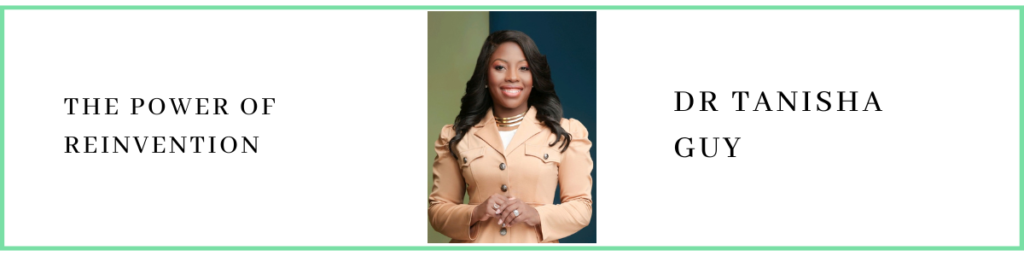
Dr. Tanisha Guy, a nationally recognized thought leader with 26 years in mental health, 21 years teaching, and 17 years in private practice, discusses how setbacks can become the start of the greatest success. Dr. Guy explains pivoting into entrepreneurship coaching after being unexpectedly let go from academia and realizing clinicians aren’t trained to be business owners. She shares how learning she had dyslexia (and dyscalculia) helped her understand her brain, complete her dissertation, and reframe neurodivergence as a “superpower” for spotting patterns and strategies. Dr. Guy emphasizes mindset, perception, resilience, and viewing outcomes as teachable moments—“fail fast”—and urges women to act despite imperfection: “do it afraid…done is better than perfect.”
3 Takeaways
From Setback to Success:
Dr. Tanisha Guy’s journey was far from linear. Starting her career in the mental health field, she spent years dedicated to teaching and private practice. However, a significant turning point in her life came when she was unexpectedly let go from her dream job in academia. Despite the initial shock and uncertainty, this setback propelled her into full-time entrepreneurship.
Overcoming Dyslexia and Embracing Neurodivergence:
Another significant challenge in Dr. Guy’s life was discovering her dyslexia during her master’s program. At first perceived as a setback, this revelation eventually became a pivotal moment in her journey. Understanding her learning disability helped her embrace her unique way of thinking, which she now considers a superpower. Dr. Guy uses her ability to see patterns and strategies differently to help entrepreneurs and clinicians build thriving businesses.
Mindset and Resilience:
Central to Dr. Guy’s success is her emphasis on mindset and resilience. She believes that perception and beliefs play a crucial role in how we navigate life’s challenges. By shifting her perception to seeing the glass as half full, Dr. Guy has maintained an optimistic outlook, even in the face of adversity.
ShowNotes
Click on the timestamps to go directly to that point in the episode
[02:08] Why She Helps Clinicians
[04:11] Fired From Dream Job
[05:52] Setback to Entrepreneurship
[07:21] Dyslexia Diagnosis
[10:25] Neurodivergence Superpower
[11:51] Mindset and Resilience
[13:56] Fail Fast Lessons
[15:17] Do It Messy Not Perfect
Get In Touch:
If you’re interested in connecting with Dr Tanisha Guy, you can reach her via her website, via Instagram, via Facebook, or via her LinkedIn.
For those interested in sharing their own stories on “Chatting with the Experts,” reach out to Paula Okonneh through her website or connect via LinkedIn.
Paula: [00:00:00] Hi, everyone. It’s another episode of Chatting With The Experts where I speak with phenomenal women. Did I say phenomenal? They’re amazing. Amazing women from Africa, from the Caribbean, and in the diaspora who share my mission, which is to educate, empower, and encourage women globally. Today’s topic is sometimes your greatest setback is the beginning of your greatest success.
My guest will be joining me in a few minutes, and she said, “What if your greatest or what if the setback you’re trying to recover from is actually preparing you for your greatest purpose?” She’s gonna share how overcoming dyslexia and being fired from her dream job, as well as navigating life’s unexpected turns, has worked in her favor.
She’s a [00:01:00] nationally recognized thought leader, a counselor, educator, entrepreneur, and author of three books, including Private Practice in 30 Days, and she’s had more than 25 years of experience in the mental health profession. She’s dedicated her career to helping women and mental health professionals overcome obstacles, embrace reinvention, and build lives of greater purpose, impact, and financial freedom. There’s so much I can say about her, as well as the fact that she’s a neurodivergent professional who has overcome so much. I’ll let her join me right now so that we can talk a lot about this. So with that, welcome to Chatting With The Experts, Dr. Tanisha Guy.
Dr Tanisha: Hello.
Paula: Hello, hello, hello. Your bio’s [00:02:00] impressive.
I know I’ve left out quite a lot. Fill us in. Fill us in. Fill us in before we start.
Dr Tanisha: Sure. Um, where do I start? So I have been in the mental health field for the last 26 years. I’ve been teaching as a professor for the last 21 years. I’ve been in private practice for the last 17 years, and about six years ago, I decided to take a leap of faith and transition outside of the mental health field, but to really focus more on helping clinicians build their entrepreneur dreams.
Paula: Wow. You decided to take a leap of faith and help clinicians. Why? There’s something that must have made you do that.
Dr Tanisha: Absolutely. I remember when I started my private practice, I knew how to be a clinician, but I didn’t know how to be a business owner.
Paula: Mm-hmm.
Dr Tanisha: And I didn’t know that there was a difference that was required.
I didn’t know that I would need to start the business and help my clients and focus on my clinical skills in that [00:03:00] area, and then switch hats, like literally take off that hat and put on another hat so that I could function as a CEO. So I made a lot of mistakes. Mm. Uh, I wasted money. I made decisions based off of the clinical background that I had, and not actually learning what it meant to build a thriving business.
So because I had that experience, I wanted to make sure other clinicians didn’t go through the same thing, because I know our clinical programs prepare us to be clinicians, but they don’t prepare us to be business owners. And so I wanted to make sure that clinicians knew that outside of your clinical training, there are other ways that you can monetize your expertise so that you’re not just trading time for money.
And because I didn’t know another way to teach them this, because it’s not taught in our programs, I decided that that would be my charge, is to make sure clinicians know how to build thriving clinical private practices that prevent them from burning out.
Paula: So that’s what is known as sometimes the power of [00:04:00] reinvention, and that’s what I’m seeing in you. You put on a new hat.
Dr Tanisha: Absolutely.
Paula: Let’s talk about that, the power of reinvention, because that’s needed more and more these days.
Dr Tanisha: Mm-hmm. Absolutely, and it was, it was a difficult transition for me because as long as I can remember, I wanted to be a educator and I wanted to be a clinician. And so I went to school, as they said, I got good grades, and then I landed what I thought was my dream job.
And I saw myself retiring from academia. I just thought I was gonna be a professor with tenure, and then I would retire and do whatever I wanted to do afterward. But that’s not what happened. And seven years into teaching in academia, uh, the faculty members were all let go because the university was going through a transition, and there was no warning sign, and it was unexpected.
And so I was not prepared to be unemployed, [00:05:00] nor did I see it. And so it was in that moment when I realized that I needed to pivot, and the idea of me retiring from academia was no longer something that I wanted because I felt as though I couldn’t control my own fate. Even though I was doing every single thing that I was supposed to do, uh, it still ended in a way in which I didn’t expect.
And so I determined at that time that I would control my fate and I would build my own business and I would then teach others how to build theirs.
Paula: And so you have. Right. So this is titled Your Greatest Setback is the Beginning of Your Greatest Success. So let’s talk about how that setback became your success.
What are the things that you have done that you know has been successful, and how you’ve helped others with that?
Dr Tanisha: Absolutely. Even though that that was my setback personally, it became my setup for the [00:06:00] comeback because instead of me focusing all of my energies at working at a university, I decided to focus my energies on building my practice.
But what building my practice taught me was, it taught me how to become a business owner. Mm-hmm. So I was no longer moving in the capacity of just a clinician, and so understanding what that meant, the type of decisions that, uh, would benefit the business overall helped me shift from just being the clinician to the business owner.
So even though it was a setback losing my job, it greatly benefited me because it allowed me to move into entrepreneurship full time. And moving into entrepreneurship full time was extremely scary, but I knew that I was willing to do that instead of going to go find another job where I could potentially be let go at any time.
So that definitely, uh, that experience greatly impacted my ability to then move forward and start helping other clinicians do the same thing. Start building their private practice, moving [00:07:00] outside of their comfort zone, pushing past the imposter syndrome, and really being able to see themselves as more than just a clinician, but also as a business owner.
Paula: I know one of the things you’ve done is, um, you’re into mental health.
Dr Tanisha: Mm-hmm.
Paula: And when I, when, when I spoke with you, when I read your bio, I know you’ve overcome dyslexia.
Dr Tanisha: Yes. Yes, absolutely. And, um, and I say I’ve overcome it, but it’s a struggle every day. Mm-hmm. And the way I found out that I have a learning disability is I’ve always known that I learn differently.
I didn’t know how, but I knew I learned differently. I knew numbers and I were not friends, and I was in my master’s program, actually in my last semester, and my, uh, faculty advisor said, “I wanna meet with you.” And so I thought she wanted to meet with me to tell me about how amazing [00:08:00] the paper was that I had written.
That’s not how the conversation went.
Paula: Mm-hmm.
Dr Tanisha: She brought me in her office and she looked and she says, “Do you have a learning disability?” And I paused and thought, “I’m about to graduate this semester with a master’s degree, and you’re asking me do I have a learning disability?” Mm-hmm. And even though that was the question she asked me, what I heard, what I heard was, “Are you stupid?”
And that wasn’t the question, and that’s not what she said, but that’s how I interpreted what I heard. And so I told her, “No, or at least I don’t think so.” And then she started pointing out things in my writing that she had noticed, patterns and styles, and she says, “Well, I think you need to get tested for dyslexia.”
No one had ever in my entire life- Mm … asked me if I had a learning disability. And so once I was able to get past the shock, I went and got tested, and it was probably the best thing that I’d ever done because it helped me actually understand [00:09:00] why my brain works the way it works and why I read numbers and why I write the way I write in terms of maybe I know that cat is C-A-T, but I might write it C-T-A.
Mm-hmm. And so I no longer question what is happening. I understand it. And because I understand now how my brain works, I can intervene. So when it comes to writing something, most people can just write it one time and move on, but I have to write it and then read it again and then read it again, sometimes four times, to make sure that it’s actually written correctly.
So it definitely was an eye-opener for me. Major setback ’cause she told me I had a learning disability, but from finding that out, it helped me be able to actually make it through my dissertation and then continue to move on to pursue other degrees.
Paula: So that’s one of the setbacks that became a success for you.
Dr Tanisha: Absolutely.
Paula: And you can laugh about it, [00:10:00] that’s good.
Dr Tanisha: Yeah, I can laugh now. It wasn’t funny then.
Paula: I’m laughing not at your discomfort then, but just saying that the fact that you can laugh at it now is sometimes an encouragement to others. ‘Cause off camera we were talking about how so many times the difficulties, the setbacks, the disappointments, the hard times we’ve experienced, sometimes it’s not just for us, it’s for others.
Ab- You know?
Dr Tanisha: Absolutely. I talk openly about being neurodivergent, and now I tell people that it’s my superpower. Mm. Yes, I have dyslexia, I have dyscalculia, but because my brain works the way it works, I also see patterns and strategies very differently than I think someone else who brain doesn’t work that way.
So it has now become my superpower.
Paula: Absolutely. You know, and you say when you see patterns and, because, like, especially as business owners, and I know you coach, when, um, an, um, entrepreneur comes to you and they have been, you know, doing things a certain way, and you’re able to look at what they’re doing and [00:11:00] see a pattern, see a strategy that they have never considered because you think in a different way.
Mm-hmm. That’s a plus. That’s an advantage.
Dr Tanisha: Absolutely. Absolutely. I, once I was able to see that, I shifted and said, “Oh, my goodness, I’ve been over here playing checkers, but now I need to learn how to play chess because I’m thinking two and three different moves ahead, and previously I was just trying to catch up.”
So that was definitely one of the benefits for me.
Paula: Wow. Wow. Wow, I love that. Seeing things, you know, from a different perspective. Seeing, instead of seeing the glass as half full, half empty. Mm-hmm. I love that you say the glass is half full.
Dr Tanisha: Half full. Mm-hmm.
Paula: So you’ve built a legacy through resilience, and I know that’s one of the things that you teach or you encourage um, your mentees to do.
How do you do that?
Dr Tanisha: So one of the things that I realized when I decided to shift from just focusing on clients as a clinician and started working [00:12:00] with students and mentees on the coaching side, is that everything starts with mindset, or at least that’s my experience, that’s my belief. Mm-hmm. And how we process information and our perception about it.
And so you can have two individuals experience the exact same thing and, and I always use someone getting a divorce. And I’ll say, I’ve had clients who are going through a divorce, and one client is experiencing depression, she’s crying, she doesn’t think that she’ll ever find love again, and it’s a real struggle for her.
The other client is getting a divorce, and she has thrown a divorce party, she is celebrating, and I can’t get her to come back to therapy because she’s having the time of her life. So how is it possible that a situation can be the same? They’re both ending marriages, but one responds this way and the other responds the next.
And so I tie it back into it’s all about perceptions and beliefs. So moving forward, I made the decision that my perception had to, as you just said, [00:13:00] see the glass as half full. Even when I’m not sure what is going to happen or the outcomes, my belief and my perception is tied to this is going to work out.
So instead of me starting projects thinking, “Well, it might not work out,” it’s never it might not work out. In my head, it’s gonna work out. I don’t care what the end result is- Mm-hmm … it’s still going to work out however it was supposed to work out. So being able to shift that perception has really helped me work with clients and mentees in talking about resilience, because people are more resilient when they’re able to shift their beliefs and their perceptions about whatever that thing is they need to deal with at that particular time.
Paula: You know what, Dr. Tanisha? I love that. Mm-hmm. No matter what the outcome is, it has worked out, you know? So you go in believing, hmm, whatever happens, it’s worked out.
Dr Tanisha: Like, yeah, like if it, if it’s something that I’m really [00:14:00] wanting it to be successful, but let’s say it’s not successful. It worked out the way it did because everything’s a teachable moment.
Mm-hmm. It’s going to teach me to do something different so that I can get a different result the next time. So even that wasn’t a loss. I don’t see it as failure, I just see it as the next teachable moment so that I can get to it. So I always say, ” Hurry up and fail fast. Fail quick so you can get to the wins.”
Paula: I enjoy this. I enjoy this. Hurry up and fail fast so you can get to the winning for the next teachable moment, right?
Dr Tanisha: Exactly.
Paula: And you know, and that’s what keeps a lot of… That keeps you going. Absolutely. That keeps people probably coming back to you to say, “All right, now this was the outcome, not quite what I expected, but there’s a teachable moment behind it.
Okay, Dr. Tanisha Guy, let’s go for the next thing.” Mm-hmm. “What else can we do?”
Dr Tanisha: Exactly.
Paula: I love it. I love it. That’s it. I love it. So I know that there are people in the audience who are listening and can’t wait to [00:15:00] talk with you, but there are also others who have missed out on this opportunity to be in the audience.
If somebody wants to get in touch with you, or is there anything… Well, let me stop myself because I’m so excited. We need to speak to the audience members. Is there anything that I haven’t asked you that you need, you really would have liked me to have asked?
Dr Tanisha: Um, you haven’t asked me, but I do want to just share this.
Paula: Mm-hmm.
Dr Tanisha: Uh, I think that oftentimes, and I can only speak to women ’cause I’ve never been anything else other than a woman, so-
Paula: I’m, this is a woman show …
Dr Tanisha: I think often, I think oftentimes as women, we sometimes feel like we have the weight of the world on our shoulders.
Paula: Mm-hmm.
Dr Tanisha: And because of that, we want to make sure that we’re navigating life safely.
And navigating life safely means we do what feels comfortable, we do what seems normal at that time or maybe what’s even expected. And sometimes we have to step outside the comfort zone, and we have to get uncomfortable so that we can get comfortable. And even though it’s a scary place, even though we might struggle with the [00:16:00] imposter syndrome of not getting started, I think we have to know that if we never get started, we’ll never get results.
And so do it afraid, do it ugly, do it messy. As Nike says, just simply do it.
Paula: I commend you on telling women that, because a lot of us women, we want everything perfect. We want the, the, all the Is to be dotted- Mm-hmm … all the Ts to be crossed- Mm-hmm … before we step out there. Absolutely. But you won’t know what it’s like except you put that first foot forward, you know, and you test.
You don’t even have to test. Put that, put that first foot forward- Absolutely … and then you can put the next foot, and you’ll be amazed at what is out there.
Dr Tanisha: Mm-hmm. And that- ‘ Cause done is better than perfect, ’cause perfect doesn’t even exist. It’s a false belief that we want to achieve, but it’s never achievable, therefore preventing us from getting started, which is why so many of us struggle with procrastinination, procrastination, couldn’t get that out, [00:17:00] because we want it to be perfect.
And again, I, I describe myself as a reformed perfectionist.
Paula: Mm-hmm,
Dr Tanisha: She is. But I now understand that that procrastination was really tied to this fear ’cause of the learning disability. I thought, “Well, maybe I’m not good enough. Maybe people will see that I do have a writing disability.” So for example, if I’m teaching a class or in a workshop and I write on the board and I spell something wrong, what will they do?
And so what I’ve started doing now, uh, at the start of trainings is I’ll go write on the board and I’ll write all the alphabet in the corner, whatever I can think of, A-E-I-O-U. I’ll circle it and I’ll say, “So look here, I can guarantee you before the end of this event I’m going to spell something wrong, and when I spell it wrong, go grab the alphabet, spell it correctly, and we gonna keep on moving.”
I know I’m going to spell it wrong, but the old version of me would have never done that. She would’ve been so afraid, like, “Oh, it’s not perfect.” But I know that my brain works that way, and once I shifted the [00:18:00] narrative and I created a new perception that I don’t have to be perfect, I just have to be me, and I show up just as who I am, authentically, as chaotic, brain works the way it works, however it shows up, it shows up.
It shows up messy, but it gets better over time, and for that I am grateful. And I just want more women to know that, that you can show up messy. You can show up the work in progress, because as long as we stay consistent with it, it does get better
Paula: I love you saying that. I commend you in saying that, because a lot of us women need to hear that, that messy is better than zero.
Dr Tanisha: It is.
Paula: It is. It is. Because at least you’ve started.
Dr Tanisha: Started.
Paula: Yes. Mm-hmm. And w- even though you’ve started and it’s messy, then you can keep cleaning it up, and it gets better, and it gets better- And it gets better … and it [00:19:00]
Dr Tanisha: gets better. Mm-hmm. You
Paula: know? But overthinking, and I was guilty of that, it took me two years to start my podcast ’cause I kept clea- trying to clean it up.
Mm-hmm. Clean it up, and I had one excuse after the next- Mm-hmm … until my virtual assistant said, “Okay, there are 30…” This is, this was in 2012. She said, “Today’s the 31st. You’ve run out of excuses. You said you’re gonna launch at the end of 2012. You gotta do it.” Mm-hmm. You gotta do it. And so I launched it, my heart beating, and here we are, 14 years later.
So yes.
Dr Tanisha: Yeah.
Paula: Messy is better than zero. Just do it.
Dr Tanisha: Let’s do it.
Paula: Mm-hmm. Thank you for saying that, Dr.-
Dr Tanisha: You’re welcome …
Paula: Tanisha. We need to hear it, and we need to hear it for we women, because men, that’s why they say men are risk-takers. They just do it. Mm-hmm. And we are waiting for everything to be perfect.
Dr Tanisha: Yeah. They do it.
Paula: So again, tell us where [00:20:00] we can find you online before you- Yes … Before the audience jumps into asking you all the questions that they have that I haven’t asked you.
Dr Tanisha: Absolutely. So I can be found on all social media platforms, Facebook, Instagram, LinkedIn, TikTok, Lemonade, @DrTanishaGuy on all platforms.
And my website is drtanishaguy.com.
Paula: That’s easy enough, folks. She can be found. Hahaha.
For those who would like to be a guest on my show, on this show, you can reach out to me on my website, which is chattingwiththeexperts.com. I’m also on LinkedIn, my business page there is Chatting with the Experts, or you can find my, me on my personal page, which is Paula Okonneh. I am on Instagram and my handle there is @chat_experts_podcast.[00:21:00]
I’m also on Facebook, my business page there is, um, Chatting with the Experts. Please like our page there. And we also have a YouTube channel where you’d find this episode. We’re streaming it live right now, but you’ll find the episode there. Please like and subscribe that episode, and all the other episodes that we have there of phenomenal women just like Dr. Tanisha Guy, who are there to encourage, educate, and empower all women globally. Thank you again, Dr. Tanisha Guy, and now we’ll open up the floor to all who joined us so that they have the opportunity to speak with her. And for those of you who are listening to this on, um, Spotify or Apple Podcast, or watching this, please, please, please join us every Wednesday at [1:00] PMs for another episode of Chatting with the Experts where you get to speak with our interviewees just like Dr. [00:22:00] Tanisha, live. Thank you again.
Dr Tanisha: Thank you.