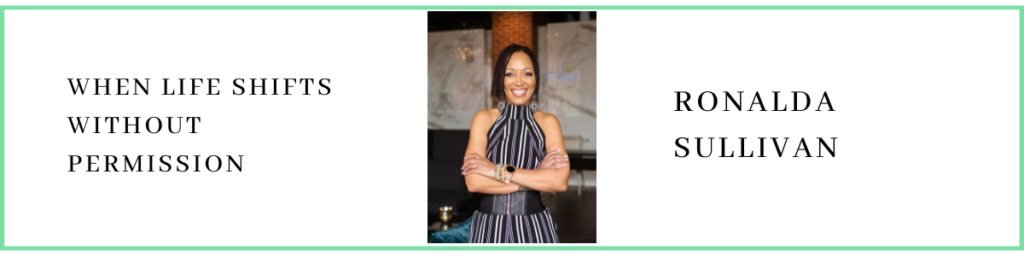
Ronalda Sullivan, founder of Dream Differently, transformational speaker, author, and coach, talks about women facing disruption and possibility. Ronalda shares how unexpected life changes shaped her message, including raising a non-speaking autistic son diagnosed after evaluations at Bethesda Naval Hospital, the end of a 22-year marriage, and decades as a veteran and civil servant. She emphasises that one painful chapter doesn’t define the whole story unless you stop turning the pages. She encourages women not to lose themselves in disruption or the “fog of fear,” but to ask what’s possible now, feel their emotions, and move forward. She notes her son now lives independently and advises parents to research autism, seek medical evaluation, and obtain a diagnosis to access resources.
3 Takeaways
The Journey of Acceptance:
Ronalda’s story is one of profound transformation, born from the intersection of disruption and possibility. She speaks candidly about her journey as a mother of a non-speaking autistic son, the dissolution of a 22-year marriage, and her extensive career as a veteran and civil servant. Despite these life-changing events, Ronalda emphasises that one painful chapter does not define the entire life story. Her message is clear: keep turning the pages.
Navigating Through Fear:
As Ronalda shares in her discussion with Paula, fear can hinder us from envisioning a new reality. During a pivotal moment in 1995, when her son was diagnosed with autism, she was confronted with the overwhelming fear of the unknown. However, she learned that while fear might be paralysing, it should not prevent us from pursuing our dreams. Ronalda encourages women to navigate fear and embrace life’s disruptions as opportunities for growth.
Redefining Communication and Connection:
Ronalda’s journey also illustrates the importance of redefining expectations. Her son’s diagnosis taught her that communication doesn’t always require words. His expressions of love and happiness without verbal communication became a testament to Ronalda that life, though different, can still be fulfilling. She urges mothers, especially those navigating similar challenges, to embrace their children’s unique ways of expression and to seek understanding through research and diagnoses.
ShowNotes
Click on the timestamps to go directly to that point in the episode
[02:41] Dream Differently Mindset
[04:20] Autism Diagnosis Shock
[10:43] Redefining Communication
[13:38] Losing Yourself in Disruption
[18:01] Feel Fear Then Act
[22:14] Autism Resources for Parents
Get In Touch:
If you’re interested in connecting with Ronalda Sullivan, you can reach her via her website, via Instagram, via Facebook, or via her LinkedIn.
For those interested in sharing their own stories on “Chatting with the Experts,” reach out to Paula Okonneh through her website or connect via LinkedIn.
Paula: [00:00:00] Hello and welcome to another episode of Chatting With The Experts where I speak with phenomenal women from Africa, from the Caribbean and in the diaspora. They share my mission, which is to educate, to empower and to encourage women globally, and that’s what we are doing today. My guest will be joining me in a few minutes, and
we are titling this episode
When Life Changes Without Permission. This is a conversation for women at the intersection of disruption and possibility, and that’s because my guest is the founder of Dream Differently. She’s a transformational speaker, she’s an author, and she’s a coach who inspires women to reimagine what is possible after life’s unexpected [00:01:00] disruptions.
She draws from her journey as a mother of a non-speaking autistic son, the end of a 22-year-old marriage, and more than three decades serving as a veteran and then a civil servant. And she wants women to know that one painful chapter doesn’t mean that you don’t get to write the whole story, or I should say your whole life story.
With that, I welcome to Chatting With the Experts, Ronalda Sullivan. Welcome, welcome, welcome.
Ronalda: Thank you. Hi, Paula. I’m so happy to be here with you and your guests.
Paula: I’m so happy that you said yes, and you notice my voice, I took deliberate breaks between some of the words in your bio because they hit home.
You know? [00:02:00] Really and truly we need to dream differently because life makes us dream differently. And what I love best is one thing that you emphasized, that one painful chapter in our life doesn’t stop us from writing the rest of our story, right?
Ronalda: Yes, absolutely. I say that all the time to everybody. One painful chapter does not get to write the whole story.
So what you cannot do is stop turning the pages. One painful chapter doesn’t get to do it, but it does. It does and it will if you stop turning the pages. ?
Paula: I love it. You know a friend of mine many years ago, I met her, she was an older woman. Well, not that much older, but she was more mature than me, let me put it that way.
And I remember talking with her and I said, “You have so much wisdom.” And she said to me, “You know something, Paula? You’re seeing me in this chapter of my life.” And that stuck [00:03:00] with me because she was so right. We meet people and we see them at a certain chapter of their life, but we don’t know those earlier chapters.
Ronalda: Absolutely. Absolutely, we don’t. The woman that you see before you today, she’s here because she met all of those different chapters. When life changed, she had to dream differently, and then she had to dream differently again, and then she had to dream differently again. You touched on it a little bit in my biography when you talked about my son, non-speaking autism, the end of a marriage after 22 years, career changes.
I’m a veteran, 30 plus, 33 decades.
Paula: Mm.
Ronalda: 34 years plus as a civil servant. We already know the ebbs and flows that come with that working for the federal government. And so all of those changes and everything that I’ve had to navigate as a, as a result of those changes is a culmination of me saying, “But I’ve had to [00:04:00] dream differently every single time.”
Paula: Hmm. So when you talk about life doesn’t ask for permission, there’s a reason that you said that, doesn’t ask for permission. It just happens, right?
Ronalda: It absolutely does. It doesn’t ask for its permission. It doesn’t wait for us to say yes or no or I’m not ready.
Paula: Mm-hmm.
Ronalda: It doesn’t wait for us to say, “Okay, fear, let me get over the fear first-
Paula: Mm-hmm
Ronalda: and then I’m ready.” My first experience that changed the whole trajectory of my life is 1995, I am, um, walking around looking like I swallowed a basketball. I’m carrying a baby boy. I’m happy to become this boy mom, so excited. We’re living in the Netherlands at the time, so I’m loving living overseas, just living life, feeling like I’m living my absolute best life, absolutely, obviously.
So when my son was born, life was great. I already had a daughter. I got a son now. Family is going and, and my family’s growing. It’s a beautiful experience. Life is [00:05:00] great. We came back to the States and took my son to a routine doctor’s appointment, and the doctor noticed something when he was seeing him rocking back and forth in the corner, and he said, “You know, how long has your son been rocking back and forth like this?”
And I said, “Um, I don’t know.” He said, “Does he respond to his name when you call his name?” And I said, “I, yeah, I think so. Does…” “Well, does he answer?” And I said, “I, n- no, he doesn’t.” So with every question, I became more and more uncomfortable. It started causing me to question every parenting decision that I made, like did I miss something?
What did I miss? So he takes his clipboard and he writes on a piece of paper, and he says, “Take, take this sheet of paper. I need you to take it to Bethesda Naval Hospital, ’cause I need you to have your son evaluated.” I did. I took my son to Bethesda. He was evaluated by occupational therapists and a speech therapist and a physical therapist, and at the end of all of those [00:06:00] evaluations, we were summonsed to a room, and the doctors sitting around the table in all of these white coats causing me to fear everything.
Mm. What are they gonna tell me? What did they find? What did they, what did they see? And one of the doctors looked at me and he said, um, “I think I know what’s wrong.” And I said, “Well, what is it? You know, what’s, what is it?” He said, “I, I think your son has autism.” And I said, “Autism? What is autism?”
“Well, Doc, I don’t even care. I just need you to tell me how to make him talk, ’cause I just need him to talk. I, I need him to talk because I need to hear that he is okay. I need him to hear, I need to know if he’s being bullied in school. I need to know if, um, he’s hungry, if he’s in pain. I need to know what he’s thinking.
I wanna hear how his day is. So you just tell me how we get him to talk. I don’t even care about autism.”
Paula: Mm-hmm.
Ronalda: [00:07:00] And he looked at me, and these four words changed everything. He said, “He may never talk.” And I didn’t know what to do with that. Fear grabbed me by the throat, and when I tell you I couldn’t even imagine that that would be the reality.
Like, like, he’s never gonna communicate with words? I’m never gonna hear him say what I’ve been waiting to hear him say, “I love you, Mommy.” Like, I’m not gonna hear that? Like, so when I tell you you can’t stop dreaming, you just have to dream differently. The dreams have to look different. And then you know, we’ve navigated, my son is doing well.
He is living a beautiful life.
Paula: Love [00:08:00] that.
Ronalda: He lives on his own. He’s got roommates. He’s living a beautiful life. The dream looks different, but you don’t stop dreaming.
Paula: I love that you told us the beginning, and now you’re telling us where he is now.
Ronalda: Yes.
Paula: Because those four words that you interjected in the middle, “He will never talk”-
Ronalda: Yes
Paula: just made my heart sink, like- Mm … oh, my gosh. Absolutely. So what happened? Because just doing the math, if you were pregnant in 1995, that means that’s, like, 31 years ago.
Ronalda: Yes, he’ll be 31 this, he’ll be 31 in December.
Paula: Mm.
Ronalda: Yes, 31 years ago. And to see him now and all of the fear in between then and now that I had to navigate, fear [00:09:00] of letting him be out on his own.
I had to realize that if I didn’t give him the freedom to live his life, I wouldn’t be free to live mine.
I wouldn’t be free to tell other women that just because the dream looks different doesn’t mean you stop dreaming. Married for 22 years, thought I’d married my Prince Charming, had a beautiful fairy tale going, at least I thought, like we all do. And then 22 years later, I find myself, it’s this, this, this relationship is no longer serving me.
Now what do I do? And but I had daughters And having daughters as a mother, it’s your responsibility. It is your responsibility to set the very best example for your daughters so that later in life they make wise choices about relationships.
Paula: Yes …
Ronalda: and then they give themselves permission [00:10:00] to do whatever it is so that their dream can look different, but it doesn’t change.
You don’t stop dreaming
Paula: I love, again, word, the choice of word. I love the fact that you said you gave your daughters a chance to know that their dreams can look different, but it doesn’t have to change.
Ronalda: Absolutely. Absolutely. And it doesn’t define, just because it looks different doesn’t mean it can’t be good.
Paula: Mm-hmm.
Ronalda: It doesn’t mean that you can’t be happy, because ultimately God’s got the final say.
Paula: Amen to that.
Ronalda: Ultimately, I saw my life one way. God saw my life another way. And my son doesn’t communicate with words, but it doesn’t mean that I don’t tell the story. [00:11:00]
Paula: See? So you’re his voice.
Ronalda: Absolutely. Absolutely.
Paula: And he’s happy.
Ronalda: And proud of it. And proud of it. And, and, and, and I tell people all the time, you know, I, I, I used to pray that the Lord would just let me hear, “Mommy, I love you.” I just needed to hear that. That was just like, God, I don’t know what I’m gonna do if I don’t hear that. Like, I need to hear that.
And every time I see my son, the way his face lights up- Aw … the way he opens up his arms to me. Uh-huh. The Lord showed me, you don’t have to hear those words. You don’t have to hear those words. He is speaking. He is communicating. You defined communication with words, not me
Paula: In other words, it’s just different .
Ronalda: It’s, it’s just different.
It’s just different.
Paula: And you know, Ronalda, Ronalda, I’m [00:12:00] just thinking, there are lots of people who have children, and if, since we are talking about your, your son.
Ronalda: Mm-hmm.
Paula: I know lots of women with sons who can talk. Mm-hmm. Who don’t say, “Mommy, I love you.”
Ronalda: Mm-hmm.
Paula: Who don’t even, they see their moms, and they don’t hug them.
Ronalda: Mm-hmm.
Paula: They look at them with disdain for whatever reason.
Ronalda: Absolutely.
Paula: So, you know, being, I was talking about that with another guest of mine, just being content sometimes with what you have. Nothing’s perfect in this world.
Ronalda: Absolutely.
Paula: But being content.
Ronalda: Yes. Being content with different.
Paula: With different, yes.
Being content.
Ronalda: But people don’t, but, but, but, but I look at mothers and because it’s been their norm, they have no idea how very blessed, and the sons don’t have any idea as well. Yes. And, and I’ve seen, and I look at families, I look at all of these other women like me, other mothers like me who have had to, you know, [00:13:00] their lives are different now.
You know, they’re in a sandwich generation. You know? Yes. They’ve become caregivers. They’re caregiving to their parents, and they’re caregiving to their children. Life looks very different. Like, all of the things that I call life disruptions. I never would have been able to introduce myself to you, Paula, if I had not experienced that disruption.
Paula: Absolutely.
Ronalda: It just looks different. It just looks very different, but it still can be the very best life. You just have to embrace that different is okay.
Paula: Yep. Yep. Yep. So I know that, um, it’s something we spoke about offline, which is the hardest thing that we lose is in this situation is ourselves.
Ronalda: Mm-hmm.
Paula: Let’s talk about that with the audience. Tell them what you mean.
Ronalda: Well, the, uh, well, I truly believe that what happens when you’re navigating disruption and, and life changes, we, [00:14:00] we automatically focus on what we lost.
Paula: Mm-hmm.
Ronalda: We automatically focus on maybe the marriage that didn’t go, the fairy tale that didn’t end the way we wanted it to, the career that’s different. Or not even the fairy tale, maybe it’s just a relationship.
Paula: Mm-hmm.
Ronalda: And fear can cause us to lose connection with ourselves because we’re so focused on what didn’t work.
We’re so focused on, “But I thought my life would look this way.”
Paula: Oh, gosh, yeah.
Ronalda: And then a lot of women, they look really, really good on the outside, but inside because everything has changed, she doesn’t even feel like herself anymore. Mm-hmm. But she doesn’t even know what to do with that. She doesn’t even realize that all of that change ultimately means you can choose [00:15:00] yourself so that you can get back to peace, so that you can actually live the life that you love.
Because whenever I was navigating all of that disruption, I was so focused on everything and everybody. What is gonna happen when my son can’t speak? What does that mean? What does that mean for him? Well, ultimately, he has to get to a place, you have to make sure that he does, so that you can get to a place where you can live your best life.
You can be so focused on the disruption that you lose sight of your ultimate goals, and our ultimate goal, I believe, should be living our best life and living a life of peace.
And fear can rob you of that if you’re so focused on the disruption.
Fear can actually have you by the throat if you are not careful. Mm. It can keep you [00:16:00] stuck because fear, when I tell you the fear of is he gonna be able to be okay? Will he be able to live a fulfilled life? Will I be able to live a fulfilled life? Will I not, what will I not be able to do some of the things that I wanna do because I’m so consumed with my dream looking different?
And so I think what my message to women is, don’t lose yourself in disruption.
Paula: Don’t lose yourself in disruption.
Ronalda: Don’t lose yourself in disruption, because disruption can cause you to be so fearful, and fear can cause you to be caught in a fog.
Paula: Mm.
Ronalda: The fog of fear, and let me just give you this visual, because we already, we all, we all know what it looks like when you’re in a fog.
Paula: Mm.
Ronalda: When you’re driving down the street, you can’t really [00:17:00] see. Fog is there, you don’t know. Fear can cause you to not be able to see your way through, because all you’re thinking about is I’m so focused on the fear of my situation. I can’t even imagine it being better. I can’t even imagine getting on the other side of this disruption.
And sometimes fear talks louder than your own voice. So ladies, don’t lose yourself in the fear.
Paula: Which brings us back to almost like a circle, you know? We talked about life doesn’t ask for permission.
Ronalda: Mm-hmm.
Paula: And now we’re talking about don’t lose yourself in disruption, don’t lose yourself in the fear.
Ronalda: Mm-hmm.
Paula: And then seeing that, you know, the disruption is really part of life. I mean, so now it’s giving yourself permission to begin afresh.
Ronalda: Absolutely.
Paula: You know?
Ronalda: Absolutely.
Paula: And [00:18:00] that’s what you do.
Ronalda: Yes, and, and, and I think the question you have to ask whenever you’re preparing yourself to give yourself permission is, you know, what’s possible now?
Paula: Yes.
Ronalda: Like, what can my life look like now? Now that I know what I need to do, what is possible with my life?
What does creating the very best life for myself look like? I had to ask myself that. Okay, so now you’re navigating this disruption. You know your son may never talk. He may have to live his life communicating without words. So now what? Because ultimately what you want is you want him to be able to live his best life so that you can live yours.
So what does that look like? It looks like feeling the fear of everything, and then doing it anyway. Mm.
Paula: Say that again, because I heard somebody talk about that a few days ago.
Ronalda: Yes, it means feeling the fear. I had to [00:19:00] feel the fear of everything that I mentioned. He may never talk. He may never say, “Mommy, I love you.”
I may never hear him say, “I’m in pain.” I may never know that he’s being bullied. All of those things that suffocated me, all of those things that caused so much fear, I had to feel all of that fear, sit in it, give myself permission to feel my feelings in it, sadness, grief, anger, frustration, all of the things.
I had to give myself permission to do that, feel it, sit in it, ’cause it comes in waves like everything does. But then at the end, okay, so now what does it look like for you to create his best life? What do you need to do now to help him create his best life so that you can live yours in a life of peace?
Well, that means that I’m gonna have to make sure that he can live a life of [00:20:00] freedom, live a life of independence because we all know that most 30-year-olds, they don’t wanna live with their mama. They wanna live a life of freedom, and they wanna be able to do what they wanna do. And I had to think about that post-diagnosis in preparation for him being able to live his best life.
What does that mean for me? I’ve gotta prepare him. I gotta work through all of that fear that may have me by the throat and do whatever’s necessary so that he can live his best life, whatever that means. And that’s for any woman. You know, you have to feel the fear of a relationship is ending. Your 22-year marriage ends like mine did.
You have to feel the fear of, okay, so now I gotta navigate life. Now I gotta get, I have to navigate single parenthood. I gotta navigate all of these things that are fearful, but I need to get to my best life. [00:21:00] And that is the life of peace and fulfillment so that my daughters win, so that my son wins, and ultimately then I win.
It’s just differently
Paula: Than you imagined
Ronalda: Absolutely.
Paula: And as I said that, what came to mind was how are we so sure that what we imagined was what was ever meant to be? You know?
Ronalda: That part. That part. We, we, but we don’t know.
Paula: We don’t know.
Ronalda: And that’s the thing. We have no idea. And then I think, you know, if we’re being real, if God showed us, we would say, “No, no, no, no, no, God, I’ll pass.
Uh, uh-uh. No, no, no. Uh, can you get somebody else?”
Paula: Yeah “
Ronalda: To not that for me. I want this door, not, not that door.”
Paula: Erase that one, yep. You’re so right, Ronalda. So right.
The grass is [00:22:00] always greener. We always want something else
Ronalda: Absolutely we do. We always think it’s always better over there
Paula: It’s always better somewhere else. Oh, boy. If only we knew. Wow. So if you don’t mind sharing- You mentioned that your son lives a happy, fruitful life.
Ronalda: Yes.
Paula: Ah. We know that you said he’s non-speaking.
Ronalda: Mm-hmm.
Paula: Are there any resources you can share with, without, I mean, of course revealing where he is, but any resources that you can share with other moms or any other parents who are probably in the same situation? It may not be a son, but a non-speaking autistic child.
Ronalda: Well, what I will say is because every state is different.
Paula: Mm-hmm.
Ronalda: And everywhere is different, and I’m not sure, where all your listeners are listening in from, but, um, what I will say [00:23:00] is do your research first…
Paula: research …
Ronalda: on autism. Because once you do your research about autism, then based on autism and based on what you might see in your son or daughter, what he may or may not be doing, if you suspect it or whatever, um, what I will say is do your research.
Learn exactly what autism is, and then the next thing that I would do is is don’t move forward with doing anything else until you actually have talked to the medical professionals and get a diagnosis, because that is the first key to getting any type of assistance. So what I would tell anyone who’s listening, any mom who may have heard this or may suspect, first do your research.
Learn as much as you can about autism. Contact your medical professional and get a diagnosis, because the diagnosis will open up the [00:24:00] doors to your resources, and without a formal diagnosis, most states won’t give any assistance until you actually have that. So I will offer research and get that diagnosis, because those are the first two steps, and do that as soon as you may suspect that something is not right.
Moms know. You feel it. Something’s not right, I don’t know what it is, and it may not be autism. It could be something else.
Paula: Mm-hmm.
Ronalda: But if you feel it, listen to yourself. ‘
Paula: Cause it’s your child at the end of the day.
Ronalda: It’s your child.
Paula: Mm-hmm.
Ronalda: It’s your child at the end of the day. Yeah. And you, you know your child.
Paula: Yes. Yes Ronalda, thank you so much for sharing.
Ronalda: Absolutely. It’s been my pleasure.
Paula: And if someone listening in later would like to get in touch with you, and of course those who are in the audience who are taking down notes, if they’d like to get in touch with you later, how can [00:25:00] they do that?
Ronalda: I am on all socials, Ronalda Sullivan.
I’m on Instagram, @ronaldasullivan. I am on Facebook at Ronalda Sullivan. I’m on LinkedIn as
Ronalda Sullivan, and I’ve just recently stepped out there on TikTok, if you can believe that. I know, I stretched myself. So DreamDifferently1 on TikTok, but everything else is Ronalda Sullivan. So please feel free to reach out, connect with me. I’m always putting content out there about how you can learn how to dream differently, because I encourage women, and I want them to be empowered, that no matter what life looks like today, you can always dream differently.
You can always reimagine. And I will also share that, um, I have a 30-day devotional journal, and it is faith-based, and it’s called Reimagine: Transform Your Tomorrow, and it is 30 days of you diving deep about [00:26:00] navigating change and what that actually looks like. So this journal is available on Amazon. And again, take the journey, because dreaming differently is the ultimate answer to you living your best life.
Don’t let that fear, don’t let that fear stop you.
Paula: Ladies, I promise you every week to bring you the best, and she hasn’t disappointed you.
Ronalda: Thank you.
Paula: She has not. And for those of you listening in on Spotify or Apple Podcasts or anywhere else you listen to your podcasts, and those viewing on YouTube, if you’d like to be a guest just as she has been, reach out to me on my website, which is chattingwiththeexperts.com.
I’m on LinkedIn as Paula Okonneh. I have my business page there, which is Chatting with the Experts. I’m also on Facebook. My [00:27:00] business page there is Chatting with the Experts. And we are on YouTube. This episode will be on YouTube. You can subscribe to our YouTube channel, and you’ll be able to view this particular episode there, as well as all the previous episodes of phenomenal women from Africa, from the Caribbean, and in the diaspora.
Thank you again, Ronalda. Thank you … for being my guest.
Ronalda: Thank you. Thank you so much, Paula, for having me. I’m so grateful to be here. And if I could just leave the women, your listeners, with one last thing, I will say this.
Paula: Mm-hmm.
Ronalda: Just remember, one painful chapter, it doesn’t get to write the whole story unless you stop turning the pages.
Paula: I love it. Unless you stop turning the pages. So let’s turn the pages, and now we’ll open up the floor to all who joined us so that they can turn even more pages, right? Absolutely. It’s talking to you.
Ronalda: Absolutely.
Paula: [00:28:00] Thank you.