
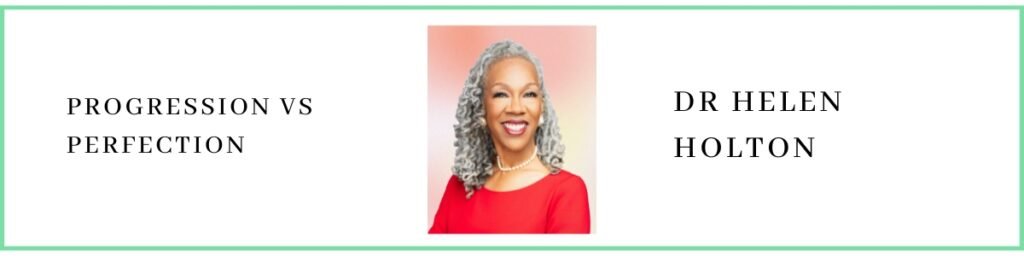
Dr. Helen Holton, a leadership strategist, coach, author, and former Baltimore City Councilwoman, discusses how perfectionism creates “perfection-driven misalignment,” the gap between excellence and perfection that pressures leaders, teams, culture, and results. Holton shares her leadership journey, including self-doubt, overworking, feeling unseen, and the need to find one’s voice amid conscious and unconscious bias, noting large numbers of women displaced from roles. She frames perfectionism as over-performance, procrastination, fear of mistakes, and difficulty delegating, and urges leaders to focus on strengths awareness using tools like CliftonStrengths, DISC, and Myers-Briggs, emphasizing progress over perfection. Holton promotes her Permission Room workshop for women leaders and highlights three essentials—vulnerability, curiosity, and resilience—plus wellbeing practices to reclaim joy.
3 Takeaways
Understanding Perfection-Driven Misalignment:
Dr. Helen Holton opens the discussion by addressing the concept of perfection-driven misalignment, a term she uses to describe the gap between striving for excellence and the unrealistic pursuit of perfection. She draws from her personal and professional journey to illustrate the pressures and challenges leaders face. Through anecdotes, Dr. Holton reveals how the pursuit of perfectionism impacted her life, linking it to self-doubt, burnout, and the endless cycle of striving for unreachable standards.
The Price of Over-Performance:
One of the striking highlights of the conversation is the cultural expectations imposed on women, particularly women of color, to over-perform. Dr. Holton points out the societal pressures that push women to over-achieve and the unspoken cultural assignments of excellence. She shares her experiences of putting in extra hours and feeling undervalued despite giving 150%, and sheds light on the biases and systemic challenges faced by women in leadership roles.
Perfectionism as a Barrier to Leadership:
The discussion takes a poignant turn as Dr. Holton describes perfectionism as a ploy of the adversary to steal joy and authenticity from leaders. She emphasizes the importance of recognizing that perfection is unattainable, and that true leadership lies in embracing one’s strengths and vulnerabilities. Dr. Holton’s message is clear: progress beats perfection every day of the week, and leaders must focus on nurturing their inherent gifts rather than falling into the trap of unattainable ideals.
ShowNotes
Click on the timestamps to go directly to that point in the episode
[02:04] Recovering Perfectionist Story
[04:51] Bias and Misalignment
[07:12] Cultural Overperformance
[09:54] Excellence Over Perfection
[12:55] Faith Lens on Perfectionism
[16:03] Strengths and Awareness
[18:29] Procrastination and Book Journey
[22:08] Permission Room Workshop
[26:28] Three Leadership Essentials
[28:03] Resilience and Wellbeing
Get In Touch:
If you’re interested in connecting with Dr Helen Holton, you can reach her via her website, via Instagram, via Substack, or via her LinkedIn.
For those interested in sharing their own stories on “Chatting with the Experts,” reach out to Paula Okonneh through her website or connect via LinkedIn.
Paula: [00:00:00] Welcome, welcome, welcome to another episode of Chatting With The Experts where I speak with phenomenal, fantastic, fabulous women from Africa, from the Caribbean and in the diaspora. And today’s no exception. Our show is titled
The Grip is Real, and my guest, who will join me in a minute, says, “Are you tired of being under the pressure of being sick and tired?”
She says she knows that feeling, and it just sucks. She calls it perfection-driven misalignment, and that is the gap between excellence and perfection. She is a leadership strategist, she’s a coach, a speaker, an author, and a recovering perfectionist who knows leadership pressure [00:01:00] travels from the leader to the team, the culture, and results.
And she’s also a former Baltimore City Councilwoman, a CPA, and a ICF PCC coach. Oh my gosh, I could say so much more about her, but what I’ll do, I’ll welcome her to the show so that she can talk more about all the wonderful things she’s achieved as we launch into Chatting With The Experts. So welcome to the show, Dr.
Helen Holton. Do, do, do, do, do.
Dr Helen: Oh, my, I love it. Hello, Paula. Thank you so much for the invitation to be here for a conversation today. I am so excited,
Paula: yes. I don’t know who’s more excited, me or you. Excited. But we’re both excited, right?
Dr Helen: Absolutely. Absolutely.
Paula: You say you’re a recovering [00:02:00] perfectionist, but I couldn’t tell looking at you.
Tell us more about this.
Dr Helen: Well, as I, you mentioned my book, and I just wanna kinda go there because that’s where it began to unfold for me, unbeknownst to me, just in looking at what does it take for a leader to lead with excellence?
Paula: Mm-hmm.
Dr Helen: And thinking about my journey over more than 30 years of leadership, I realized that, uh, now I’m a church girl.
I grew up in the church. I, I’m a God girl, okay?
Paula: Hallelujah to that.
Dr Helen: And I remember as a little girl hearing, um, pastors say or preachers say, you know, “With new levels come new devils.” Mm-hmm. And I just thought it was a fancy way of, “Oh, yeah. Oh, yeah,” not understanding what that meant. But in a full circle moment as I began to rise in leadership, I began to notice the challenges, the, the harder it became.
I began to notice my own self-doubt, my own feeling like I [00:03:00] wasn’t good enough to be in the place. Having to work harder, putting in the extra hours, burning the midnight oil. And then watching someone who didn’t do half as what I did be promoted or get that next opportunity to do something. Every job I left, the last three jobs I left, the one thing they all had in common is that I had to train more than one person to replace me.
Hmm. Do you know how much that stings?
Paula: Mm.
Dr Helen: Do you know how much that says, “Did anybody notice everything I was doing?” Mm. I was there giving 150%-
Paula: Mm-hmm …
Dr Helen: until I was used up. I just felt like this is a dead-end path. This is interrupting my ability to rise higher.
Paula: Mm-hmm.
Dr Helen: Going through my, I still didn’t understand what it was. [00:04:00] Then I realized it was internally. It was not being able to find my voice and use my voice to speak up. It reminds me what Shirley Chisholm used to say, ” If there’s no seat for you, bring your own chair.” When I look at the women who have broken ground, and I’m gonna speak specifically about women of color, women period.
You know, Gloria Steinem died just a few, died this year.
Paula: Mm-hmm.
Dr Helen: Um, there was someone else in that genre of trailblazer. I can’t think of who the other woman was. Oh, Dolly Parton. I was gonna say. And so, but the, Dolly Parton. And I look at the Shirley Chisholms, I look at the Kamala Harris’, I look at the Michelle Obamas.
I look at women who rise up, and what I believe today, and I believe it because of my [00:05:00] experience, and I know that there’s intellectually I believe it, but I also believe that there are conscious and unconscious biases in our society. I just left a conference and talk- where they were talking for women, women in high roles in heavily male-dominated fields that struggle with, that are looking for ways to not only keep their career on track, but how do I bring others behind me?
As I began to look further and really dissect what was going on, and 2025 really sent me down a path that says we’ve got to find a way to find our place and our space, because women, I believe, have less value today than they had five years ago in the workforce, in these male-dominated roles. When you look at right now, a year ago, there were 300,000 women that were displaced [00:06:00] out of government, corporate, nonprofit organizations.
Today, that number has doubled. Whether they left on their own, out of frustration, out of not being seen or heard, but we’re at a place where we need to find our space and place. And when I looked at it, I can trace back what I believe disrupts the leadership of not just women leaders, but leaders, period.
It’s just that we as women tend to absorb it differently than men, and that is what I call perfection-driven misalignment. It is not a curse. It is not a bad word. It is not a term that we hear often today, but it is a reality that we face today as leaders.
women of color mentioned
Dr Helen: So this is not something relegated just to women, but I will tell you this, as a woman, as a woman of color, [00:07:00] I can trace back over my life what has caused misalignment.
Paula: I know we spoke at length offline, and would you say, we, we talk about women in general and then we filter it down to women of color.
Would you say that excellence is, or denial of excellence, or over-performance, because that’s almost like sometimes perfection-
Dr Helen: Over-performance
Paula: Yeah, it’s over-performance. Mm-hmm. It’s a cultural, and it’s an unspoken cultural assignment?
Dr Helen: Yes. Yes. And here’s a saying, and I’m gonna go back, and I’m sure you’ve heard this saying Mothers spoil their sons and raise their daughters.
Paula: Yes [00:08:00]
Dr Helen: That’s putting you on a path to be perfect
Paula: Yes
Dr Helen: If you wanna get a good husband, you better learn how to cook
Paula: Mm-hmm.
Heard that
Dr Helen: It’s always, how do I get to be me? And what is that husband, who’s, who’s instructing that man on what he should do if he wants to get a good wife? Be a provider
However, when you look at the plight of divorce rates, and I use that because oftentimes in a divorce, especially where children are involved, all of those things end up sitting on the plate of mom, not dad.
When you look at the number of single parent households, they’re mainly led by women.
Paula: Yeah. And that’s worldwide.
Dr Helen: And mothers… Absolutely. Absolutely. So when you say I need to have [00:09:00] all the answers before I speak What does that sound like to you? Everything looks successful, so why do I feel so exhausted?
This is what I know. The purpose of leadership is to expand you, not to exhaust you.
Paula: I like that. The purpose of leadership is to expand you.
Dr Helen: Not to exhaust you.
Paula: Not to exhaust you. I’m writing this down.
Dr Helen: And so when I hear, it’s, it’s so, it’s so much that I hear people speak from a space of wanting to be perfect, that I’m gonna be the one, I’m the leader.
You know? I can’t celebrate yet. There’s still work left to be done. Yeah, love. So in my book, I talk about strengths awareness. What does that [00:10:00] mean? It means knowing who you are at your best by nature and nurture. And oh, by the way, you don’t just wake up one day knowing this. No. You’ve got to do the work.
And what does do the work mean? So I use several assessment tools when I’m coaching, training, working with leaders and rising leaders and potential leaders, is because you can say, “Oh, well I need to be…” Case in point, I’m a halfway decent end user of technology. Now, I go to other people that do it, like, off the top of mind.
“Oh, how’d you do that?” “Oh, I don’t know, I just…” And they go, and I’m like, “Okay, back that up. Record that for me. Let me write it out for me because you said it so quick I can’t even ingest it, but you fixed my problem.” Now, I’ve had a knack for numbers since I was a little girl. I could [00:11:00] remember phone numbers back in the time when we had dial phones.
Remember that? Some of your callers may be talking about dial phones. What the heck is that? Party lines.
Paula: I remember. I’m there with you.
Dr Helen: And that’s something that I just know how to do that. So what does it take to become good at your gifts, talents, education, and experience? An assessment, a tool that’s going to, I’m gonna say for lack of a better word, but objectively or put you in a position so
there’s no right or wrong. It’s gonna type you out in a certain way, whether it’s CliftonStrengths, whether it’s DiSC, whether it’s Myers-Briggs, whether it’s… I mean, there are tons of assessments out here. The purpose is to help you identify with who you are-
Paula: Mm-hmm …
Dr Helen: at your best. Now, this is talking about how do you strive for excellence, not perfection.
Perfection is when [00:12:00] you wanna do those things that aren’t in your wheelhouse, but you feel like they have to be done because you’re the leader, and if they don’t get done, it’s not, you know how many times have you rewritten the email because you wanna make sure it’s just right? What is just right?
Progress beats perfection every day of the week.
Paula: So I want you to define that again because especially, as you say, as women- Mm-hmm … we always strive for perfection. I have had other guests talk about this, like from a man, and we most times 99.9% our guests are women. So for a man, 60% of a task once done is done.
For women, we gotta get everything right. And learning or unlearning that behavior is a task in itself.
Dr Helen: I’m gonna give you a description of perfectionism [00:13:00] from through the lens of a woman of God.
Paula: Mm-hmm. Amen.
Dr Helen: Perfectionism is a ploy of the adversary to steal, kill, and destroy-
Paula: I like that
Dr Helen: I can’t afford to make a mistake. Mm, Sounds like perfectionism. It’ll take too long to explain. I’ll just do it myself Perfectionism causes you not to trust people you lead because you want everything to be perfect. Well, newsflash: imperfection cannot create perfection.
Paula: That’s a, oh, oh my gosh. That’s a aha moment, especially as me [00:14:00] as a believer. Imperfect- Well, you, you started off by saying perfection is a ploy of the adversary. Mm-hmm. And so being that the adversary is imperfect, as you said- Mm-hmm … imperfection cannot create perfection. So the-
Dr Helen: Well, each and every one of us.
Right. Without God loving us enough to send And I’m gonna, I’m gonna call it, say it this way. To send a guide to lead us back to
the Source of All.
Following Jesus won’t make us perfect, but it’ll certainly get us a lot further to ensure where we will spend our forever.
Paula: Can I say Amen? Complete Amen! [00:15:00]
Dr Helen: And I’ve experienced it time and time again. Think about, think about something as simple as: have you ever been in a position where you were working and striving to get that next promotion or that next level of leadership only to see it go to someone else?
Paula: Mm.
Dr Helen: Here’s what happens when you chase perfection. It’s here and you think you’re gonna reach it, and just as you get close, it, it moves higher. Just as you get close What it takes to get and attain that thing that’s going to make you feel like you’ve accomplished or arrived, you’re never going to attain because it’s not excellence, it’s perfectionism.
Everybody’s talking about it today, but I actually research it. And so what does it take to really, and I say a recovering perfectionist because the grip is [00:16:00] real. It doesn’t ever wanna let you go. It is your responsibility, awareness. You gotta be aware. You can’t do everything. So I’m a Gallup certified coach. There are 34 talent themes, and whenever I give someone this assessment, what’s the first thing they want to go do, look at when they get the ranking of their talents?
They want to go to the bottom. No, you don’t start with the bottom. You start with where you’re strongest. You start at the top. And well, I don’t have this, and I don’t have that. Said, okay, you don’t, but any of those 34 talent themes, any task can be successfully completed through any one of those 34 talent themes if it’s at your top.
Now, if you want to spend all [00:17:00] day trying to make what’s at the bottom be what gets you through, look at the, all the time, and you’re not focused on who you were created to be. Each and every one of us are born with gifts and talents that only you bring to the planet. And if you aren’t willing to develop them and be in relationship with yourself, who am I, that you can put it out to the world.
Paula: Yes, Dr. Helen. And that’s so many of us
Dr Helen: live in- Women
Paula: Yes, almost all Women
Dr Helen: more than men.
Paula: Yes Yes. Live in, you know, the word that’s coming to me, for some purpose, is bondage. Or sometimes it’s even denial because someone is telling you, “This is what you’re good at.” But like you said, you want to look [00:18:00] at the things that you’re not good at.
“But I’m not good in this,” instead of celebrating what you are.
Dr Helen: What you are.
Paula: Yes. The gift you know, and understand it is a gift. A gift is something that you don’t earn. Somebody, for us as believers, we believe God has given it to you, so enjoy it. Walk in that. And the other things you can learn at a later date as opposed to beating up yourself about what you can’t do.
Dr Helen: Here’s the thing.
Paula: Mm-hmm.
Dr Helen: Procrastination
When you don’t act because you want it to be just right. Mm-hmm. “Oh, it’s not ready yet.”
Why not? When’s it gonna be ready? It took me seven years to write my book. My publisher was gonna fire me. I’d gone through two book coaches and still no book. And I will tell you, it was John Maxwell that [00:19:00] convicted me to complete my book.
Paula: Mm.
Dr Helen: And I’ll tell you how I was at one of, uh…
So I, I, John Maxwell, I see John Maxwell personally twice a year. And at one of those gatherings, he gave us a book. He gave everybody there a book. And I was like, and it was called something like The Greatest Story Told or something. And I thought, “Oh, this is really nice.” And I opened it up, and it had, like, printed in it a little handwritten note.
And I read, “Oh, how nice.” And then it had some questions to think about and consider. And then the rest of the book were blank, lined pages
And I set that book up on my night table so that before going to bed every night and waking up every morning, I would see that book and it would say, “I have work to do.” And I’ve been writing. I’m a, I’m a ordained minister, a preacher. I mean, so it’s not like I [00:20:00] don’t deliver messages, speak to people, have things full of content.
And it convicted me.
Paula: Mm.
Dr Helen: I got that book completed in about six months, ’cause I had all the pieces. And realizing after a while I was so in it, I said, “I need someone to review, to read this ,” I mean, ’cause I keep reading it over and over and filling it in and this, that. And I used, I used a developmental editor to help me pull the pieces together.
Because we all have different gifts. God created us as relational beings. We need each other. We don’t know everything. Never will.
Paula: Never will.
Dr Helen: There’s an African proverb, ” If you wanna go fast, go alone. If you wanna go far, go with others.”
Paula: Mm-mm. Mm-mm.
Dr Helen: I’m going far.
Paula: Mm-hmm.
Dr Helen: It doesn’t have to be fast. [00:21:00] I do want it to be memorable, impactful, able to pass on to others.
Uh,
Paula: I believe they call that legacy Mm-hmm. Quoting that proverb, um, ’cause just yesterday I was speaking about it with somebody, and we, we talked about, many times, still about the same topic about permission. Uh, not permission, about, you know, wanting to be perfect, but…
And I said permission be- Perfectionism Yeah, perfection- perfectionism. ‘Cause what I wanted to bring up is about permission, because permission and perfectionism I think go hand in hand. Because many times we want to ask for permission before we even do what we know we want to do, because we’re thinking it has to be perfect.
“So I don’t wanna do all this in case I make a mistake.” So you’re even afraid to do it because you feel you [00:22:00] have to ask for permission, and you’re afraid to ask for permission, so you don’t get it done because you want it to be perfect. So it’s like a circle, you know?
Dr Helen: There’s a workshop I created, a free workshop.
I do it when it fits, and then I promote it so people know, because it’s called, it’s developed specifically for women leaders. Mm-hmm. What do I define women leaders as executives, entrepreneurs, and rising, and leaders on the rise
I call it the permission room.
Paula: I like that.
Dr Helen: And the permission room was created for women to identify and understand what it means to be in the grip. Because the grip is real. Many of us [00:23:00] live in denial of it, but as I said, I mean, look, I need to have all the answers before I speak.
Paula: Yeah. Really?
Dr Helen: Why? You know, “Let me look at it one more time before it goes out.”
Paula: Yeah. Hmm. And I said, “Hmm.”
Dr Helen: I should be able to handle this on my own I can’t afford to make a mistake. Paula, these are the messages that we feed ourselves.
Paula: Yes.
Dr Helen: And we feed this to ourselves because we’re asked that. I remember getting a report card. I was so proud of this report. I couldn’t wait to get home to show it to my parents.
I had four As and a B. My mother said, “Oh, that’s wonderful.” My father looked at my report card. He said, “Why aren’t they all As?” Hmm.
What do you think that sets up in the mind?
Paula: You’re a failure.
Dr Helen: Or [00:24:00] you’re not good enough
Paula: Yeah.
Dr Helen: We don’t celebrate
accomplishment.
Paula: Yep. …
Dr Helen: in a way to just… Have you ever had someone say, “Oh, Paula, I love that. You look gorgeous in that outfit.” Oh, this old thing?
Paula: Yes.
Dr Helen: Come on now.
Paula: Yep.
Dr Helen: Come on now.
Paula: I have had to unlearn that. Mm-hmm. And it took me years to, you know, when someone says that, to say just a simple thank you.
Dr Helen: Thank you.
Paula: Instead of, you know, doing the, “Oh, is it this? Oh, nah.” No, we were taught as females as women to downplay any words of appreciation. Oh, no. No, not at all. I love your glasses. This? Oh, this thing I’ve had for so long? No.
Dr Helen: Yes.
Paula: Just say thank you.
Dr Helen: Thank you.
Paula: That’s it.
Dr Helen: It’s [00:25:00] just like this. I train, coach women on how to say no.
No is a complete sentence.
Paula: It is.
Dr Helen: And I say, if you really are uncomfortable with it, you, then you say, “No, thank you.” No, thank you.
Paula: You still said no.
Dr Helen: And zip it up, because you will talk yourself out of something you really did not want to do because I don’t wanna let them down, they’re counting on me.
You’re the only one that can do that, that can deliver that
Paula, the grip is real, and this is why I’m out here sharing information, speaking truth to power, calling it what it is. Because if you can’t name it, [00:26:00] if you can’t own what is destroying you, what is robbing you of the gifts that God has given you because you’re afraid, you’re, don’t feel like you’re ready to yet, you haven’t studied it enough, you haven’t achieved enough, stop it! You got it interrupted
And I’ve learned. There are three things that in my book I talk about the three things every leader needs to succeed. But they need these three things also to keep perfectionism
from masquerading as excellence or the pursuit thereof. That’s what it does. The grip of perfectionism is like [00:27:00] a masquerade. It’s like, “Oh, I’m wearing the mask. I’m gonna make you think it’s excellence,” but it really isn’t
Wow. And it requires us to be vulnerable, to be honest, that we carry more than is ours to carry.
Paula: So one of the three things is being vulnerable. That’s what I’m hearing?
Dr Helen: Yes.
Paula: Yes. Vulnerability. Okay. All right. I’m looking at the time because whatever we don’t finish here, we’ll continue with the audience.
Dr Helen: Yes. Wonderful. I love it. Vulnerability, it is, um, we’re not curious enough to ask. You know, the word of God says we have not because we ask not.
Yes. What are you afraid of asking? What’s the worst thing they can say? No.
Paula: No. That’s it.
Dr Helen: But what’s the best thing that they could say? Yes. “Hey, I didn’t think of that. Sure. Yes.”
Paula: So curiosity is the [00:28:00] second one?
Dr Helen: Curiosity. But, uh, the big one, the big one is resilience.
Paula: Love it.
Dr Helen: Resilience is not something we’re born with, it’s something we build throughout our lives.
Mm-hmm. But you have to know that, and you don’t build it when you’re in a crisis. And I have, in my book I list eight or 10 ways in which you can build resilience. The other is wellbeing. Not wellness. We all need to take care of our health, but we need to understand the nature of wellbeing. You can think of it, I created a wheel, and I have to tell you, I’ve done trainings around it that have been so powerful.
People have made major transitions in their life. Changed jobs, decided they needed to retire to honor themselves the more they’d worked all these years and, “Why do I keep doing this?” Hmm. Or staying in a job that’s secure but not pleasing. [00:29:00] That’s secure, but you’re not growing
And so wellbeing, looking at what creates that. And I, I do the free workshop
And even the shift in that I realized in the vulnerability, it takes a trusted, safe space to face our fears. And you probably know like I know, years ago I learned fear is no more than false evidence appearing real. Okay. Yeah. But when it’s there, baby, it’s very real.
Paula: Yes, it does. Yep. Yeah.
Dr Helen: And it’s just a, it’s like anything else.
You’re not going to shake perfectionism because you went to a workshop. [00:30:00] If it were that easy, everybody’d be doing it. It’s a process. It’s a discipline. It’s a practice that you put in place to guide your life, to reclaim your joy.
Paula: Ooh. Yeah, you know, as I said, we could talk forever, but, uh, we’ve been talking for 30 minutes. So we will continue this with the attendees, but for those listening online who would love to continue the conversation with you, how can they do that?
Dr Helen: I would welcome that. If, if anything I have said has resonated with you, I want you to go to LinkedIn-
Paula: Mm-hmm
Dr Helen: and connect with me and DM me.
Paula: Mm. “
Dr Helen: I wanna know more. I’m ready to break the grip.”
Paula: Mm. “
Dr Helen: I wanna be free.”
Reach out to you there. Just, just if you wanna have a conversation, DM me, “I’d like to have a conversation.” [00:31:00] It’s just that simple.
Paula: Just like you had a conversation with me.
Dr Helen: Absolutely. I’m living my best imperfect perfect life unapologetically.
Paula: I love it. Best im-per-
Dr Helen: Perfect … perfect … perfect life. Yes.
Paula: I look at you, smiling.
Dr Helen: Don’t I look like it?
Paula: You look it, every bit of it.
Dr Helen: I’ve learnt not to sweat the small stuff.
Paula: Mm-hmm.
Dr Helen: And baby, it’s all small stuff.
Paula: It is.
Dr Helen: I, I can be in my own space and, you know, challenged by stuff going on that, you know, and then I have to-
Paula: Remember …
Dr Helen: I have to say, “Just stop.”
Paula: Yep.
Dr Helen: Stop it.
Paula: Remember.
Dr Helen: Let it go.
Paula: Mm-hmm. Remember who you are and whose you are.
Dr Helen: I lost my favorite coffee cup while in Chicago, and for a moment, you know, I lamented. I said, “Oh, that was my favorite,” and I said, [00:32:00] “Well, it’s just time for a new season. God has said you don’t need that anymore,” and it’s gone. So I will just wait for something better to come and replace it.
Paula: Mm-hmm, Mm-hmm. Wow, I could keep talking with you. But for those listening and those viewing this, I, I say this every week, I get the best, and Dr. Helen Holton has not disappointed me. So if you’d like to be on the show just as she has been, reach out to me on my website, which is chattingwiththeexperts.com.
I’m also on LinkedIn, and just reach out to me on my business page there, which is Chatting With the Experts. I’m also on Instagram. My handle there is @chat_experts_podcast,
and we have a YouTube channel. Subscribe to us there and you’ll be able to [00:33:00] view this episode as well as all the other episodes that we have had so far with phenomenal women whose mission is the same as mine, which is to educate, empower, and encourage women globally. Dr. Helen Holton, thank you so much for being such a phenomenal guest.
And now let’s open up the floor to those who have joined us so that we can continue this conversation, this fascinating, fantastic conversation that we’ve been having together. Thank you. Thank you.
Dr Helen: Thank you. It has been my pleasure. Mm. And I look forward to Chatting with the Experts more.
Paula: Aw, thank you.