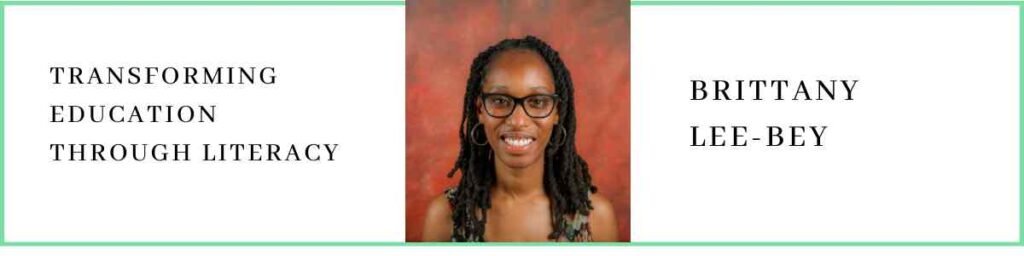
Brittany Lee-Bey, a reading specialist and author of ‘Etymology Rules, Back to Basics’, shares her passion for language and literacy, which began in childhood, and discusses her journey in teaching, especially her focus on helping children with reading difficulties. She elaborates on the science of reading, the importance of phonics, and how her book aims to equip teachers and parents with the tools to improve literacy skills. Brittany also touches upon her work with incarcerated youth and the significant impact of literacy on personal growth and societal advancement. The conversation highlights the universal principles of language and the transformative power of reading.
3 Takeaways
The Science of Reading:
During the conversation, Brittany highlights the importance of the “science of reading,” a methodology combining phonics and comprehension to foster a holistic reading experience. She notes that understanding the building blocks of language is crucial not only for academic success but in everyday life as well.
Language Across Borders:
Brittany and Paula discuss the universal principles of language, pondering how various languages incorporate sounds, meanings, and syntax. While each language has unique characteristics, the foundational elements of phonetics, morphology, semantics, and syntax are consistent across the board. Brittany expresses her interest in exploring how these principles apply to different languages, such as Amharic.
The Influence of Literacy on Life:
Addressing the broader implications of literacy, Brittany and Paula reflect on its crucial role in shaping lives and futures. Brittany advocates for a society where education is prioritized and accessible to all, suggesting that a strong foundation in reading can open doors to endless opportunities.
ShowNotes
Click on the timestamps to go directly to that point in the episode
[02:23] Brittany’s Journey into Language and Literacy
[05:52] The Science of Reading
[10:33] Language Across Cultures
[13:58] The Power of Literacy
[18:53] About Etymology Rules
Get In Touch:
If you’re interested in exploring the depths of language, you can find Brittany’s book, “Etymology Rules: Back to Basics,” on Amazon. For educational content and language insights, follow her on social media platforms like Instagram, TikTok, YouTube, and Facebook. For direct inquiries, reach out via email at etymologyrules@gmail.com.
For those interested in sharing their own stories on “Chatting with the Experts,” reach out to Paula Okonneh through her website or connect via LinkedIn.
Paula: [00:00:00] Hi everyone and welcome to another episode of Chatting with the Experts TV show where I, Paula Okonneh, I’m the host and I showcase women from Africa, from the Caribbean and in the diaspora. These women are professional women or they’re successful business women or they’re both professional and successful business women.
And the mission of this show is to inspire, is to also empower and educate women globally. On a few occasions, I’ve had men join us, but for the most part, it’s always women. My guest today is Brittany Lee-Bey, and we’ll be talking about The Power of Language and Literacy. When you join us, you’ll learn about literacy and language because she, that’s Brittany, is a reading specialist and she’s the [00:01:00] author of Etymology Rules, Back to Basics.
I’ll tell you a little bit about her because my guests always have such great bios that I tell them jokingly that if I have to read their bios That would be the whole show. So I’ll tell you a little bit about her before I ask her to join us. And so, Brittany Lee-Bey is the author of Etymology Rules Back to Basics, which is a workbook teaching the fundamentals of language and literacy instruction.
She is a language enthusiast, and she aims to equip the world with the power and knowledge of words while committing to this mission in all and everything that she does. Of course, I said I could say a lot more, but why don’t I invite her on so that we can talk more about how she got into this, why she does this, and of course, who she is. And with that, I want to welcome Brittany to Chatting With The Experts. [00:02:00] Hi, Brittany.
Brittany: Hello. Thank you so much.
Paula: Thank you. Thank you. I always say this, but thank you for joining us and thank you for saying yes to being a guest on the show. Ah, as I said, I only gave a snippet of your bio. Tell us a bit more about you. Why the book? Why that interest in the power of language and literacy?
Brittany: I’ll start with the interest in language and literacies just from a child or as a child, I always loved to read. I loved language. I loved writing. I wrote little books and stories and speeches. I was on the debate team in high school. So I’ve always been interested in using language. Even when I remember being in second grade we did reading, writing, spelling, and I remember one day our teacher said, well, you know, it’s the end of the year and I’m going to let you all [00:03:00] watch Reading Rainbow. So that’s my era, the Reading Rainbow era.
And you know, I loved Reading Rainbow and so did my classmates, but I remember telling my teacher, well, I want to stay behind and do more spelling because I just really loved playing with and manipulating words. And so fast forward to when I became a teacher, I first started teaching at Oak Hill Youth Detention Center which is for D. C. incarcerated youth. And I wanted to teach history, but I found that a lot of the students struggled to read the material. And so it just switched my whole focus to where I wanted to help students learn to read, because I just believe that is, a powerful tool. It’s an invaluable tool that you need in almost every facet of your life.
So I’ve been teaching for 17 years, and I’ve been teaching children to read particularly older students who have difficulties. But what I realized is [00:04:00] that throughout a good amount of my training and the training of other teachers, we never really learned about language specifically. And so all the learning I had done was on my own, and I just thought it was, I thought it was crazy that we’re being asked to teach children to read, which is, in a sense, dealing with language, and yet we don’t have a strong sense of how language works. So I really wrote the workbook for teachers in mind, as well as parents, but then, you know, also language enthusiasts find it really enjoyable as well. So that’s how I got to writing Etymology Rules. I just wanted to write something that would help teachers better help children.
Paula: Wow. I like that. You wanted to help teachers better help children. And off camera, I was telling you how my daughter was. I mean, when she was like five or six, I realized [00:05:00] that she was very good at memorizing stories. And so if you gave her a book and you read it to her, she would have memorized everything so she could read it back to you. And it was later on, we realized that she didn’t quite, know how to read, but it was teachers, teachers like you who helped her develop the, you know, the love of reading helped her read to the point that she actually went on and had a degree in communication and marketing. And every day she reminds me, mom, I love books. So my hat goes off to people like you who see, The need and you either help the children or in this case, you wrote your book to help teachers help children. Thank you.
Brittany: Thank you. Yes. Yeah.
Paula: So that means I noticed, I mean, when my daughter was being held, there is a technique, there is a science to reading. Can you talk about that? [00:06:00]
Brittany: Yes. So, and some people may have heard this term as of late the term science of reading, but it really isn’t anything new. There’s been a reading wars that some people call it. Where it kind of goes from people say we should teach phonics, teach children how to sound out words, decode language to whole language, where the goal is to foster a love and appreciation of reading. And it’s a big focus on sight words and comprehension. And my belief is I think both are necessary, but the science of reading says that the foundation is indeed phonics, fluency, word study. So that is understanding that when I see the word cat, I know that there are three letters and each of those letters represents a sound.
And as opposed to if I have the word [00:07:00] chat, like I’m chatting with my friends, Well, now that has four letters, but it still has three sounds. That first sound we call it a digraph in reading. I’m actually in school for linguistics, so I’m training to be a linguist, and so we use a little bit of a different vernacular. We call that an affricate, but in any event, when it comes to spelling, we know that C H is two letters. That makes one sound. Being able to decode that, being able to understand orthographics and how we build words in our language is a foundational skill that I’m glad more and more schools are waking up to realize.
Paula: Absolutely. And now the science of reading, when you’re talking about you’re going to school for linguistics, I mean, and the science of reading in general, this is for English, correct? Does it apply to all other languages?
Brittany: That’s a good [00:08:00] question. You know, maybe that is like a dissertation topic. It’s something that I could dive deeper into, but, you know, the concepts of language, it’s across the board, right? You have sounds, that’s phonetics. You have sounds and those sounds, you put them together and you make words. You have parts of words. That’s morphology. So in English, you know, we have prefixes, roots, suffixes .You have a semantics. That’s the meaning. You have syntax. That’s how words are arranged, the order that words go in.
And so while in languages around the world, we do have different sounds, there’s different syntax. There’s different morphology, but all of those foundational aspects are a part of a language. So, you know, I think the science of reading and how we understand it here in America and in English, I think there’s aspects of it [00:09:00] that could apply across the board. You know, our language is we have a sound, a symbol, correspondence. So that means like I mentioned earlier, I have a letter or I have a group of letters and that represents a sound where you have some languages like Mandarin. They read their graphemes or their letters are more like pictures. I believe they call those logograms as opposed to ours.
Ours are like actual alphabetic letters. So there is some difference. And how we go about teaching someone to read language to language. But I think there’s some general foundational principles that are the same. The science of reading, they do say foundation is phonics, word study, decoding, but that it’s not that alone. It’s also fluency. So that’s being able to read a text smoothly, accurately at a [00:10:00] proper rate. I believe that’s probably universal. Comprehension that is okay, you’ve read this aloud. You’ve read it beautifully. No mistakes. What is happening in the story? What does this mean? Vocabulary as well is another tenet of strong reading skills that the science of reading advocates. So I think those principles probably are universal. But as I said, that is a wonderful research topic that, that I would love to dive more into.
Paula: Yes. I think, I mean, I’m happy that I kind of sparked that interest because, you know, I have Nigerian parentage. My dad was Nigerian. And fortunately, he’s been dead for a while, but then living in Nigeria, there’s some words that you would think would be pronounced a certain way because of the English language, but they’re not. And I don’t know enough of you know, of [00:11:00] words and etymology and so on, but you know, like a word like B O D E, you may say in England or in America, bode, but in Nigeria, in a particular language, that is body.
So it’s very interesting, you know, and the more you spoke is like, yeah, it’ll be good. Excuse me, to kind of hear how different languages, different cultures and how languages came into being to get those particular sound, or whether we were influenced by those who colonized us. And just, you know, put words and we knew that, okay, in our language, this is how it sounds. So even though the words don’t match the sound phonetically, but we know this is what it is.
Brittany: Mm-hmm .
Paula: If that makes sense.
Brittany: Yes . Yeah. My interest is Amharic. I’m in DC and we have a large Ethiopian population. I don’t speak Amharic at all. But I’m just very interested in how [00:12:00] Amharic speakers and thus those who will read the script of of that language. I believe it’s called Geʽez or Geʽez, but in any event, I’m curious, how do those students learn to read because their alphabet is completely different from our English alphabet. So, that is something I’m interested in, like how reading takes place in other languages.
Paula: Well, you may have to have another conversation with that, you know, and that’s you making me interested. And as I, excuse me, you said off camera, I am not, my background is mathematics and accounting. So words had their place, but they did, they were not top of my line for interest at all. So, as you introduced yourself, you mentioned that you work with children whose parents have been incarcerated?
Brittany: So, [00:13:00] well, I worked for a detention center where the students themselves were detained. The students were ages 12 to 21, and they were in there for various reasons. It was an all male population and it was for students from kids from D. C. So, I found a lot of students had reading difficulties. And I always am curious, is there a correlation? A lot of people say there is that, you know, I think they say looking at reading rates by the age of eight or by third grade can be a predictor of future incarceration rates. If that’s the case, it’s incredibly sad because it’s our responsibility as teachers in a society where, you know, education is not only free, but it’s required. So how do we have so many people who are slipping through the cracks?
Paula: Yes, yes. And that brings me to a question of the [00:14:00] power of literacy, because, you know, as I said, I lived in Nigeria, and of course I have, my mom was from the Caribbean, and so very much conscious of how much lack of education could derail your future. You know, you can have families that, you know, because one person was better educated, they were able to educate their children better and you see, you know, the different opportunities that are given to the children who are, who had parents who recognized the importance of literacy and emphasized on that. And those that didn’t. So can we talk a little bit about that? Because as you mentioned that you worked in, you know, that institution, it touches my heart.
Brittany: Yes. You know, I’ve been at quite a few schools in the area and I see pretty similar trends. I think maybe less so at this point in my career, but [00:15:00] overall I see similar trends and The number of students who have difficulty with reading and who are disengaged from it, you know, there’s good instruction, read good literacy instruction matters, but it’s just like a sport as well. You have to practice. So you can have the best coach in the world but if you aren’t getting your practicing in outside of your time with the coach or the team, then you won’t make as great progress as you could. And I would say the same is for reading. I tell my students that all the time. And so a lot of it is, as you mentioned, just the emphasis of how important reading is not equal across the board.
You know, my parents they both were the first to graduate from college and their families. And they come from very humble beginnings down south, but and then their parents were not as educated as they are. But I know both my mother [00:16:00] and my father’s parents just made sure it was a priority. And I think that has been passed down to us, the grandchildren of our grandparents. So, I have seen firsthand how that has had a big impact on me. I have a lot of students who say, I don’t like reading. Reading is boring. And then I also have students who say, I don’t want to go to college. And I think that’s okay. What I always tell them, I think it’s okay if you don’t want to go to college, but I always tell them though, is it doesn’t matter if you go to college, what you do, you’re going to have to learn how to read.
You’re going to have to read it. Let’s say you want to go to trade school. Okay. Which I think is a wonderful route. You want to be a plumber, electrician work in construction. You’re going to have to know you’re going to have to read. And you’re going to have to know math actually. And that’s a whole nother conversation, but you know, I tried to speak to them about the realities of what illiteracy looks like for an adult in this country. And also I talked to them [00:17:00] about contracts. You know, you want to get your first apartment, you’re getting a credit card, you’re trying to get a loan, all these things. I hope you don’t just write your name on something and sign it away. You know? So I try, if they’re not like, You know, I love learning in schools. I’m working on my fourth degree. I love being in school. Thank you. But I recognize everybody doesn’t, but that doesn’t mean that you are off the hook from learning how to read.
Paula: It’s the fundamental to growth, I think. I mean, as you said, no matter what you want to do, if you can’t even It’s like when I travel and I travel to a foreign country and you can’t read the instructions, I feel so lost, you know? You don’t even know whether they’re saying, you know, don’t go down this way because there’s danger. Or, you know, they’re saying when, if you’re driving, though I wouldn’t drive in a foreign country if I don’t understand language, but you know, even walking, like, [00:18:00] Hmm, are they saying there’s a pothole here or look out, you know, it’s the fundamental to almost anything.
Brittany: Yes, it is. So you want to order something from a menu. You’re going to have to be able to read that medication. You know, when you get medication, they give you instructions and, you know, God forbid you can’t read that. And you take the medication incorrectly and it doesn’t cure you or even worse, it makes you more sick. So, I mean, we are in a day and age where literacy is fundamental. There were times in the past where and far, far past where we weren’t as literate as a society, but today in the 21st century, we are. And so if you want to be able to not just survive, but thrive, you’re going to have to pick up a book and get to practicing, is what I like to tell my students, so.
Paula: Yep, and I agree. I agree. Now, you mentioned that the book you wrote was really for teachers. So how, I haven’t read the book, of course. [00:19:00] So, do you give, like, instructions on how to teach literacy to children? Tell me more about that.
Brittany: So it really covers the foundations of language, right? I mentioned earlier that all languages have sounds that would be the study of phonetics and phonology. And so I go over, well, here are the sounds in the English language. Then I cover, well, here are the different letters that represent these sounds. Here are the patterns. How do you know that this A is going to say ah versus this A saying eh? You know, children and even us, we don’t encounter every single word in the world. So we have to know that when we get to a word in English, we have word-attack skills. And like I said, I did a lot of research on my own time. I learned to read so long ago that, you know, I don’t remember all the little rules.
[00:20:00] So I had to do my own research and that was me going to different workshops and trainings and reading different books and different articles. All just to teach me about how language works. So understanding about the sound and the symbol relationships, there are exercises in the book that are like, how many sounds, how many phonemes or sounds are in this word? A word like vacation, vacation has V A C A T I O N, that’s eight letters. The sounds are [vacation pronounciations] so that’s seven. So understanding, you know, if you looked at the word vacation, the ending is TION. You would think, oh, it’s TO, right? But you know that suffix, TION, that pattern says shun.
So just covering those type of things. That’s [00:21:00] the first and second chapter. Then I go into prefixes, suffixes, and roots, because.= I teach at a school where the students learn Latin. They start learning in fifth grade and we’re five through 12, so they have to have like three years of Latin on their high school transcript in order for them to graduate.
I asked the principal one day, like, why, why Latin? You know, it’s a dead language. Nobody speaks it anymore. And she said, Well, in theory, if they have a good grasp of Latin, they’ll have a good grasp of grammar, but also vocabulary, because and the numbers vary depending on who you ask, but it’s anywhere from 70 to 90 percent of the words in the English language are of Latin or Greek origin.
And so I noticed that the students weren’t making that connection. And I think what helps is when teachers are able to help them make that [00:22:00] connection. So I’ve done professional development using my book. And one of the things I always tell the teachers is that, you know, let’s lean into our students Latin knowledge. When you introduce a vocabulary word break that word down into its prefix, root, and suffix. Find the, where the word came from in Latin. Maybe the students know that Latin word, and now you are taking a derivation from that Latin word and you’re making that connection for them so that they can see where these things come from and it’ll help them to recognize the meaning of words a lot faster.
So there are about four chapters on that and then the last chapter, it’s just a fun chapter, I find a lot of kids get… they’re fascinated when they learn about the etymology, the actual origin of different words. And so some of the ones I like to share that are kind of fun are consider and disaster.
So, disaster, I believe is of Greek origin, but consider is [00:23:00] Latin. And both of those have, you know, a root word that mean the same thing. So in consider the root word sitter comes from well, it comes from the Latin, that means star. And disaster also comes from the Greek meaning star. And so then you say, well, what does consider and disaster have to do with stars?
Well, in the ancient world, there was a heavy reliance on utilizing the stars for predictions, planting and reaping and sowing, et cetera. So, when you consider something that’s like you’re looking to the star and it’s a good omen, but a disaster, because this is bad. When you look to the stars, it’s something bad. Of course, it’s not what it means today, but you can see how that word, like the history of that word. And I think a lot of people are just kind of interested in [00:24:00] that. So that’s why I included that as the last chapter.
Paula: Oh my gosh, I’m almost like maybe my major would have changed if I had someone like you to make English and you know, the origins of the words and you know, bring in the Latin. I mean, just what you said, disaster, consider, stop. Never heard that before. That’s amazing. Oh, my God. And that’s what can make, you know, that can change a child’s life, that can change their destiny, that can change so much about them, you know, because just hearing that story makes me like, okay, maybe I will order her book. I’m not a teacher, but it sounds interesting. And you said you made it fun so that I guess they in turn can teach it in a fun way so that children will learn it. You know, I, I became a mathematician because somebody made math fun for me. And so, I know that the same thing can apply to, you know, reading [00:25:00] and understanding language and falling in love with it and say, Oh, no, you know, and we need it.
As you said, they, everybody needs to know how to read and having someone like you, who is so embedded in it, who is interested in it. You said from a very young age, you were reading and trying to find out the origin of words. You love school. This is your fourth degree. Where were you when I needed you?
Well, you know, of course we always have people join the show. And so they’re going to be people who want to ask you questions. But before we go into the Q and A, how can people get in touch with you?
Brittany: So my book itself is on Amazon. So if you’re interested, you can order a copy on Amazon. Again, it’s called Etymology Rules Back to Basics. I can also be found on Instagram, TikTok, YouTube. [00:26:00] And there’s one more. I want to say Facebook as well. And there you can just find little bits of information about language on TikTok. I’ve done root word of the week, so, I have like a little root word tree. And different words that have the same root and I just share it throughout the week. So if you just want more information those are places where you can get that. And I can always be found via email at etymologyrules@gmail.com.
Paula: Awesome. And for those of you who are watching this later on, if you’d like to be a guest on my show, like Brittany, you can reach out to me on my website, which is chattingwiththeexperts.com. I’m on LinkedIn. I love LinkedIn. Look up, just search for Paula Okonneh. You’ll find me there. I’m also on Instagram. My handle there, I’ll make sure I get it right. I always get it wrong, but most of the time my handle on IG is [00:27:00] @chat_experts_podcast, and I am on Facebook. And Brittany and I actually connected through a past guest of mine, so that’s another way.
If you are friends or connected with a past guest of mine, if you look at some of my shows, reach out to one of those people to connect with me and you can be a guest. As I said, the mission of this show is to empower, to educate and inspire women globally. That started with me because now I’m going to go buy that book. I have been educated beyond words. Thank you so much, Brittany, for being a guest on the show. And of course we’ll open up the floor to whoever else was joined, who wants to ask you questions.
Brittany: Thank you for having me. Thank you very much.
Paula: Sure.