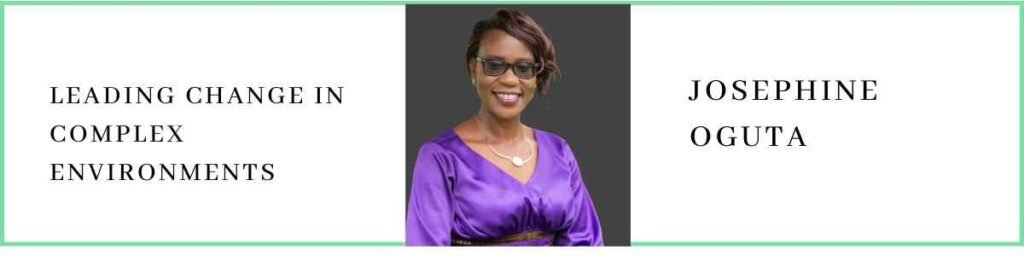
Josephine Oguta, a seasoned leader with 25 years of experience in strategic leadership within international development and human rights organizations, discusses how to lead through uncharted territory, emphasizing the importance of courage, adaptability, and vision. Josephine shares her extensive experience working with organizations like ActionAid International and World Vision International, discussing the complexities of organizational change, the importance of trust, clear communication, and the challenges of balancing power and resources. She highlights the necessity of authentic change and how different organizations approach transformation. Josephine also provides insights into her current work as a consultant, helping organizations redesign structures and governance systems to foster inclusive decision-making and equitable partnerships. The conversation underscores the critical role of transparent communication and stakeholder involvement in successfully navigating uncertainty.
3 Takeaways
Building the Boat While Sailing:
Josephine shared vivid memories from her tenure at ActionAid International—where the metaphor of “building the boat while sailing” proved to be an apt description of their formative years. “If we stop sailing, we will drown,” she reminisced, illustrating the organization’s approach to fostering change amidst uncertainty. She discussed the critical need to infuse trust into this process, an ideology that required empowering voices from every corner of the organization, regardless of size or influence.
The Challenges and Triumphs of Change:
Throughout the conversation, Josephine delved into the intricacies of implementing authentic change. Emphasizing the importance of power balance and the challenges when donor needs mismatch with local realities, she painted a picture of what authentic engagement should look like. She articulated that for change to be meaningful, it must extend beyond theoretical ideals to become part of the organizational fabric.
The Role of Communication in Change:
Clear, transparent communication emerged as a recurring theme in Josephine’s dialogue. As organizations venture into uncharted territories, the necessity to transparently convey objectives became apparent. Josephine emphasized the importance of a well-understood vision by every organizational member, cultivating an environment prepared for collaboration or confrontation with the unexpected.
ShowNotes
Click on the timestamps to go directly to that point in the episode
[01:14] Josephine Oguta’s Background and Experience
[02:17] Welcoming Josephine Oguta
[03:22] Navigating Uncharted Territory
[07:01] Building Trust and Empowerment
[10:56] Challenges in Power Devolution
[15:28] Importance of Clear Communication
[30:00] Learning from Mistakes and Falling Forward
Get In Touch:
If you are interested in reaching Josephine, you can contact her via email at josephine_oguta@outlook.com or LinkedIn.
For those interested in sharing their own stories on “Chatting with the Experts,” reach out to Paula Okonneh through her website or connect via LinkedIn.
Paula: [00:00:00] Hello everyone, and welcome to yet another episode of Chatting with the Experts TV show where I speak with amazing women from Africa, from the Caribbean, and in the diaspora. These women are professionals, and they are also successful business women, entrepreneurial women, and they share with me a mission which is to educate, empower, and inspire other women globally. I do this weekly and today’s no exception. Today our topic is Leading Into Uncharted Territory, and my guest will be coming on shortly, says that leading into uncertain territory requires courage, adaptability, and vision.
In an [00:01:00] environment defined by uncertainty and complexity, leadership is not about having all the answers, but it’s about navigating with vision, fostering trust, and resilience. Josephine Oguta has 25 years of strategic leadership experience in international development and human rights organizations, of which 19 years she has spent specializing in leading change within global development organizations, designing inclusive governance frameworks that empower organizations to rethink their structures and policies, fostering power, balance, and strengthening inclusive decision making and broadening equitable South-South and North-South partnerships. She has led in organizations such as ActionAid International, [00:02:00] SOS CVI CARE International, AMREF International, Help Age International-Kenya, amongst many others. Wow. My guests always fascinate me. So with that, i’d love to welcome Josephine to Chatting with the Experts. Welcome, Josephine.
Josephine: Thank you Paula. Pleasure to be with Chatting with the Experts. Thanks. Yes.
Paula: Your bio is impressive. I didn’t even know where to stop when reading it. I’m like, whoa, I’ve got a dynamite here on my hands.
Josephine: That’s 23 years condensed in a paragraph.
Paula: Condensed in a paragraph. Wow. Off camera I was saying to, or we were reminding each other how when we first met virtually, [00:03:00] of course we meant to speak for 15 to 30 minutes. One hour later we had to say bye, and we still had so much to talk about. So, you know, when she told me that she could fit a busy calendar into my calendar, I grabbed it. And so, Josephine, thank you.
Josephine: You are welcome. My pleasure.
Paula: So, you know, we are talking about Leading Into Uncharted Territory. In other words, providing clear direction in uncertainty, help us, expand on that for us, please.
Josephine: Well, I have been fortunate in my career to be hired or to serve in organizations that are interested in changing? You know, in the last, I would say two decades, most international development organizations have been very keen on changing how they’re structured, the issues of neocolonialism, [00:04:00] just balancing the power between the North and the South and localizing their operations. So I have been fortunate to help many of these international organizations in changing those structures.
But many a times you find that there is a vision of what they want to become. But there are very little examples of who has done it. So it becomes very unchartered territories and all you’ve got is a vision to work with. I remember when I started at ActionAid International, we had a six page memorandum of understanding where the Northern founding organizations that come together and they say, we want to create a federation.
Paula: Mm-hmm.
Josephine: And, ActionAid was operating in over 43 countries at the time, and they want to create a federation of equal members. At [00:05:00] the time that, my goodness, that’s almost 20 years ago now. In fact, it is exactly 20 years ago because those 2005, when I started off with ActionAid, and at the time when they looked at it, there were very few international organizations who had done that. Devolved their country offices to be independent entity, who then came back to more or less form this federation that empowered collectively, but also empowered them individually and therefore leading through that uncharted territory required building a lot of trust. It required the ability to explore. Be willing to make mistakes and quickly. I would say fall forward, accept when things are not working, and just re-engineer and move, re-engineer. The chair of the international board at the time [00:06:00] would say, “we are building the boat while sailing”. So you have the boat, but the full boat is not here, but we have to keep moving. If we stop sailing, we will drown. If we stop building, we will drown. So we have to keep just seeing what fits in and we keep building the boat while sailing. And therefore keeping a clear vision is one thing that I believe helped us in navigate that unchartered territory. Yes.
Paula: Wow. So, you know, just thinking about that, building a boat while sailing means you have to build trust because you’ve gotta trust the captain, you’ve gotta trust the fellow sailors. You know, because you are sailing in uncharted waters. So how do you, I mean, how do you go about that? I mean, it takes courage. A lot of courage. It takes being open to change, being flexible. Tell us more. Because yeah, there’s so much uncertainty [00:07:00] in general.
Josephine: Yeah. Well, building trust, one thing that it takes, I would say that it takes a lot of courage and knowing who the stakeholders are. Sometimes it’s easy to identify the bigger stakeholders who are loud in the process, and to really just hear them and believe that you are forming a structure that involves everyone. Because the louder parts of the organization may get heard more. But in order for you to build a system that people really trust, you have to be courageous enough to go into the smaller country offices. The smaller stakeholders whose voices maybe have been stifled throughout the history of the organization and hearing from them, what does this change really mean for them.
What does being empowered really mean to them? And not only being [00:08:00] empowered, but are they ready to take on that power and be different in the process of that power? Because one of the things that I realized was as you are working to empower the southern part of the organization mostly, there’s usually hesitation because they tell you we want to be empowered, but we are fearing this power will mean that if we don’t look enough like say Action eight uk, then we are not succeeding. But do we have a safe space to be empowered and to operate, to remain authentic to our identity? So building trust that this system is actually opening doors and it’s not a cookie cutting system. It is authentic and there is legitimacy behind it is really important as you speak and you are moving forward with [00:09:00] change because change can be very theoretical and superficial. And we know sometimes, especially in the development organization, sometimes the organization is implementing a change just because a donor has asked for it, but at the heart of the organization it isn’t there.
And if you’re working in many international organizations that have experienced several changes that are not authentic, then there’s usually a lot of hesitation. So you have to fast peel off that layer of mistrust and then communicate that vision and prove to them that this is authentic and they can actually own it. Yes. Building that ownership trust and ensuring that their voices are heard has been really important. Yes.
Paula: Wow. Ensuring that their voices are really heard, you know, and it’s not being influenced, as you said, by a donors. A donor’s [00:10:00] voice or donor’s want, because, you know, sometimes what the donor wants is not what the people need or what the organization is even structured to undertake.
Josephine: Yes.
Paula: Hmm.
Josephine: Yeah. And with localization actually, you find that sometimes donor needs have to be matched with the local needs. And if that’s not matching, then it’s impossible to have an authentic change. And, even those who are embracing the change cannot trust the system. They may do it, but there’s no trust.
Paula: I love that you stress that the donor needs have to match the localized needs. So how do you, as you know, you’re dealing with human beings. How do you work around that? Especially as it’s international, you work in a lot of international spaces.
Josephine: Yes, yes.
Paula: How you, you know, do deal with that?
Josephine: Well, because you’re moving into a space where you are asking organization to [00:11:00] share power, and power is a very delicate matter.
Paula: Yes.
Josephine: Sometimes we feel there is not enough to go round and I usually believe power is a very big pie. If you just cut it right, there’s enough to go round. So how do you do that? It’s first and foremost understanding where power has been imbalanced.
Paula: Hmm.
Josephine: I genuinely addressing that and then finding out if the change that is being proposed is willing to address those power imbalances.
Paula: Mm-hmm.
Josephine: Unless those power imbalances can be addressed, the change cannot be authentic. At the same time, those who are pushing or are willing to be empowered, and I would say to share the power also need to be accepting of the responsibility that comes with that. Because one thing that [00:12:00] people forget is that when you’ve got power to do something, there’s responsibility and accountability that comes with it.
Yes. I remember whenever we spoke about independence, part of the organization becoming independent. Many organizations, part of the organizational country offices thought they could now do anything that they want, but in order to be part of an global ecosystem, there is more interdependence in this
Paula: Yeah.
Josephine: Than independence and bringing out the interdependence component is earlier on in the conversation rather than later when people already have these false assumptions of what power means to them is very, very important. So you bring the interdependence need, we all need each other to succeed. What would that mean? What responsibility are you willing to take on? Which ones are imposed, which ones are legitimate? What that vision would look like [00:13:00] for you? And also the parts of the organization that are devolving, maybe the excess power that they’ve held, finding out the implications of that, which one’s a policy, what systems will be required, because you find usually most of the time the part of the organization that is devolving power has had the opportunity to make mistakes or to restructure for several decades. While if this power is being devolved to you, you are almost expected to hit the ground running.
Paula: Mm-hmm. Hmm.
Josephine: And the question is, is there room for us to have a teething process?
Paula: Mm-hmm.
Josephine: Is there a room to pilot before this is devolved too far? Is the capacity going to and systems going to be put in place and resources put in place before we are told we now need to be autonomous enough to raise our own funds? Is there going to be capacity devolved to a company, the responsibility? And [00:14:00] that is a challenge because unfortunately sometimes, I’ve worked with organizations that the devolution is not purely strategy led, but it is resource constraint led.
Paula: Mm-hmm.
Josephine: Where it’s a strategy to do more and to have deeper impact, it has been a beautiful process. But where the headquarters are seeing the donor landscape changing and therefore they’re devolving because they can no longer raise funds, say for emerging mid-income countries. And yet they had not invested sufficient capacity for these country offices to raise their own money, but they’re being devolved to this responsibility.
It has not been a very easy space. So, those are some of the challenges that comes with it and therefore change when it’s at the heart of the mission and it’s to expound impact, it’s a beautiful [00:15:00] process to work on the North-North South-South partnership, but where it’s just as a way of now devolving responsibility because the donor appetite has diminished while the mission or the work is still relevant, it hasn’t been an easy one. Yeah. Yeah.
Paula: I can only imagine the difficulties that arise from that. And that’s where I guess you come into play, you know?
Josephine: Yes.
Paula: But I believe it must take a lot of clear communication on both sides of letting people know. Okay. Like you said initially, that, donor needs need to match the local need. But then when you, you also mentioned that you know, when resources are, you know, restricted, then, you know, then that balance is not there. You know, if the donors aren’t there, you still have the mission to be, you know, achieved.
Josephine: Yes.
Paula: Oh, so now is that clear [00:16:00] communication brought on? Is that encouraged at the onset? You know, like, okay, putting out all the possibilities that can happen and say, so if this happens, then how do you intend to, you know, work X, Y, Z?
Josephine: Oh, yes. Clear communication, because as you can imagine, it’s a very uncertain space.
Paula: Yeah.
Josephine: Yes, nobody knows. We all have a vision of what we want, but how do we get there? You could try one route, you try the other and it’s not working. So you need to be very clear, first and foremost to why we are doing this, and transparently communicate. If it’s due to funds that are dwindling, say it is due to dwindling resources. If it’s mission driven, say it’s for us to expand impact. So that, there’s a system that enables you to succeed can be put in place and clear [00:17:00] communication that’s transparent can also be put in place. Now, clear communication. Sometimes you actually don’t know what the next step looks like or would look like, and you yet you need to be ahead of the team at any given time. You need to be one step ahead.
Paula: Mm-hmm.
Josephine: Otherwise, there’s disarray. Now you need to know that when you are doing change, there is self preservation that is there. ’cause some people like the current system and they don’t see themselves surviving outside of the current system. There are those who are anxious about the new system and then there are those who are really excited. But if you level the ground by making transparent, clear communication available to everyone to have a conversation, leading leaders is very important because the leaders need to make sure that at every level where they are, they’re [00:18:00] communicating to all the levels of the organization. So making sure that every leader, whenever they go to their forum, their country team meetings, global meetings, they’re clear about what we’ve done so far, where we are heading and some of the steps that needs to be still taken care of. Even if we don’t know how, clarity on the what needs to get done in order for us to get where we are going is very important because as a leader, it gives you courage to defend the mission. But where there is so much uncertainty and yet communication is also not clear, people will fill in the vacuum. And, you know, nature oppose vacuum.
Paula: Yes.
Josephine: People will be filling with their own assumptions, with their own fears, with their own anxiety or excitement. And you do not want 10 different narratives out there. So clear [00:19:00] communication, where things are have been accomplished, what we are still struggling with, what we are hoping for needs to be out there. Yes. In that way, the rumors are muffled and confidence is built. Also, letting those who are involved in the change, take ownership of the messaging. And ask them to interpret it in their different languages. So that any staff, regardless of the level of their work, whether they’re in the frontline, whether they just doing office administration, they understand what this change entails for them. Yes.
Paula: I love that part about taking ownership of the messaging. You know, so that they understand what part and the impact that the messaging will have on, you know, the population that they’re serving.
Josephine: Yes.
Paula: That’s [00:20:00] so relevant. That’s so needed, you know? Especially as you said, when things are so unpredictable.
Josephine: Yes.
Paula: ’cause it’s not clear communication. It’s not there and people jump in and you say some out of anxiety?
Josephine: Yes.
Paula: Some out of excitement. It’s a mixed message, isn’t it?
Josephine: Yes. And even self preservation and yeah. Self preservation is there when you’re changing. There’s some people who like the current system.
Paula: Yes.
Josephine: Yes. They really cannot imagine how the organization would look like outside of the current system. And remember, you’re moving into unchartered territory, so you cannot even draw an example from within the organization to show them.
Paula: Yes.
Josephine: Funny enough, the most recent changes I think have been slightly easier as opposed to when, ActionAid International will trailblazing. Right now you find there are more organizations that have done the localization in different ways, through networks, through federation, and therefore you can [00:21:00] find more peer comparison. But I will not tell you that even if you have peer comparison, it’s easier. Many organizations believe they are unique, so usually also communicating that yes, we may be unique, but we are not that different, and we can still borrow a leaf from a peer and then customize it to our own needs. But, making yourself absolutely unique as if there is nothing you can learn from the sector is also a narrative that has been used to more or less prevent the change.
Paula: Mm-hmm.
Josephine: Yeah. So consistently saying, yes, there are others who’ve done it and succeeded is making these changes a bit easier lately. But, bold organization like ActionAid International, it was at the heart of their mission and they were willing to build the boat as they sailed. And it was a very exciting opportunity working with them. I mean, it’s been almost, [00:22:00] I would say, wow, I would say 14 years since I worked with ActionAid, but that change shaped the lens through which I see institutional transformation. I’ve done several transformations since then. And I would say many of them have succeeded because I know what authentic change looks like. And therefore if you have a good benchmark, it’s very easy to know when things are not going according to authentic change. Yes, it was a very authentic process.
Paula: Wow. So with that one, I’m just, I mean, I’m curious about the ActionAid international, because I know being international, there’s so much in the world. I mean, we had the Miramar earthquake. We’ve got, you know, Ukraine war. We have so much going on, and it’s been 14 years, as you said, since you worked alongside with them.
Josephine: Yes. [00:23:00]
Paula: Are you still in contact with people there? Just curious.
Josephine: Oh, yes. Oh yes. I’m still in contact with them because, I mean, as I said, it was a very authentic change that required you not only to be professionally involved. There was a lot of emotional involved investment that went into that change. I would, I remember the times when the CEO and I, there’s a board meeting coming up and we need to present a structure. There was a time we worked two days almost back to back when we were shaping the federation structure. We had a consultant who’d done a research for us, and when they gave us a final paper. It wasn’t anywhere near world we had envisaged.
Paula: Ooh.
Josephine: And so we had to rewrite it in two days.
Paula: Ooh.
Josephine: Yes. Because we knew what the organization wanted, and so we said, no, there is a framework here. Let’s dig within us and populate it. Let’s not throw away the baby with the bath water. What [00:24:00] the consultant has given is a good framework. But it’s not what we want. And we were able to populate it. And actually that is a federal structure that is currently driving ActionAid. Yeah. Over 14 years later. So, there was a lot of investment and yes, I’ve been involved with ActionAid. Since then, I’ve facilitated one of their general assembly meetings where it was, I mean, it was private when I left, they had like, 12 new members who had come in. 14 in the process. But when I was facilitating this general assembly of members, there were like 38 members eligible to vote in the room from six where we had, it was just a pride to see the international board is so diverse. This is an organization that started with a UK only board.
Then the UK board started diversifying a bit and now if you look at their board, it’s a global board. [00:25:00] You know, you want someone from South America, you’ll find them. They’re North America, Europe, Africa, and it’s not just Africa as one. They acknowledge that there are different parts of Africa, so you’ll find East, West, North, South Africa all represented in there? Yes. So Australia, because they work across Australia. So, I mean it was, I would say it was a gift that I managed to get back into that space. I’ve worked closely with some of their national boards just because the moment you are empowered to have a local board, your board also needs to understand how to govern locally, being local and global at the same time. So you have almost dual citizenship. I’ve worked with some of their country offices in defining that space and ensuring that their local boards are strong enough. I would say that the other organization that I worked with that impressed me was World Vision International.
Paula: World Vision. [00:26:00]
Josephine: Yeah. World Vision International has a very interesting system in that their change was not externally driven at all.
Paula: Hmm.
Josephine: It was internal. They looked at the themselves as a Christian international organization and they said, we are all part of one body, and every part of the body has its purpose and therefore the hand cannot do what the foot does. The eyes cannot do what the hands do, and it is important that we acknowledge and treasure each part of this body. So we are one body, one federal body, but we are a single partnership and they brought in members from all parts of the organization. Although they are federation, it’s a very different kind of federalism. So sometimes you find a lot is still centralized, but they are open to [00:27:00] empowering every part of the organization because they know the hands need to be the strongest hands. In order for the whole body to function effectively. The eyes need to be the best sight.
Paula: 20/20 vision.
Josephine: Yes. 20/20 vision in order for them to have clear foresight. So with that principle, you find balancing the power becomes much easier for them. They’re not struggling against external forces. It’s internally motivated. So it’s unique. They’re rarely used as a benchmark, but you find because it’s internally motivated, they actually have a very healthy federation. Their approach is very different. So many organizations that try to structure into global federations rarely use one vision as a benchmark.
But I went in there and one thing I learned about was the graduation process of taking institution step by step and allowing them space to participate even [00:28:00] while they’re still growing. As part of their growth process. So that was a good five years experience there too. So I’ve gleaned from different organizations here and there. So I think those who I’m working with right now, yes, there is a treasure trove of different kinds of examples we can draw from. Yes.
Paula: You know, world Vision just touched my heart because you said it’s a Christian organization and I’m a Christian, and it just touched, you know, it’s biblical. I mean, I think it’s in First Corinthians.
Josephine: Yes, yes.
Paula: 12?
Josephine: Yes, it is.
Paula: Yeah.
Josephine: Yes.
Paula: It says, you know, there are many parts, but one body Yes, but one.
Josephine: Yes.
Paula: That seems to be the principle… once you started talking about it. That mean I started getting very excited, just thinking, wow, I mean this is exactly what the body of Christ stands for. You know?
Josephine: Yes, yes.
Paula: Hands cannot do what the foot is doing, but you need the strong hands, as you [00:29:00] said, to lift up what needs to be carried. You need the 20/20 vision so that we can have foresight, whoa.
Josephine: And if you look at it in reality, then the federal principle that govern that body are very authentic.
Paula: Mm-hmm.
Josephine: In and of themselves. Yes, yes, yes. So, the systems around that usually does it make that part of the body strong enough to handle or to do the best that it’s supposed to do. So it’s a very different kind of question to when you’re just looking at federalism as a political or an organizational structured theory. Yeah, yeah. Yeah.
Paula: Wow.
Josephine: Yes.
Paula: Oh my gosh. I could talk with you forever, but there’s something,
Josephine: I know.
Paula: Something you talked about because with all of this, as you say, we’re still dealing with human beings, trying to take care of human beings problems in one way. ’cause we did live in a world and it’s humans who run the world for the most part.
Josephine: [00:30:00] Yes.
Paula: In your work so far with all these international organizations, how open are people to like falling forward, learning from and embracing their mistakes while, you know, learning at the same time and celebrating that, you know, we are human, you’re going fail that, you know, things are gonna go wrong.
Josephine: Yes. I would say. Theoretically you’ll find that, it’s written that yes, we are willing to fail and fall forward. And usually, how do I put this in a neat way? You find that there is more, I’ll say more grace accorded to other parts of the organization than to others.
Paula: Mm.
Josephine: And therefore you find that a mistake in one part of the organization could be considered [00:31:00] as, oh, that’s a learning opportunity.
Paula: Mm-hmm.
Josephine: Whereas a mistake in another part of the organization is you failed. You do not deserve to get that opportunity again, and therefore, while handling this change, balancing that tension to ensure that everybody has equal opportunity to fall forward and to self correct is provided is usually a very big challenge. First and foremost, there are resources involved because whatever you did, even if it was experimental, there were resources that were invested in it.
Paula: Mm-hmm.
Josephine: Time that was invested in it. Humanitarian organizations, the mission, the frontline is an emergency. Constantly life issues don’t wait. So with limited resources to facilitate actual institutional change, sometimes the space for falling forward could be limited. And if you don’t ingrain it in the change [00:32:00] process and say that there have to be resources invested in experimenting and opportunities to learn. It makes actually the failures less expensive when you don’t accord that opportunity to fall forward. I don’t want to call it failure because there’s a lot of learning that comes through it. When you don’t put resources into it and you just insist on staying on a specific path, even if it’s not proving to be the right path.
Paula: Mm-hmm.
Josephine: It normally you say, oh, this change the direction was wrong. We made a mistake. What we had previously was better than what we are aspiring for. But the reality is that no, you did not give the change the opportunity to crystallize and to transform with the organization. Yes, yes. So falling forward, yes, it’s a good space to create, but resources have to be put [00:33:00] or invested there for organizations to learn, for people, to re-engineer, go back to the drawing board and say, what needs to change here? What worked well, what didn’t work well, and how can we forge forward? Yes.
Paula: Josephine, this has been an incredible learning session for me, as I know it has been for those who have joined us. So for those who will later ask you questions yeah, they have an opportunity to ask you all. I mean, there’s so many more questions I have for you, but we’ll leave that for the audience. But if someone wants to get in touch with you who’s watching this recording and hasn’t had the opportunity to join in the audience, how can they get in touch with you? Where can they find you online?
Josephine: Well online, LinkedIn, I’m Josephine Oguta on LinkedIn or Josephine Oguta. And, via email if you’d like to reach me via email, I’m on josephine_oguta@outlook.com. That is [00:34:00] O-G-U-T-A at outlook.com and I’m always happy to connect any other channel that the person who contacts me would like to get in touch. Yes. And I’m currently in full-time consultancies. I usually have, well, after five years of service, I take a break, go out, learn from other organization as I also pour into them what I’ve learned from my experiences.
So I’m currently in full-time consultancy, looking at organization, redesign, development, governance, restructuring, and I’m enjoying it so far. Yes. My last assignment, just having been with SOS CVI, which was an exciting, challenging one as 75-year-old organization that was totally transforming its governance structure. So it was an exciting one, but successful one. And, I’m looking forward to many more coming up. Yes.
That’s so exciting. So exciting.
Yes.
Paula: And for those of you [00:35:00] who enjoyed what you just heard, who listened to Josephine Oguta. If you’d like to be a guest just like she has been, please reach out to me, Paula Okonneh on my website, which is chattingwiththeexperts.com. I’m on LinkedIn as Paula Okonneh. I also have a page there. I have to look into that even more. I am on Instagram and my handle there is at chat_expert_podcast. I’m on Facebook as Paula Okonneh, and I also have a business page, which is Chatting with the Experts on Facebook. At last, but not least, we have a YouTube channel. It’s Chatting with the Experts. So subscribe, visit me on LinkedIn, on all the other social media resources, I mentioned, which is IG, Facebook, and reach out to me and you in turn can inspire, motivate, and empower women [00:36:00] globally. So now, well, thank you so much again, Josephine. This has been very, very, very interesting. 30 plus minutes hearing more about, Hmm. Leading in uncharted territory. Thank you.
Josephine: Thank you, Paula. It’s been a pleasure.
Paula: Now we open up the floor to all those who joined us. Thanks.