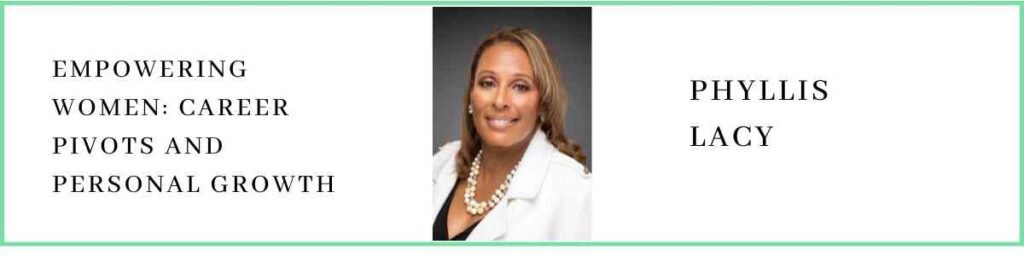
Phyllis Lacy, a visionary educator and empowerment strategist with over 20 years of experience, delves into the importance of clarity, confidence, and purpose-driven success. Phyllis discusses her approach to career transitions, mentorship, and community involvement, highlighting how she helps women lay the groundwork for monumental shifts in their professional journeys. She shares inspiring stories and practical advice on utilizing existing skills, embracing personal growth, and leveraging community support to achieve one’s goals.
3 Key Takeaways
Vision and Growth:
The importance of vision is a recurring theme throughout Phyllis’s insights. She describes how a clear vision can serve as a catalyst for growth. Drawing on real-life examples, she illustrates how individuals can pivot during challenging times by drawing strength from past experiences. Everyone has a personal toolbox filled with skills and knowledge gained over years, and sometimes it just takes someone like Phyllis to help them recognize and leverage those assets.
Mentorship and Its Impact:
Phyllis details how mentorship can play a pivotal role in personal and professional growth. She emphasizes the significance of learning from those who have walked a similar path and using that knowledge to forge your own trail. Mentors can provide invaluable guidance by encouraging their mentees to think differently, thereby transforming their potential into reality.
Building Community:
Another pillar of Phyllis’s approach is the power of community. She advocates for finding and engaging with communities that align with your interests and goals, as they offer support, shared experiences, and new opportunities. Engaging in communities, according to Phyllis, not only fosters personal growth but also enriches professional development by fostering connections with like-minded individuals.
ShowNotes
Click on the timestamps to go directly to that point in the episode
[02:47] Empowering Women to Soar: The Importance of Vision and Mentorship
[03:58] Navigating Career Transitions and Personal Growth
[16:07] The Role of Community and Mentorship in Elevation
[26:46] Celebrating Victories and Personal Growth
Get In Touch:
If you’re interested in connecting with Phyllis Lacy, you can reach her via her website, via email, or on LinkedIn.
For those interested in sharing their own stories on “Chatting with the Experts,” reach out to Paula Okonneh through her website or connect via LinkedIn.
Paula: [00:00:00] Hello, hello, hello everyone, and welcome to another episode of Chatting with the Experts, with me the host, Paula Okonneh, where I speak with incredible women from Africa, from the Caribbean, and in the diaspora. These women are successful entrepreneurs. They’re professionals who have and share with me mission of educating, empowering, and inspiring women globally. Today’s episode is called Empowering Women to Soar, and my guest who will be joining me in a few minutes says, Elevate is your personal guide to clarity, confidence, and next level success. She says, whether you are reentering the workforce, pivoting industries, or launching your own venture. She’ll help you through elevate, move forward with [00:01:00] a purpose.
So I’ll tell you a bit about my guest. Ooh. So the speaker I have the privilege to introduce is a visionary educator, an empowerment strategist with over 20 years of experience transforming lives through mentorship, education, and leadership. She has dedicated her career to guiding women through career transitions, entrepreneurship, and personal growth, while also advancing digital equity and workforce development through innovative education programs. This speaker’s expertise lies in mentorship, nonprofit leadership, and building transformative platforms that foster clarity, confidence, and purpose-driven success. She’s also the founder of Elevate Mentoring Services and Quantum Studios Institute [00:02:00] for Education and is a life long advocate for inclusive learning, youth development, and women’s empowerment. Please help me. Welcome to Chatting with the Experts. Drum roll please. Phyllis Lacy.
Phyllis: Hello.
Paula: Hey Phyllis.
Phyllis: Hi. That was quite an introduction. Thank you so much.
Paula: Oh my word. Your bio is so impressive. I had to condense it. So I mean, and even that condensed version is so impressive. Thank you for saying yes to being a guest on Chatting with the Experts.
Phyllis: Well, it’s my pleasure to be here with you. Yeah.
Paula: Absolutely. And we are gonna be talking about something that’s dear to my heart and I know it’s dear to yours as well. And that is empowering women to soar .
Phyllis: Yes, yes, yes, yes. I think [00:03:00] that there’s no better moment in time than where we are right now, where it’s so important for women to. Find themselves if they have to pivot from a career that they were once in, or if they’re trying to start a new business, I would like to be that person that will help them to clarify and strategize on what the next step is for them. Let me put it to you this way. I, in my lifetime, you know, in a career, it’s not just one thing that you’re doing. It’s becomes like a journey. You start off doing one thing and then before you know it, you’re doing something else.
It might be in the same career. And I think it’s all about the vision you have for yourself. You can’t stand still. No one’s standing still. But if you have that vision for yourself, then you can start moving in a direction, in another direction and create for yourself other opportunities. I have met some [00:04:00] young women recently who when I started mentoring them, I actually thought it was about one thing. It ended up being about something else. It could have been about them going into a divorce, you know, and they were like, you know, I really am thinking about this career move because I need more money.
Paula: Mm-hmm.
Phyllis: Okay. You need more money, you know, that’s interesting. You know, it never occurred to me they were talking about divorce. And they were talking about a career change, a shift that was going to be monumental. And I helped ’em lay the groundwork. It’s not about me. This whole thing is not about me, it’s about the person that’s sitting in front of me or on the computer with me and it’s about, you know, giving them some direction, you know, on what it is that they feel as though they need to do. And then helping ’em figure out how to get there. And a lot of [00:05:00] times…
Paula: Go ahead, go ahead.
Phyllis: And a lot of times it’s really emotional. It’s very emotional, you know, you’re dealing with giving the emotional and mental support along the way and letting them know that. This is something they can do. And one thing that’s my famous little tagline is, you’re enough you can do this. And figuring out, you know, as we move towards that end that they are enough. I use that all the time. I say, you are enough. And they’ll look at me and they’ll be like, buying into it slowly, buying into it. You know, you get this aha moment and you’re saying, okay what tools do you have in your toolbox right now?
Okay. These are all the things that help them to see that they’re valued. You know, it’s like, like their jewelry box. Okay, let me open up what are some of my practical tools and what are some of the resources I have or what tools do I need to develop in order to get me there? And I can look at them and talk with them [00:06:00] and say them, well, you got it all. You know, let’s just figure out a way to put it together to make it work for you so that you can move on. And it doesn’t necessarily take a long period of time, it’s just people figuring out that they can do it, you know? They can do it. They got the tools that they can do it. Let’s figure out where it is you’re going, whether or not it’s a new job or it’s a new career, or if it’s an opportunity to start a new business. And that is what I like.
Paula: Absolutely love it.
Phyllis: Mm-hmm. Yeah.
Paula: Yeah. That is, you know, you know, I’m looking at you and you may not, of course, you may not be looking at yourself the way I’m looking at you, but you know. You said it doesn’t always have to be difficult because…
Phyllis: No, it’s not difficult.
Paula: You know, you’re more than enough. You are enough.
Phyllis: You’re enough. You’re enough just where you are because by the time you get to, even in your twenties, [00:07:00] you gotta life experiences that you bring, and anytime that you go forward with something, whether it’s a, like I said, a career or an opportunity to start a new business. You are bringing with you experiences that you’ve had for at least 20 years. It’s just how you package them, how you put it together, how you utilize them in order to get you to the next level. And sometimes you just need someone. That can empower you to utilize what you already have to make that first step. And then you possibly could need some training. Everybody can use a little training, you know?
Paula: Mm-hmm.
Phyllis: It doesn’t necessarily mean it’s gonna be like a six-month course. It could be like a two-day, you know, something. You know, whatever it is, we don’t know what it is until we talk about it. And then [00:08:00] all of a sudden you realize I don’t need anything. You know? Oh, I remember I did something with that once upon a time. I know how that goes. You know, so you say, okay, you got those tools. Everyone needs to figure out that that they’re valued. You know, everybody has to figure out how to value themselves. And, I would like to think of the role that I play is a role that enlightens people to look at themselves differently. You know, we come here to each other, we come and sit down with one another. Everyone sees something different. You know, when you look at me, you see something. When I look at you, I see something. And wouldn’t it be nice if someone would actually tell you what they’re seeing?
Paula: Yes, yes, yes. Sometimes people…
Phyllis: And that’s what Elevate does. You know, that’s what I do, is I try to empower people by giving them the tools that they need by telling them what I see and what I [00:09:00] think you need to do to get to the next level.
Paula: I love that. I love that. I love that there’s something you said earlier on about, you know, when we are still talking about that you are enough, especially for young people who may not see that, you know, the 20 years they have lived, 25 years they’ve lived, that they’ve actually been acquiring some experiences, some knowledge, something that they can use. And you mentioned the toolbox, but you tell them to look in their toolbox because there’s something there that they can pull out and use whatever the situation that they may be in. So, with that, it made me think of something that we discussed earlier on about vision. Vision as a catalyst for growth. You know, I see it looking in the toolbox. You must have vision to look in. It’s a form, you know, you’re looking there, you’re using your vision. How can we talk about that?
Phyllis: Well, when you talk about like, okay, so, you know, some people I was looking at my [00:10:00] son was telling me he had a new vision board.
Paula: Mm-hmm.
Phyllis: Okay. So some people actually have to have it in front of them.
Paula: Mm.
Phyllis: You know, to see where they’re going. And then some people have it like right in here. They got it right up here. They actually see for themselves. So you have to envision, somehow we have to envision our next step. And I like to think that by going over your life, you know, going over the things that you’ve experienced and what your expertise has been in getting over that mountain, a lot of times will let you know that you have the strength it is to do that next thing, whatever it is. I don’t, you know, we could say, you know, you’re a young person and you’re coming outta undergraduate school and you say, I wanna be a brain surgeon. Well, let me think about this, but even if [00:11:00] it were someone that’s coming outta school and says I’ve just finished my dentistry. You know, I’m a dentist now and no one in my family’s a dentist.
I wanna open up an office. I wanna do this. Okay, so how are we gonna do this? Okay. What are your options? You know, for doing this because some young people don’t know what the next step would be to do that. They’ve gotten a degree, they don’t know what they, someone told me I could join the military and they will help pay for my start, you know, jumping off, you know, someone said, okay, let’s sit down and think about this because we want you to be successful and we don’t want you to fall into the wrong hands where you owe people money. What is the next best step for you to get you to the next level? That’s real concrete. Okay. That’s something that’s, you know, that’s a plan that many people have taken that road to opening up a business, they can do it through a couple of different ways.
And then you’re talking about something that’s been in the workforce [00:12:00] for maybe 20 years and they’re really ready to pivot. So it’s a little different, a lot more difficult to get them to envision themselves doing something different. You have to lay in front of them those things that they value and help them strategize. You know, I say, you know, you got a career strategy. You got them. You gotta deal with their emotional and mental support. You gotta help them craft some tools in their toolbox. And then you have to talk about personal growth and empowerment. I talk about a lot of different things and I believe in doing my research.
You know, I don’t think that there’s one set of tools for every person. I believe that every person is different, and if I’m looking at you and you’re trying to make a pivot in some form or fashion, let’s just say 20 years into your career, [00:13:00] it’s gonna have to be something that you’re gonna have to stick with, hopefully for at least a couple years because we pivot all the time. We change all the time. I remember in my career, I started off as a teacher. I said, there’s gotta be more to being an educator than this. And I talk about following the footsteps of someone that’s come before us.
And I remember listening to other teachers talk about working for the state of Virginia. That’s where I was teaching. And they talked about working for the State Department, you know, and what were they doing? You know, this is like a volunteer, something that they were talking about. I did my research, found out what it was, wrote a letter to them, and they invited me to sit on the board. That opened up so many doors for me and opportunities, [00:14:00] and I said to myself, everyone needs to be able to have their ear to the ground, listen to what other people are talking about, figure out a path for themselves to do something different. I was still a teacher, but it opened up a lot of other doors that may not have been open had I not been aware of what opportunities were out there, because no one’s gonna tell you, you gotta do some research.
Paula: Yes, you’ve got to do some research.
Phyllis: You gotta do some your research. And I remember once I was on that board for a while, the person who was the head of the arts in Fairfax County where I was working, they nominated me for Teacher of the Year because I was doing a lot of work. I was doing a lot of work. I started planning the convention for the State of Virginia, the convention they had for the teachers. And it was just like, you are doing so much that we’ve gotta recognize you for what you’re doing for [00:15:00] us, for Northern Virginia, Fairfax County.
So sometimes, having a dream that’s bigger than yourself, where you are right now is what you need is you need someone to sit with you and say, you know, you’re doing this, but have you ever thought of, you know, what is it that you wanna do? Have you ever thought of the stepping stones that’s gonna take to get you there? That you may have to do some volunteer work, that you may have to watch how other people are doing things? You know, in order to figure out how you’re gonna do that yourself, volunteer is not a bad thing. You know, it also helps you measure yourself up against other people. Am I getting through the people or people liking what I’m saying and how I’m acting? You know, no one thinks of volunteering as an opportunity to get [00:16:00] experience leading. And because not everybody’s gonna let you lead just ’cause you wanna be a leader.
Paula: There’s something I do want to ask you and you know, your business is called, you are the founder.
Phyllis: Elevate.
Paula: Elevate. Elevate.
Phyllis: Elevate.
Paula: I love that. I love the, and I know when we met offline. About two weeks ago, we talked about community being part of, you know, your elevation tools and mentorship being part of your elevation tool. Let’s, I mean, can you give us some tips on how to use mentorship and community as a tool?
Phyllis: Oh, wow. So, okay. So mentorship is important for so many reasons. There are people already out there doing the same thing that you wanna do.
Paula: Mm-hmm.
Phyllis: Okay? So even if you follow behind someone or allow, you know, they allow you to walk with them in their [00:17:00] field and see how they do things and show you how to do it, doesn’t mean that you’ve gotta do it exactly the way they do it.
Paula: Say that again, because some people think you have to do exactly what you’ve seen.
Phyllis: I think it’s important to, to ride it out, to do what they’re doing and to follow through with the directions, because when you’re following through with how they tell you to do something, if they’re telling you, you know that let’s say you’re a master chef and you’re, you’ve already gone through the school and everything and you’re falling behind how they’re doing something. They’re doing cajun food or whatever. In doing what they do as they’ve done it, something could go off in your mind and say, yeah, they did it this way. But I see an opportunity to do a little differently after you’ve done what they’ve done.
And a good mentor, once you get started under their wing, [00:18:00] they will look for you to do something a little different. They don’t want you necessarily copying them. They wanna see you expound upon it, you know, take off and do something more with it. And that’s what that’s all about. So you kind of go along with them for a while, you kind of follow behind them, and then all of a sudden, boom, you explode. That’s the part. That’s more…
Paula: Explode then you elevate.
Phyllis: That’s right. That’s what the mentor wants to see of you. You know, and I…
Paula: Let’s talk about community.
Phyllis: And then that’s community too, you know, and then you’d start developing a community of people that you work alongside with.
Paula: Yeah.
Phyllis: There are different communities. Someone was sharing with me, okay, so you wanna find yourself . Well, some people believe in going to church. Some people believe in joining other organizations , whether or not it’s your community organization or you’re in a biking club or whatever, you have a community. Just [00:19:00] because you’re riding a bicycle with other bikers doesn’t mean you’re not gonna learn something other than biking.
Paula: Mm-hmm. I like that.
Phyllis: And from talking with these people, these people could be leaders in their own regard, you know, in their own businesses. As soon as you share something about yourself, somebody’s gonna say, Hey, you know, let me share this about myself. Let me give you some more tools to help you to elevate yourself where you wanna go, you know? So community means that you are coming together with other like-minded people for that moment. Biking, for instance, and once they get to know you, they will share with you. So I tell people all the time, I am just one vessel. There are so [00:20:00] many other people out there. You need to join this or you need to go to this. You need to see what this is about. That will help you because. Eventually someone’s gonna share something.
That’s how we grow. Okay? Those are one of the tools that is something that you’re gonna learn to value, because more times than none, I take what I tell other people and I use it for myself. So when I go out, when I leave out, you know, someone invites me to something, to an event or something, I’m going there not looking for someone to give me information, but I know it’s coming. I know I’m gonna learn something and that’s something I’m gonna impart on somebody else someday that’s gonna help to get them to their next level. We are community, and I value community, you know?
Paula: Yeah. A question I also [00:21:00] have for you is like Elevate. There’s a reason you chose Elevate, a reason that you are talking about Empowering Women to Soar that’s the title of a show today. Are there any acronyms that we get from Elevate Empower? I’m just, this is just me going with that. , V-A-T-E.
Phyllis: I think it’s enhancement. I think it’s an enhancement.
Paula: Enhancement.
Phyllis: Empowering, enlightening.
Paula: I like that.
Phyllis: What else is it? Oh. I think it’s an opportunity to align your strengths and passions. You know, when you elevate you’re looking to going another direction, and maybe it’s upward, you know, maybe it’s becoming better or richer. Richer, not necessarily of money, but richer in the regard of adding more to yourself. You know, and it is funny, you know, when I talk about [00:22:00] enrichment, it has nothing to do with money, but I do believe money can follow. Okay. But, to elevate yourself is to take yourself to another level that you may not even have seen for yourself. ’cause I know that , the people that I’ve worked with… , there was this young woman that I worked with. And she talked about her first job was, she had a pretty powerful job. I don’t wanna say too much about it, but she had a pretty powerful job. And when she became pregnant, her and her husband were starting a family, she said I had to get out of that because it was just too much work and it was too stressful. And she became a makeup artist. And then she said, okay, I’ve been this makeup artist made good money for years. I’m ready to get back into the business world.
Paula: Mm-hmm.
Phyllis: And I wanna do this, and this. She was telling me what she wanted to do and , I said, okay. I said, , [00:23:00] well if I think she wanted to work for one of the major tech companies, and she even showed me a film that they were talking about this new career opportunity where you could make like $150,000 a year if you get this six month training course and this whatever. I said, okay. I said, well, I think that the experience that you had is definitely gonna help you get to the next level. Do you think you can go back and get a job similar to that?
And then once you take this class because of that experience you have, they will put you in a position to be accepted by this tech company to do this new job because of this old job. And she said, yeah, that makes sense. So she was smart. She didn’t really need me, but I helped her work through some things and vision for herself this new opportunity.
Paula: Mm-hmm.
Phyllis: Within a month she called me, she says, I just got a job making over a hundred [00:24:00] thousand dollars a year doing something similar to what I used to do, but it’s also has a little technology in it. So when I finished taking this course, I’ll be in the position to make. I was like, wow. She did it. I was like, oh my goodness. Well, before I knew it, she had gotten… we talked about resumes and things like she had found someone that could cater her resume to the government, the government standards of creating a resume. The next thing I knew, she had 15 job interviews with the government. 15 or more.
Paula: Wow.
Phyllis: It might’ve been more, she had a lot of it. She was like and this one didn’t pan out, but this one didn’t pan out, but this one did. I got a second interview. She was going through it all, and all of a sudden she had the job. This was during that turbulent time where right now people were getting fired, but she [00:25:00] got the job and she kept the job even.
Paula: Wow. That’s a story.
Phyllis: Sometimes it just needs someone to, huh.
Paula: That’s a success story, I’m saying.
Phyllis: Yeah, sometimes we just need someone to talk us through some of the steps. Talk about some of the things that you’ve done. Okay? Nothing that you have done in your life is not worthy of looking back at, you know, look back over your life and some of the things that you’ve done that were successful and use them to propel you forward. You know, and she was like, oh, you know, that was, you know, she had her. I said, just look at it. Get yourself ready, because that was a powerful job you had.
Paula: No journey is ever wasted. You and I spoke about that earlier on.
Phyllis: Yeah.
Paula: Prior to coming on. Yeah. No journey. No matter how bumpy, no matter how smooth, [00:26:00] every part of the journey is worthwhile, even if not for yourself. It’s also for others where you can share what you’ve done and empower them, encourage them, inspire them to do even more.
Phyllis: Right.
Paula: Because you’ve walked that journey.
Phyllis: Like I said, you are good enough right now. You know, let’s just look at ourselves.
Paula: Yes.
Phyllis: And find the value in what you’ve done and help propel you forward. You know?
Paula: That was such a good story, Phyllis. Can you believe it ? We are almost 30 minutes into the show, but I want you to talk about, that was such a good story there. I really want you to talk about some victories. I know you say no part of the journey’s ever wasted. Do you have a story in which you could talk about how we should celebrate victories no matter how small they may be, and even if they get big?
Phyllis: Do I have a story where somebody should [00:27:00] celebrate? Is that what you’re saying? Somebody should.
Paula: I’m saying yeah, I know that, you know that story you gave just now about that young lady who had such a powerful job and then had to because of maternity, having a baby, she had to leave for a while, but you were able to s show her that was not a waste being at home.
Phyllis: No, it wasn’t.
Paula: Or not working or doing something other than her high power job, could still be used as a pivot.
Phyllis: Right.
Paula: To get into, you know, so I’m just talking about victories. I know we talked about celebrating victories offline, big or small, right? Ooh, celebrating victories.
Phyllis: , I find that sometimes we have to look at our own personal growth. It doesn’t necessarily have to be job related. It just has to be about us. And we go through as humans or as women, we go through a lot of situations [00:28:00] and some of the situations we go through that could be heart-wrenching. When we come out the other end, we realized we had to go through it in order to be ready for the next thing, whatever the next thing is going to be in our lives. You know, whether you are a spiritual person or not, you know, some people say it’s God that has prepared me for what I’m going through now. Or if you’re not a spiritual person, it’s just the way life is set up, you know? It’s like we’re climbing that staircase and we have to have been there in order to get to where we’re going.
I know for myself, I can say that the naïveté that I may have had when I was younger, the way that things were revealed to me [00:29:00] did not change or make me bitter. It made me better. It was like, oh, okay, so this is how life is. Okay. But I’m not going to become this person that no one likes or I don’t like just because people act like this. I believe that for myself or personal growth, I have to show people how to be better, you know? And I remember teaching in the county and people look at you and see you not as you see yourself. You know, so if you have pretty good self-esteem, you know, we’ve all gone through stuff. If you’ve got pretty good self-esteem what you’re doing? You think you’re doing a good job, and then there’s people next to you that don’t want you to believe you’re doing a good job.
I say to people, keep going [00:30:00] because eventually you are going to see, you’re gonna turn around and see you were doing a good job just doing whatever it is. Even if you made a mistake, you make, everybody makes mistakes. You are doing a good job. So there is growth in being steadfast, in being deliberate in planning for your future in looking at the small things that you do and saying, I’m gonna keep doing it this way because it’s good. You know, just good. Not necessarily I, you know, I might make mistakes. It may not be perfect, but I’m doing it for the right reasons. You know, it’s not all about me. And when you get through it, when you get through all the stuff that comes along with it, you see that God was setting you up, somebody was setting you up for the next thing. You know, I don’t know if that’s what you mean, but that’s how I see it. [00:31:00]
Paula: Celebrating every moment.
Phyllis: Every moment, believing in yourself. And then when you get to the end and you say, oh my God, I did it. I did it. You know?
Paula: Yeah.
Phyllis: Yeah.
Paula: So, you know, we are gonna continue this with our interactive audience who have joined us. But for those later who are watching this on YouTube or listening to it on Spotify, Apple Podcasts, or wherever, how can people get in touch with you, Phyllis?
Phyllis: Okay. , they can get in touch with me by sending me an email
Paula: Mm-hmm.
Phyllis: At phyllis@elevateempowerment.com . Yeah. This is, you know, this is a new journey for me. I have done so much in mentoring over the years, and to take it and turn it into a business has been pure joy. But it is.
Paula: I see it.
Phyllis: I love it.
Paula: I see it in your face and your [00:32:00] website. I’ll drop it in the chat. Is elevateempowerment.com?
Phyllis: Yes.
Paula: Correct?
Phyllis: Yes. Because you said Elevate. Yeah.
Paula: Alright. What about LinkedIn? Are you on LinkedIn?
Phyllis: Yes. My LinkedIn handle, I’ll let you put it in later on. I’ll give it to you. I’ll put it in the chat. Okay? Yeah. Alright. Yeah.
Paula: Wow. I love all the women and the few men that join me every week because I learn a lot. I learned so much from you today, Phyllis. And so, again, for those who have, who are following me, I invite you to join me every week at [1:00] PM Eastern Standard Time. To meet not just with my interviewee, but also to meet with the audience that joins us. But I do want you to know that if you’d like to be a guest on Chatting with the Experts, just as Phyllis has been, reach out to me on my website, which is chattingwiththeexperts.com. I am on LinkedIn as Paula Okonneh.
I’m also on Instagram. My [00:33:00] handle is at chat_experts_podcast. And I’m on Facebook as Paula Okonneh. We also have a YouTube channel. Please subscribe and check us out. We have, oh my gosh, so much value, so much content there. All from women from Africa, the Caribbean, and in the diaspora, sharing their wisdom and their knowledge with women globally.
And so I’m blessed every single week learn something new from these women and I have to acknowledge the men that do join us. So now we are gonna open up the floor to all who joined us live so that they can talk directly with you, Phyllis, and ask you any questions that I might have left out while talking with you and also to share whatever they may have learned among [00:34:00] themselves. Thank you again, Phyllis, for saying yes to being a guest on Chatting with the Experts.
Phyllis: Thank you for having me.