
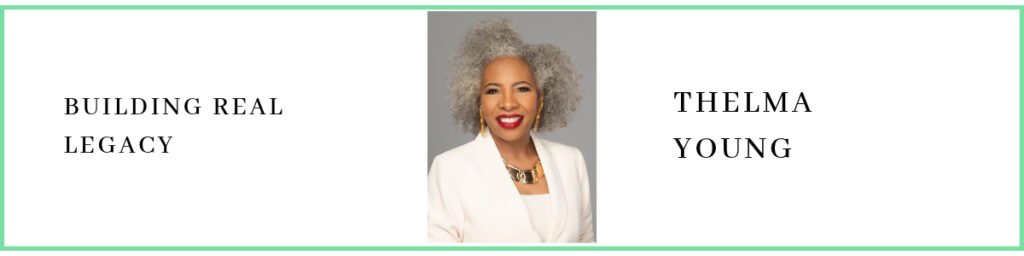
Thelma Young, certified life coach, ordained minister and U.S. Army veteran, frames legacy as decisions guided by the question, “What do I have to leave as a legacy?” Thelma contrasts chronos time (measured days and minutes) with kairos time (memorable moments) and urges intentional living. She presents REAL legacy: investing in Relationships through forgiveness and care, being an Example through daily micro-decisions, living with Authenticity, and building a Legacy that compounds across generations, illustrated through her children and grandchildren. Thelma describes her 3D Life Leadership System—Designed identity, Destined presence, and Determined delivery—and shares a major pivot from being dismissed from law school after illness to earning an MBA with a 4.0, emphasising reclaiming perceived losses. She defines generational wealth as passing on kairos memories, stories, and origins.
3 Takeaways
Understanding Time:
Thelma offers an enlightening perspective on time, distinguishing between chronos and kairos. Chronos represents the measurable passage of time—days, hours, and minutes that everyone receives equally. In contrast, kairos encompasses those unforgettable moments that define our lives. From the birth of a child to significant milestones like weddings and graduations, these kairos moments form the foundation of our personal stories and legacies.
Investing Time Wisely:
Thelma introduces the acronym REAL, which stands for Relationships, Example, Authenticity, and Legacy. She believes that investing wisely in relationships, being exemplary, embracing authenticity, and understanding the compounding nature of legacy contribute significantly to one’s legacy. These principles serve as a guide for making daily decisions that impact future generations.
The Importance of Pivoting and Authenticity:
Thelma emphasises the necessity of embracing authenticity and being open to life’s pivots. She shares her personal journey, recounting how she pursued law school in her 50s but faced dismissal due to illness. Instead of feeling defeated, she pivoted to earn an MBA, demonstrating resilience and the power of reclaiming time. Her story inspires listeners to view obstacles as opportunities for redirection, reinforcing that a detour is not an end but a pathway to new beginnings.
ShowNotes
Click on the timestamps to go directly to that point in the episode
[02:00] Chronos vs Kairos Time
[05:13] REAL Legacy Framework
[11:18] 3D Leadership System
[15:13] Pivoting Through Setbacks
[22:56] Reclaiming Time in Family
[25:21] Generational Wealth Memories
Get In Touch:
If you’re interested in connecting with Thelma Young, you can reach her via her website, via Facebook, or via her LinkedIn.
For those interested in sharing their own stories on “Chatting with the Experts,” reach out to Paula Okonneh through her website or connect via LinkedIn.
Paula: [00:00:00] Hello everyone, and welcome to another episode of Chatting With The Experts where I speak with fantastic women from Africa, from the Caribbean, and in the diaspora. Our title today is Reclaiming My Time: Legacy is Built Daily.
My guest says, “What do I have to leave as a legacy?” She says this question should guide every decision and action of everyday life. And so we’re gonna explore how you can live in such a way as to spend your time wisely and to invest it in legacy building. My guest will join me in a minute, and she says she helps women reconnect with the power that’s already within them so that they can stop being overlooked and start living with confidence, with clarity, and with presence.
She helps high-achieving [00:01:00] women to rise boldly to their next level of leadership, not by changing who they are, but by fully owning who they are. And with that, I welcome Thelma Young to Chatting With The Experts so that we can talk more about this. Welcome, Thelma.
Thelma: Hello, Paula
Paula: Oh my gosh. What you’re talking about is what we need to hear. In fact, I had a conversation with a young man today about building legacy, and only for us to meet to talk about that. We talked about earlier offline that there is no coincidences with God, so this is it. Let’s talk about this.
Thelma: Let’s talk about it. All right. First of all, thank you so much for having me on as a guest. I really appreciate it, and like you said, there are no coincidences. This was ordained long before either one of us knew each other, so I appreciate that. [00:02:00]
Paula: Absolutely.
Thelma: I’d like to talk about time. The Greeks have two words for time, chronos and kairos.
Sometimes the English language is just a little too vague, but if we look at the Greek, chronos and kairos time. Today, I have lived 22,215 days. I’ll let you mathematicians figure out what that means. But that’s chronos time. Everybody gets the same amount of time when we think about chronos. I think about the Broadway play, Rent, where they said, “565,600 minutes.”
In five hundred twenty-five thousand six hundred minutes.
How do you measure a year in the life?
We all get the same number of minutes. We all get the same number of [00:03:00] hours and the same number of days. But kairos time, unlike chronos time, is not measured by the hours and the minutes. Kairos time is the times that are those moments that you’ll never forget. I’ll never forget the birth of my first child, my second child, my third child, my fourth one, and I’ll never forget waiting to hear them cry, and the moment they cried was a kairos moment for me.
When I said, “I do” to my husband, that was a kairos moment for me. Graduation days. Unfortunately, the funerals that we all have to attend sometimes, those are kairos moments. Those are the moments that will live with us forever. We may not count all 22,215 days. Some of them just pass without any thought, but [00:04:00] those kairos moments, the moment I met you is a kairos moment for me.
I will never forget it. Having this podcast interview is another kairos moment. I won’t ever forget it. And in order to build legacy, we don’t just need to count the chronos moments. We need to hold dear to the kairos moments and be intentional about how they pass.
Paula: Wow. Couldn’t have said it better. You could not have articulated that in a better way. So what I’m hearing from you is that looking at time as a return of an investment, like a ROI, and spending it wisely. You know, when we talk about investments, we think about money.
Thelma: Yes.
Paula: But time, the difference between time [00:05:00] and money is that we never get it back.
Money we can invest, and when we invest it, we intend to get it back, but time we can’t get back. Mm-hmm. Right?
Thelma: Right. Right. And I’m an accountant by trade, so looking at money is something that I do on a daily basis. But if you think about, uh, ROI on your time, I like to use the acronym REAL.
Paula: Mm.
Thelma: That is the real legacy in life. And the R is for relationships invested wisely. You know, there’s a movement now where, uh, people are being encouraged if someone has ever hurt you to never be involved with that person again, boundary them, especially your close family. “Oh, my family’s toxic. My mom is toxic.
My dad is toxic.” And if you sit back and you really think about it, um, [00:06:00] mom was toxic, but maybe the fact that she brought you here. Is her kairos moment. And maybe she did the best that she could. And I’m in no way saying to be around people who continue to hurt you, but what I’m saying is forgive and move on.
Because if you don’t invest in the relationships, even if you aren’t present with that person, that forgiveness is an investment in that relationship because you’re not carrying that around. And then when you have your children, you are able to pour into them clean love because you’re not carrying toxic things.
So when I look at the R and the relationship investment, pour into your children, check up on your siblings, you know, hug your husband, kiss your [00:07:00] husband or your spouse, those that are close to you. Keep up with good friends, you know, because that is real legacy. These are the people that are gonna remember the times that you were kind, that you made them smile, that you cried with them, those kairos moments we talked about.
And the E is for being an example Live your, live your life daily like you would want to have someone in your life like that. Making those micro decisions every day, that will impact your legacy. If someone cuts you off driving, and Lord knows I am the worst driving patient person on Earth, but instead of holding onto that, be the example.
Let that go. Maybe they’re trying to get to the hospital and they’re just not focused right now. Good thing I’m a defensive type driver. Instead of carrying that around with you. [00:08:00] And then the A, authenticity. Be your authentic self, because there’s nothing worse than being the imitation of someone else.
When you have a perfectly good self to be, authenticity will leave a legacy with people, and they’ll say, “You know that Thelma, one thing about her is she is a real person.
Paula: Mm-hmm.
Thelma: She is not a copy of anyone. She was her real self, and she told you about what she liked and what she didn’t like.” We don’t have to pretend to be anybody other than ourselves.
Paula: Mm-hmm.
Thelma: Pass that on. And then the L is a legacy that compounds. I am blessed enough to be a grandmother, and when I spend time with my grandchildren, I see the compound legacy. I can see their parents in them, those are my children, and then I can see myself in them, in some of [00:09:00] the things they like to do, some of the, the ways that they imitate us.
That is compound legacy and, and if you’re blessed enough to see it, it is wonderful. I still get to work with my grandchildren in church. I teach their class and some of them attend, you know, my class with me, and I love watching them learn about, you know, the Bible stories and the things that are important to us as a family.
I’m a woman of faith. Mm-hmm. And so I get excited when I see them learning things that I learned as a child, and that I taught my children. You know, the way that we value family. My husband and I are very intentional about our marriage and our family. And to see the cousins all care for each other and wanna be with each other is just compound legacy, and that’s the L.
R, relationships. E, be an example daily. A, be your authentic self [00:10:00] and pass that down. And then L, watch the legacy compound. That’s deep.
Paula: That’s deep. That’s really deep. I love it. L- legacy compound, you know. Um, I had a guest on recently who talked about compound interest. Mm. And now where we’re talking about investment and compound, that, it brings me back.
And of course you’re an accountant, so. the rule of 72 and, you know, knowing that when we sow into something, and this time it’s sowing into lives, into our children if we have children, but into family, because most of us have family. Yeah. It trickles down. It’s an investment. It’s not just for us, it’s for the generations that come.
And you can’t go wrong.
Thelma: No.
Paula: And you talked about, you know, it’s a legacy that builds, because you see it. As you said, when you look at your [00:11:00] grandchildren, you see what you built into their parents.
Thelma: Mm-hmm.
Paula: And you see yourself, and your husband in your case.
Thelma: Yes.
Paula: Ah. That must make you feel proud.
Thelma: It does. Like I said, we were intentional.
Paula: Mm-hmm.
Thelma: But, you know, through the years, um, I’ve been able to work with a lot of women and, you know, unfortunately, uh, in this world, women don’t always get the attention and recognition for their brilliance that they deserve.
Paula: Mm.
Thelma: And so when I, when I work with women, it just builds my heart and my legacy to see them step up into their own.
You know, I have developed a 3D life leadership system, and over the years I’ve deployed it, in small groups or individual coaching with women, and it just brings me so much joy to see [00:12:00] them step into their own. It starts with knowing who you are. Who were you designed to be? Each one of us was created with care, and if we learn why, there’s a reason why I like to read, there’s a reason why I like to journal.
That’s part of who I am, and, and knowing that is important to me. So I like to take assessments, you know, those, the free ones, not the ones you have to pay for, but sometimes you do have to pay for them. But there’s plenty of them out there, and if, you know, anybody would like that, they can just email me and I can send them a group of free assessments.
So, you know, personality assessments and who are you leaning towards in your natural state? What do you naturally like to do? They’re all free, so, um, that’s a good start. And then your destined presence. It’s like, what am I supposed to do? You know? Well, who am I supposed to be? Where am I supposed to go?
You know, we make tiny micro decisions [00:13:00] every day that impact our legacy and use our time. So let’s do it informed. Let’s know what we’re destined to do. Let’s know that we are in the place that we need to be, and if not, we will pivot. Yeah. No harm, no foul. Everything you learn is valuable. Take it with you, but pivot, and don’t be afraid of that.
And then determine, that’s the third D, uh, determined delivery. Stand up. Stand up straight. Speak clearly. Speak confidently. You deserve the space that you take up. Don’t hide. Don’t get in the shadows. I call myself a shine strategist. Everybody has light within them. They just need to learn how to turn it on and shine.
So I just love helping women learn to do that.
Paula: I love that framework, the three D [00:14:00] leadership system. Designed identity, destined presence, and determined, I wrote it down, determined delivery.
Thelma: Yes.
Paula: Oh. Yes. Did you come up with that?
Thelma: I did.
Paula: Oh, I love it. The three D. And it’s so relevant to where we are right now in this world, you know?
Thelma: Oh my gosh, yes.
Paula: Design, who are you? The destined, destined presence. Who you’re supposed to be? Did I get that right?
Thelma: Yes, who you’re supposed to be. Your image and your impact.
Paula: Your image and your impact. Yes. And I love the, you give the, us, I’m gonna include myself because I’m a woman. You’re given permission to pivot because sometimes where you’re going and you realize, “Okay, I need to branch.
I need, there’s a diversion somewhere.” Not saying, “Well, I’m supposed to go down this way and this is the only way,” because sometimes things change. There’s [00:15:00] a bump in the way, in the road. There’s construction, so you’ve got to…
Thelma: Yes.
Paula: You have to make that detour, a little detour. There’s a detour.
Thelma: I love it.
Paula: You know?
Thelma: I love it.
Paula: Yeah, making the detour is okay.
Thelma: I love it. As a matter of fact, I can tell, I always, ever since I was a little girl, I wanted to be on the Supreme Court.
Paula: Mm-hmm.
Thelma: Oh, I loved a good debate. I loved standing up for what’s right. And so as a little girl, I decided I was going to be the first Black woman on the Supreme Court.
Oh, I love it. I’m very proud that Ketanji is, but it was gonna be me. Yeah. But things changed. Went in the Army. I met my husband, started a family. Pivot, you know? So I did that and I like to think I did it well. And so I did something in my 50s. I applied and went to law school.
Paula: I didn’t know that.
You didn’t tell me that before we went live.
Thelma: I [00:16:00] did. I went to law school, but I got sick.
Paula: Oh.
Thelma: And anyone that’s ever been to law school knows they are very unforgiving when it comes to missing time.
Paula: Mm.
Thelma: And so I had to miss some days, and my grades suffered for it because you’re deducted and, you know, and it’s very hard and, you know, that sort of thing.
And so I was dismissed from law school.
Paula: Oh, no. Yep.
Thelma: And I have never been dismissed from anything academic. Mm. And so I, I said, “Okay, this has happened.” You know, I’m praying. I’m wondering what is going on. I got in. It was such a struggle. I’ve been working so hard, and I am not starting over in this thing. So that was one of the biggest pivots of my life.
Paula: Hmm.
Thelma: So I came home, I packed up my books, I took them to the school, I donated them to anyone who needed them. I came home [00:17:00] and that, after that weekend, I applied to go to graduate school and I got an MBA two years later.
Paula: Okay.
Thelma: Graduated with a 4.0. You talk about a pivot. I could have just wallowed in it and felt sorry for myself, ’cause that was a huge dream that I had.
Paula: Mm-hmm.
Thelma: But it wasn’t right. It, it just didn’t work out. So I pivoted, and I am, I am still just living kairos moments day by day. I will never forget the dean telling me, “Yeah, we’re going to have to dismiss you,” and how I felt in that moment. But we’ve all been dismissed from rooms.
Paula: Oh, yes.
Thelma: We’ve all had that happen.
Just pivot, regroup, and do the next thing.
Paula: And you know what, Thelma? That experience, and you’re talking about it like that, I know has helped and is going [00:18:00] to help other women. Because sometimes women need to know that your detour is not the end. Your detour is so that you can sometimes along that way appreciate the scenery as you go past- Yes
along the detour. You know? And then you get to the next scene and you’re like, “All right.” So that MBA, I’m sure there were people there you met, and the things that you do now because you have an MBA, you’re able to look at life differently. You’re able to approach things in business things and, you know, where you work differently just because of that.
And even the law school, that incomplete dream, that experience in itself has enabled you possibly to even come up with this framework, this 3D life leadership system, where you can tell women now that… you know, who you are does [00:19:00] not change. Circumstances may change, but who you are doesn’t change.
Thelma: Absolutely. Absolutely. Mm-hmm. The detour is not a death sentence, just like you said.
Paula: Thank you.
Thelma: And I love how you said, “Enjoy the scenery.” I love that. I’m gonna have to borrow that.
Paula: You can.
Thelma: I’m gonna give you credit for it now.
Paula: Please do.
Thelma: I may not remember when I’m using it, but I’m gonna give… I love that. Enjoy the scenery on the detour.
And I did, and I got a wonderful education. I met some beautiful people that I would not have met, when I was in law school. And now I know an entire graduating class of lawyers.
Paula: That’s right …
Thelma: if I ever need one.
Paula: Mm-hmm.
Thelma: And I also know how the law works.
Paula: Hey, look at that.
Thelma: So that takes a fear of, of that away.
I know how to go find case law and look at the briefs and find the holding of the judges and all those [00:20:00] sorts of things because I learnt it while I was there. And like I said, I now know an entire graduating class of attorneys if I ever need one.
Paula: If you ever need one.
Thelma: I know them personally. And along the way to my MBA, I met some wonderful people and, you know, some lifelong friends.
So you use it all. It all becomes a part of who you are. It all becomes a part of your legacy. You can reclaim everything that you think you’ve lost.
Paula: Mm.
Thelma: You can reclaim it. When Maxine said that in the Senate, when Congresswoman Maxine said that in the hearing, forgive me, when she said, “I’m reclaiming my time. I’m reclaiming my time,” that stuck with me because we might look at it as a loss, but it’s not. You just reclaim it and turn it to your good. Make it good. Tell everybody about the experience. Right. You know, you’re gonna encourage somebody else someday, and your family needs to see you be able [00:21:00] to handle failure.
Paula: Talk about that
Thelma: Yeah. We don’t like to let people see us get dismissed or, or have to pivot or be wrong. That’s a gift. When you can admit those things and when you can plow through it and keep climbing and keep, keep going, that is a witness. That is allowing someone to know, “Oh my gosh, I can, I can do the same thing and not be a failure.”
Yeah. It’s one thing to fail, but you are not a failure. Take that coat off and put another one on because that does, that’s not you. That is not who you are.
Paula: Absolutely.
Thelma: You are still the same person.
Paula: Same person, just having another opportunity to try…
Thelma: Yeah
Paula: … something else in a different way.
Thelma: And reclaim it. Okay, so that was two years of my life in law school, but I didn’t lose it. It’s still with me. [00:22:00]
Paula: Yes.
Thelma: It’s still part of who I am. Mm-hmm. And I’m still okay.
Paula: And that’s the main thing. You are still okay, and I love the fact that you said that, your friends or you’re acquainted with a lot of lawyers now, a graduated class of lawyers.
Thelma: Yes.
Paula: You understand now how the law works.
Thelma: Yes. Yes.
Paula: Something you would not have had an opportunity to have if you hadn’t gone to law school, even though you didn’t complete it, but at least you know about it.
Thelma: I do. I do.
Paula: Mm …
Thelma: it was a good failure.
Paula: As one of my guests said, “FAIL is an acronym for First Attempt In Learning.”
Thelma: Ah, I love it. I love it. First attempt.
Paula: I’ve held onto that since you told me that. First Attempt In Learning.
FAIL.
Thelma: Absolutely. Absolutely.
Paula: Mm-hmm.
Thelma: I just, when I think about reclaiming [00:23:00] my time, you know, my childhood was a little bumpy.
Paula: Mm-hmm.
Thelma: Some things I wish didn’t happen, and maybe another time we’ll talk about that.
Mm-hmm. But when I was blessed to have children, I was able to reclaim whatever time I thought I lost as a child, and see it through their eyes, and, and live it with them.
Paula: Mm-hmm.
Thelma: So I got to be silly. I got to roll around on the floor and play with babies and I got to go to the school events, and I got to go to the playground with my children.
You know, all those things that maybe I don’t quite remember in my childhood, or the yucky parts, you know? But I got to redo it with my children. I got to reclaim that time and turn the chronos into kairos. And certainly now with my grandchildren-
Paula: Oh …
Thelma: We are having the time of our lives. Look. I have no responsibility for [00:24:00] them.
I can sugar ’em up. I can bring ’em back home dirty, tired.
Paula: I hear that.
Thelma: Late. I mean, I don’t have to get them up for school the next day.
Paula: I have heard that as some of the pluses of grandparenthood. And I saw it with my parents. The things that they never allowed us to do. Yeah. I was shocked.
Like, “Huh? Mom?” She’s like, ” I was young then. Now let the children be.” I’m like, “Let the children be? You didn’t let us be.” She said, “That was you.” Wow.
Thelma: My children do the same thing. They’re like, “Who are you?”
Paula: I know. I know.
Thelma: They’re like, “Oh, it’s okay.” I’m like, “Oh, they’ll be fine.”
Paula: And I guess in some ways, that is the legacy.
That is the wisdom that has come along with aging, uh, or with maturity or with being seasoned now. You’ve [00:25:00] learned that- Yeah … some things really didn’t matter.
Thelma: No. Not as much as I thought they did. Oh. And we have a ball. We do. Family is everything.
Paula: Yeah. I agree. I agree. I love family.
I love, love, love family. I really do.
Thelma: Oh,
Paula: I do. I say it all the time. So let’s end with this. You mentioned that generational wealth is legacy. Can you expand on that before we close out here?
Thelma: Sure. It’s not about property and money, um, passing on generational wealth. Certainly, that’s a good thing.
Mm-hmm. It’s not a bad thing. But I think more importantly, it is passing on generational kairos time.
Paula: Mm, I love that.
Thelma: When we gather at a funeral, and after, you know, at the repass or- Mm … when we’re all talking, you know, after all [00:26:00] the funerals have happened, um, I rarely hear anybody talking about how much money went into the grave with the person.
Paula: Oh.
Thelma: Or what the inheritance is going to be. I’m sure some families are more concerned with that, but none of the ones I’ve been around. We start talking about, “Oh, do you remember when Aunt So-and-So let us do so-and-so? You remember when Mama just let us stay up all night and eat popcorn and lay out on a blanket and watch movies all night long, and, and called it our move-a-thon, movie-a-thon, or whatever?”
Or, “You remember how Mama used to curl our hair?” Or, “Do you remember how Daddy used to take us fishing?” Mm. Um, “Do you remember how Daddy used to drive on the long road trips?” I don’t hear anybody at those times talking about, “Well, how much money did they leave in the bank? How much [00:27:00] property do we have?”
Certainly, you have to deal with the estate. I’m not being unrealistic.
Paula: Mm.
Thelma: But that’s not what brings the smiles during those times. That’s not what brings hope, and that is certainly not what puts joy into those moments. It is all kairos. It is all kairos legacy. It’s all those moments that took your breath away that people talk about.
Paula: Yeah. And that is why you have more than 30 years of executive leadership experiences. We didn’t talk about you being a coach and, and, and, an ordained minister as well as a US Army veteran.
Thelma: Yes. Yes.
Paula: And those are all part of the things that we see being wrapped up in this conversation.
Thelma: Yeah.
Paula: The generational wealth, you say at funerals we don’t talk about the money and the inheritance, we talk [00:28:00] about the memories. I got you. That’s part of the wisdom that you’ve brought today.
Thelma: Yes. So invest in those. Leave a lot of memories.
Leave a lot of memories. That is generational wealth. Tell the stories. Help them remember who they are and where they come from.
Paula: Yeah.
Thelma: You know, I took an Ancestry DNA test so that I could learn what part of Africa did my family touch.
Paula: Yeah.
Thelma: And I was so proud to learn You know, I was so proud to learn that, that I, I have a spot-
Paula: Mm-hmm
Thelma: on the other side of the world
Paula: Mm …
Thelma: where my maternal people originate. It made me feel just, just concrete, solidified. it just did something for me. Tell those stories. Leave those stories. That’s wealth. That’s wealth.
Paula: And you know, what I’ll leave with [00:29:00] you, Thelma? Record all of that, because I think those are the memories to… I hear my children saying that, “I wish we had more verbal records from our grandparents and great-grandparents,” ’cause those are the things sometimes they wanna hold onto and listen to so that they can see where.
They know where they came from, but just to hear it sometimes over and over, that seals it. It does.
Thelma: Thank you so much.
Paula: Absolutely. So for those listening to this or viewing this on YouTube, if they’d like to get in touch with you, Thelma, how can they find you?
Thelma: They can find me, send an email, thelma@coachthelmayoung.com.
Paula: Okay.
Thelma: That’s thelma@coachthelmayoung.com, and I will certainly reply back and send those resources that I talked about [00:30:00] earlier. And, uh, at that time, I’ll give you all my other contact information and links at that time. But I am on Facebook, Instagram, Thelma Hall Young, and YouTube and LinkedIn, Thelma Young, Coach Thelma Young.
Paula: I’ll drop all of that in the chat and we…
Thelma: yeah
Paula: … definitely put that on our website.
Thelma: Thank you.
Paula: Sure. Sure. And for those of you listening to this or viewing this on our YouTube channel, if you’d like to get in touch with me, please reach out to me on my website, which is chattingwiththeexperts.com. I am also on LinkedIn, and my business page there is Chatting With the Experts.
You can reach out to me on Instagram. My handle there is @chat_experts_podcast. And please subscribe to my YouTube channel, where you will see this episode. Yay. And connect [00:31:00] with Thelma Young there, and listen to all the other inspiring women, women from Africa, from the Caribbean, and then the diaspora who have so much expertise to share with you.
Stories, not stories, but really the expertise that will encourage, educate and empower you in ways way beyond that you can imagine. And now we’re gonna open up the floor to those who have joined us so that they have a chance to speak with Thelma Young. Thank you so much, Thelma, for being…
Thelma: Thank you.
Paula: Such an amazing person and sharing with us the legacy that stays with us. Thank you.