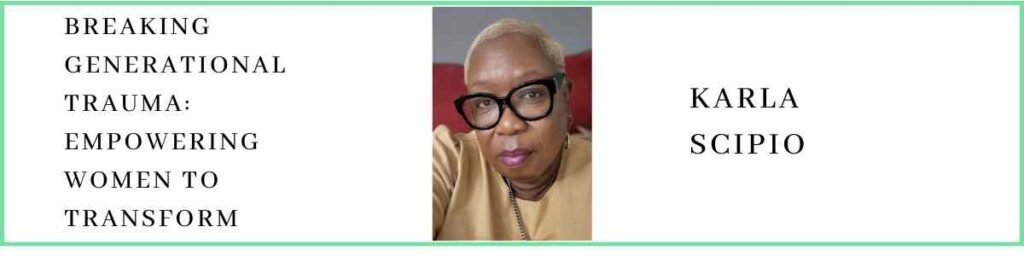
Karla Scipio, a nurse consultant, author, and coach dedicated to empowering women to heal from generational trauma, discusses the importance of breaking the cycle of silence within Black families and the global nature of this issue. Karla emphasizes the power of storytelling, self-reflection, and intergenerational conversations for healing and transformation. She explores topics such as the difference between surviving and thriving, the significance of self-care, and the legacy of healing that impacts future generations.
3 Key Takeaways
Storytelling: A Tool for Healing:
Karla illustrates the power of storytelling as a vehicle for liberation and healing. She reflects on her upbringing with a mother who chose silence and a grandmother who communicated family history, recognizing the power of intergenerational storytelling. Karla emphasizes that when women share their truths without shame, it paves the way for collective healing.
The Global Reach of Trauma:
Paula and Karla acknowledge the global nature of generational trauma. With Karla’s experiences in places like London, interacting with women from diverse backgrounds, it becomes clear that sharing stories of trauma and triumph can bridge cultural divides and engender understanding and unity.
Transforming Survival into Thriving:
Transitioning into the distinction between surviving and thriving, Karla advocates for a mindset shift. She encourages women to embrace joy, peace, and purpose, grounding themselves in faith and self-reflection as tools for transformation. The conversation delves into self-care as an essential component of personal growth and empowerment.
ShowNotes
Click on the timestamps to go directly to that point in the episode
[02:00] Breaking the Cycle of Silence
[05:48] The Power of Storytelling
[09:07] Surviving vs. Thriving
[10:21] The Importance of Self-Care
[17:12] Legacy of Healing
Get In Touch:
If you’re interested in connecting with Karla Scipio, you can reach her via her website, via email, via Instagram, via LinkedIn, or on Facebook.
For those interested in sharing their own stories on “Chatting with the Experts,” reach out to Paula Okonneh through her website or connect via LinkedIn.
Paula: [00:00:00] Hi folks. It’s yet, it’s another episode of Chatting with the Experts where I speak with phenomenal women from Africa, from the Caribbean, and in the diaspora. These women are professionals and successful entrepreneurs, and they share one and the same mission with me, which is to educate, empower, and inspire women globally. Every week on Wednesday, I have these women share their expertise, and so today our topic is Healing Generations- From Trauma to Transformation.
My guest who will join me in a few minutes is a nurse consultant. She’s an author and she’s a coach, passionate about empowering women to heal from generational trauma [00:01:00] and to step into wholeness. As a founder of Her Wellness Nook and The Women in My Garden Project, she creates spaces for storytelling, for sisterhood and transformation. And through her books, she has helped women move from surviving to thriving through embracing self-love, purpose, and legacy. And with that, I welcome Karla Scipio to the show.
Karla: Thank you so much for having me. I am truly honored to be here.
Paula: And I’m truly blessed to have you here. Thank you for what you do. And you know, helping women to move from surviving to thriving, and I know offline or off camera, we talked about some of the things that you do to [00:02:00] help them. I know one of them is breaking the cycle of silence.
Let’s talk about that.
Karla: Definitely. You know, for too long, many of us, especially in black families, were taught not to talk about hurt. We were told to pray about it, keep the family business private, and simply be strong. And that talents became a generational habit, but it also became a generational wound because we kept all of that inside of us.
What you don’t speak, what you don’t release tends to hurt you, tends to cripple you, and that’s why it’s so important for us to speak on our past hurts, to speak on those, that pain that was handed down from generation to generation.
Paula: Oh, sorry. Go ahead. I wanna cut you short. Was just talking [00:03:00] about unspoken trauma.
Karla: Many of our mothers and grandmothers carry pain quietly. They carry the abuse, they carry rejection, even colorism. They carry their loss, the poverty and this silence passed down to us. I can speak for my family. My mother was the one that didn’t talk. She kept all of that bottled up inside of her.
Paula: Mm-hmm.
Karla: And it shows up. It shows up as anxiety.
Paula: Mm-hmm.
Karla: As you know, distrust.
Paula: Mm-hmm.
Karla: Sometimes anger. Definitely a lot of anger and perfectionism.
Paula: Mm-hmm. And, you know, so a few weeks ago I had another woman talk about this and we said it was global. And why I say this is global because you, I know are from the islands. You’re from Trinidad.
Karla: Yes, from Trinidad and Tobago.
Paula: Tobago. [00:04:00] So when this lady I spoke with, I had two other guests. One was from Nigeria and then the other woman is African American. And now you are from the Caribbean. From Trinidad and Tobago to be specific. And you’re talking about the same thing. So this is global. This is not confined to one part of the world or women whose culture embrace this sort of thing. This is global.
Karla: Yes. It definitely is a global issue. I went to London probably about a month ago.
Paula: Mm-hmm.
Karla: And I did a workshop on barriers, things that prevent women in the diaspora from thriving, from rising. I realized, Paula, that a lot of the women, they were women from Nigeria, from Ghana, from Zimbabwe, from South Africa, women born in London, and we all carried the same burden. That burden of [00:05:00] shame, the burden of pain. I mean, they know. But PTSD, I think this one young lady from Liberia that shared her story and it made me realize that the things that we go through and how we live is not just limited to one space or one place. These things tend to unite us and we need to speak on it. We need to be the change so the generations coming behind us wouldn’t have to go through what we went through and what our ancestors went through.
Paula: Absolutely. And you know, that’s why you mentioned earlier on that we talked about, you know, we are talking about breaking the cycle of silence, you know?
Karla: Yes.
Paula: And so, you know, expand on how you feel that sharing our story, because as a people, we are very verbal. We are more verbal. Our history has showed that we carried on our tradition through, [00:06:00] you know, stories and so on. So, why do you think we haven’t been so vocal about sharing our stories, which is part of our culture anyway, sharing stories and how does it come about? How does it bring about healing and strength collectively?
Karla: Someone that knows me will tell you. I believe in intergenerational conversations.
Paula: Mm-hmm.
Karla: I tell people I come from a family of storytellers.
Paula: Mm-hmm.
Karla: There were some members of my family, like my grandmother for instance, that would sit me down and would share the family history with me. Then you had my mother that kept all of that stuff inside of her that didn’t talk and you know, silence comes with a cost. It comes with the pain festers. It affects our relationship, it affects our health, our ability to feel joy. But for me, there is power in storytelling.
Paula: Mm-hmm.
Karla: Sharing our stories [00:07:00] truthfully. Without shame becomes a form of liberation. As women, storytelling connects us back to our roots. It’s how our ancestors, like you said, shared their wisdom, how we survive. But now healing in this community, every time one woman speaks her truth,
Paula: mm-hmm.
Karla: She gives permission for another woman to do the same. That’s how we start healing together.
Paula: It’s how we start healing together. Okay. So…
Karla: And you know, teaching women how silence keeps us stuck. How Speaking that brings you healing because you learn it. I wasn’t the only person that suffered from incest.
Paula: Mm-hmm.
Karla: You know, why are my father’s… my father so angry? Where did this [00:08:00] alcoholism come from? We learn more. We realize that we have so much commonality, which gives us the strength to be in a safe space where we can be honest, truthful, and transparent. I’m not here to shoot you down. Your story gives me courage and inspires me to know that I can do this. If she did it, I can do it as well.
Paula: Mm-hmm. And that’s where the collective strength comes from, right?
Karla: Right. From community.
Paula: And community.
Karla: So you know, together, two can do so much more than just one.
Paula: Yeah.
Karla: So with that combined strength, our combined voice, we’re speaking for those two who doesn’t have the strength, the courage, or even the voice to [00:09:00] speak up.
Paula: Mm-hmm. You’re right. So, yeah. So another thing that we spoke about was the difference between survival and thriving.
Karla: Go ahead.
Paula: You know, I was gonna say, yeah. What is the difference?
Karla: So it’s about a mindset shift.
Paula: Okay.
Karla: Surviving sense, I’m just trying to get it through the day. I’m just making it through this day. Thriving sense, I deserve peace, I deserve joy, and I deserve purpose.
Paula: Mm-hmm.
Karla: And for me, and I encourage people. Faith is my foundation. Faith grounds you.
Paula: Mm-hmm.
Karla: It helps you trust the healing and abundance of my birthright. They’re my luxury.
Paula: Mm-hmm.
Karla: I also encourage women to journal.
Paula: Mm-hmm.
Karla: And I [00:10:00] encourage reflection. I tend to say that confrontation with ourselves or in another way. ’cause you know, confrontation is a strong word. Addressing yourself.
Paula: Mm-hmm.
Karla: Taking that time to find a quiet time every day, just to be quiet.
Paula: Mm-hmm.
Karla: Just to think about you and I tell people, you know, everything for me is about self-love and self-care.
Paula: Mm-hmm.
Karla: So I do in order to love someone else. Even our children and our spouses, our family members, we have to learn to love ourselves. How do you learn to love yourself? You have to learn to get to know who you are.
Paula: Mm-hmm.
Karla: And confronting and adjusting ourselves can be painful because that means we hold ourselves accountable for the role that we [00:11:00] play in whatever incident, whatever circumstance.
Paula: Mm-hmm.
Karla: Yeah. So the time of self-reflection gives us power, and it’s something that we need to do on a daily basis.
Paula: Go ahead.
Karla: No, just, I just add to just being quiet. Being still.
Paula: Being still. Because that was the question I was gonna ask because, you know, some of us grow up our culture, sometimes we have extended families. So you know, even finding time to be quiet is almost, or space to be quiet is almost impossible. Or looked at that, where are you going? You just disappear like that. You know what I mean? And so how do you, in our type of community, find that quiet time if there’s no space to even find that quiet time.
Karla: You know, it’s funny that you answer because as you saying [00:12:00] that, I started thinking about my daughter and then also kind of perfected on me too. When I was younger, my children were still small. One of her space is in the bathroom. You know, when she disappears into the bathroom, I’m like, what is she doing in there?
Paula: Mm-hmm.
Karla: And sometimes she’s in the bathroom for an hour.
Paula: Mm-hmm.
Karla: For me, when my children were younger, I made sure I set time in boundaries. They had to be in bed by eight o’clock.
Paula: Mm-hmm.
Karla: Which gave me enough time for myself. And time for my mate.
Paula: Mm-hmm.
Karla: Or even the hours early in the morning when everyone is still asleep.
Paula: Mm-hmm.
Karla: That quiet time.
Paula: Mm-hmm.
Karla: You know, even deep breathing helps to, and you can, everything could be going on around you, but just being able to center yourself.
Paula: Mm-hmm.
Karla: And just be still, even with the little [00:13:00] kids playing, the children laying on the floor.
Paula: Mm-hmm.
Karla: And being able to do that without feeling guilty.
Paula: That’s a big part, Karla. Without feeling guilty, because as mother’s guilt, you know what I mean? I should be, I’m not doing what I need to do. Oh my gosh, my children, my child, or my children need me. And here I am by myself? Our culture doesn’t really encourage too much by ourselves.
Karla: And we have to shift that thinking.
Paula: Mm-hmm.
Karla: I can’t give to my child until my cup is full.
Paula: True.
Karla: I can’t give to everyone or anyone until my needs are met, and I’m not saying, you know, sometimes self-care looks selfish. But it’s not being selfish, it’s being able to just like a [00:14:00] car, the car gotta get an oil change, right?
Paula: Mm-hmm.
Karla: We gotta put gas into the car to get to point A to B. So it’s the same way with us. We gotta fill up, we gotta refuel, and that’s why a lot of us are burnt out, stressed, anxious, we deal with chronic diseases because we don’t rest.
Paula: Mm-hmm.
Karla: We deal with hypertension.
Paula: Mm-hmm.
Karla: All of that stuff affects us we more so because of who we are and where we live in the circumstances that surrounds us, we got double jeopardy. We are female and we’re black, and oftentimes class also plays a place in how much money we have, determines a lot as well. Because you know, as a public health specialist and consultant, one of the things they talk about, [00:15:00] social determinants of health, it says the saying, and I wanna prove it wrong. Where you were born determines how long and how well you live. But with our mindset shift, where we promote rest and quiet and healing. We can change the narrative.
Paula: We can change the narrative when we promote rest and see rest as healing. Time for the body to heal, for the mind to heal. Many times you don’t see rest as being productive. It’s almost like you’re lazy if you are resting.
Karla: Mm-hmm.
Paula: Not realizing that your body needs a downtime to recoup. And as you rightfully said, a few minutes ago, just like in the car mechanical
Karla: mm-hmm.
Paula: It’s not human of course. [00:16:00] It has no life. You have to, you know, to break fluid. Hm. Change your tires. You know? You have to maintain the car.
Karla: You gotta work in that car.
Paula: Yeah.
Karla: You gotta take care of the car, otherwise it’s not gonna last as long.
Paula: And it’s not gonna take you from point A to point B. It’s not gonna do its job. And so, like us, moms, females, in order to function and do our jobs properly, we gotta do the same thing. Self-care, it’s like maintenance.
Karla: Mm-hmm. And you know, you said something that’s so on point. God mandated rest.
Paula: Yes.
Karla: On several different levels. He’s the creator of all mankind. He created the universe where He rested on that seventh day.
Paula: Yes.
Karla: And He wants us to rest. And He even created our bodies where when we sleep, our body [00:17:00] rejuvenates the cell process, recreation.
Paula: Mm-hmm.
Karla: You know, so rest is so important.
Paula: Mm-hmm. Wow. So let’s talk about something else that you mentioned, legacy of healing. You mentioned that it’s not just for us. As a legacy, that means we are leaving something for people who come after us. So legacy of healing from your perspective, it means we are doing things that will positively affect our daughters, our granddaughters, and future generation, right?
Karla: Right.
Paula: So how can we bring about transformation? Because I know that’s one of the things that you do.
Karla: Yes, I love intergenerational conversations. I believe when we heal, we change the story of those who come after us. [00:18:00] And I wanna emphasize again, healing is not selfish. It’s sacred work that impacts generations, you know, intergenerational impacts our daughters, like you said, our nieces, our granddaughters are watching how we respond to life.
Paula: Yes.
Karla: When we model self respect, boundaries, and love, they learn to do the same thing.
Paula: Mm-hmm.
Karla: Every time we choose to heal, we breaking patterns. Every time we choose forgiveness over bitterness, and faith over fear, and truth over silence, we shift the family line every time and there’s a ripple effect. Healed women build healed communities. The transformation of one woman’s heart can change a household. ’cause remember, as mothers, we are the nurturers. We can change a neighborhood. [00:19:00] We can change nations. I realized the way that I raise my children wasn’t always the best way.
So now I encourage my children, they’re like, well, you did this and you did that, but you letting them get away with it. No, I learned that my grandparents, when, you know, coming from the Caribbean, they were hard. They were harsh. They’ll send you outside in the hot sun with stones in your hand and to kneel on some kind of rock or, and they did these things because that’s what they saw and that’s what they taught. So now it’s our responsibility, what we learned, the lessons that we learned in life. We wanna make sure [00:20:00] I’m tell my kids this. I don’t want y’all to walk down the streets, not walk that long. That’s why I did it. So now I’m telling you. So we create new stories, new pathways to transform the young ones that are coming behind us. And the reason why, like I like intergenerational conversations is that, that, you know, the young people bring the new insight the older people bring the sage wisdom.
Paula: Yes.
Karla: But we need to strengthen the young people. We need the new things that they doing in the community and we need to help them just as much as they help us. But we also have to bring that respect. We have to be able to listen to what they’re saying. So they can also learn from us and we learn from them.
Paula: I agree with you, Karla. 100% [00:21:00] intergenerational conversations better us. It doesn’t make us go backward and they in turn realize that we respect their views and their take on things because we don’t know everything and I’m all for that, you know, having these intergenerational conversation because we get better. We see things different. I mean, things are changing all the time. And if we are not in touch with change, we stay behind and they, in turn learn from us because we’ve been down the road, not quite the same road, but some of the things that they’re experiencing, we’ve seen it and we know the outcome so we can change it. And so that’s why I love when you started off by explaining that the legacy of healing comes from knowing that healed women can heal women.
Karla: Yes.
Paula: A healed older woman can help heal or speeding up the healing of a younger woman. [00:22:00] And that’s what you’re talking about through intergenerational conversations? Yeah.
Karla: We can help in the transformation because as a coach, I help women look forward and you know, I’m gonna come to the car example again. Before you go out into the street, you look in your rear view mirror on your side mirror to see what’s coming behind you.
Paula: Mm-hmm.
Karla: So we need to address those generational traumas, things that we inherited from our mothers and our grandmothers. We need to look at it. Then we also need to look forward.
Paula: Yeah.
Karla: And move forward. So we gotta deal with those things. And I tell people those negative things in our lives, but we also have to pay attention to the generational blessings. In my family, hey we have this artistic… we can do anything with our hands. Or, we are teachers. We are educators.
Paula: Mm-hmm.
Karla: Or we may be the ones that are nurses. We are caregivers, we are healers. So we need to look at not just the curses that are handed [00:23:00] down. That’s in our DNA.
Paula: Yeah.
Karla: We can negate those, but we also need to focus more now on the positive.
Paula: Yeah.
Karla: And even for those. You know, people don’t realize even, there’s so many things that I’ve handed down to us in our DNA, not to say that, you know, I grew up with my mother, so I’m acting like my mother. You may grow up with someone completely different, but still have the traits of your family. So there’s so many things that we need to address as women in the diaspora. And I think one of the things for us is dealing with that trauma. And there are people who appear to be successful and thriving and deep down in something they’re suffering because they haven’t faced or addressed themselves.
Paula: Yes. That’s the absolute truth, Karla. The absolute truth. The outside does not always reflect the [00:24:00] inside.
Karla: True.
Paula: You know, and come full circle back. Full circle to what we said initially, that our culture did not encourage conversations, and now that’s what you on a mission with other women to do, to break this cycle of silence. Well, what we are gonna do now is open up the floor so that other people who have joined us can continue the conversation. You can continue the conversation with them. But before we do that, and for those who are watching online or listening to this online, how can people get in touch with you, Karla?
Karla: And the easiest way is Instagram and it’s I am Karla Scipio, and it’s Karla with a k. Last name is Scipio and I’m gonna spell it. S-C-I-P as in Paul, I-O or they can email me at hello@herwellnessnook, so it’s [00:25:00] hello@herwellnessnook.com.
Paula: Okay. All right, we’ll drop all of that in the chat and of course it’ll be in the show notes. And for me, I want you to know that just as Karla was a guest on the show, so can you, if you reach out to me on my website, which is chattingwiththeexperts.com. I’m also on LinkedIn as Paula Okonneh. I am on Instagram. My handle there is at chat_experts_podcast and my handle on Facebook is Paula Okonneh. I also have a YouTube channel that I’d love for you to subscribe to because there are so many videos there of amazing women and a few men who are sharing information that can educate you, inspire you, and [00:26:00] encourage you, and so every week on Wednesday, I meet with these amazing women and a few men who share with you nuggets of wisdom. They inspire you through their stories, and they educate you through information that they have. But thank you so much for tuning in and for Karla, thank you for being a guest today, and now we will open up the floor to those who have joined us.
Karla: Thank you for having me.
Paula: Absolutely.