
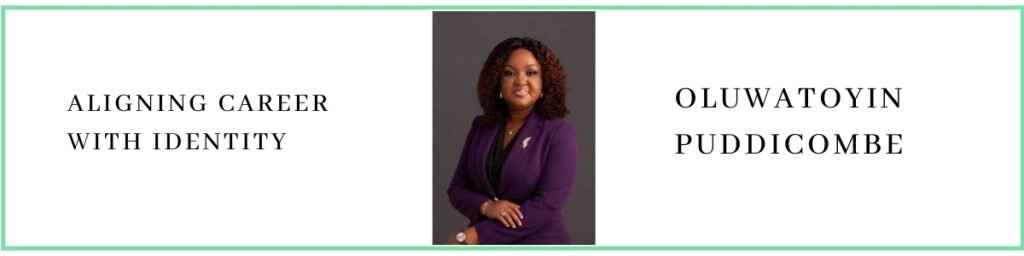
Oluwatoyin Puddicombe, Nigerian HR professional and career fitness coach, discusses what happens when who you are doesn’t align with what you do. Puddicombe shares how societal expectations led her into medical school, where she struggled, failed key exams, and faced identity and family pressure before switching to Communication and Language Arts, excelling and graduating near the top of her class. She explains how the lack of career guidance motivated her to help young professionals find career fit, develop employability skills, and navigate career transitions through Toyin Talks Talent and the T3 Torchbearers Academy. She describes tools she uses, including personality and career-interest assessments like Myers-Briggs, Big Five, and the RIASEC model, alongside CV, interview, networking, and LinkedIn training in a 12-week, scholarship-based online program.
3 Takeaways
Discovering the Mismatch:
Like many, Oluwatoyin’s journey began with the traditional drive toward a stable and respected profession. She spent years dedicated to the study and practice of medicine, driven by the desire to make a meaningful difference in people’s lives. However, over time, she began to realize that while she was working in a field centered around care and compassion, her own professional identity felt increasingly mismatched.
Recognizing the Signs:
The first step was acknowledging the subtle signs indicating that her true calling might lie elsewhere. Despite the success in her medical career, she often found herself more intrigued by the interactions with colleagues and the dynamics of team efforts. Oluwatoyin witnessed firsthand how critical it is to have the right people in the right roles, which sparked a curiosity that she couldn’t ignore.
The Leap of Faith:
Transitioning to HR was a decision not made lightly, and it required a leap of faith into unfamiliar territory. Questions and doubts abounded: Would my skills transfer? Could I find fulfillment in a completely different field? However, Oluwatoyin discovered a robust parallel between the core goals of both careers—enhancing people’s lives and fostering environments where they could thrive.
ShowNotes
Click on the timestamps to go directly to that point in the episode
[02:34] Career Fit Mission
[03:07] Medicine Pressure
[04:38] Struggling in Med School
[07:32] Failing Exam Turning Point
[09:07] Switch to Communication
[13:09] Parents and Healing
[15:22] Building Talent Guide
[17:08] Career Tools Explained
[23:26] T3 Academy Program
[25:33] HR Meets Youth Culture
[29:09] Connect and Origins
[31:28] Invest in Next Gen
Get In Touch:
If you’re interested in connecting with Oluwatoyin Puddicombe, you can reach her via her website, via Facebook, via Instagram, via X(Twitter), or via her LinkedIn.
For those interested in sharing their own stories on “Chatting with the Experts,” reach out to Paula Okonneh through her website or connect via LinkedIn.
Paula: [00:00:00] Hello, and welcome to another episode, another exciting episode of Chatting With The Experts, where I speak with phenomenal women from Africa, from the Caribbean, and in the diaspora, and today’s no exception. Today’s title is The Talent of Identity Mismatch, and my guest, who will join me in a few minutes, says this is her medicine to HR story.
She says, “What happens when who you are doesn’t align with what you do?” And she says she knows what it feels like to be on a path that looks impressive on the outside but feels misaligned on the inside. After starting out as a medical student and later finding her true fit in HR, she turned that personal experience into a mission to help [00:01:00] young professionals discover their talents, build practical employability skills, and choose careers that truly fit who they are.
As an HR professional and career fitness coach with 20 years’ multi-sectorial work experience spanning aviation, business services, consulting, insurance, broadcast media, and microfinance banking, she has acquired skills and competencies in client services, relationship management, and human capital management, with a strong bias for talent development and employability skills.
Please welcome Oluwatoyin Puddicombe to Chatting With The Experts. What an impressive bio you have, my [00:02:00] dear.
Oluwatoyin: Thank you. That’s kind of you to say.
Paula: Thank you for saying yes to being a guest on Chatting With The Experts. And you said-
Oluwatoyin: Hmm …
Paula: what happens when who you are doesn’t align with what you do? That’s a story on its own. So let’s talk about that. What you do, I know, is help individuals pursue paths that shape with the expectations rather than, you know, their self-awareness. Let’s talk about that.
Oluwatoyin: Okay. Thanks once again for having me on the show. My day job is HR, so I go to the office and I do my thing there. Uh, But what really drives me, what really moves me is helping people find what I call their career fit, one that aligns with their natural abilities or their natural talents.
And um, that, of course, came as a result of my story, which quite, um, you know, sometimes you look at it and you think it’s like a [00:03:00] movie. Uh, You’re watching somebody else take part in it, but then you just, once in a while it dawns that’s actually your reality. Uh, I’m Nigerian and, uh, you know very well what uh, premium people place on some certain courses or professional you know, directions, medicine, law, engineering to be specific.
They give accounting maybe, you know, if you try all else and all else fails, maybe accounting you know, we can you know, accept accounting, that sort of thing. So, um, So from a young age, you know, that societal perception kind of shaped the direction I was gonna go. Um, I was what we call an all-rounder, which means there weren’t too many standout um, subjects that you know, looks you know, specifically, oh, she does so well in this, right?
But I was a science student. Very good. I was a science student and so I did the physics, the chemistry, the biology, maths and all that, and I was pretty good at it. Member of the Jets Club, represented the school here and there. [00:04:00] Had good marks in my class. One of the top students in my class anyway. So when it came to what to study in the university, my destiny seemed like it was carved out for me. To be fair to my parents, I’m not going to um, knock them too much ’cause they were uh, in the same society that I was in, so sometimes things like this are just the way things are, as opposed to someone being intentional about forcing you down a particular path.
So they didn’t force me down a particular path. I even remember my father said he didn’t know if he wanted medicine for me because, um- six-year course and, you know, I’m a lady, was thinking about marriage and all that. And, you know, it just kind of made me more determined. I mean, What do you mean? I mean, it’s what I really want my life and all that kind of stuff.
Anyway, so, I gained admission for medicine into school and, um, from the very first year I knew that this was a mistake.
Paula: Mm. ‘
Oluwatoyin: Cause the way it runs in my university, you have all the science students taking the same course in 100 level, right? So in my class, you’d have the medical students, dentistry, [00:05:00] physiotherapy microbiology, engineering, all of us were in the same 100 level.
And so, it became very, very clear that the chemistry that I barely survived in school, I did well, you know, I didn’t like it, but I did kind of well in it. Uh, it’s, It’s a different language in the university. None of it made sense to me. And I kid you not, it sounded like a different language- It didn’t sound like English, and they’d say all these things and somehow my brain couldn’t comprehend it.
And, uh, but I was kind of stuck ’cause not only was I sort of, you know, blazing the trail for my family in a way, I, I also had a scholarship, right? And so you can imagine the pressure I was under. I could not tell my parents, or at least I believed that I could not tell my parents that I was having a tough time of it.
So I kind of asked around, looked for counsel, guidance who could help me you know, make this decision, know what to do and all that. I mean, I remember someone, and it’s so funny that I never really thought about it until, you know, you asked the question. There was a particular person that asked me what did I want to do with my life?
And I said, “Oh, well, I wanna be a doctor, you know, help people and all [00:06:00] that.” And he told me, “No, that’s not true.” And I was kind of resentful ’cause I was like, “Well, what do you know?” You know, kind of felt like he had exposed me sort of because I’d, I’d started already struggling at that point. So I sort of ignored that, but I did ask people around me, what do I do?
I asked someone who I respected and he said, “You know what? Um, 100 level isn’t medicine. 100 level is just science. Until you get to med school, you can’t really tell.” You know, And it made a lot of sense to me. I still think it was a wise thing to do ’cause it’s, it’s kind of different. So I said, “You know what?
Let me stick it out and let’s see how, how it’ll go.” Well, I saw how it went, and it went from bad to worse.
Mm.
And each day was a struggle. Tests came back low, really, really low scores. And for someone who had been a high flyer all her life, it was very, very debilitating for me. I think, um, because I’m this sort of person, I was an introvert- I don’t know whether I am.
I’m more outspoken now, but I, I was an introvert and took a lot of identity from my intelligence. So when I got into a spot where it felt like my intelligence that I depended on wasn’t [00:07:00] serving me anymore, sort of, it broke me a little bit, and it made me sort of fold back into myself. And so it was like if I’m not smart, then who am I?
You know?
Yeah.
Uh, And I was the kind of smartest in my family, person that came first in class, one that got all the prizes and mom and dad bought and all that kind of stuff. So it was really an identity shift for me, and I, and I didn’t quite know what to do. So I pushed harder, drove myself further, but it felt like the harder I pushed, the worse it became, and it seemed like there was no salvation for me.
It was not a pretty place to be in. So I recall I saw my nurse. There’s this exam we take called MBBS Part 1. It’s, It’s the sort of exam, the first major medical exam you take that sort of moves you from the pre-clinicals to the
clinicals. Mm-hmm. And I saw that as like, my salvation. Like, Let me just get into clinicals. Let me just pass this exam. Let me just move over to the other side and I’ll be at least, I’ll be able to think about what next to do. And so I did the exam. Wasn’t great. Mm. But by the time the results came [00:08:00] out, it, it told me what I needed to know. I had three papers.
I failed two out of three. Mm. What that meant was that I have to repeat the whole thing again. Um, And I cannot tell you how everything within me recoiled at the thought of having to go through all that again, and I told my parents, “I can’t do this anymore. I just can’t do it anymore. I can’t go through all this.”
Oh, of course, there was the distress. Oh, something going on. Someone pray a bad prayer for me. You know, They got people. Talk to this person, talk to that person. Got many people to talk to me, but I, you know, I was adamant. I said, “You know what? I can’t do this anymore.” So they said, “Okay, so what do you want to do?”
That was the question I couldn’t answer. Mm. And so it made sense that if I didn’t have an alternative, to stay the course until I did. And so with great reluctance and, and a weightiness of soul, I brought out my medical books to start, you know, the reading [00:09:00] process all over again. It felt like even my eyes were running away from the pages, I couldn’t think, couldn’t think.
I didn’t think I could do that anymore. But so I mean, I’m, I’m a Christian, so I mean, it was a prayer thing for me, and it was, “God, what do I do? What’s the next step? How do I solve this?” I don’t believe it’s a coincidence now, but I did have a classmate who– uh, I said a classmate, roommate, who was studying a course in the faculty of arts called communication and language arts.
And I thought, “You know what? Why not just go through her notes, see what she’s, what it’s about.” I don’t know what made me think of going through her notes, but you know, I, I was just in such a confused state. And so I was going through her notes and for the first time in about three and a half years, I feel like I was reading English again.
Things started making sense to me. It was literally like, it was like a, like a Damascus experience of Paul- Okay … where the scales fell from my eyes, and I felt like, oh my goodness, things are beginning to make sense again. It felt so I don’t know whether the word is cathartic, like, oh my gosh, it’s like there’s [00:10:00] no- there’s nothing wrong with me, you know?
And I had to inquire more about what’s going on here. So she tells me a bit about her course, and I wonder h- how do I make more inquiries. Didn’t know what to do but I learnt that I had a senior in medical school whose husband was a lecturer in that department. On the strength of that and that alone, I went there, I found him and that’s where I credit the hand of the divine in all that this man that knew me from nowhere decided to help me.
And not just help me, put his reputation on the line for me, because getting into the department wasn’t a smooth process. But eventually I did cross over, and it was because of this man’s sterling reputation, so to speak, within the department wa- that people were willing to give me a chance. Because they kept on saying, “What’s a, what’s a medical student, what’s a science student going to do?
How is she gonna cope with arts? It’s a whole different ballgame.” And I was looking at them like, [00:11:00] “You don’t realize-” They didn’t know … “that in this makes sense to me. Where I’m coming from doesn’t.” You know? Yeah. But I did have to prove myself, and thankfully my results showed I did so well, um, in all my courses.
Eventually graduated second best in my class, won an award, yada, yada, yada. And, uh, well, the rest is history. I mean, more, more to come. Uh, I don’t know whether I- I’m not talking about the HR side of things now. But, uh, I graduated quite well. My former classmates in med school ’cause it was a six-year course, we kind of graduated together.
Mm-hmm. Very, very supportive. They were there cheering me in the hall, and it was- Aw … so surreal. But it was, uh, it turned out quite well for me. Uh, I didn’t know that that was just the first step in a interesting story, but at least that’s how, um, I moved from medicine to CLA, and then a few more steps along the way and they’ve got me to HR.
But I don’t know if that’s a story for now, but let me, let me, um, I think I’ve answered the first question.
Paula: I think it’s so good, ’cause I’m listening to you, I hearing you, because of course I have Nigerian connection. I know how difficult it is [00:12:00] to go from medicine, as you said. Medicine is like, oh my gosh the, the, the pinnacle of everything, and you’re going to communication and l- a- and language, which is great, but in those days- Yeah
it wasn’t looked at as great. Oh, you’re frozen
Oluwatoyin: Oh, okay. Uh, y- you’re actually frozen from my end as well, so I think- Okay … it must be, uh, some bandwidth or something Am I unfrozen now? Oh, you’re back.
Paula: Okay.
Oluwatoyin: Yeah, you’re beginning to move a little bit. I don’t know if it’s better from your perspective. Am I better?
Am I moving now as well?
Paula: Yes, you’re moving too, so we’re both unfrozen now.
Oluwatoyin: Okay. That’s great. Yeah. But- So that’s, that’s how this all started
Paula: But you know, the greatest thing is I’m thinking that no, as I’m a Christian too, as you know, but no journey’s ever wasted. Because I’m thinking of all the lives you’re touching now, all the, the, the, the students who are feeling similar things to you, feeling misaligned, and you’re coming along.
You’re not just talking from an angle of, “Oh, well, if you are feeling this way, just do it.” You’re talking from a place of passion. “I’ve been there. I feel [00:13:00] it. I know, but look at me today, and that could be you. So yes, let me hold your hand. I can pray with you, but I can also walk with you.” You know?
Oluwatoyin: Yeah,
Paula: exactly.
Yeah, absolutely. That is so helpful for a young person, because young people can be despondent. They can feel scared, and especially, I know in our society where parents are, you know, respected and their, their guidance, uh, uh- Mm-hmm … you know, we reverence our parents, we respect our parents- Mm-hmm, mm-hmm … and we are afraid of them too.
So what are you gonna tell Mom and Dad who has spent all these years saying, “Ah, my child, this is what you’re going to do,” and now you’re saying, “I’m going to do something else”?
Oluwatoyin: Honestly, it, it wa- it wasn’t the easiest and, and I, I, I kind of played down the home front, but it was quite a, it was quite a, an experience.
It was … I mean, I don’t, I don’t blame my parents. I mean, I didn’t carry them along. I didn’t, I didn’t tell them what was going on ’cause I feel like you said, I was scared to. I was scared, um, uh, about their reaction. Mm-hmm. And I think in a way there was some shame, yeah. This is your golden child, so to speak, that’s now coming back to tell you I’m a [00:14:00] failure,” or, “I’m failing at something,” and that wasn’t something they were used to hearing from me.
So there was a bit of, maybe a little bit of pride as well. I don’t know whether that, that makes sense, but, uh, yeah, there was some shame in it. And so they, they … it was tough for them to come round to understanding the decision that I made, but eventually they did. In fact, it’s uh, what’s the word I’m looking for now?
Providential that the same dad that gave me the tougher time was the only person who could make it to my graduation. So he was actually the only person there to see me walk up to, to win my award and to, to get my prize and all that. And and the words he said, you know, I’ve not, I’ve never heard it from my father before, and I guess the circle situation was quite unusual in my house ’cause my dad is a very straightforward person.
Yo- you can set the clock by my dad. He’s a very routine-oriented person. Goes to work at [7:00] AM in the morning, comes back by [4:00] PM has dinner at this time. So he’s not the kind of person that knows how to cope, knew [00:15:00] how to cope with this sort of disruptive sort of element in his life.
So it was tough for him to c- come round to having to deal with, especially because none of my other siblings had a similar experience. But when he saw me go up, and he, he went home and I heard he told them, “She did us proud.”
Mm-hmm.
And I think that that kind of healed many, many, many years of, of pain, of, of shame, of hurt, of low self-esteem.
It did a lot. But, um, one critical thing that I didn’t mention was that I didn’t really have anyone- To counsel me. I didn’t have anyone to hold my hand and tell me it’s going to be okay. I didn’t have anyone to ask me, “What do you like to do?”
Paula: Mm.
Oluwatoyin: You know, “What comes easily to you?”
Paula: Mm-hmm.
Oluwatoyin: “What do you think you have a natural flair for?”
Mm. And if, if I had someone like that, I would have… You know, remember that when I was younger, I don’t know how much of a difference it would have made, because of how we grew up, but when I was younger, I used to be the coordinator of all our entertainment, presentations. I was usually the MC that was telling what was next on the program, you know, when we had birthdays or family events, I, [00:16:00] I’d be the one.
Funny enough, I have a daughter that does exactly that now, you know, and it’s so interesting, right? And I was the one that, you know, I, I could sing, I could act, and I could do all that stuff, you know? And never knew that communication was the link that tied all those things together. Mm. And so, if someone had been there to guide me, at least I’d have thought about it a little bit more.
So what I’m doing now with the Toyin Talks Talent or the T3 Torchbearers Academy is to serve as that guide. That’s why my, my newsletter is called The Talent Guide, to help you kind of recognize some of these things that are, you know, in your life, to help you sort of shape your career. There’s nothing we can do about your course of study because, I mean, you’ve studied it.
But now that I’m in HR, I can tell you what options you have even if you studied this and what your career interest is something else. These are how we marry those two things together. These are the tools you can use. These are the courses you can take. These are the certifications, professional qualifications you can gain, and that is how we help guide these [00:17:00] young people into fulfilling careers one young person at a time.
Paula: Love that.
Oluwatoyin: And that’s essentially what we’re doing with the T3 Torchbearers Academy.
Paula: I love that. So can you tell us some of the practical guidance some of the tools that you use? Can you share, like, one or two? Because I know people are gonna be listening to this and, um, are there any- specific ones that you can name?
Oluwatoyin: Oh, okay. Okay, so my training gives me access to a specific personality test that people can take that helps them. It not only tells them what their personality type and career interest is, it actually recommends the sort of course you could study, and maps out your progress.
So it tells you about what kind of what um, you can need a master’s degree for the job, if you don’t need it and tells you, um, you look for this, any sort of training that gives you the ability to do ABC. So it goes that in-depth, and that’s why we call it career counseling. But right now we actually have these tools um, at our fingertips.
Your, [00:18:00] Your regular run-of-the-mill Myers-Briggs personality tests, for instance, tells you what… And I have to say, that test is controversial. So, some people prefer what we call the Big Five personality test, that’s a more accurate and scientific test. So I just want to make that disclaimer here.
But that Myers-Briggs is the one that tells you, you know, I don’t know if you’ve come across these terms. You’re like, um, a ENFJ, ENFJ, a ISTJ. Yeah. Yeah, yeah. So that’s your Myers-Briggs, and it tells you four major things about yourself, whether you are an introvert or an extrovert. It talks about whether you are intuitive, more feelings-directed, or you are thinking, which is more, you know, intellectually or brain-directed- uh, I think it’s intellectually directed.
It talks about whether you’re um, someone who relies more on your uh, logic. Or someone who is more holistic in your approach. You don’t consider just the logical side of things, you consider the other side of things. [00:19:00] And then are you somebody who is a spontaneous person or somebody who is a systematic person?
So that’s what the Myers-Briggs tells you. So by the time you see your results and it shares it with you, if you have like, a larger percentage of it, you know, accurate, because it also depends on how you answer the questions, to be honest.
Paula: That’s true. I was about to say … uh,
Oluwatoyin: What I recommend to people, yeah, is that, yeah, you may take one test today, it may be maybe, what, 70% accurate, but then take it maybe another three years down the line and see what it says. When I started the test, I was an I, that’s an introvert. I do the test now, it tells me I’m an extrovert. I don’t think I am, but I guess because of the way I, I answered the question one, and that’s based on the fact that my job conditions me to be outspoken. I’m an HR person, and I work with people on a daily basis.
I have to be able to learn how to explain difficult things to them. I have to organize HR programs. They call us even event planners now, because if [00:20:00] you’re doing anything like a, you know, staff awards or things like that, you’re part of putting all those things together. So by conditioning, I’ve had to become more outgoing, you know, as an individual, even though I’m a natural introvert.
I’m the one of those people that loves my own company, can entertain myself hours on end. I don’t need people to make me feel like I am as- I’ve associated or had connections with people. But because my job has conditioned me, the test is telling me something different from what it told me.
But that’s the only thing about the test that has changed. Everything else has remained the same.
Paula: Okay.
Oluwatoyin: So it’s a good idea to do those tests, you know, over periods. That’s the first one. Another tool is called what we call the RIASEC model. That’s the one that tells your career interest. Now, RIASEC-
Paula: What’s it called? Sorry …
Oluwatoyin: R-I-A-S-E-C stands for different things, and I’m gonna try and quickly summarize them and not give away too many tools of the trade. Um, But R stands for realistic, and what that means is that you’re someone who’s good with your hands. Mm-hmm. [00:21:00] So people who have the realistic things go into careers that are hands involved.
So you find they’re the ones that are the engineers, they’re the ones that are the software designers. I mean, like most other things, there’s a blend of everything. So it’s not, it’s not strictly that, but-
Paula: Understood.
Oluwatoyin: You are people that do things with your hands mostly. Um, Then the uh, athletes fall into that category as well.
Then the I stands for the, Intellectual. So you’ll find those are, those are the ones that go into mostly careers that involve a lot of brain work. So you’re talking about doctors, you’re talking about scientists, right? Those are the people that are the I. Then the A stands for, uh, um, artistic, which I think it kind of explains itself.
Mm-hmm. The artsy types. You draw, you sculpt, you have all those creative abilities.
Paula: Mm-hmm.
Oluwatoyin: Um, Then there’s the S that has to do with social. So those are the people that go into, into careers that have to do with, you know, one-on-one intimate interactions and having to you know, resolve social ills.
So you have your teachers, you have your social workers-
Paula: Okay…
Oluwatoyin: Those are the people in the S. Then you [00:22:00] have the E, which is the enterprisers. Those are the people in the business sector. So you’re looking at your um, people in the corporate space. You’re looking at your entrepreneurs. Yeah, you have those sort of people in that.
And then the last is the C, which is the conventional people, they are the ones that are very by the book. They’re the one who are very, they’re very step-by-step process driven. That’s where you find your judges, your auditors, your accountants, et cetera, et cetera. So you can have a blend of any of these sub-source.
You can have people who are realistic, intellectual and creative, so your RIC. So you meet that your lady, your friend that you spoke to who has a double doctorate and is also artistic, and she may be an RIC. So she’s intellectual, she’s realistic, she’s creative, all blended together, which is why she’s able to move and shift in between these different abilities- Right to have this, you know, sort of very rich scope of, uh, the things she can do. And so helping people understand those things helps them to know, okay, the, [00:23:00] it kind of unlocks their capabilities and they, they find that they’re able to do more, or they find that the things that they enjoy are not like, you know, I won’t say bad or evil, but you know, things to be discarded because they have no place in a society that values, a steady regular job that earns you a salary every month, that you sit down and you’re able to you know, make a living for yourself, et cetera, et cetera.
So those are some of the things that we take them through in the academy. Then of course, we interweave those with, um, employability skills. So your CV writing, interview skills, networking, LinkedIn profile optimization and all that kind of stuff. So all that together we do in 12 weeks of the academy.
We’ve added one or two things over the years too, and it’s been very, very rewarding. Um, It’s 100% scholarship. We have industry experts that volunteer their time to teach people this stuff. So, um, I don’t have overheads per se. The thing, the only thing I would say we pay for is we do a graduation [00:24:00] ceremony.
Once in a while we make it physical so people can just, you know, have fun together and get to see each other and all that. So that’s where really, but mostly it’s 100% online, so people from all over, uh, Nigeria, all over, I mean, we have a couple of people from outside of Nigeria, in Africa as a whole.
We even have someone from, uh, I think Canada too, that’s joined the class.
Paula: Oh, great.
Oluwatoyin: So it’s been really exciting and this is our third cohort we’re currently running as I speak to you. So that has been my own little way of helping people not have to go through what I went through, and it’s been extremely rewarding, I, I have to say.
Paula: All right. And that’s the T3 Torchbearers Academy, right? The T3? Yeah, T3 Torchbearers Academy. Mm. T3 Torch, oh, T3 Torchbearers Academy. So it’s almost like you have two very busy careers that you do. You do the HR and you do the academy.
Oluwatoyin: Yes.
Paula: But I noticed something that made you come alive. It’s when you were talking about the, the academy, [00:25:00] you came alive with that one.
Oluwatoyin: Yeah.
Paula: And I guess it has to do because it’s kinda related, really related to your personal story.
Oluwatoyin: Yeah, it does. And, um, I think the other, the other reason why the academy makes so much impact but I, I mean, I’m, I’m one of those people, if I say my RIASEC profile, I’m actually an S an SEC.
Paula: SEC. Okay.
Oluwatoyin: So I’m socially inclined enterpre- enterprise or entrepreneurially uh, disposed as well, and then there’s the `creative side of things that, you know, sort of put things together.
It, It sort of touches every aspect of me. Mm. So that’s why it makes me sort of, come alive. And the thing is that when I got into HR, uh, what drew me to it was recruitment was my first entry point into HR. Mm-hmm. And when you, you’re recruiting, you’re finding someone who is a fit for a role.
So all of these elements that I’ve discussed sort of come into play. I mean, uh, When I started out, they hadn’t, you didn’t have personality tests as mainstream tools that you used to use back then. Mm-hmm. It was mostly based off of experience, you know, and [00:26:00] really how confidently you can answer the question, and really how, how much research about the company you could do.
Paula: Right
Oluwatoyin: you know. But now as I evolved in the HR role um, evolved, you could see those elements begin to come into, especially when it gets to the, the more senior roles because then you see that, um, you just can’t bring someone who says, “I have 20 years experience in HR,” and just plonk them in your organization because your organization, that’s why it’s called an organization.
It, It has uh, a culture, what we call culture, and there’s some personalities that may not thrive in your culture. And if that’s going to be a leader, you need to know whether or not this person can thrive in your culture and get your organization from where it is to where you want it to be.
So those things begin to feed into your decision-making, and it now brings all those things we were talking about back then, it makes it more relevant now. I’m very certain that it’s been used, you know, for years and what, but when I got into HR here in Nigeria, it wasn’t so mainstream, uh, like I said, especially for [00:27:00] younger roles.
But now we’re doing all that now because, uh, we know that our young people of today, they’re keeping us on our toes, aren’t they? They’re- Absolutely … they’re not, uh
Absolutely. If you’re lucky, you get two years out of them. Yeah. You know? So you’re being all the more careful now to kind of understand what- Who they are … motivates them-
Paula: Yeah …
Oluwatoyin: what would make them feel that they’re having a great employee experience with you. And, it is like a good meeting point between my two interests.
Yeah. So that’s why I think the HR thing sort of looked like a good- fit for me, um, when, when it started. I stumbled into that as well. Uh, You let me know if you want to know the story of that one. But eventually- … it kind of made sense, everything together. But the HR came before the academy started, so-
Paula: Oh
Oluwatoyin: I’d been doing HR for a bit before I started the academy.
Paula: Well, uh, but I think it lends into what you’re doing too, because you did, as you said, you started with recruiting, and recruiting was based on different, um, para- or you, you, you, you used different skills then that was relevant for then. But now, as you said, the younger people, there’s a younger [00:28:00] generation that is coming now they’re into the experience
Oluwatoyin: It’s a knowing laugh. You’re laughing- Yeah … a knowing laugh.
Paula: I said to some of my, my peers and my contemporaries, “You gotta work with what you have. You can’t be saying, ‘But it used to be like that.’ Yes, it was like that, but this is what we have.” Mm-hmm. “So let’s work- Mm-hmm … with what we have. Let’s use the tools that we have available to,” because they’re using the tools that’s available too, and you’ve got to be you gotta meet them where they are. I say that all the time.
Oluwatoyin: You’ve got to, you’ve got to. Mm-hmm, mm-hmm.
Paula: You’ve got to meet people- You’ve got
Oluwatoyin: to …
Paula: where they are. And I’m learning from them too. We learn, there’s so much they have to offer us. Me, I’m willing, um-
Oluwatoyin: Honestly.
Paula: … I’m willing to learn, though. I am willing to learn. They are delightful. I love the young adults, I call them.
The young adults- Yeah … teach me so much every day, and I teach them too, ’cause, it’s a back and forth, so. Mm-hmm. Um, we’re- Yeah, and,
Oluwatoyin: and I thought… Okay. Oh, sorry, go ahead.
Paula: No, I’m looking at the time, and I’m just saying thank… Yeah. Um, I [00:29:00] think we have to wrap up now, but of course, we have the audience who are going to have many, many, many more questions for you that you will have the opportunity to answer.
And of course, you have to come back a second time. So if those who are looking at this after, of course, they, those who haven’t joined us, if they’d like to get in touch with you, how can they do just that?
Oluwatoyin: Okay. So, um, Oluwatoyin Puddicombe, just exactly how it’s spelled. I think it’s showing on your screen.
Yes. Um, that’s where you’ll find me across social media. But you’ll also find me as @toyintalkstalent. That’s what T3 stands for. Okay. So most of my, uh, enterprises that I get into, uh, you’ll see T3 in front of them. So @toyintalkstalent is on, um, it’s on Instagram, it’s on LinkedIn, it’s on, uh, Twitter, X, as @toyintalkstalent.
I’m also on Facebook as well. So you can connect with me on any of those any of those, uh, platforms. But I should add, and I think that it would be a real disservice for me if I didn’t add that a [00:30:00] couple of years ago when T3 started, I, I have to say that a catalyst for it was my husband. Mm-hmm. And he’d hear me moan and groan and talk and, you know, get angry over how, you know, people are not doing what they’re supposed to do.
They come to interviews, they ask us things, they ask this, blah, blah, blah. And he said, “Look, why don’t you just do something about it?” And I would, and, and I have to say that that was, that was what galvanized me. Um, I call him a co-founder because I don’t know how far I would have gone with T3 if he hadn’t been there to sort of, edge me on. And as God would have it, or as life would have it, however you put it COVID came, and we’re all under lockdown. And that time gave me the opportunity to have enough time to actually think of what I wanted to do, and it just started off, and we’ve not stopped. Yeah. And God willing, we’ll continue for as long as we can.
Amen.
Paula: Amen, amen.
Oluwatoyin: Yeah.
Paula: See. Ooh, what sometimes looks like such a a disadvantage, God can turn it around to be a blessing.
Oluwatoyin: Yeah. [00:31:00] 100%.
Paula: And you’re blessing so many. And you know, the young, the young people are our future, and if we, what we invest- Mm … in them is not just for us, but it’s for the generations to come.
So thank you- Mm … for what you are doing. You are making an impact, and it’s needed. And I love that knowing laugh because, yes, I have conversations with the young adults all the time.
Oluwatoyin: And do you know what? They’re the same everywhere.
Paula: Yes.
Oluwatoyin: In Africa, here in Nigeria, in the US, I hear them talk. They’re the same everywhere.
Okay. Uh, but I, I don’t know how much time we have, but I only leave a thought that we need to ask ourselves as a generation, what was our, or how complicit were we in creating these young people of today that we complain about?
Paula: Thank you.
Oluwatoyin: What, What role do we play in making them who they are?
Mm-hmm. Is it some things that we didn’t do or some things that we did do? And I think that because every generation feeds into the [00:32:00] other one way or the other, we can’t make those distinctions between us so stark in that, oh, we’re the Gen X or we are the Gen Y or this is the Gen Z. We’ve got to see the things that bring us together and the things that we can learn from each other, like you very rightly said, and then let that flow continue.
Because if we don’t do that with this generation, and we have such issues, you have to ask yourself what’s the next one gonna look like?
Paula: And that’s a great-
Oluwatoyin: So it’s important that we invest in them.
Paula: Yes.
Oluwatoyin: Now and so that we, we create the kind of young people that we want to see in the future.
Paula: Yes. I think that’s very- So that they in turn can invest in the next generation.
Because every generation looks back or, I know what my grandparents said about my parents’ generation, and my parents’ generation said about my generation, and [00:33:00] we are now saying about the generation. And it’s just, it doesn’t change. So we have to look back and say, “Right, so there is something that we,” as you said, “What did we do so that they are where they are?”
And they can learn from us, and we in turn have to learn from them, ’cause we are not perfect. And the- None of us are perfect. Yeah.
Oluwatoyin: We’re here for each other. Yeah.
Paula: We’re here for each other. Thank you so much.
Oluwatoyin: You’re so welcome.
Paula: So as you can see, ladies, mainly ladies who joined us, although a few gentlemen, this has been a very, very, very interesting and informative episode.
And for those of you who have listened to Oluwatoyin, if you’d like to be a guest just as she has been, please reach out to me on my website, which is chattingwiththeexperts.com. I’m also on LinkedIn. My business page there is Chatting With The Experts. I’m on, um, Instagram. My handle there is @chat_experts_podcast.
I have [00:34:00] a YouTube channel that I’d love for you to subscribe to. You will hear this episode there, or view this episode there, as well as all the other phenomenal women who have shared their expertise there. And what we’re gonna do now is open up the floor to all who joined us so we can continue this very interesting conversation.
Thank you again for being a guest on Chatting With Experts.
Oluwatoyin: Thank you for having me. It’s been such an honor. Ab-
Paula: absolutely. Thank you